Help for Struggling Readers
Why Parents Must Act Now: The Post-COVID Reading Crisis
American students are facing an unprecedented literacy crisis. Reading scores have plummeted to their lowest levels in three decades, with the 2024 National Assessment of Educational Progress (NAEP) showing continued declines for both fourth and eighth grade students. This isn’t just a COVID aftermath—scores have been falling for over a decade, and the problem is accelerating.
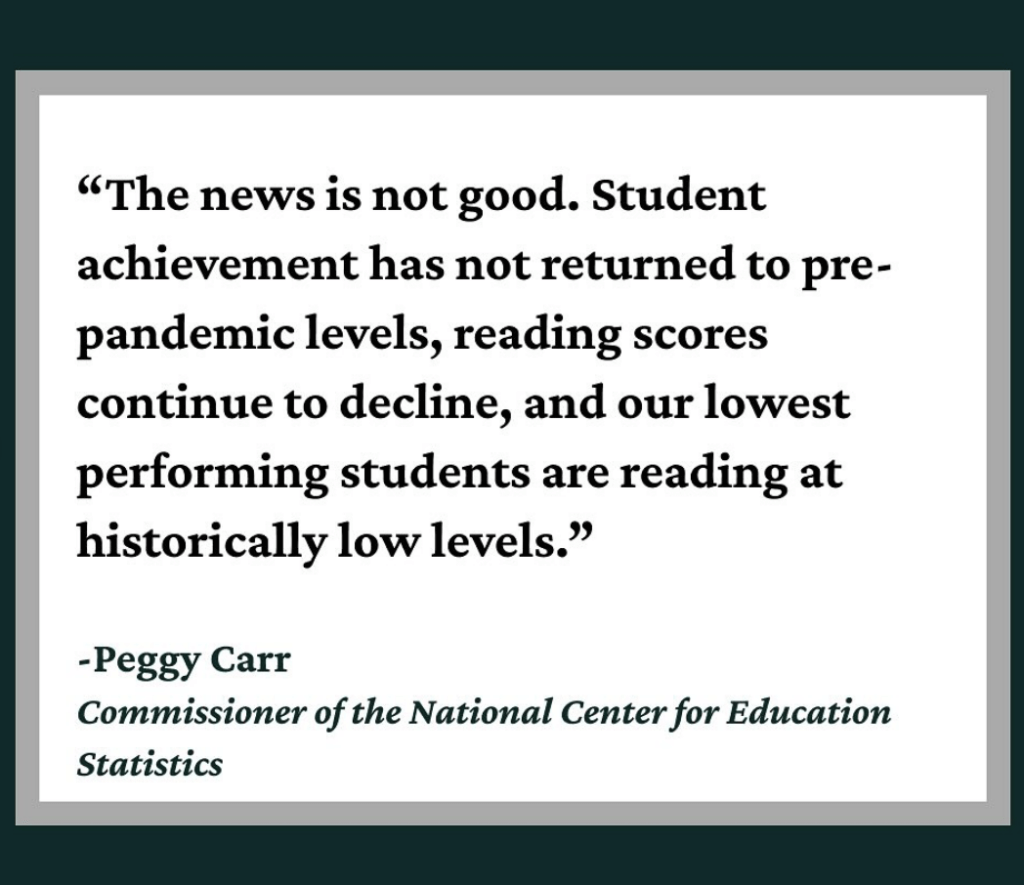

The scale of this crisis is staggering: 28 percent of U.S. adults now read below a third-grade level, a 9 percent increase since 2017. Only one in three students reads at grade level. Approximately 37 percent of fourth graders and 31 percent of eighth graders score below basic proficiency in reading.
The economic impact is devastating: The United States loses up to $2.2 trillion annually due to low literacy rates. One in three employers report their employees lack the literacy skills needed to do their jobs effectively.
Perhaps most troubling: children of adults with low literacy have a 72 percent chance of struggling with reading themselves, creating a multigenerational cycle of educational disadvantage.
Why Your Child Struggles With Reading
Understanding why children struggle with reading starts with understanding the literacy code. The same systematic phonics approach that helps adults can transform your child’s reading journey.
Why Schools Can’t Solve This Alone
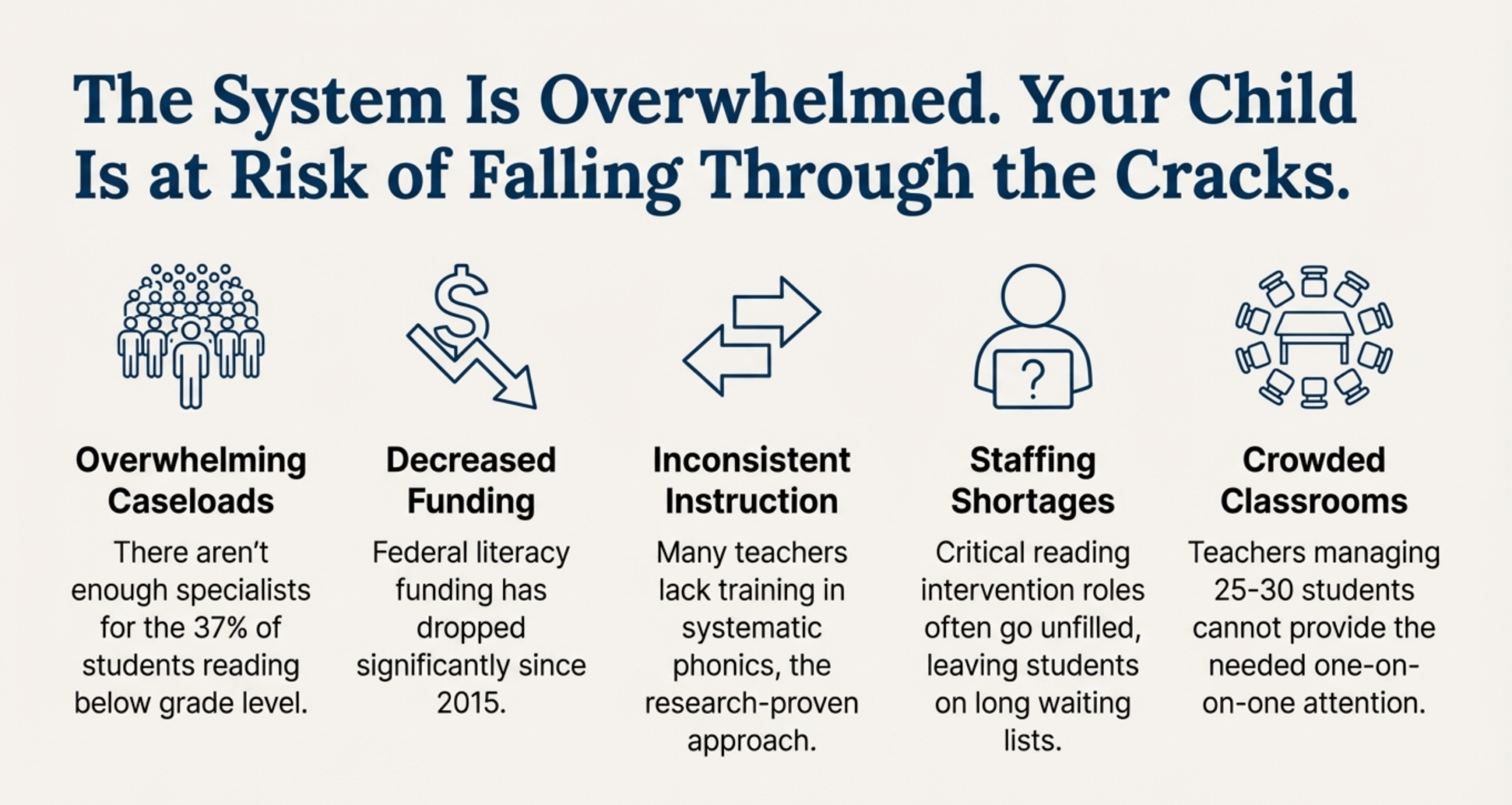
Schools are struggling to address this crisis for reasons beyond their control:
Overwhelming Caseloads
Reading specialists and intervention teachers face impossible student-to-teacher ratios. With 37% of students reading below grade level, there simply aren’t enough specialists to provide the intensive one-on-one instruction struggling readers require.
Decreased Funding
Federal funding for literacy initiatives has decreased significantly. When the No Child Left Behind Act was replaced by the Every Student Succeeds Act in 2015, literacy funding dropped—and reading scores began their steady decline.
Inconsistent Instruction Methods
The “reading wars”—ongoing debates about how to teach reading—have created instructional inconsistencies. Many teachers never received training in systematic phonics instruction, the approach research proves most effective for struggling readers.
Post-Pandemic Staffing Shortages
Teacher shortages, particularly in reading intervention roles, mean many struggling students receive no specialized help at all. Even when intervention programs exist, waiting lists can be months long.
Crowded Classrooms
Class sizes increased post-pandemic while support staff decreased. Teachers managing 25-30 students cannot provide the intensive, individualized attention struggling readers desperately need.
The reality: Schools want to help but lack the resources, staff, and capacity to address the magnitude of this crisis. If your child is struggling with reading, waiting for school intervention may mean waiting months or years—time your child cannot afford to lose.
Why Parents Must Take Action

You are your child’s first and most important teacher! While schools play a crucial role, parents who take direct action to help their struggling readers see dramatically better outcomes.
Homeschooling Your Struggling Reader?
You know your child is capable, but the progress isn’t there. See how our complete homeschool curriculum provides the systematic instruction your bright child needs—without requiring you to become a reading specialist.
Three Critical Reasons to Act Now:
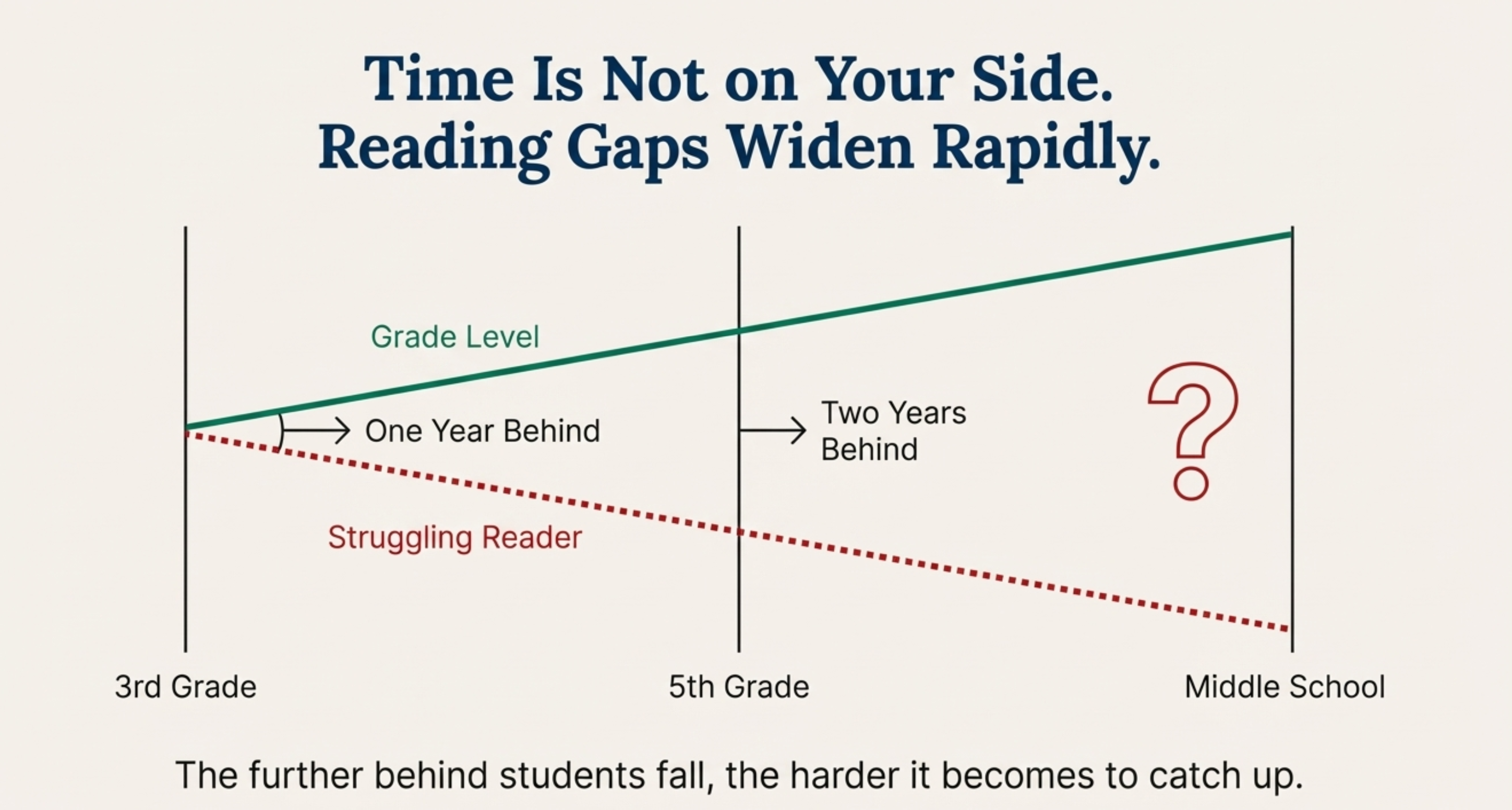
1. Time Is Not on Your Side
Reading gaps widen rapidly. A child one year behind in third grade will be two years behind by fifth grade without intervention. The further behind students fall, the harder it becomes to catch up. Early action prevents struggling readers from becoming non-readers.
2. You Control the Intensity
Your child might receive 20-30 minutes of school intervention per week—if intervention is available at all. At home, you can provide daily systematic instruction. Research shows struggling readers need intensive practice: 20-30 minutes daily, five days per week produces measurable progress.
3. You Prevent Secondary Consequences
Struggling readers who don’t receive help develop reading avoidance, anxiety around literacy tasks, and damaged self-esteem. They fall behind in all subjects because they can’t access grade-level texts. Early parent intervention prevents these devastating secondary effects.
The good news: parents don’t need specialized training to help struggling readers—they need the right systematic program and commitment to consistent practice.
Nine Essential Actions for Helping Struggling Readers
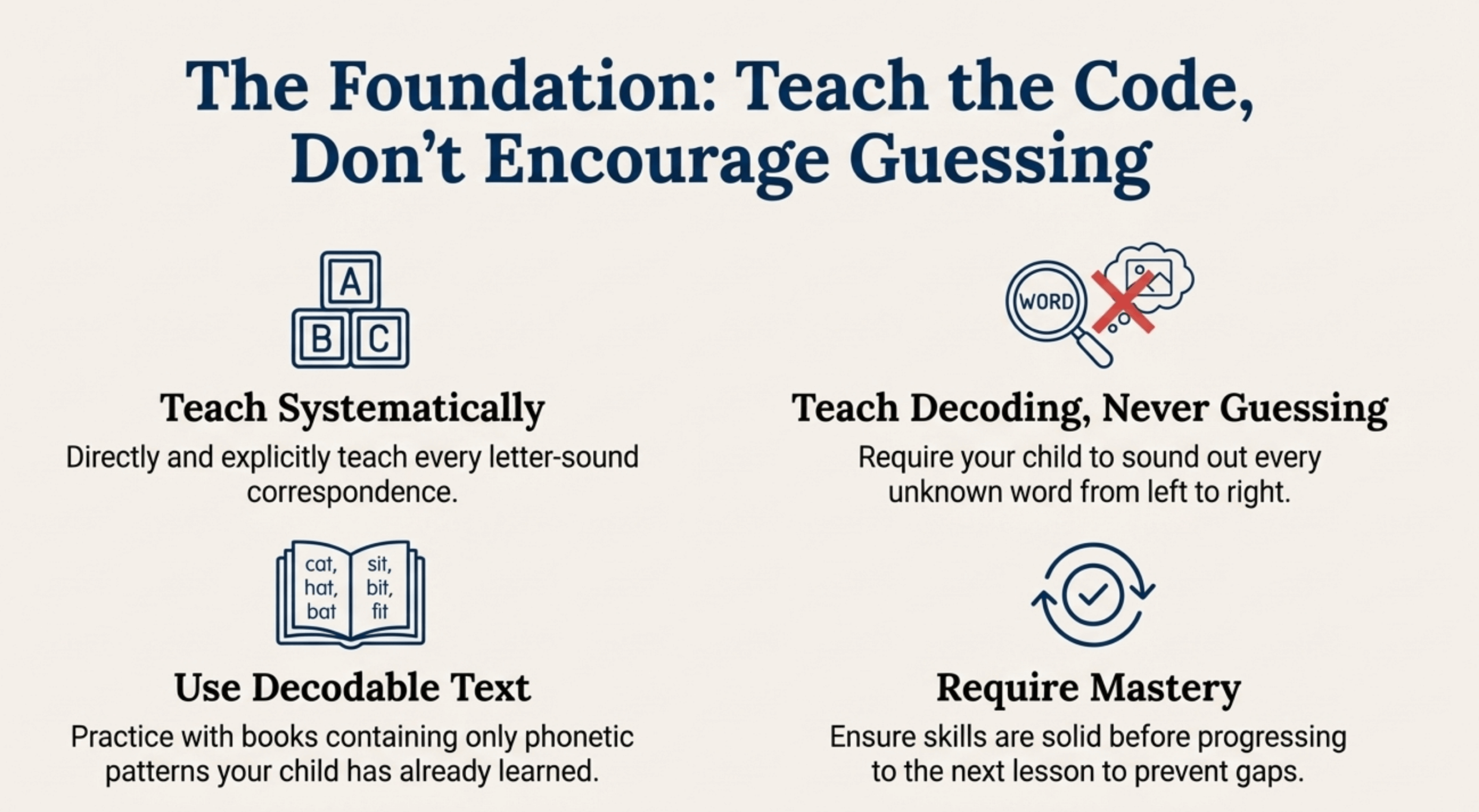
Research identifies specific instructional approaches that work for struggling readers. Parents who implement these nine evidence-based strategies see their children make significant progress:
Does Your Child Read But Struggle With Spelling?
Many parents notice their child can read words but can’t spell them. This paradox reveals a critical gap in traditional literacy instruction—spelling isn’t being taught as a core skill.
1. Why Parents Must Take Action
Schools can’t help every struggling reader. Understanding why parent intervention is essential is the first step toward helping your child succeed.
Learn why parents must take action →
2. Teach Letter Sounds and Spelling Rules Systematically
Struggling readers need explicit instruction in the relationship between letters and sounds. Don’t assume they’ll “figure it out”—teach every sound-symbol correspondence directly and systematically.
Learn what to teach: letter sounds and spelling rules →
3. Teach Decoding—Never Allow Guessing
Struggling readers often guess at words using pictures or context rather than actually reading. This guessing prevents them from developing true reading skill. Teach your child to sound out every unknown word from left to right.
Learn how to teach decoding and stop guessing →
4. Use Decodable Text for Practice
Decodable books contain only phonetic patterns your child has already learned. This controlled vocabulary allows struggling readers to practice successfully, building confidence and fluency. Regular books contain too many unknown patterns for struggling readers to decode.
Learn about decodable text and why it matters →
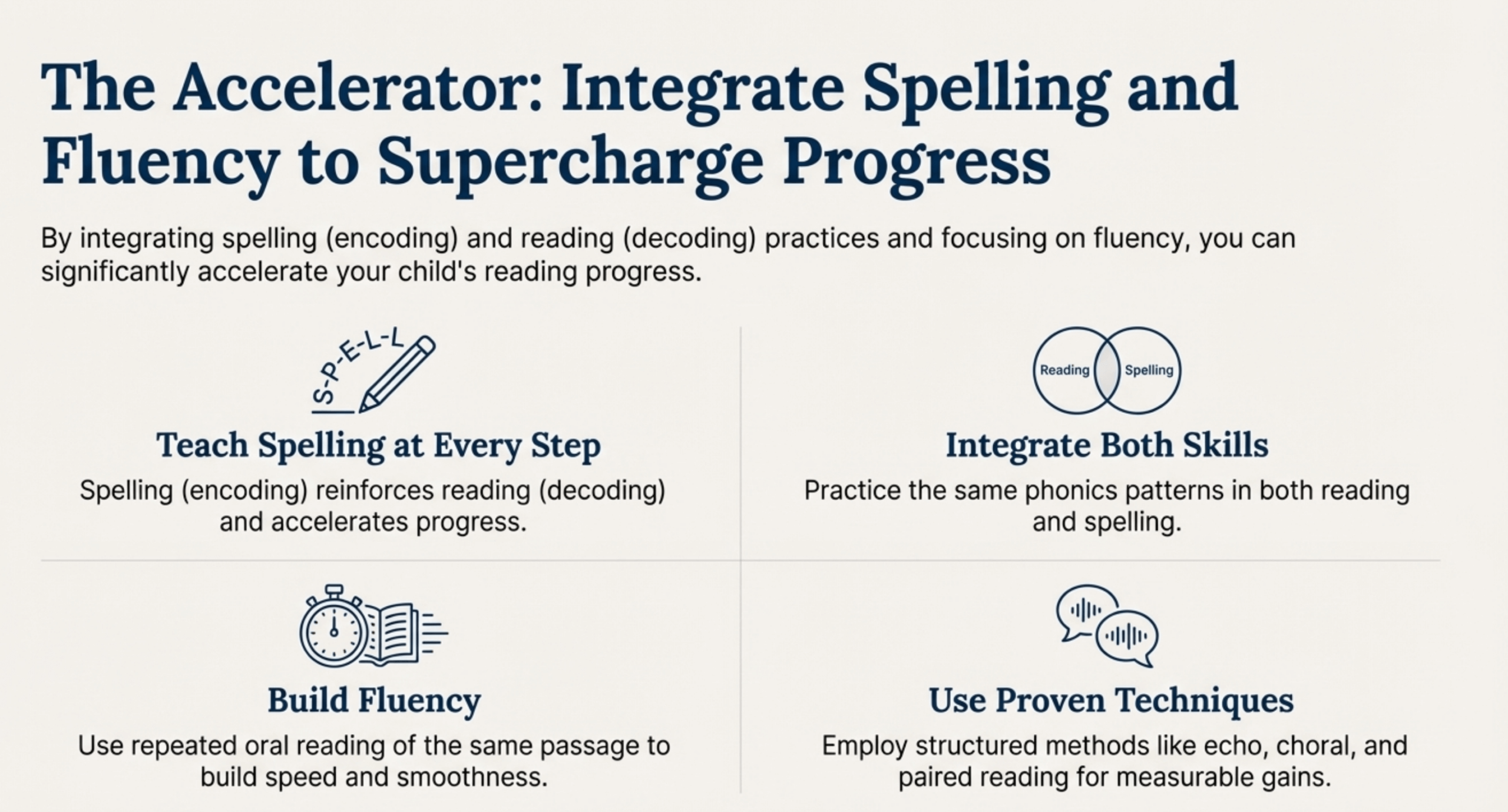
5. Teach Spelling at Every Step
Spelling (encoding) reinforces reading (decoding). When your child spells words, they actively apply phonics knowledge rather than relying upon memory to spell words. Spelling practice dramatically accelerates reading progress.
Learn how to incorporate spelling practice →
6. Integrate Spelling and Reading Instruction
Don’t teach reading and spelling separately. The same phonics patterns apply to both skills. When your child learns that “ai” says /ā/ in reading, immediately practice spelling words with “ai.” This integration doubles learning efficiency.
Learn how to teach reading and spelling together →
7. Require Mastery Before Advancing
Struggling readers have gaps in their phonics knowledge because they moved forward before mastering previous skills. Don’t make this mistake. Your child must decode accurately, read fluently, and spell correctly before progressing to the next lesson.
Learn about mastery-based instruction →
8. Build Fluency Through Repeated Reading
Accurate decoding isn’t enough—struggling readers must develop fluency (reading speed and smoothness). Provide guided, repeated oral reading practice every day. Have your child reread the same passage multiple times until it becomes smooth and automatic.
Learn why fluency matters and how to build it →
9. Use Proven Fluency-Building Techniques
Specific techniques maximize fluency development: echo reading, choral reading, paired reading, and timed repeated readings. These structured approaches produce measurable fluency gains when practiced consistently.
Learn specific fluency-building techniques →
How Our Program Addresses All Nine Essential Actions
Our comprehensive phonics program was designed specifically to help struggling readers by systematically implementing every evidence-based strategy outlined above:
Systematic Letter-Sound Instruction
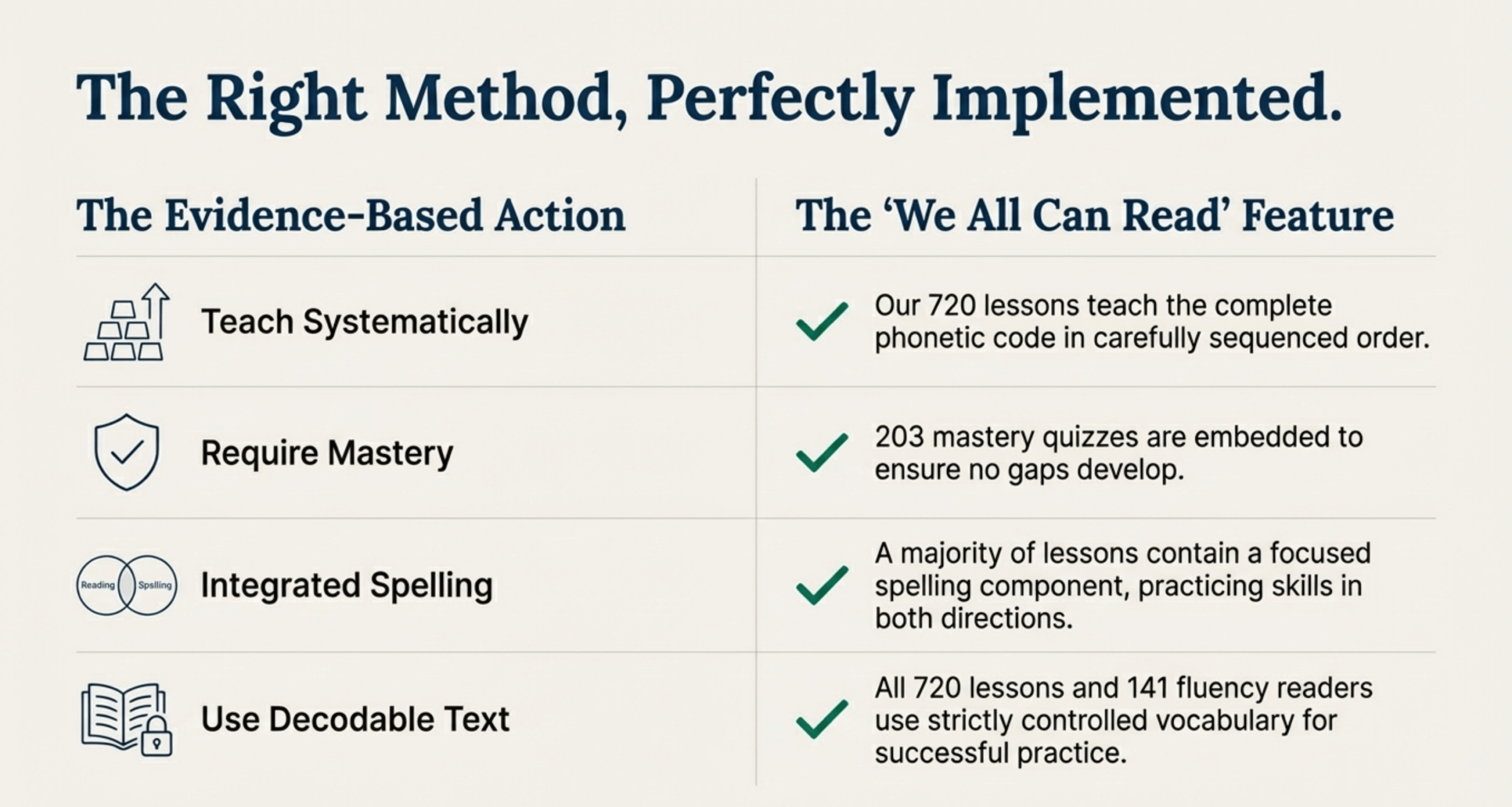
Our 720 lessons teach the complete English phonetic code in carefully sequenced order. Every letter-sound relationship is taught explicitly—nothing is assumed or skipped. Students master simple patterns before progressing to complex ones.
No Guessing Allowed
Every lesson requires students to decode words phonetically from left to right. Our controlled vocabulary ensures students can sound out every word using patterns they’ve already learned. Pictures and context clues are eliminated, forcing true reading skill development.
Decodable Text Throughout
All of our 720 online lessons and our 141 lessons from our supplemental fluency reader use strictly controlled vocabulary. Every story, sentence, and word list contains only phonetic patterns already taught. Students experience reading success from lesson one, building confidence as they progress.
Integrated Spelling Practice
A majority of our lessons contain a focused spelling component. Students hear words, segment them into sounds, and write the letters representing those sounds. This encoding practice reinforces phonics knowledge and accelerates reading development.
Reading and Spelling Together
Students don’t just read words—they spell them. They don’t just spell words—they read them. Every phonetic pattern is practiced in both directions, creating deep, permanent understanding of how English spelling works.
Mastery Required to Advance
203 quizzes are embedded throughout our program. Students cannot proceed to the next lesson until they demonstrate mastery of current material. This ensures no gaps develop—every student builds a complete phonics foundation.
Built-In Fluency Development
Our lessons provide controlled text for repeated reading practice. Students read the same passage multiple times, building speed and smoothness. Progress tracking shows measurable fluency improvements over time.
Professional Instruction at Home
Video instruction in every lesson means parents don’t need to teach—the program teaches directly to the student. Over 100 hours of professional video instruction ensures consistent, high-quality teaching every single day.
Why This Approach Works for Struggling Readers
Fills the Gaps
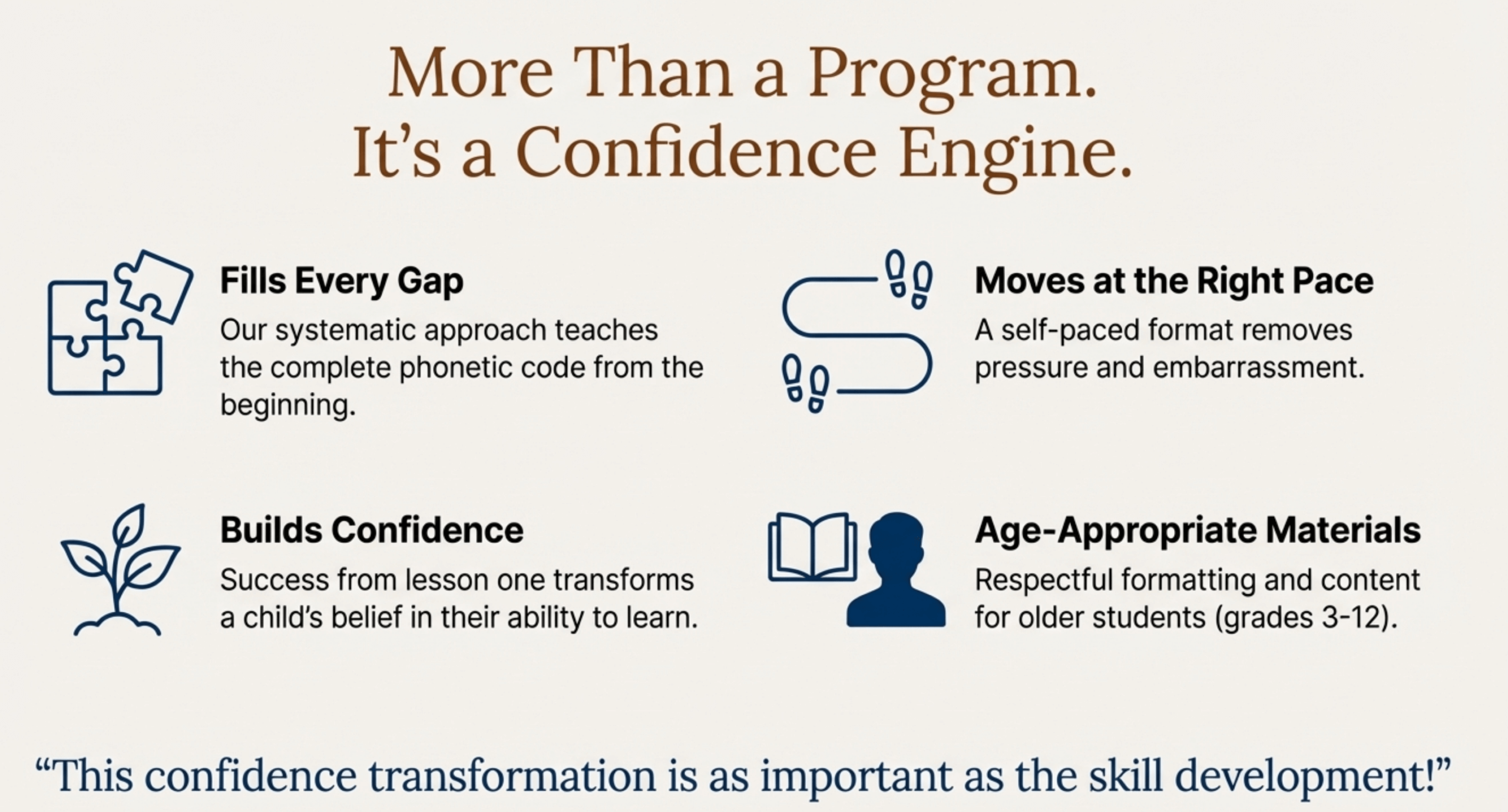
Most struggling readers have gaps in their phonics foundation—sounds they never learned or patterns they misunderstand. Our systematic approach fills every gap by teaching the complete phonetic code from the beginning.
Moves at the Right Pace
Struggling readers need more time and practice than typical students. Our self-paced format allows students to spend as long as necessary on challenging concepts. No pressure to keep up with classmates, no embarrassment about working at their own speed.
Builds Confidence
Success breeds success. When struggling readers experience reading success—decoding words accurately, reading fluently, spelling correctly—they begin to believe they can learn to read. This confidence transformation is as important as the skill development!
Provides Sufficient Practice
Struggling readers need extensive drill and repetition. Our 720 lessons provide this intensive practice in a structured, systematic way. Students practice each new skill repeatedly before moving forward.
Age-Appropriate Materials
Struggling older students (grades 3-12) need phonics instruction but can’t tolerate materials designed for six-year-olds. Our program uses mature formatting and age-appropriate content, respecting the intelligence of older learners while teaching foundational skills.
Success Stories from Parents Helping Struggling Readers
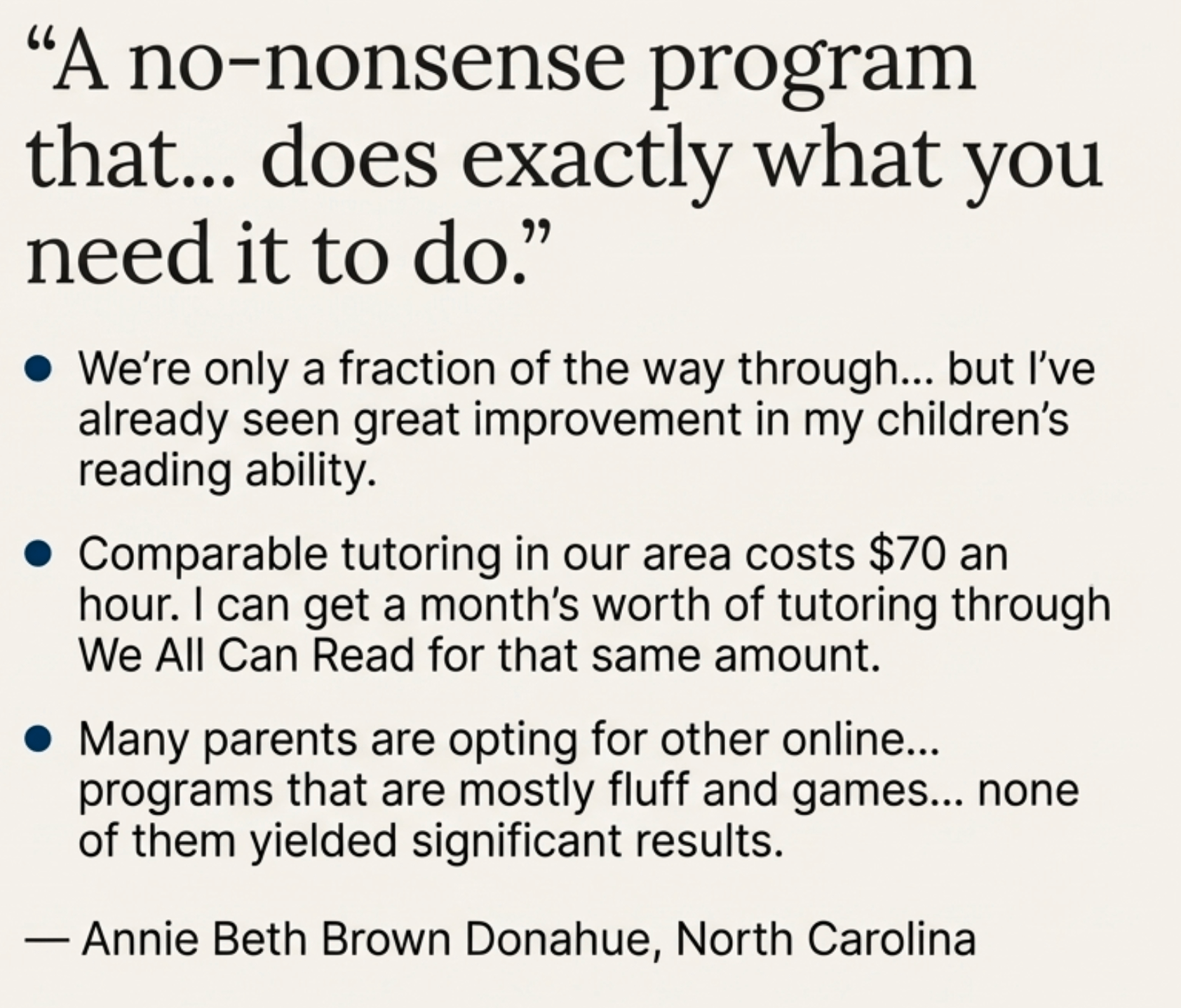
“We’re only a fraction of the way through the program, but I’ve already seen great improvement in my children’s reading ability.”
“I have multiple children using the program at different levels—some with learning disabilities and some without. I am excited to see how much they are going to progress this year.
The only school in the area that uses similar teaching methods costs over $20,000 a year to attend. Comparable tutoring in our area costs $70 an hour. I can get a month’s worth of tutoring through We All Can Read for that same amount.
Many parents are opting for other online, subscription-based reading programs that are mostly fluff and games. Despite the great reviews and the fun graphics, none of them yielded significant results, even with daily use. In contrast, We All Can Read is a no-nonsense program that starts from the ground up, eliminates learning gaps, and does exactly what you need it to do.”
— Annie Beth Brown Donahue, North Carolina
Read more success stories from parents →
Take Action Today
The reading crisis won’t solve itself. Schools can’t do it alone. But you—as a parent—have the power to change your child’s literacy trajectory starting today.
Start with 10 Free Lessons

Experience our systematic approach with the first 10 lessons completely free. No credit card required, no obligation. See for yourself how explicit, systematic phonics instruction transforms struggling readers.
These introductory lessons teach consonant sounds and the first short vowel, demonstrating our clear instruction and mastery-based progression.
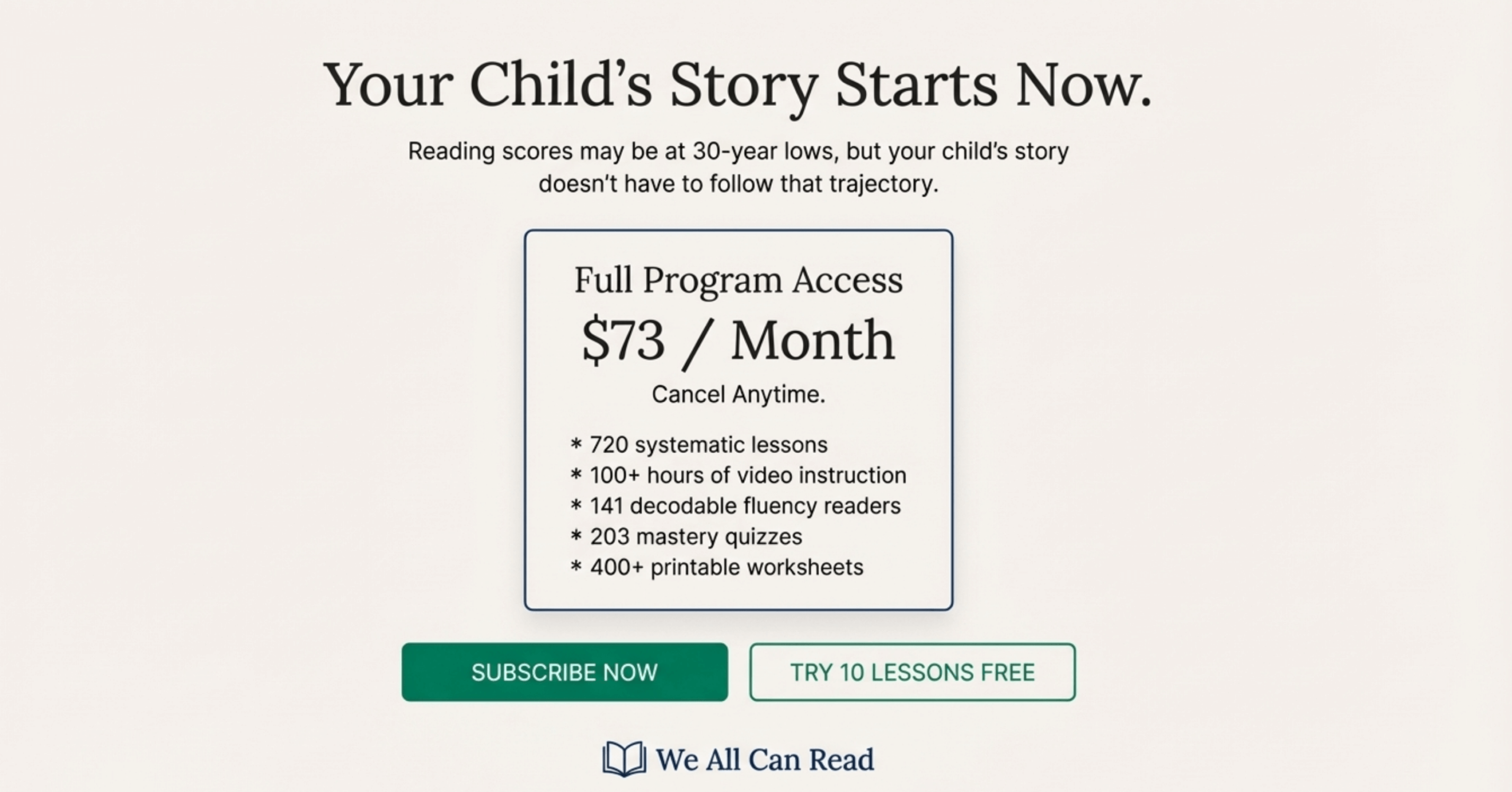
Full Program Access: $73/Month
Complete access to all 720 lessons with unlimited practice and review:
- 720 systematic phonics lessons (video, audio, text)
- 141 decodable fluency readers
- 400+ printable spelling and writing worksheets
- 100+ hours of professional video instruction
- 203 mastery quizzes ensuring comprehension
- Progress tracking dashboard
- All materials printable for offline practice
One month costs less than a single tutoring session. Cancel anytime—no long-term contracts.
Take the First Step
The question isn’t whether your child can learn to read—it’s whether you’ll take action now to help them succeed.
Continue Reading: The 9 Essential Strategies
Next → Why Parents Must Take Action for Struggling Readers
Related resources: Homeschool phonics curriculum | Remedial phonics for older students
Questions about helping your struggling reader? Contact us or explore our frequently asked questions.
Learn more: Read about our systematic Orton-Gillingham methodology