Adult Phonics Success Stories: Real Results from Real Students
Can Adults Really Learn to Read with Phonics?
Absolutely. While many adults worry they’re “too old” to learn or that their struggles are permanent, systematic phonics instruction works at any age. The adult phonics success stories featured on this page started with varying reading levels—some could barely read at all, others read adequately but struggled with spelling—and all achieved significant, measurable improvement through our Orton-Gillingham adult phonics program.
These aren’t marketing claims or theoretical possibilities. These are real students who dedicated themselves to consistent practice and transformed their reading and spelling abilities. Their stories demonstrate what’s possible when adults receive proper phonics instruction designed specifically for their needs.
These students achieved their reading goals without spending $10,000-40,000 on traditional tutoring programs. They learned through affordable, self-paced online phonics instruction that fit their budgets and busy schedules. To understand the cost differences between adult phonics approaches and why online systematic phonics can be just as effective as expensive tutoring, see our Adult Phonics Cost Comparison Guide.
Ready to start your own success story?
Try your first 10 lessons free—see how systematic phonics works for you.
No credit card • Watch Lesson 1 in 2 minutes
What Makes These Success Stories Credible?
Every testimonial on this page is:
- From a real person who completed our program
- Specific and detailed about his or her starting point and progress
- Voluntarily shared by students who wanted to encourage others
We’ve changed nothing except minor details for readability. These are their authentic experiences in their own words.
Roger’s Story: From Struggling Reader to College Graduate
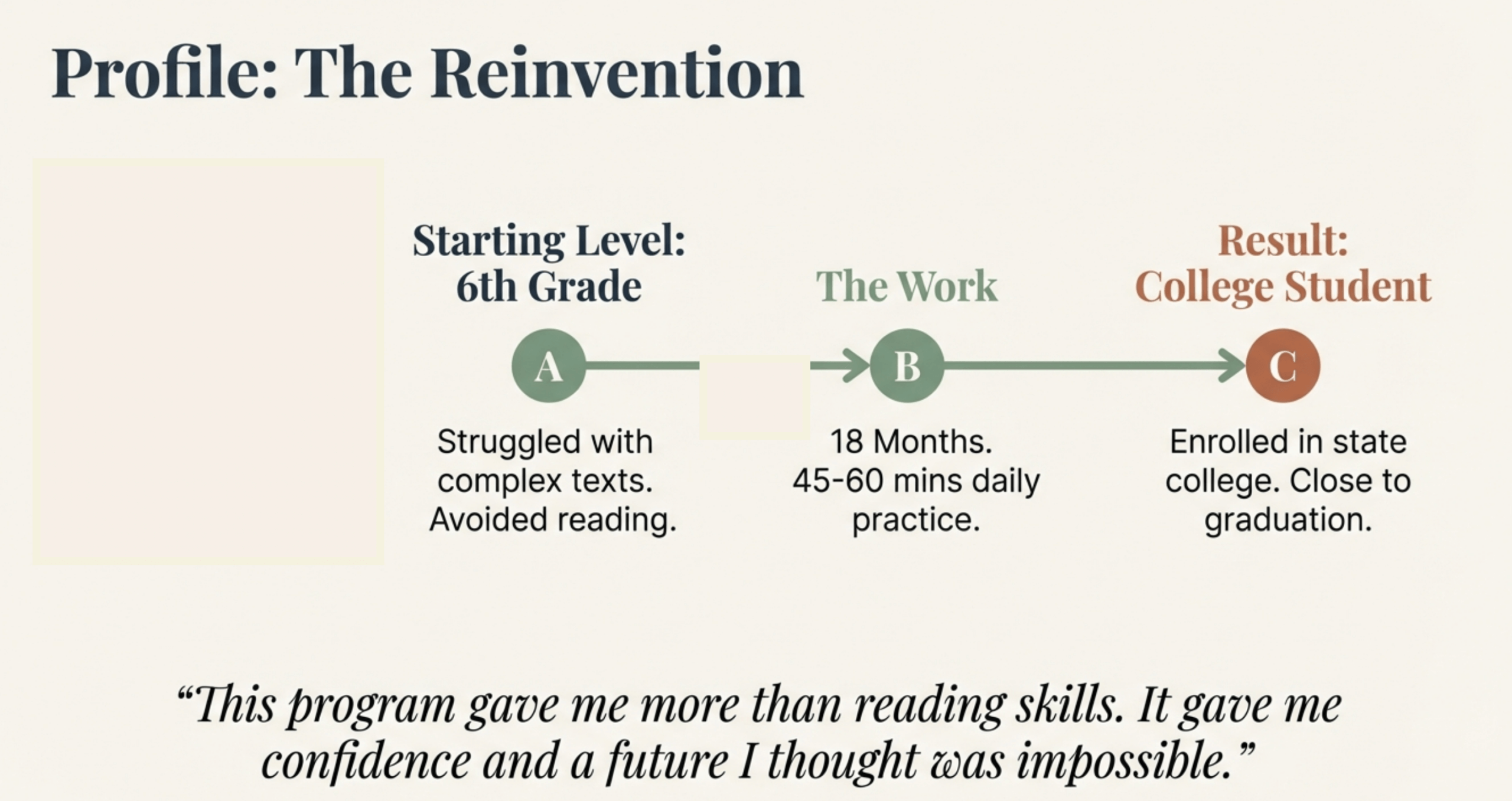
Age: 41
Starting Level: Approximately 6th-grade reading level
Time in Program: 18 months
Daily Practice: 45 minutes to over one hour
Roger’s Journey
Roger came to our program after years of frustration with reading and spelling. Despite completing high school, he struggled with complex texts and avoided situations requiring reading or writing. He knew his literacy skills were holding him back from career advancement and further education.
Working full-time while studying, Brandon committed to consistent daily practice—45 minutes to over one hour every day without exception. He progressed through our 720-lesson sequence systematically, mastering each concept before advancing.
Life Impact
Roger enrolled at his local state college and is currently close to graduation.
“This program gave me more than reading skills,” Roger shared. “It gave me confidence and a future I thought was impossible.”
Key Takeaway
Roger’s story demonstrates that with consistent practice and proper instruction, adults can achieve reading proficiency even after years of struggle. His timeline—18 months—is realistic and achievable for motivated adult learners willing to commit to daily practice.
Bob D.’s Story: Confidence at Age 60
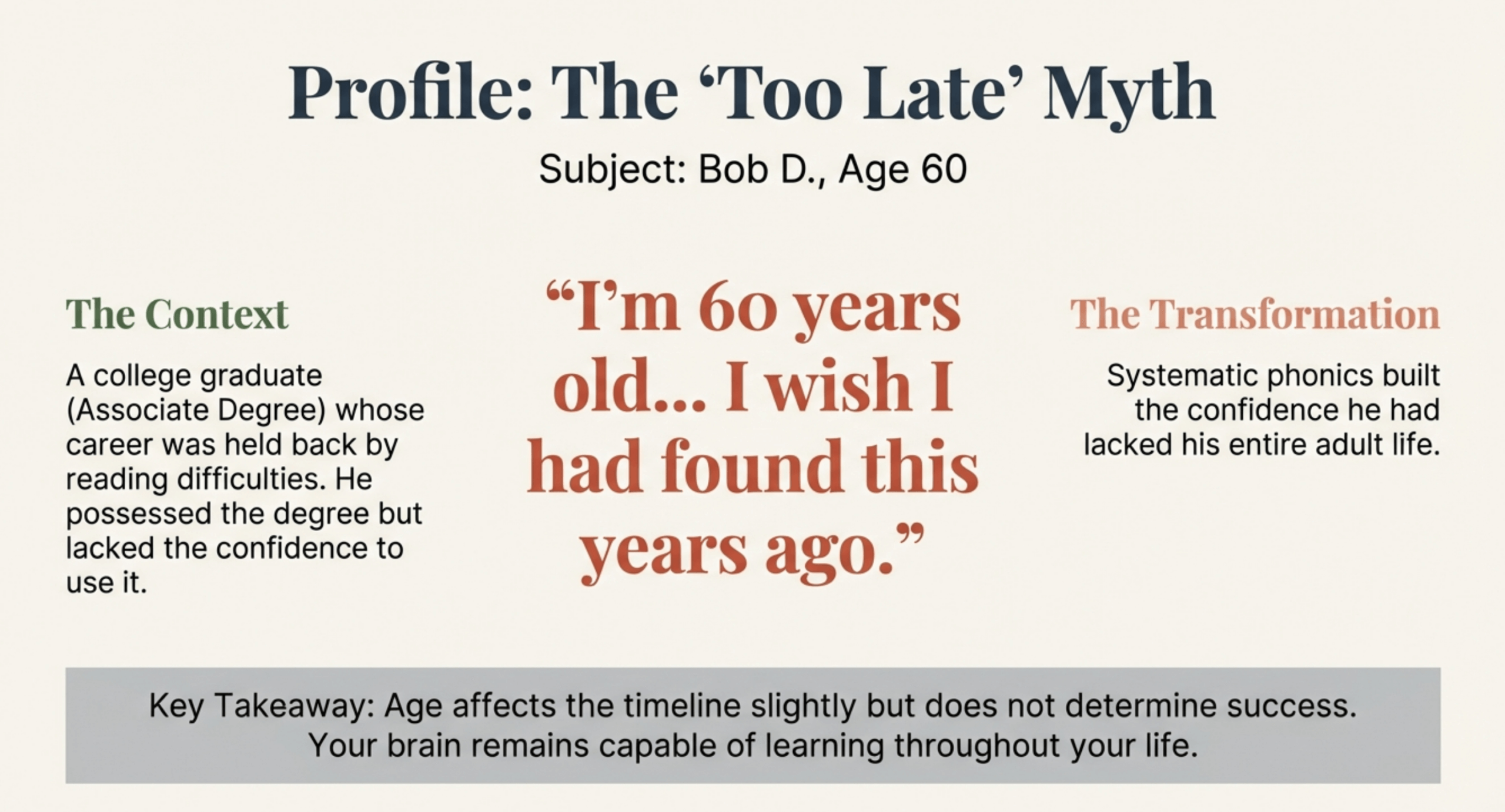
Age: 60
Starting Level: College graduate who struggled with reading confidence
Background: Associate Degree, career held back by reading difficulties
In Bob’s Own Words
“I’m 60 years old with an Associate Degree. Reading has held me back from great success. Your program is giving me confidence in reading for the first time. I wish I had found this years ago.”
— Bob D.
Key Takeaway
Bob’s story proves you’re never too old to improve. Despite having a college degree, he recognized that weak reading skills limited his career advancement. Even at age 60, systematic phonics instruction built the confidence he’d lacked his entire adult life.
His regret—”I wish I had found this years ago”—echoes what many older students express. But the crucial point is: he found it now, and it’s transforming his life.
Kim Wilson’s Story: Helping Her Homeschooled Son
Student: Adam, age 11
Parent: Kim Wilson, Great Britain
Challenge: Struggling with spelling and decoding after starting homeschool
Time to Breakthrough: 1 month
The Breakthrough Moment
Kim started homeschooling her 11-year-old son Adam, who struggled significantly with spelling and decoding. She needed an affordable, effective program that worked online and used proven methods.
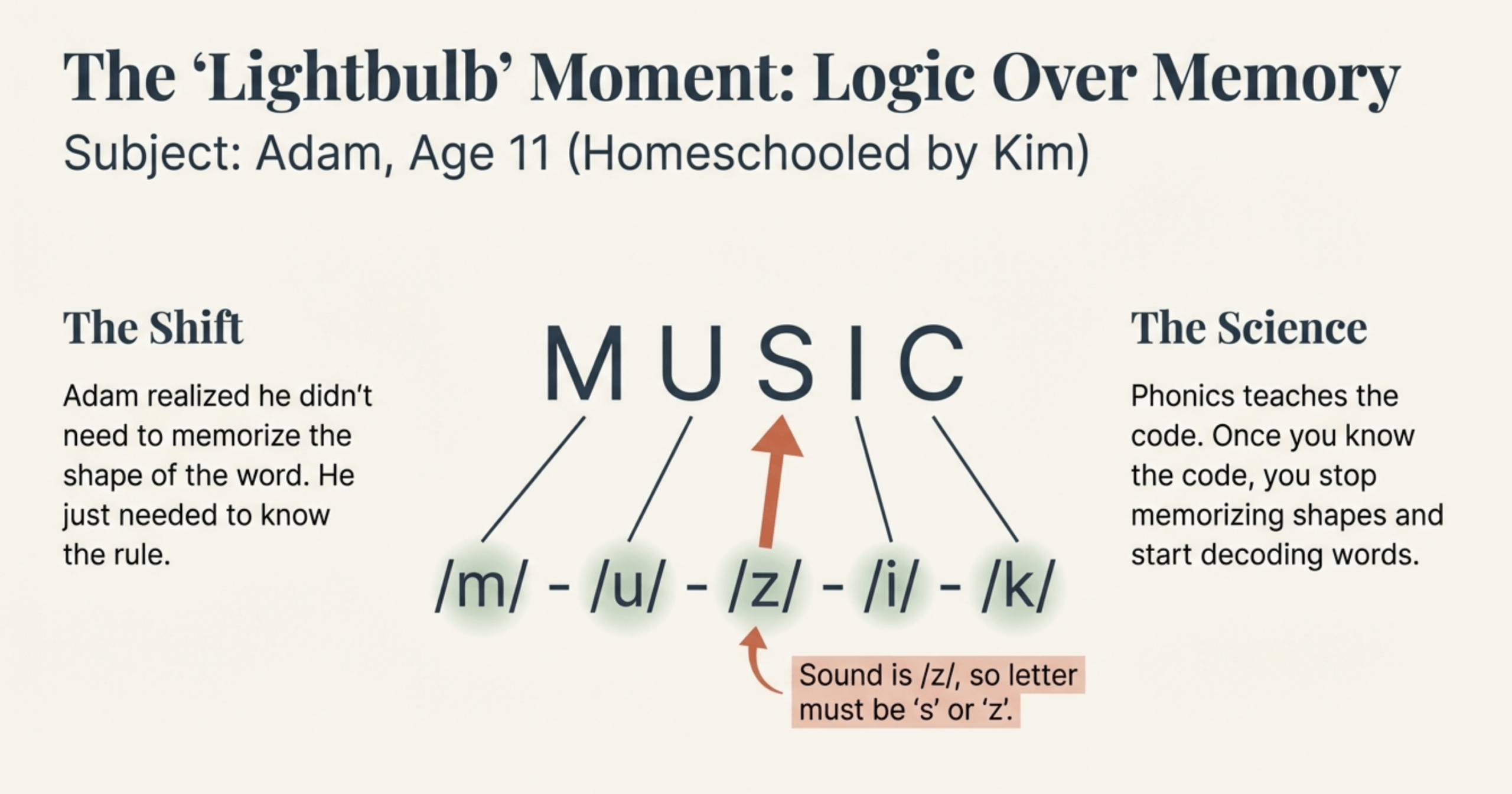
After just one month with our curriculum, Adam experienced a pivotal moment. While trying to spell “music,” Kim told him to listen for the next sound. Suddenly, everything clicked.
In Kim’s Own Words
“Right then a light bulb went off! He said, ‘Oh! It is /z/ so it must be either an ‘s’ or a ‘z’ and I’m pretty sure it isn’t a ‘z’.’
I realized he had been trying to memorize every single word before because he had hardly any rules to guide him. Thanks for this great homeschool curriculum!”
— Kim Wilson, Homeschool Mom, Great Britain
Key Takeaway
Adam’s “light bulb moment” illustrates what happens when students learn systematic phonics rules instead of trying to memorize thousands of individual words. Once students understand the code—the relationship between letters and sounds—they can decode any word, even words they’ve never seen before.
This cognitive shift from memorization to understanding is what makes phonics instruction so powerful.
Susan’s Story: Professional Confidence Through Better Spelling
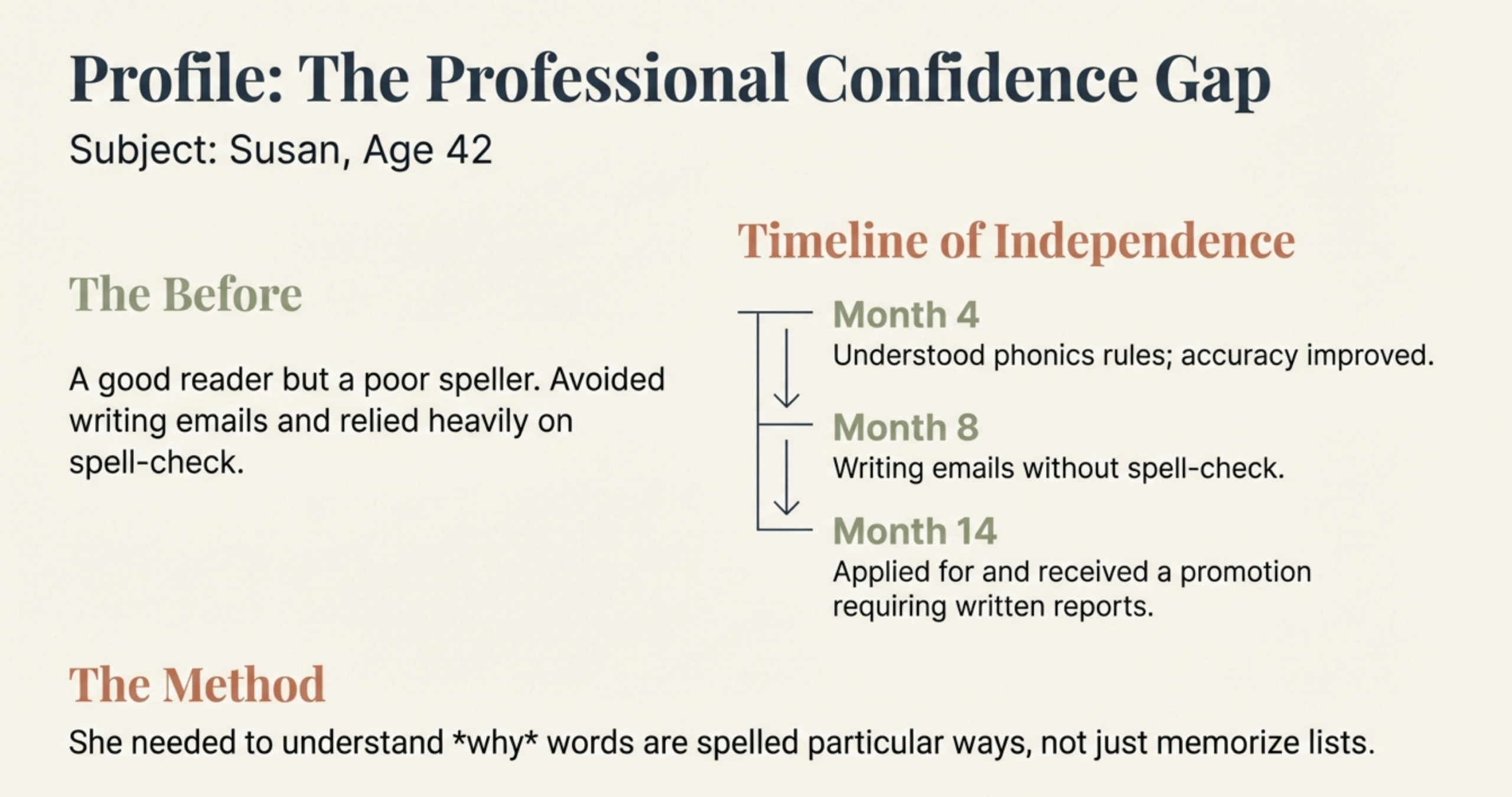
Age: 42
Starting Level: Good reader, poor speller
Time in Program: 14 months
Daily Practice: 20-30 minutes
Susan’s Challenge
Susan could read adequately but struggled with spelling. She avoided writing emails, relied heavily on spell-check, and felt embarrassed about her spelling in professional contexts. She wanted to write confidently without technological assistance.
Progress Timeline
- Month 4: Spelling accuracy improving; understanding phonics rules
- Month 8: Writing emails without spell-check; confidence growing
- Month 14: Applied for promotion requiring written reports; succeeded
Life Impact
Understanding spelling rules transformed Susan’s professional life. She applied for and received a promotion that required preparing written reports—something she would never have attempted before. The spelling instruction integrated throughout our phonics program gave her the systematic knowledge she’d been missing.
Key Takeaway
Many adults read adequately but struggle with spelling. This often stems from missing the systematic phonics instruction that explains WHY words are spelled particular ways. Susan’s story shows that it’s never too late to fill these gaps and achieve professional confidence.
Michael’s Story: Functional Literacy in 8 Months
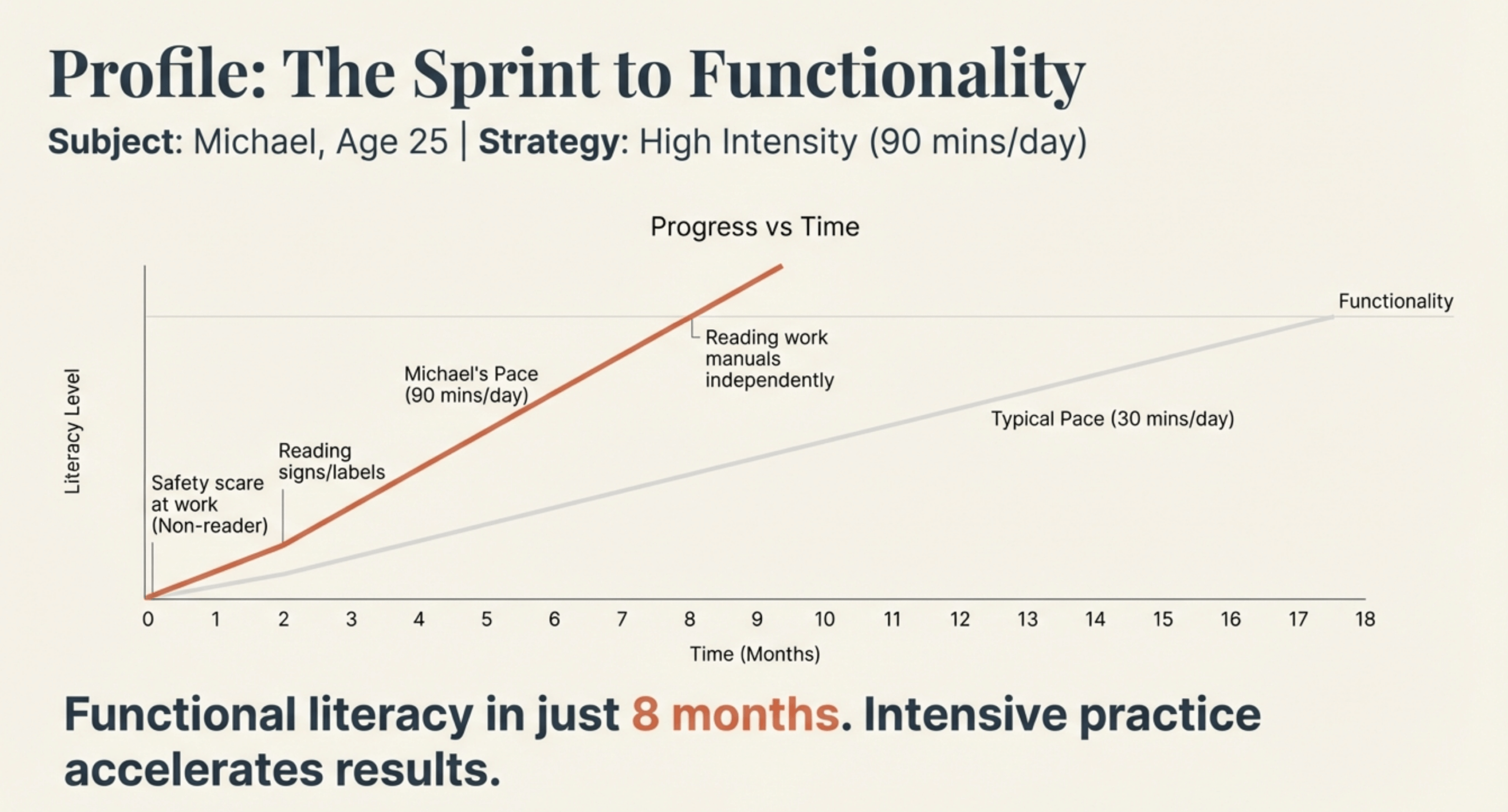
Age: 25
Starting Level: Nearly non-reader
Time in Program: 8 months (ongoing)
Daily Practice: 60-90 minutes
Michael’s Motivation
Michael could barely read when he started. A wake-up call at work—being unable to read critical safety information—motivated him to finally address his literacy. Highly determined, he dedicated 60-90 minutes daily to the program despite working full-time.
Accelerated Progress Timeline
- Month 2: Reading simple signs and labels independently
- Month 5: Reading simple books to his children
- Month 8: Reading work manuals and forms without assistance
Life Impact
Michael achieved functional workplace literacy in 8 months—faster than typical because of his intensive daily practice. He can now perform his job safely and independently, read to his children, and navigate daily life without assistance.
He continues working through advanced lessons but has already accomplished his primary goal: the ability to function independently in reading-dependent situations.
Key Takeaway
Michael’s story demonstrates that intensive practice accelerates progress. His 60-90 minutes daily, compared to the typical 30 minutes, brought him to functional literacy in 8 months rather than the typical 12-18 months. His story also shows that even adults with severe reading difficulties can achieve independence with proper instruction.
Join Thousands of Adults Who’ve Learned to Read
These success stories started exactly where you are now. The same systematic Orton-Gillingham instruction that worked for them is waiting for you. Try 10 complete lessons—completely free.
Start Your Journey Today →✓ Proven methodology ✓ No credit card required ✓ Cancel anytime
Common Patterns in Success Stories
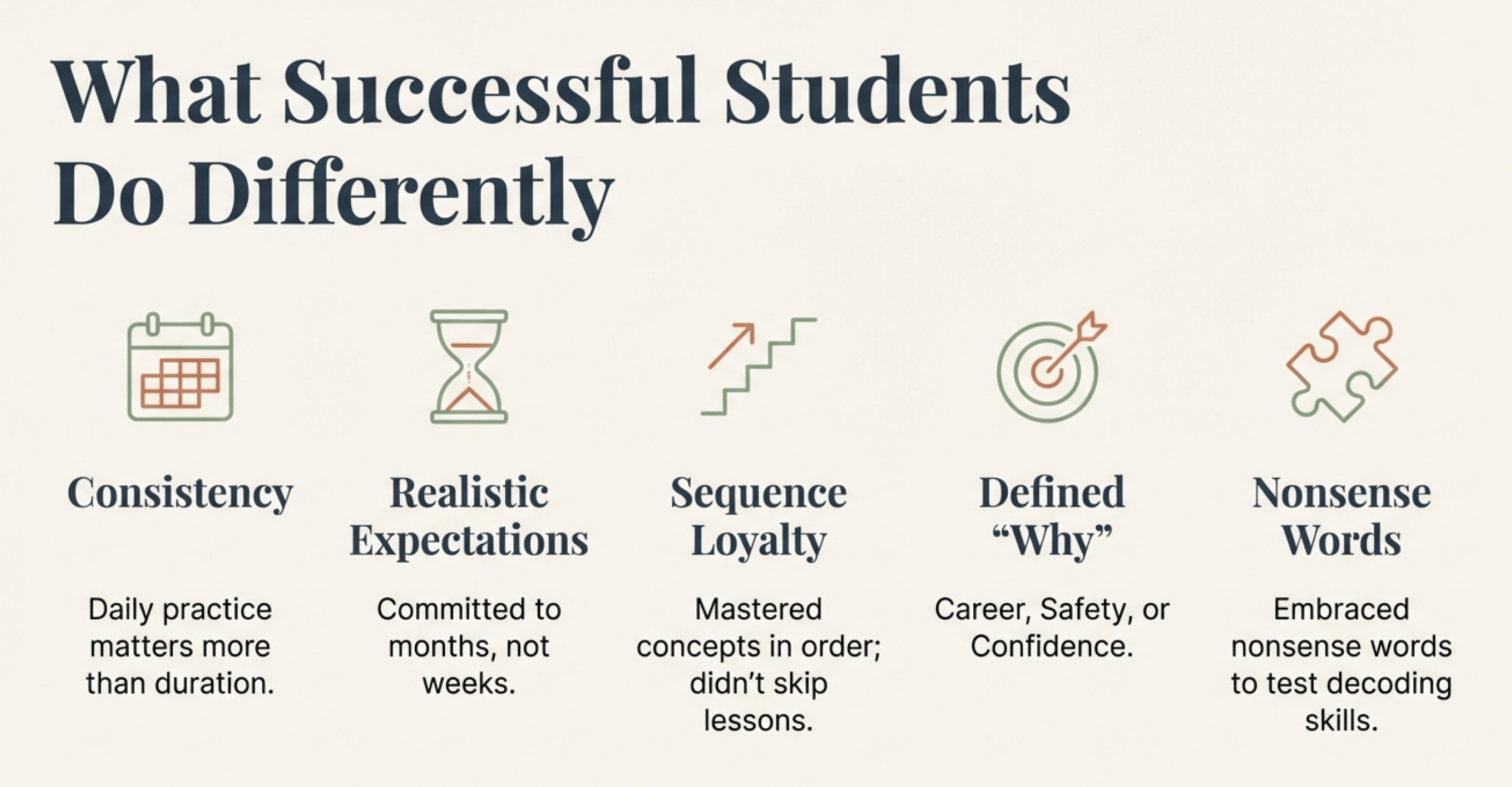
What Successful Students Share
Analyzing these and dozens of other student testimonials reveals consistent patterns among those who succeed:
1. Consistent Daily Practice
Every successful student practiced regularly—typically daily or near-daily. Whether 20 minutes (Susan) or 90 minutes (Michael), consistency mattered more than duration.
2. Realistic Timeline Expectations
Students who succeeded understood that learning takes time. They committed to months, not weeks, and trusted the systematic process rather than seeking quick fixes.
3. Following the Sequence
Successful students worked through lessons in order, mastering each concept before advancing. They didn’t skip lessons that seemed “too easy” or jump ahead to advanced material.
4. Strong Personal Motivation
Whether career advancement (Roger), professional confidence (Susan), workplace safety (Michael), or helping children (Kim’s son), successful students had clear reasons WHY they wanted to improve.
5. Willingness to Practice with Nonsense Words
Students who embraced nonsense word practice—even when it felt strange—developed stronger decoding skills than those who resisted this element.
Different Starting Points, Similar Success
Complete Beginners (Like Michael)
Starting point: Can read few or no words
Typical timeline: 12-24 months to functional literacy
Outcome: Ability to read workplace materials, signs, simple books
Struggling Readers (Like Roger)
Starting point: Can read simple texts but struggle with complex material
Typical timeline: 12-18 months to grade-level reading
Outcome: College-level reading, career advancement
Adequate Readers with Spelling Problems (Like Susan)
Starting point: Read fairly well but can’t spell
Typical timeline: 9-14 months to spelling mastery
Outcome: Confident writing, professional advancement, spell-check independence
Older Students Seeking Confidence (Like Bob)
Starting point: Functional but lacking confidence
Typical timeline: Varies based on goals
Outcome: Increased reading confidence, career advancement, personal satisfaction
Why Orton-Gillingham Works for Adults
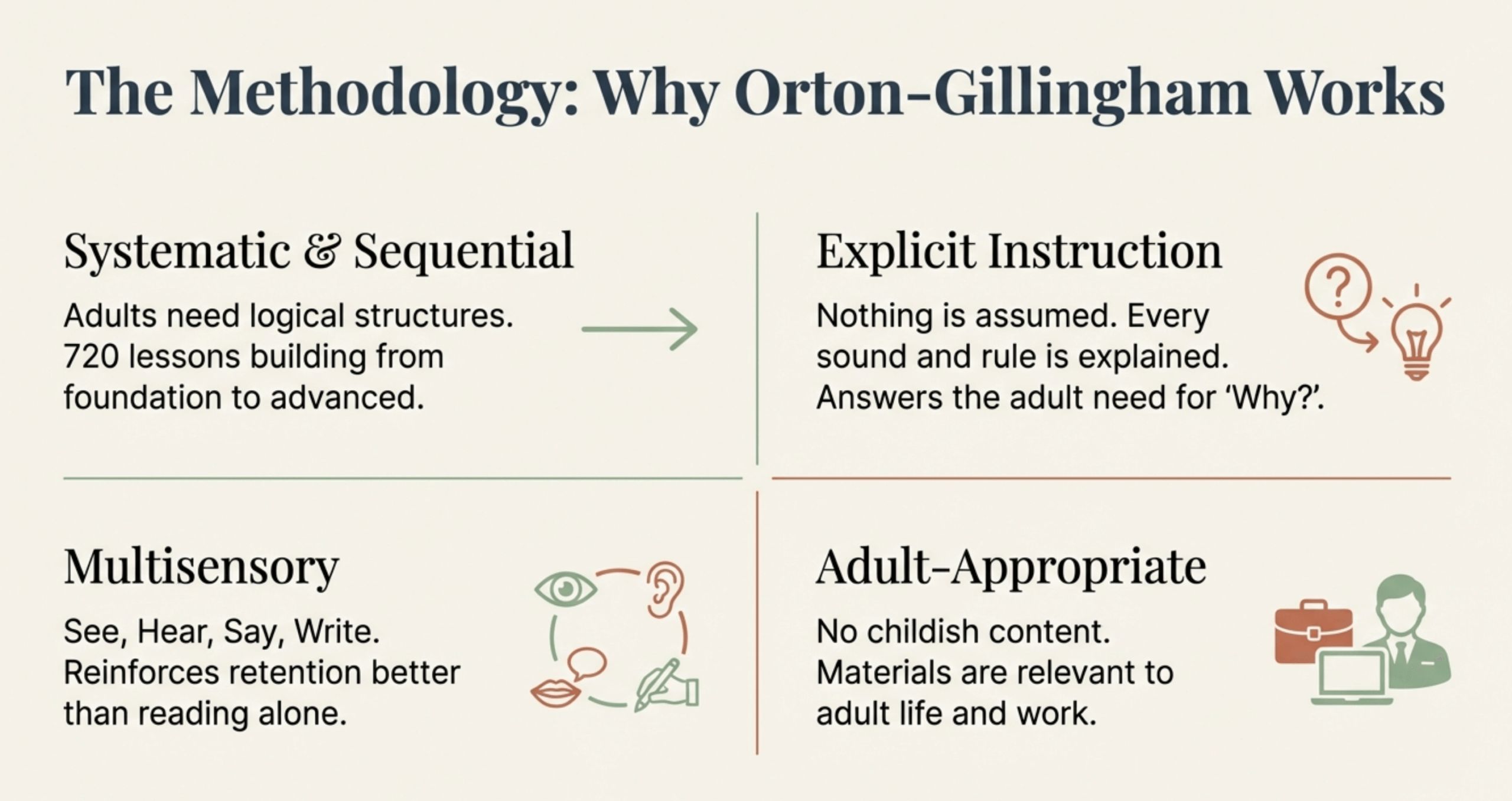
These success stories all involve students who used our Orton-Gillingham based curriculum. This approach succeeds with adults because:
Systematic and Sequential
Adults don’t need random tips or tricks. They need systematic instruction that builds logically from foundational concepts to advanced skills. Our 720-lesson sequence provides this structure.
Explicit Instruction
Nothing is assumed. Every sound, every rule, every pattern is taught explicitly through video lessons. Adults appreciate this clarity—they finally understand the “why” behind English spelling and reading.
Multisensory Learning
Students see, hear, say, and write each concept. This multisensory approach reinforces learning and helps concepts “stick” better than reading or listening alone.
Mastery-Based Progression
Regular quizzes ensure true mastery before advancing. This prevents learning gaps that create problems later and gives adults confidence they’ve truly learned each skill.
Adult-Appropriate Materials
Our program uses age-appropriate examples and vocabulary. Adults aren’t asked to read “The cat sat on the mat”—they work with materials relevant to adult life, work, and interests.
Addressing Common Concerns
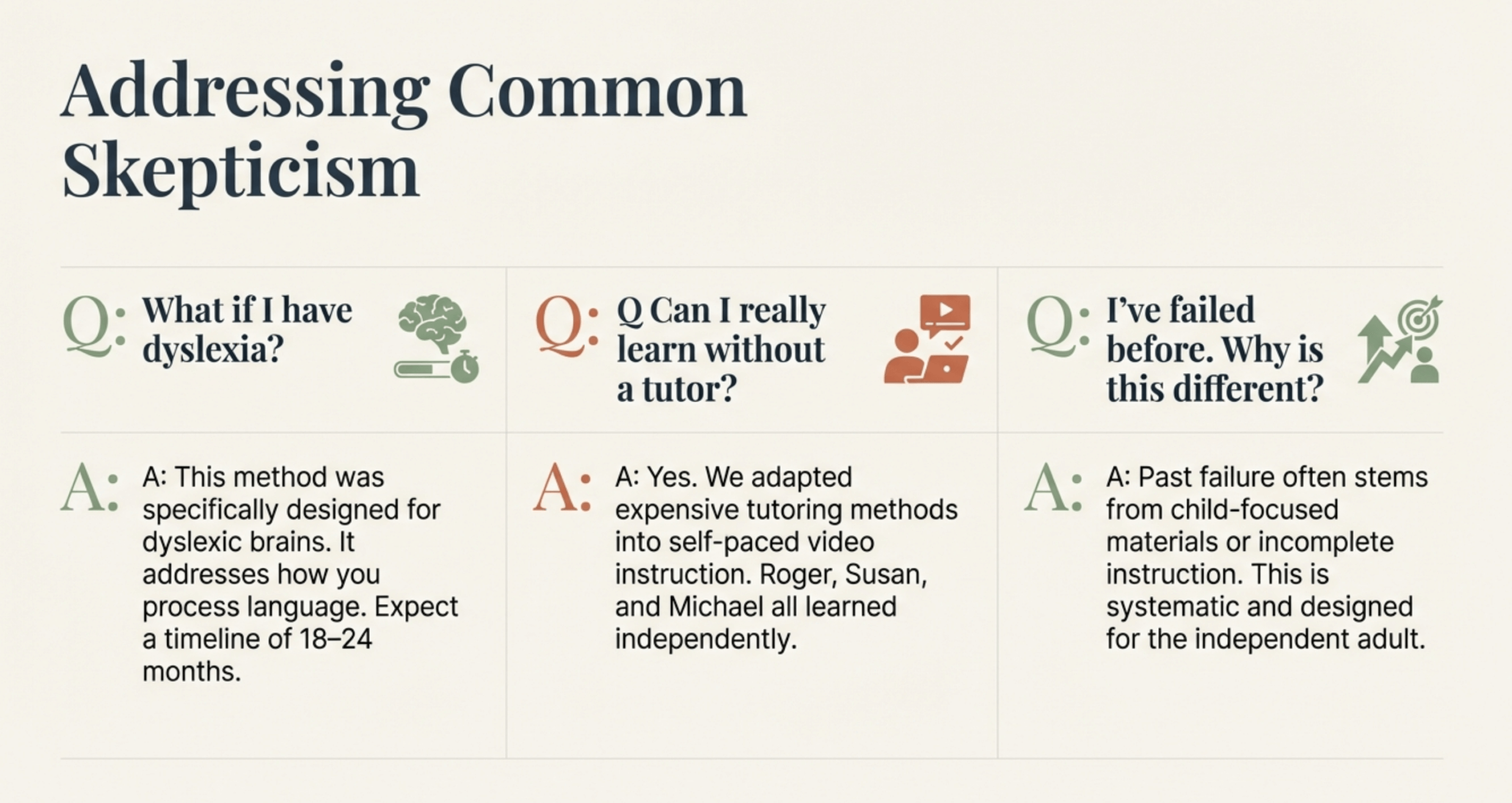
“Am I too old to learn?”
Bob D. started at age 60 and achieved significant improvement. We’ve worked with students in their 70s and 80s who successfully learned to read. Your brain remains capable of learning throughout your life. Age affects the timeline slightly but doesn’t determine success or failure.
“I’ve tried before and failed. Why would this work?”
Many of our successful students tried other programs before finding ours. The difference: systematic, explicit Orton-Gillingham instruction specifically designed for independent adult learning. Previous failures often resulted from incomplete instruction, poor sequencing, or child-focused materials that felt inappropriate.
“What if I have dyslexia or learning disabilities?”
Orton-Gillingham instruction was specifically designed for dyslexic learners. Many students featured here likely have undiagnosed learning differences. The systematic, multisensory approach works specifically because it addresses how dyslexic brains process language. Learn more about how adults with dyslexia can learn to read.
Expect timelines on the longer end (18-24 months), but success is absolutely achievable.
“Can I really learn independently without a tutor?”
Every student featured on this page learned independently through our online program. While traditional Orton-Gillingham requires expensive tutoring, we’ve adapted these methods for self-paced video instruction. Roger, Susan, Michael, and thousands of others prove this approach works.
“How much time do I need to commit?”
As little as 20 minutes daily (Susan) or as much as 90 minutes (Michael)—you choose based on your schedule and how quickly you want to progress. More time = faster results, but consistency matters more than duration.
What Success Looks Like at Different Stages
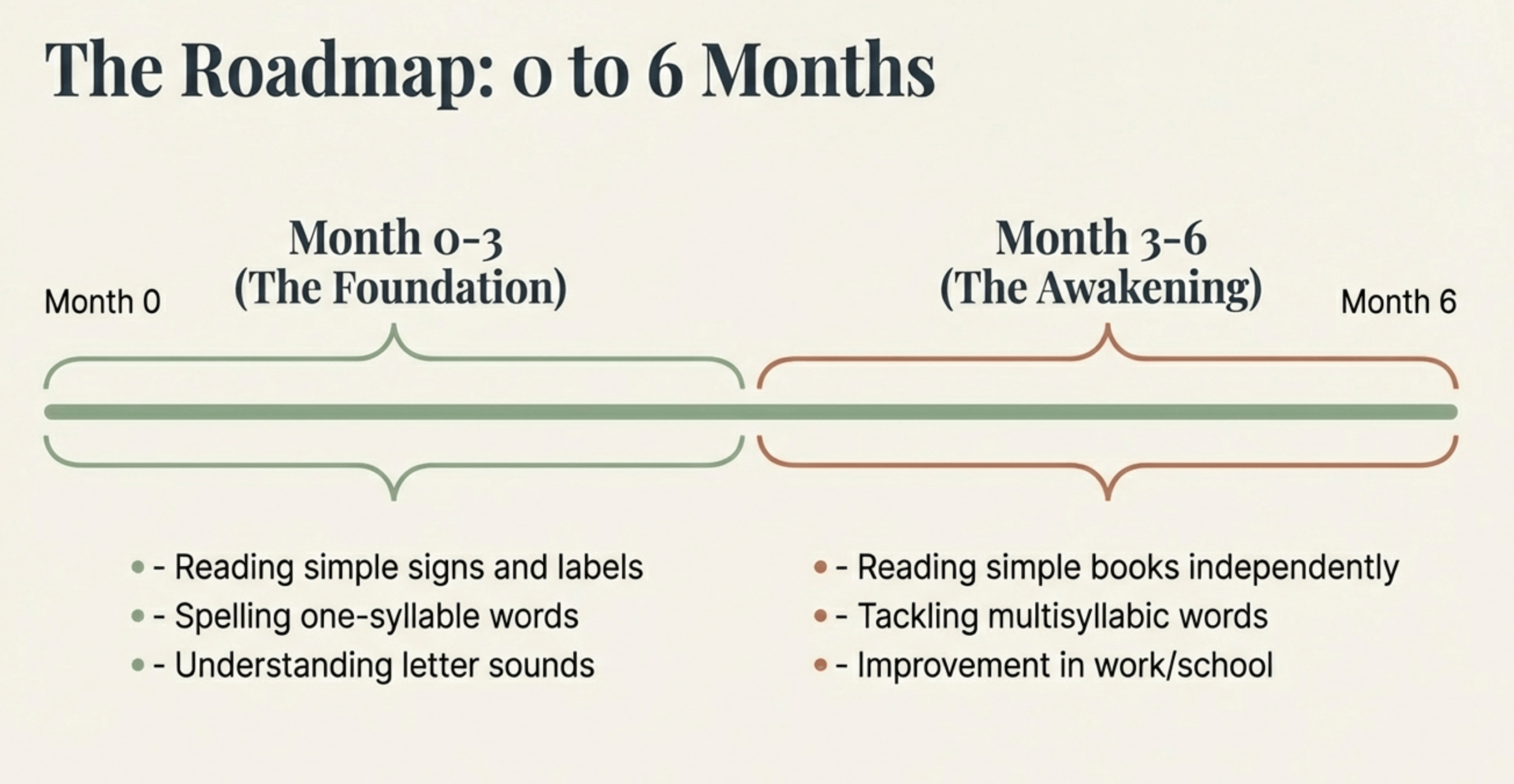
After 3 Months
- Reading simple signs, labels, and basic text
- Understanding how letter sounds work
- Spelling simple one-syllable words correctly
- Beginning to decode unfamiliar words
- Increased confidence and motivation
After 6 Months
- Reading simple books independently
- Decoding most one-syllable words accurately
- Beginning to tackle multisyllabic words
- Spelling with significantly improved accuracy
- Noticeable improvement in work/school performance
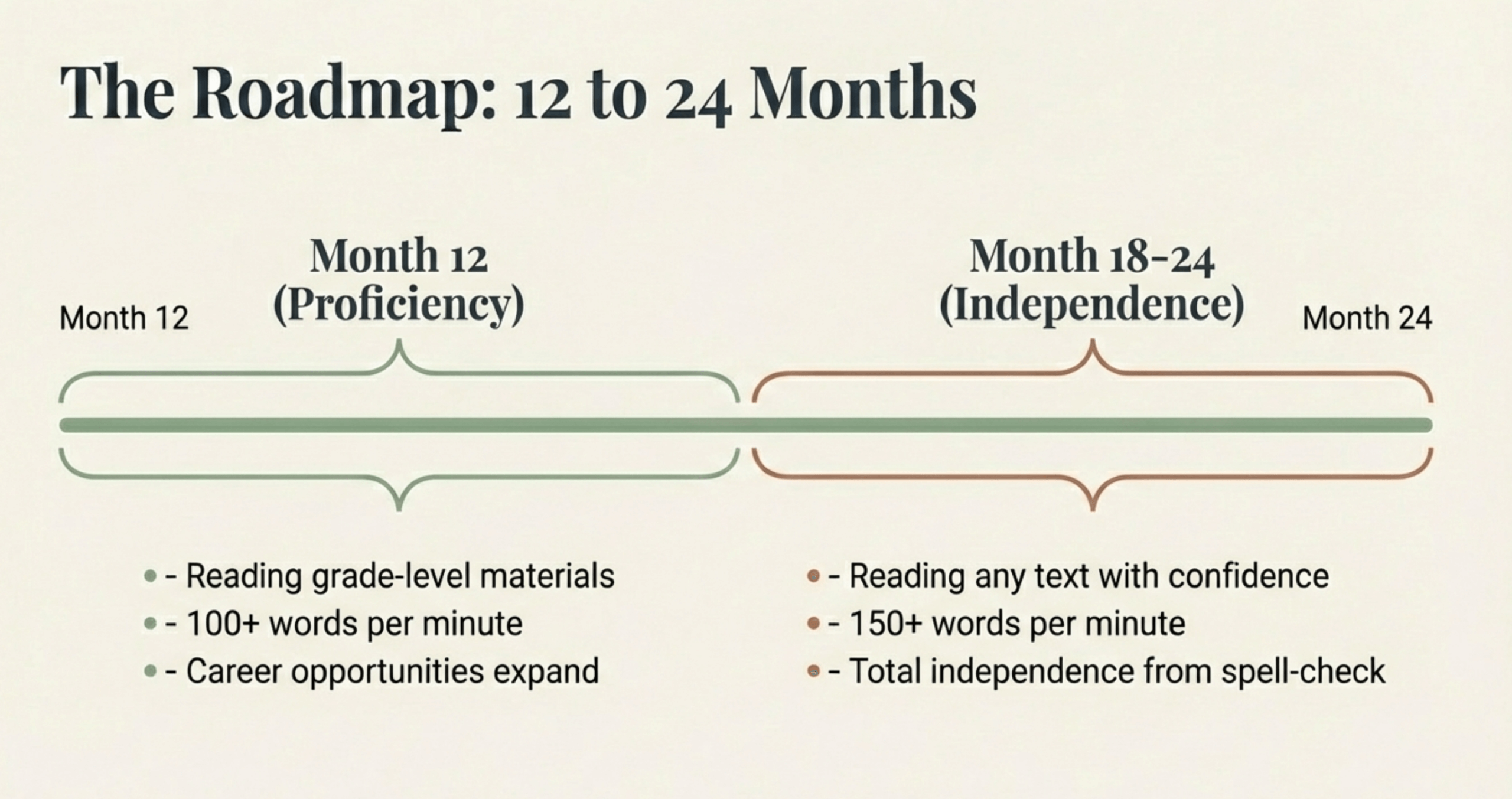
After 12 Months
- Reading grade-level materials comfortably
- Decoding complex multisyllabic words
- Spelling most words correctly without assistance
- Reading fluently at 100+ words per minute
- Life-changing impact on career/education opportunities
After 18-24 Months
- Reading any text with confidence
- Mastery of advanced spelling patterns
- Fluent reading at 150+ words per minute
- Independence from spell-check and assistance
- Complete transformation in literacy confidence
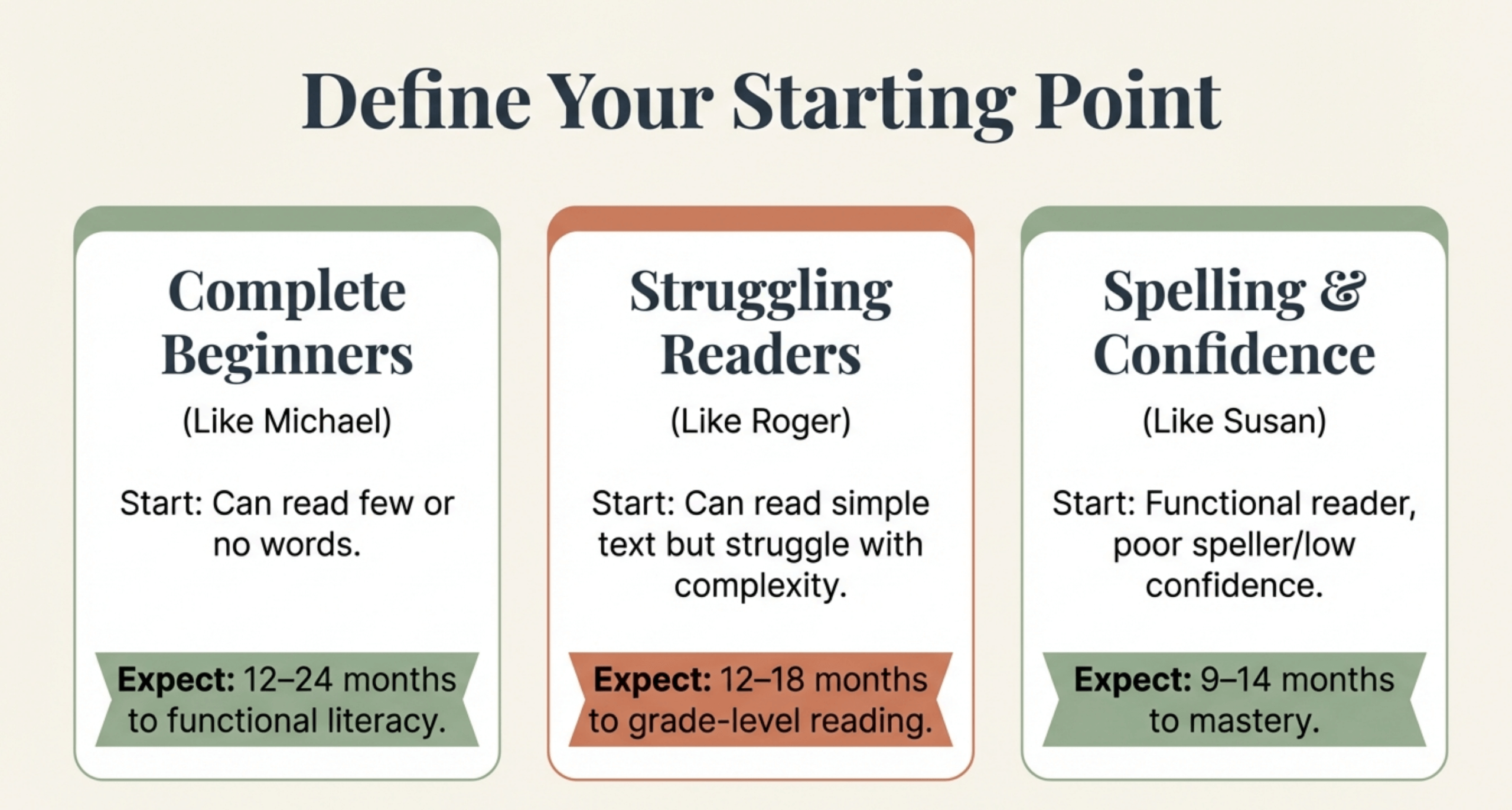
Your timeline depends on your starting point, practice consistency, and personal goals. Review our complete timeline guide for detailed expectations.
Start Your Own Success Story
Every student featured on this page started exactly where you are now: uncertain whether improvement was possible, concerned about their age or past failures, wondering if this program would finally work.
They all took the same first step: trying our first 10 lessons completely free.
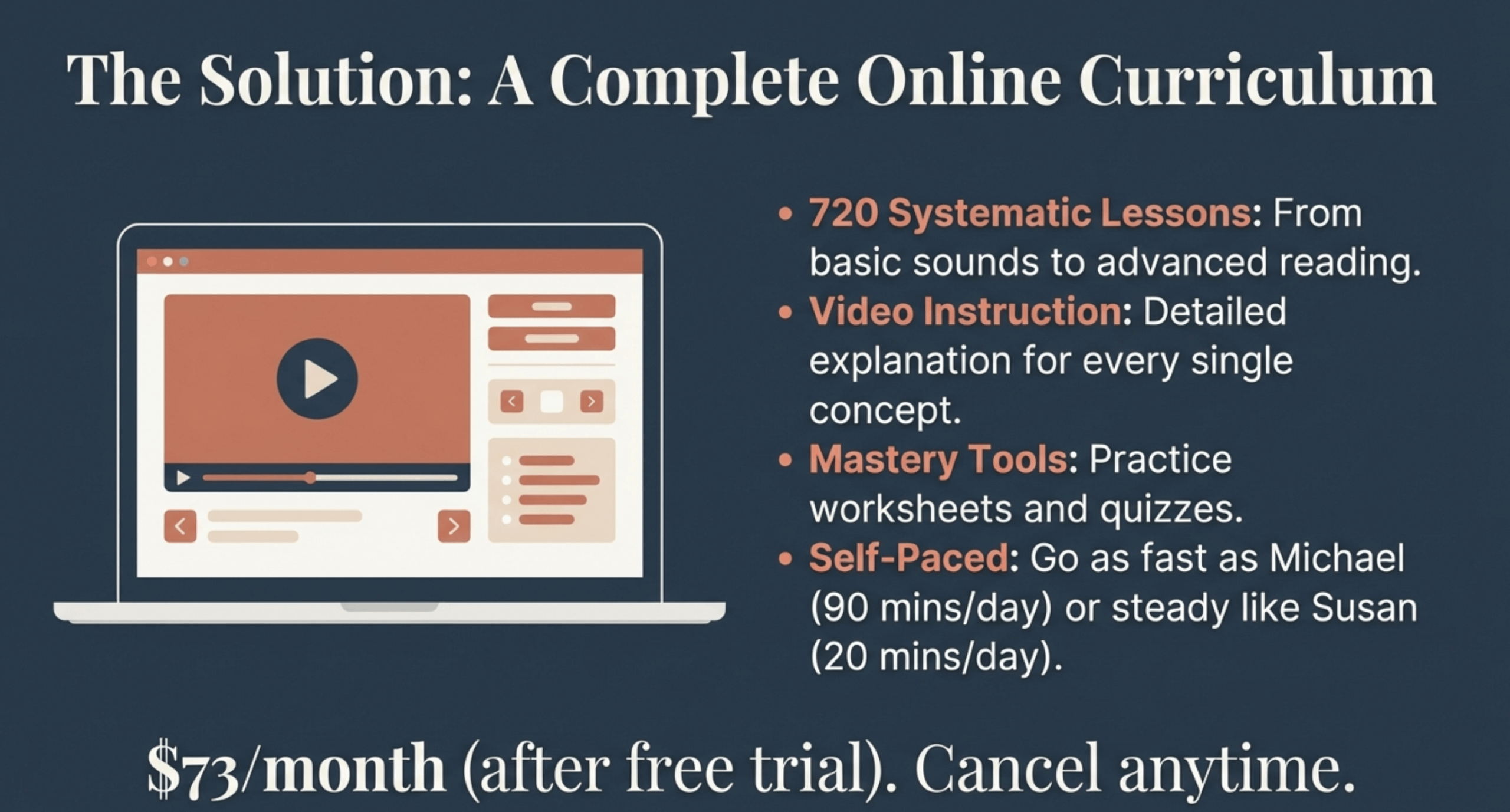
Our adult phonics program provides everything these students used:
- 720 systematic lessons from basic sounds to advanced reading
- Video instruction for every concept
- Practice worksheets and mastery quizzes
- Progress tracking to monitor improvement
- Self-paced format—learn as quickly or slowly as you need
The students featured here aren’t special or uniquely talented. They’re ordinary adults who committed to consistent practice with proper instruction. If they can do it, so can you.
More Success Stories
The testimonials featured here represent just a few of the hundreds of adults who’ve transformed their literacy through our program. Visit our complete reviews and testimonials page to read more stories from students of all ages and backgrounds.
Try 10 lessons free • No credit card required • $73/month after trial
Related Resources
How Long Does It Take Adults to Learn Phonics? – Realistic timelines and what to expect
Adult Phonics Program Overview – Learn more about our complete curriculum
Orton-Gillingham Principles – The research-backed method these students used
Why Nonsense Words Work – Understanding this critical phonics tool