How Spelling and Phonics Reinforce Each Other
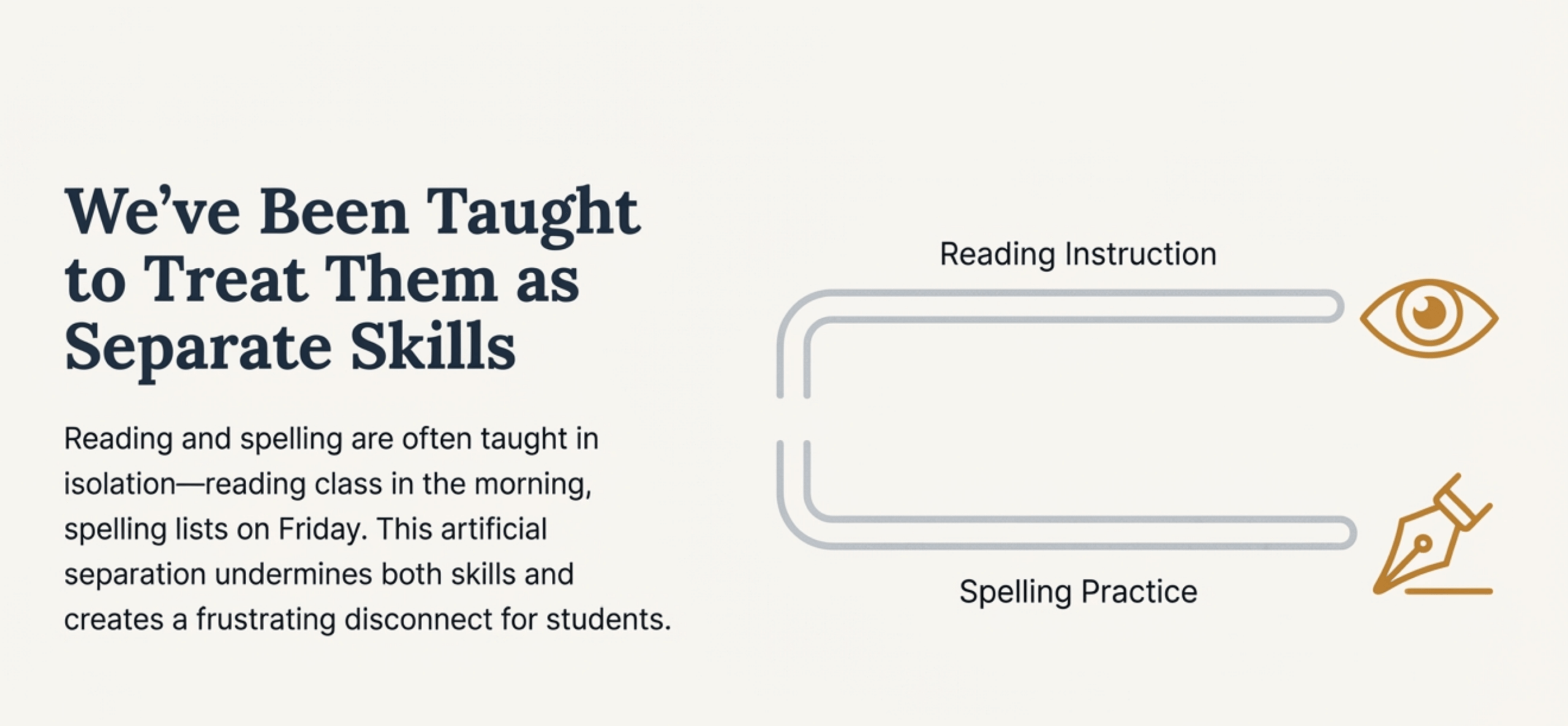
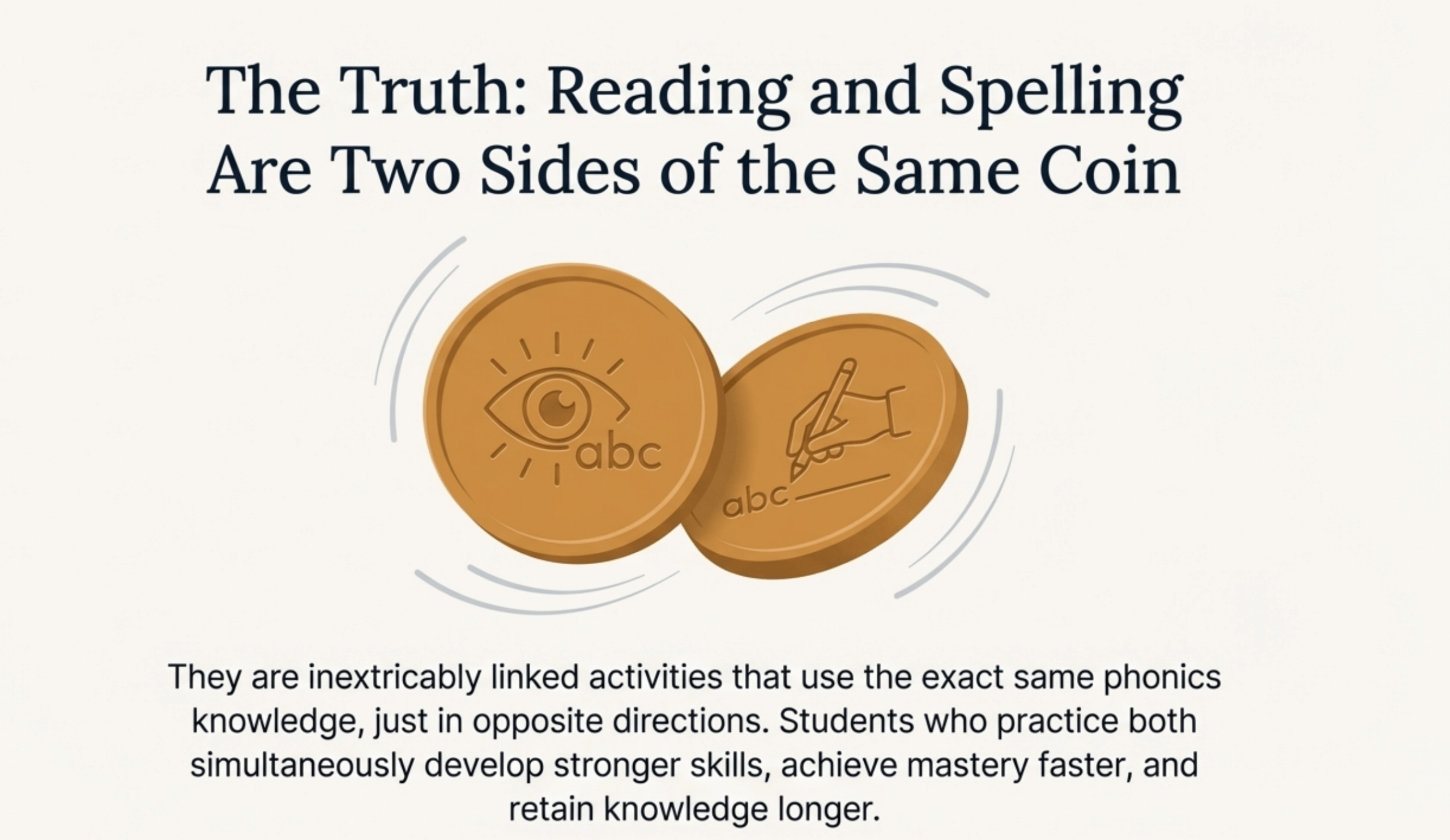
Reading and spelling are often taught as separate subjects—reading class in the morning, spelling lists on Friday. This artificial separation undermines both skills. In reality, reading (decoding) and spelling (encoding) are inextricably linked activities that use the same phonics knowledge in opposite directions.
Students who practice both reading and spelling simultaneously develop stronger phonics knowledge, achieve mastery faster, and retain skills longer than students who practice only one skill.
Understanding why these skills reinforce each other—and how to teach them together—transforms struggling readers into confident, capable students.
Understanding Decoding and Encoding
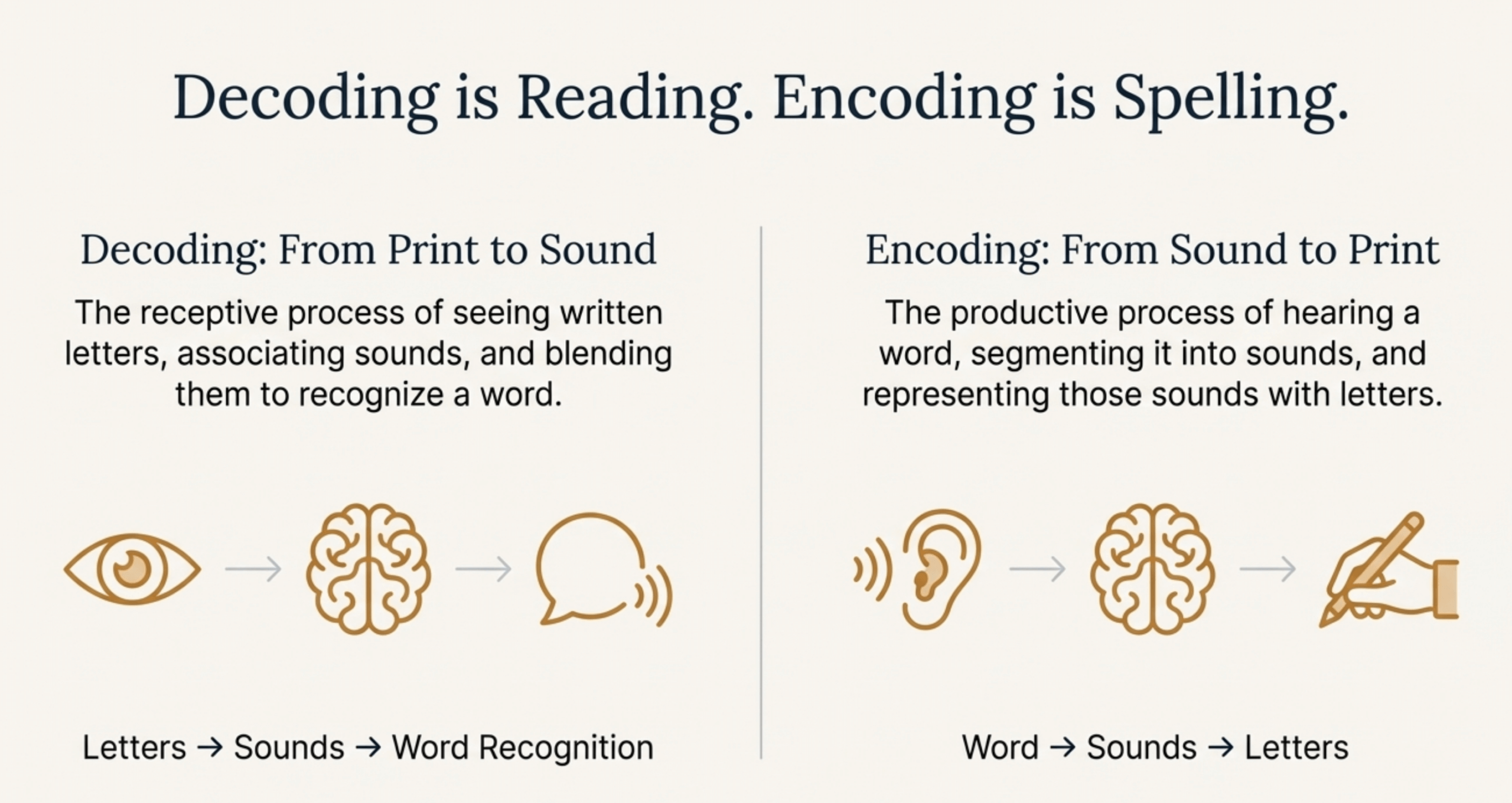
Decoding: From Print to Sound
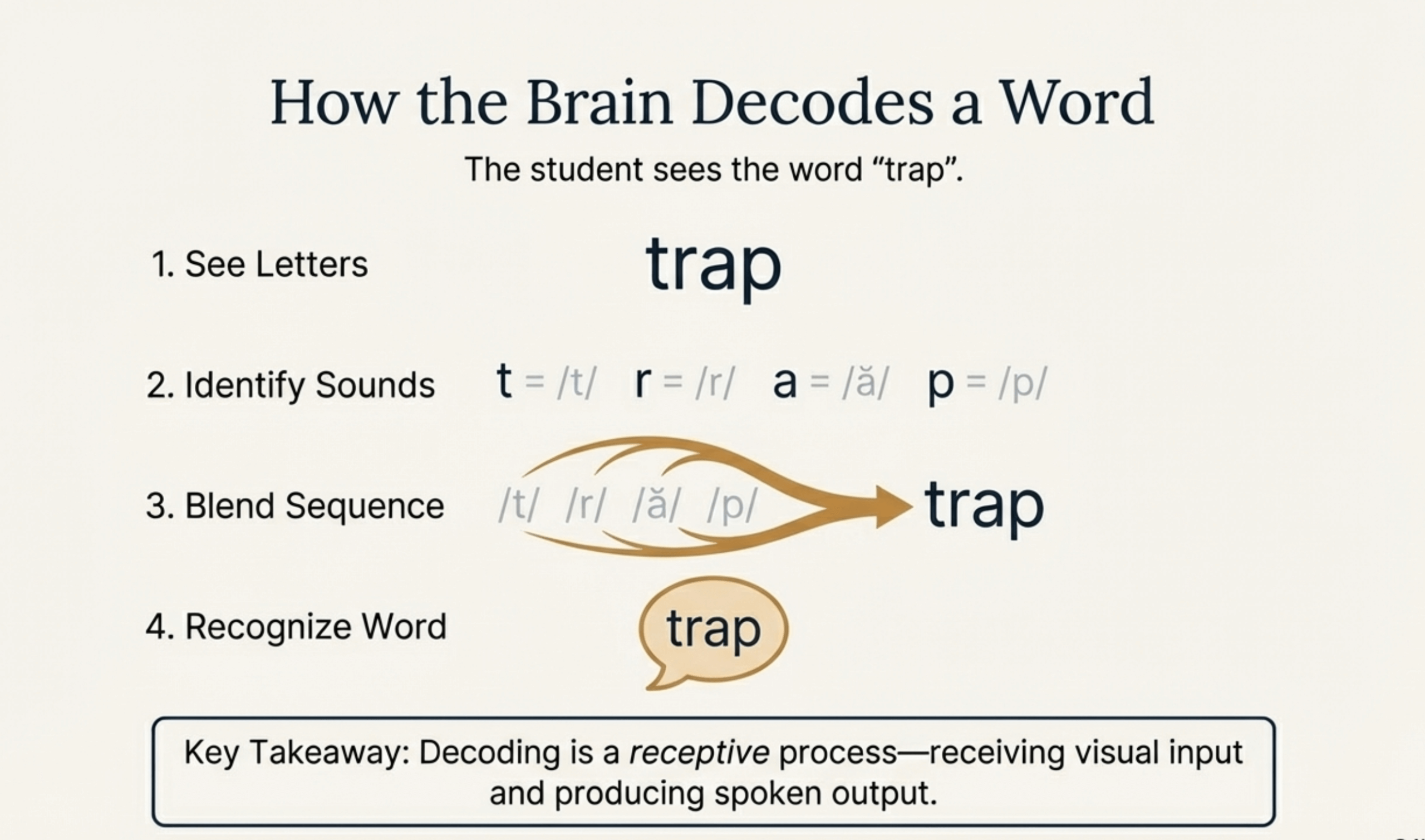
When your child reads (decodes), they:
- See written letters on the page
- Associate sounds with those letters or letter teams
- Blend the sounds together in sequence
- Recognize the word and access its meaning
Example: Student sees “trap”
- Identifies: t = /t/, r = /r/, a = /ă/, p = /p/
- Blends: /t/ /r/ /ă/ /p/
- Recognizes: “trap”
Decoding is a receptive process—students receive visual input (letters) and produce spoken output (word pronunciation).
Encoding: From Sound to Print
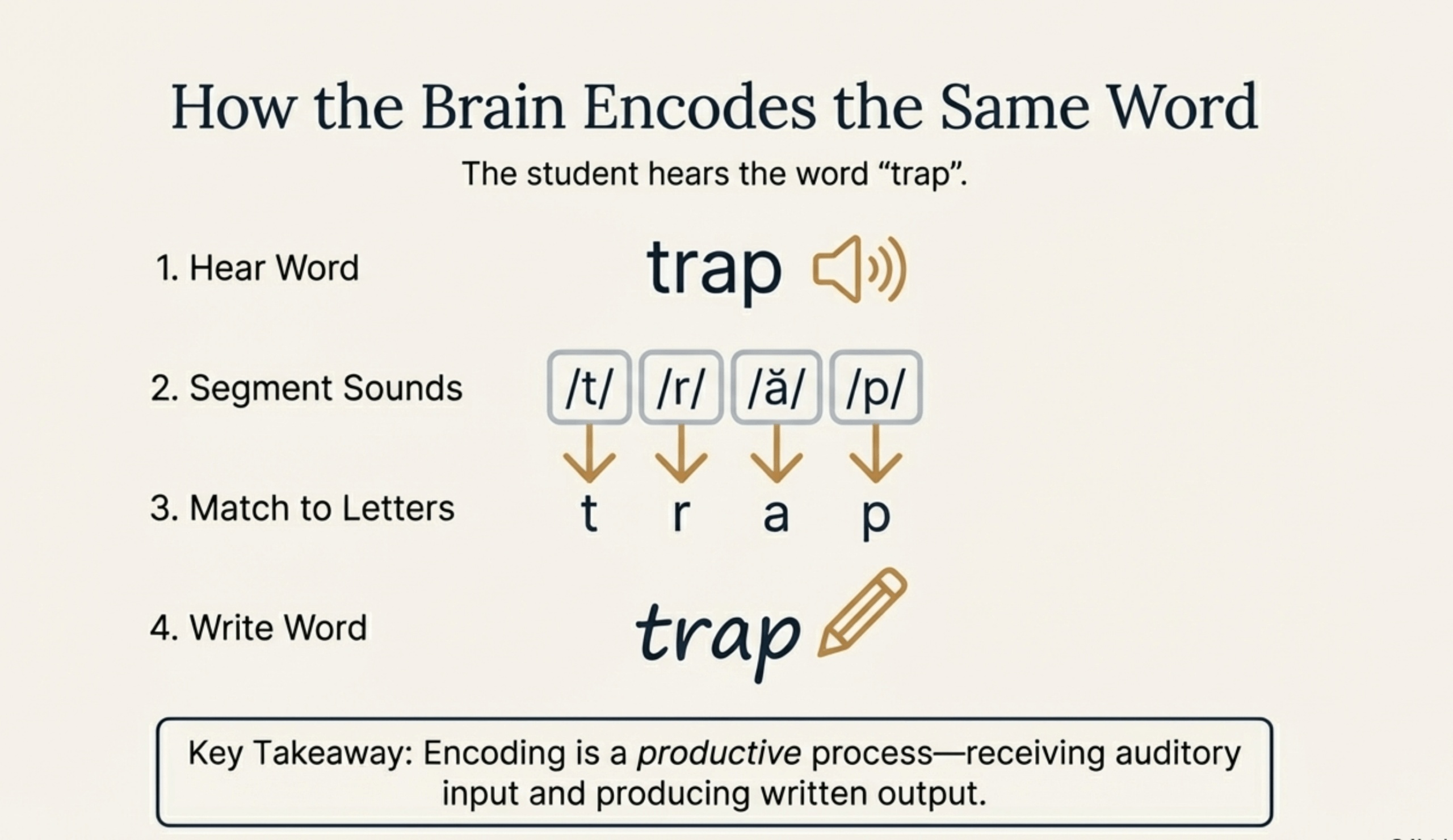
When your child spells (encodes), they:
- Hear a word spoken (or think of a word to write)
- Segment the word into individual sounds (phonemes)
- Determine which letters represent each sound
- Write those letters in correct sequence
Example: Student hears “trap”
- Segments: /t/ /r/ /ă/ /p/ (4 sounds)
- Matches sounds to letters: t-r-a-p
- Writes: “trap”
Encoding is a productive process—students receive auditory input (word pronunciation) and produce written output (letters).
The Same Phonics Knowledge, Applied Differently
Both decoding and encoding require understanding the relationship between letters and sounds. The difference is the direction:
- Decoding: Letters → Sounds → Word recognition
- Encoding: Word → Sounds → Letters
A student who truly understands that “ai” represents /ā/ can both read the word “rain” and spell it when dictated. The same phonics knowledge applies in both directions.
Why Teaching Both Skills Together Accelerates Learning
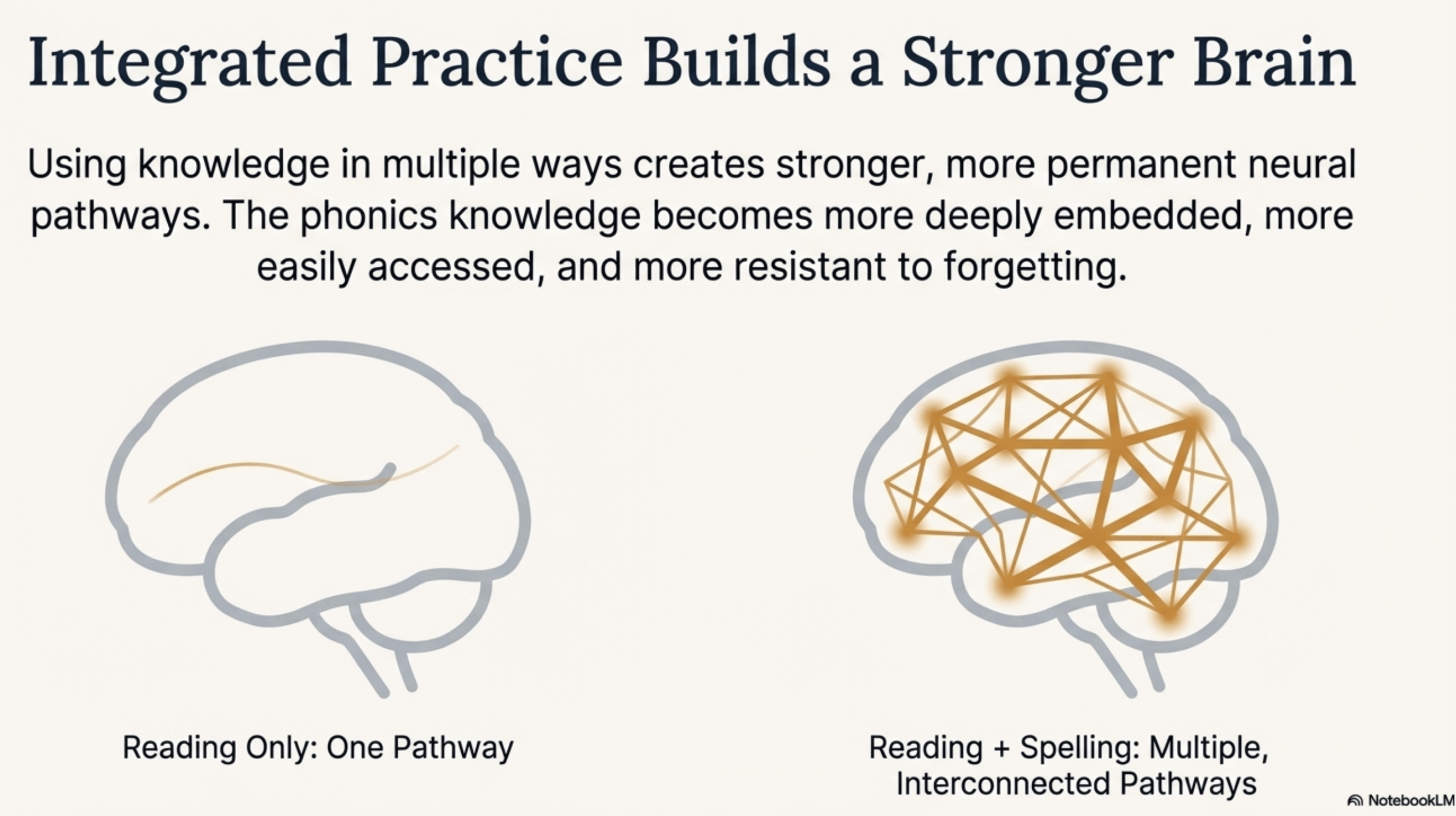
Reinforcement Creates Stronger Neural Pathways
Brain research shows that using knowledge in multiple ways creates stronger, more permanent learning. When students practice a phonics pattern only through reading, they build one neural pathway. When they practice the same pattern through both reading and spelling, they build multiple interconnected pathways.
Result: The phonics knowledge becomes more deeply embedded, more easily accessed, and more resistant to forgetting.
Spelling Reveals Hidden Gaps
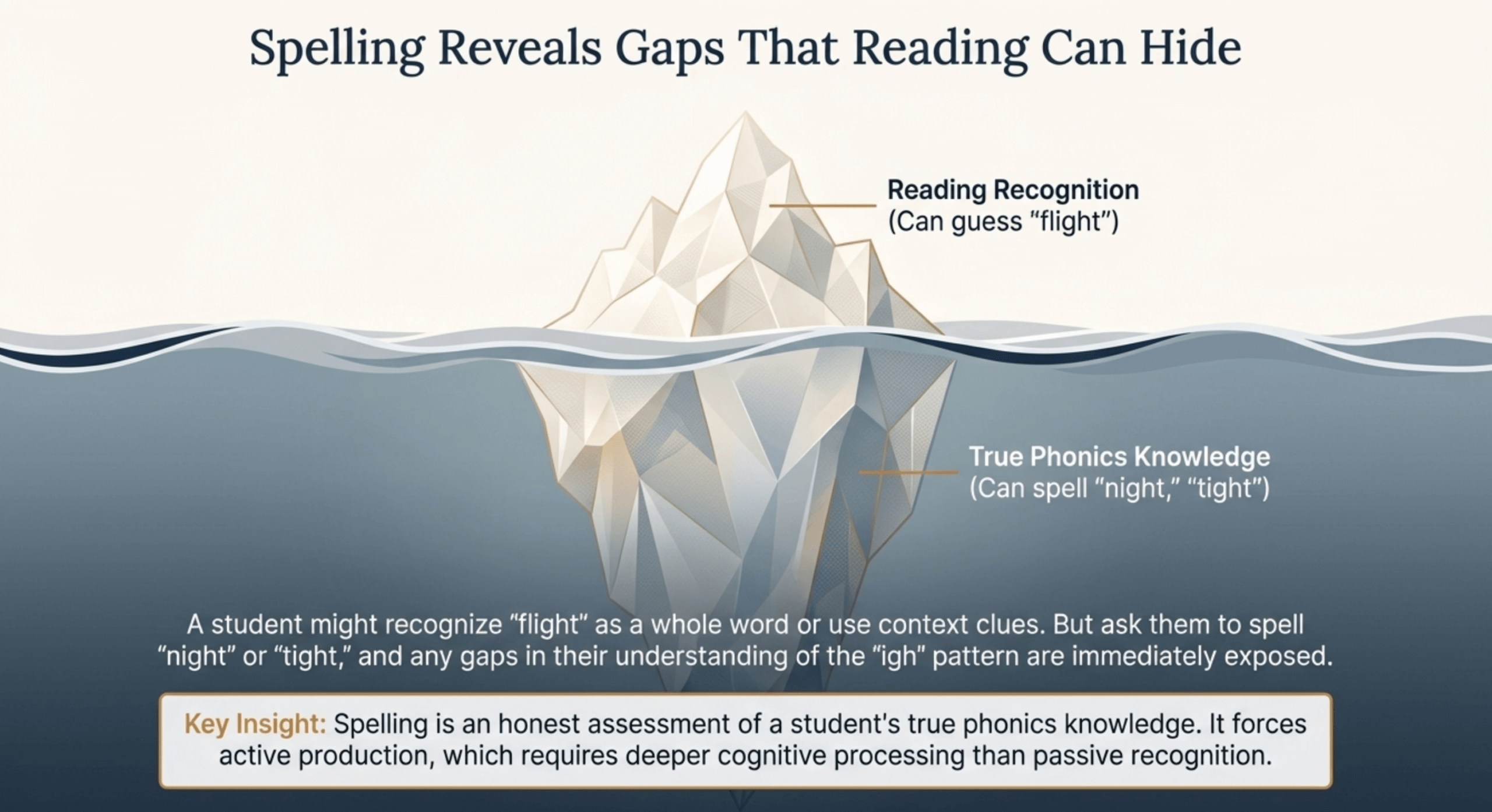
Students can sometimes read words correctly without fully understanding the underlying phonics pattern. They might recognize “flight” as a whole word or use context clues to identify it.
But spelling exposes incomplete knowledge. When asked to spell “night” or “tight,” a student who doesn’t truly understand the “igh” pattern will struggle. Spelling reveals gaps that reading alone might hide.
This is valuable: Identifying gaps early allows you to address them before they compound into larger problems.
Active Production Deepens Understanding
Reading is somewhat passive—students recognize patterns they’ve seen before. Spelling is active—students must consciously generate correct letter sequences from phonics knowledge and memory.
This active production requires deeper cognitive processing. Students can’t passively recognize; they must actively apply rules and patterns. This deeper engagement accelerates learning and builds true mastery.
Each Skill Reinforces the Other
When your child spells “train” correctly, they’re reinforcing their knowledge that “ai” represents /ā/. The next time they read a word with “ai,” that pattern is more automatic and confident.
When your child reads “chain” accurately, they’re strengthening the same “ai” knowledge they’ll use when spelling “pain” later.
Every reading experience supports spelling. Every spelling experience supports reading. The skills build on each other in a positive feedback loop.
The Hierarchy: Reading Develops Before Spelling
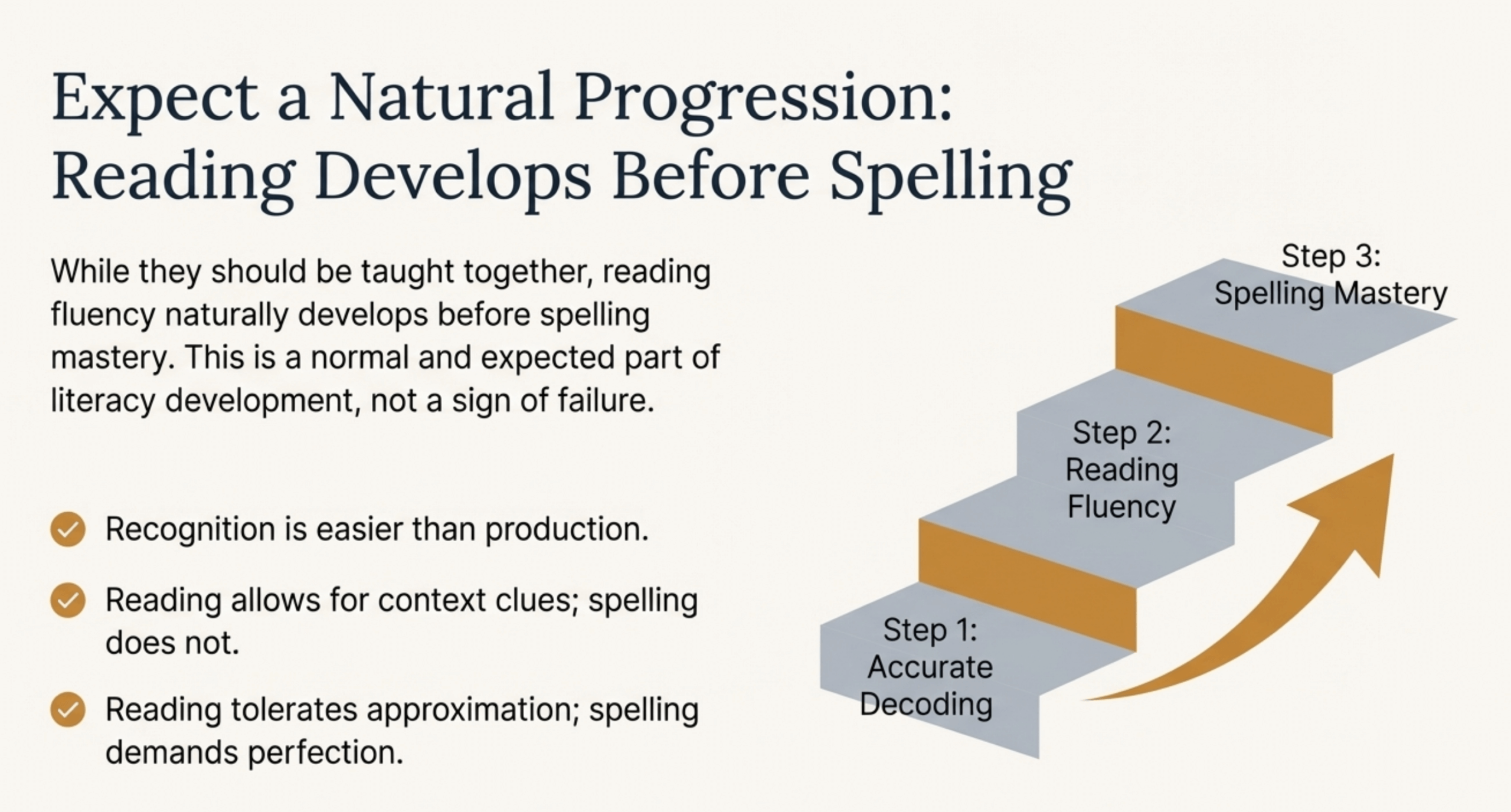
Decoding Fluency Comes First
While reading and spelling should be taught together, reading fluency naturally develops before spelling mastery. This isn’t a problem—it’s a normal part of literacy development.
Why reading develops first:
- Recognition is easier than production – Identifying a pattern is simpler than generating it from scratch
- Reading allows context clues – Surrounding words help students identify unfamiliar words; spelling has no such support
- Reading tolerates approximation – Students can understand “restaurant” even if they decode it imperfectly; spelling requires exact accuracy
The Timeline: From Decoding to Fluency to Spelling Mastery
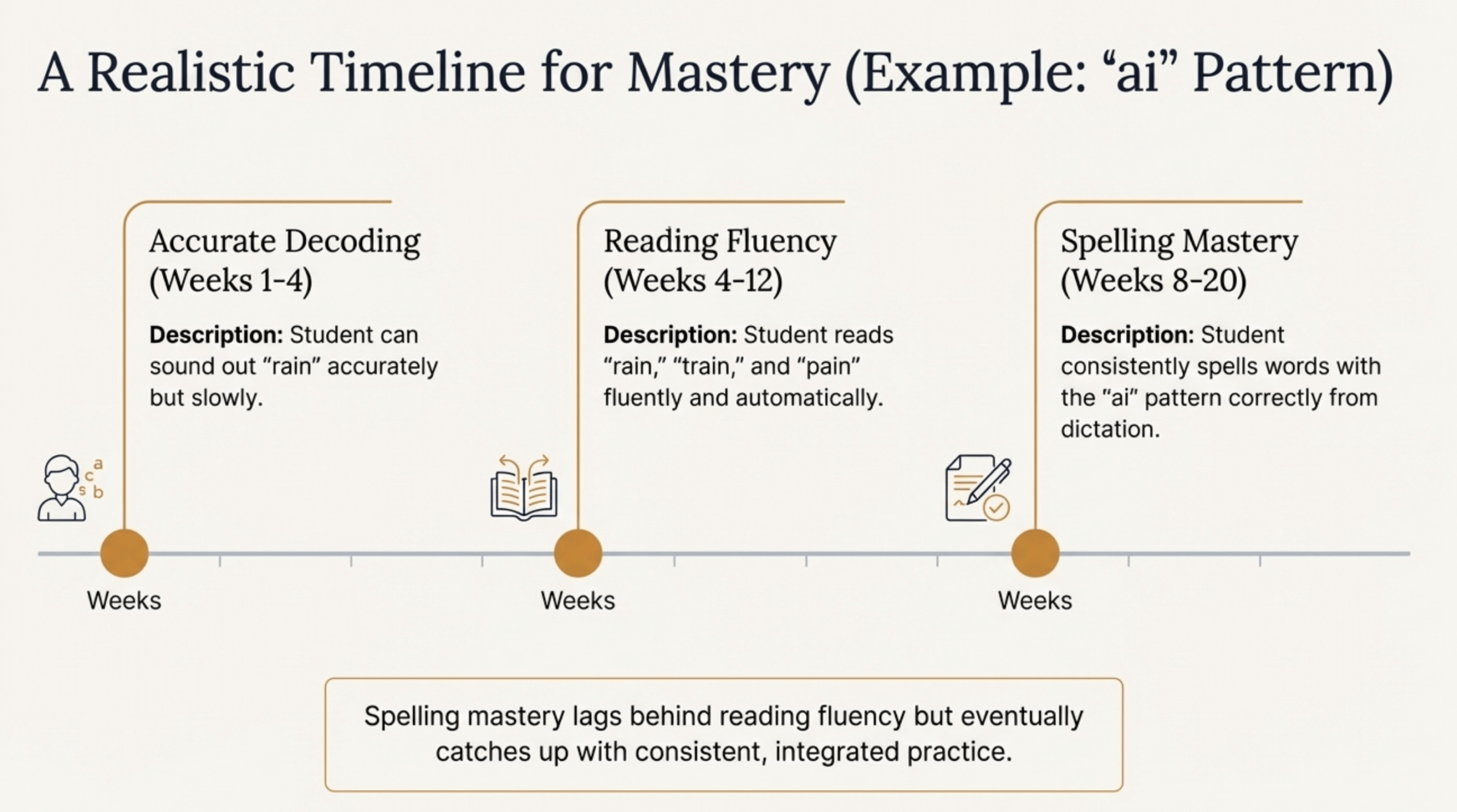
Stage 1: Accurate Decoding (Weeks 1-4 of learning a pattern)
Student can sound out words with the new pattern accurately but slowly.
Stage 2: Reading Fluency (Weeks 4-12)
Through repeated exposure, student recognizes words with this pattern instantly without conscious decoding. Reading becomes smooth and automatic.
Stage 3: Spelling Mastery (Weeks 8-20)
Eventually, student can spell words with this pattern accurately and confidently. Spelling mastery lags behind reading fluency but eventually catches up.
Example with “ai” pattern:
- Week 2: Student can sound out “rain” accurately
- Week 6: Student reads “rain,” “train,” “pain” fluently
- Week 12: Student consistently spells “ai” words correctly
Why Spelling Takes Longer
Spelling demands perfection—every letter must be exactly right. There’s no partial credit for spelling “because” as “becuz,” even though this shows strong phonetic thinking.
Reading tolerates imperfection—students can comprehend text even if they occasionally misread a word or decode it imperfectly.
This higher standard means spelling naturally requires more time and practice to master. Parents should expect this lag and not be discouraged by it.
How to Teach Reading and Spelling Together
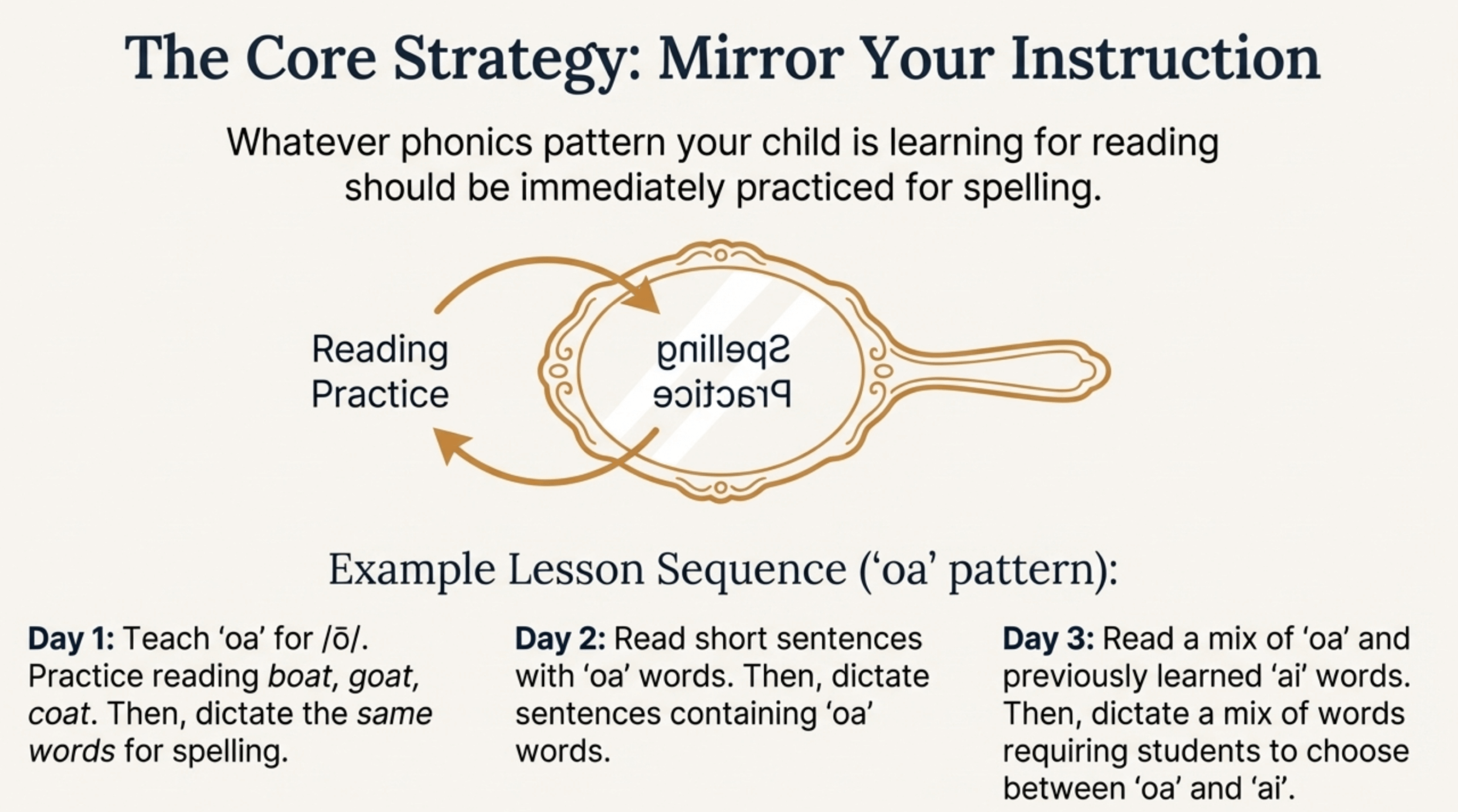
Mirror Your Instruction
Whatever phonics pattern your child is learning for reading should be immediately practiced for spelling.
Example lesson sequence:
Day 1: Introduce “oa” pattern for long /ō/
- Teach: “When o and a are together, they usually say /ō/”
- Reading practice: boat, goat, coat, road, toad
- Spelling practice: Dictate the same words for student to spell
Day 2: Practice “oa” in context
- Reading: Short sentences with “oa” words
- Spelling: Dictate sentences containing “oa” words
Day 3: Mix with previous patterns
- Reading: Mix “oa” words with “ai” words (both long vowel patterns)
- Spelling: Dictate words requiring students to choose between “oa” and “ai”
The Spelling Dictation Process
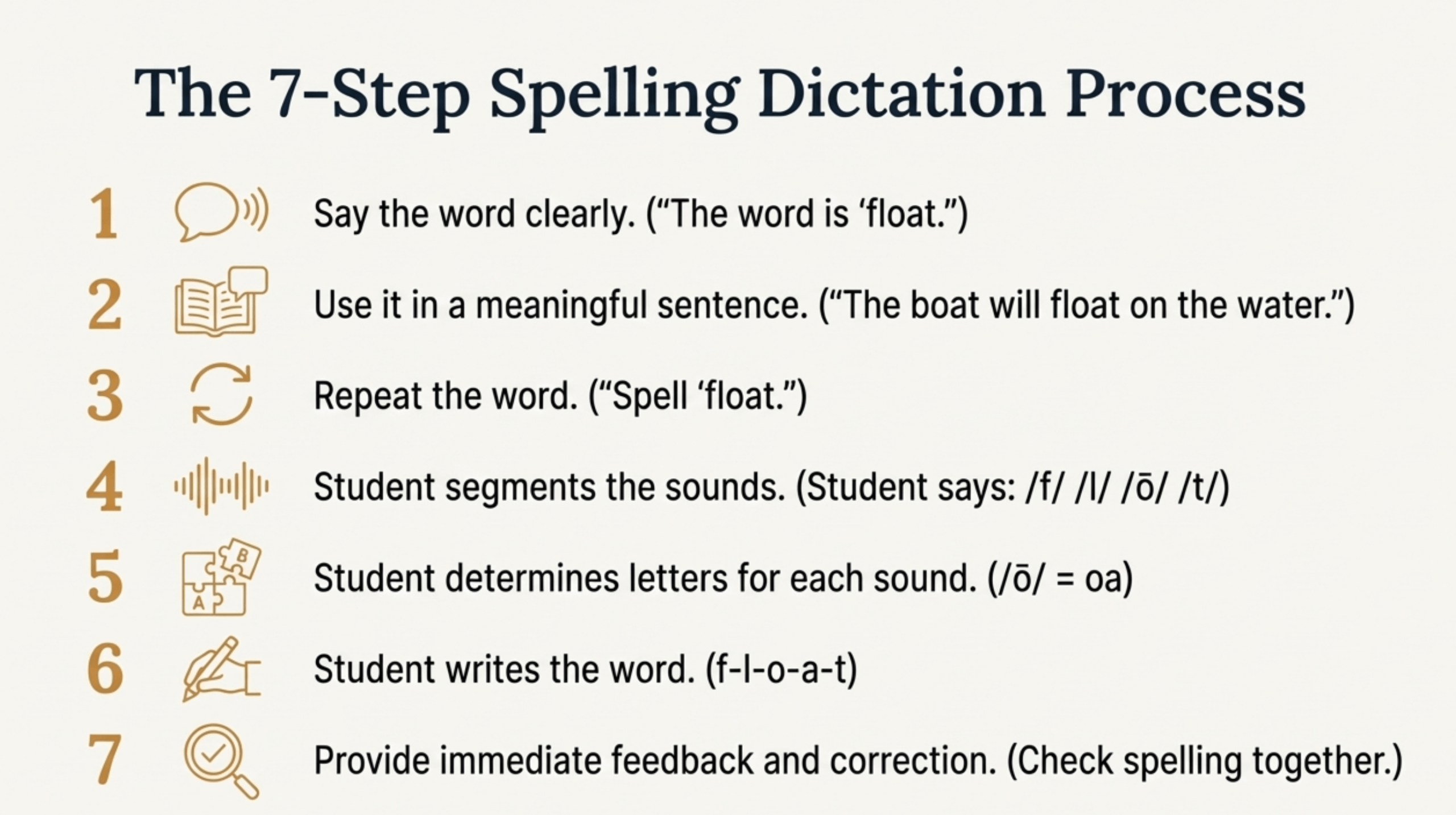
Effective spelling practice follows a specific sequence that builds phonemic awareness alongside encoding skills:
Step 1: Say the word clearly
“The word is ‘float.'”
Step 2: Use it in a meaningful sentence
“The boat will float on the water.”
Step 3: Repeat the word
“Spell ‘float.'”
Step 4: Student segments the sounds
Student identifies: /f/ /l/ /ō/ /t/ (4 sounds, even though 5 letters)
Step 5: Student determines letters for each sound
/f/ = f, /l/ = l, /ō/ = oa, /t/ = t
Step 6: Student writes the word
Student writes: f-l-o-a-t
Step 7: Immediate feedback and correction
Check spelling together. If incorrect, guide student to identify which sound was represented incorrectly.
Marking Words After Spelling
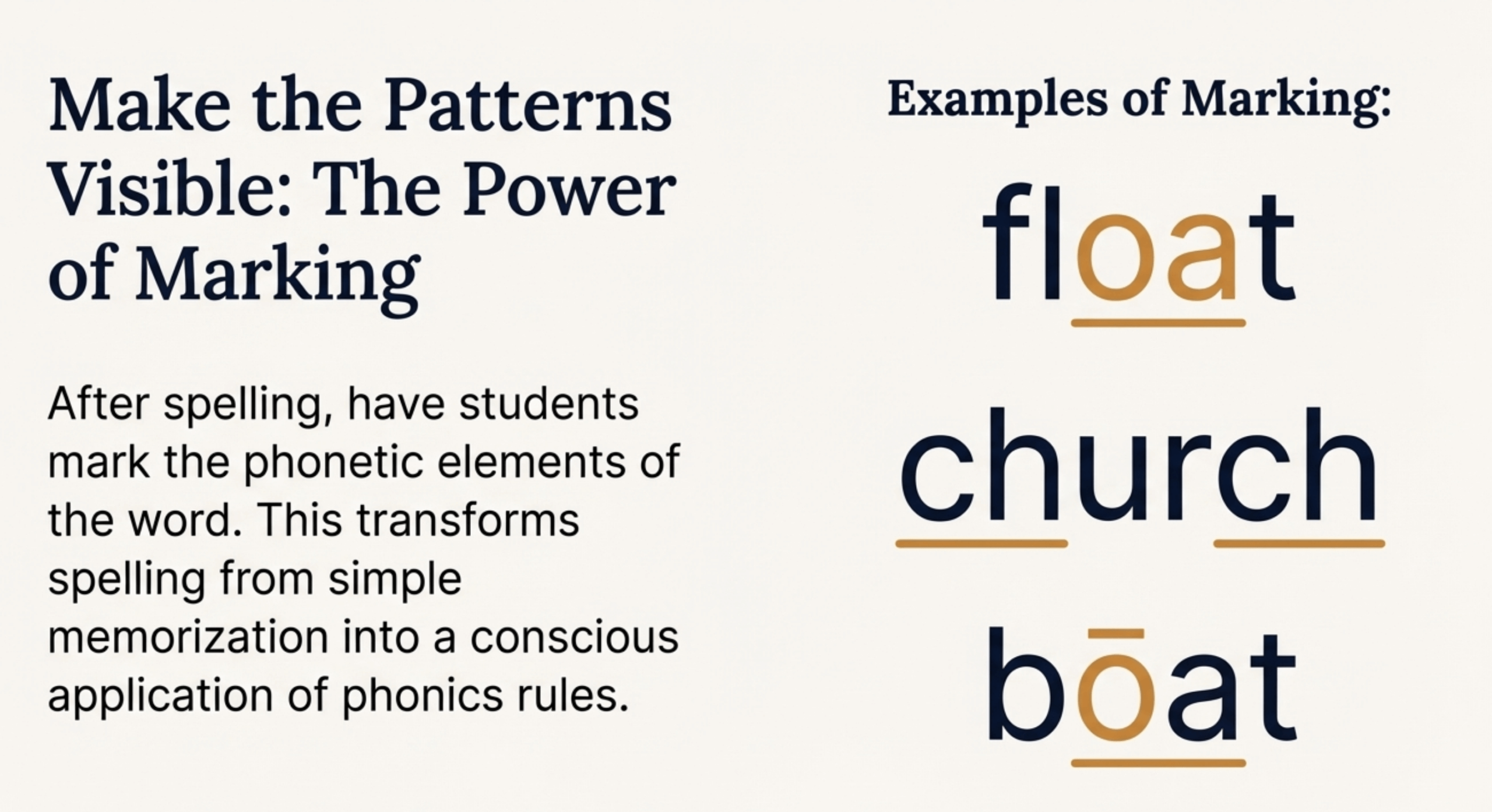
After students spell words, have them mark the phonetic elements:
- Underline vowel teams (“oa” in “float”)
- Underline consonant teams (“ch” in “teach”)
- Mark vowels as short or long
- Double-underline letters using their second sound
This marking process forces students to analyze the phonetic structure of every word they spell. It transforms spelling from memorization to conscious application of phonics rules.
The Benefits of Integrated Reading and Spelling Instruction
Students Recognize English as Logical and Consistent
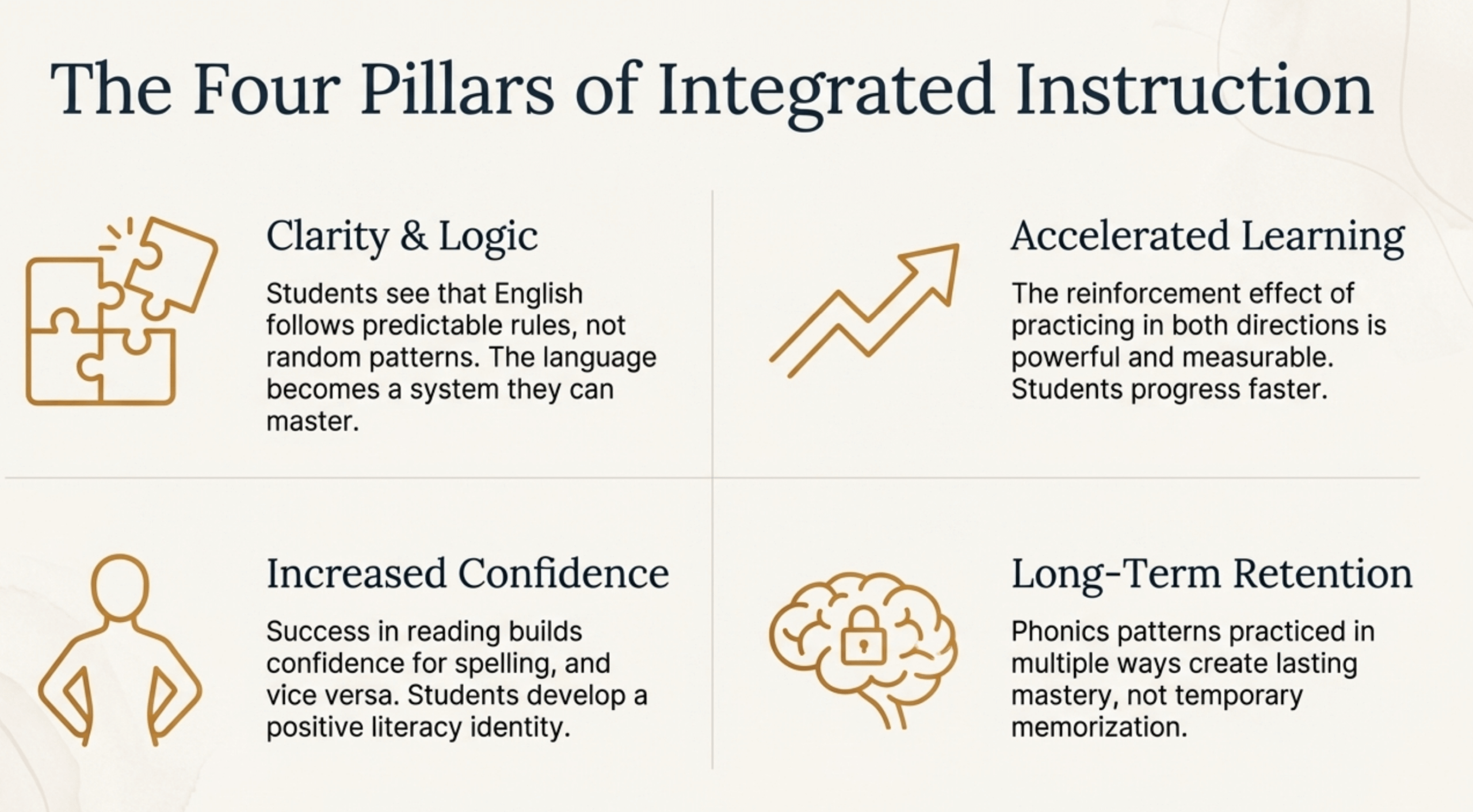
When students see the same “ai” pattern working in both reading and spelling, they understand that English follows predictable rules. The language stops feeling arbitrary and random—it becomes a system they can master.
Confidence Builds in Both Directions
Success in reading builds confidence for spelling. Success in spelling builds confidence for reading. Students develop a positive literacy identity: “I’m someone who can read and spell.”
Learning Accelerates
Research consistently shows that students receiving integrated reading and spelling instruction progress faster than students receiving reading instruction alone. The reinforcement effect is powerful and measurable.
Retention Improves
Phonics patterns practiced in both reading and spelling are remembered longer. The distributed practice—using the same knowledge in multiple ways—creates lasting mastery rather than temporary memorization.
How Our Program Integrates Reading and Spelling
Every Lesson Includes Both Skills
Half of every lesson consists of spelling dictation. Students don’t just read words—they spell them. They don’t just see patterns—they produce them. This balanced approach ensures both skills develop together.
Coordinated Progression
The reading materials and spelling dictation in each lesson use identical phonics patterns. When students learn “ee” for reading, they immediately practice spelling “ee” words. Perfect synchronization ensures maximum reinforcement.
The Marking System Makes Patterns Visible
Our comprehensive marking system requires students to analyze every word they spell:
- Which sounds do I hear?
- Which letters represent those sounds?
- Are any letter teams working together?
- Is this a short or long vowel?
This metacognitive awareness—thinking about the thinking—accelerates understanding far beyond simple memorization.
Mastery Required in Both Directions
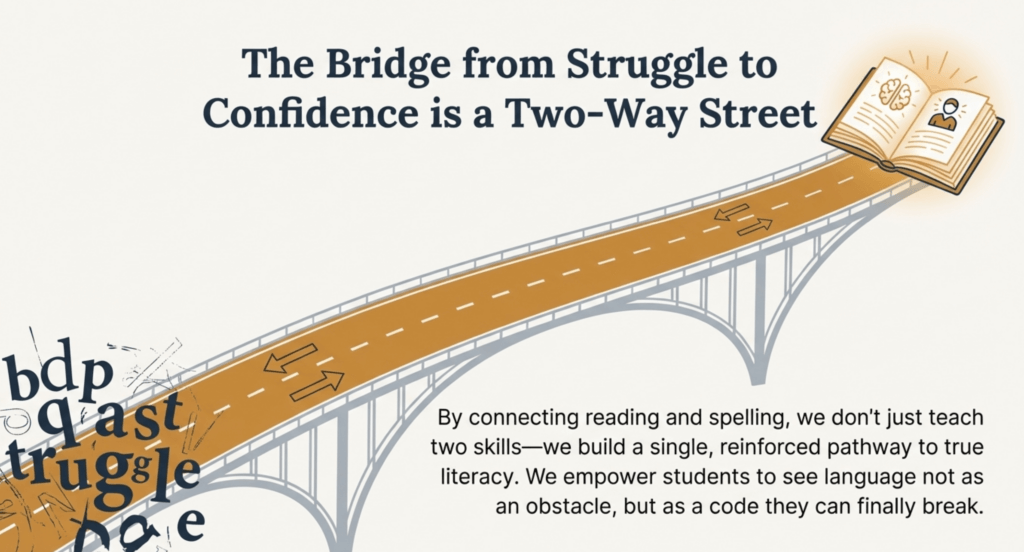
Our built-in quizzes assess both reading and spelling. Students cannot advance until they demonstrate mastery of both skills. This prevents the common problem of students who can read but not spell (or vice versa).
Continue Reading: The 9 Essential Strategies
← Previous: Why Teaching Spelling at Each Step Matters
Next → Teach to Mastery: Preventing Learning Gaps
Questions about integrated reading and spelling instruction? Contact us.