GED Reading Skills: The Hidden Reason Students Fail
You’re Not Alone, and It’s Not Your Fault
If you’ve failed the GED test once—or multiple times—you probably blamed yourself. Maybe you thought you weren’t smart enough, didn’t study hard enough, or just “aren’t good at tests.” You’ve watched others pass while you struggle, and the repeated failures have shaken your confidence.
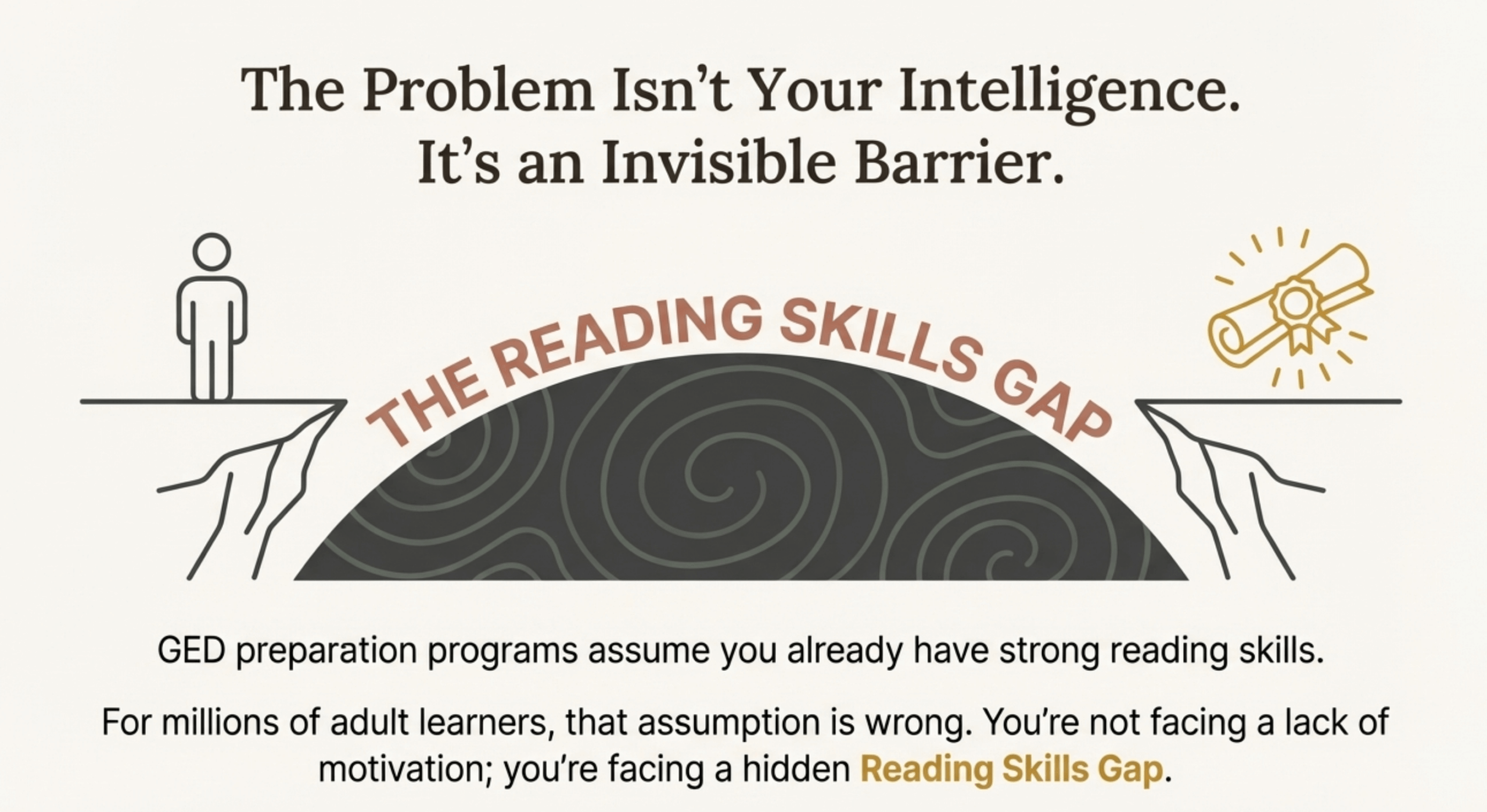
Here’s what GED preparation programs won’t tell you: the problem isn’t your intelligence or motivation. The problem is that you don’t have the reading skills the GED requires.
Most GED students who fail repeatedly are struggling with an invisible barrier that no one acknowledges: inadequate foundational reading skills. GED programs teach you history, math, and science content—but they don’t teach you how to read at the level those subjects demand. They assume you already have strong reading skills. For many adult learners, that assumption is wrong.
The good news: reading skills can be built at any age. Once you understand why you’re struggling, you can address the real problem and succeed.
The solution isn’t more GED practice tests—it’s building the foundational phonics skills most GED students never received. Our adult phonics program systematically teaches the decoding and spelling skills that make the GED reading section manageable, not overwhelming.
The Reading Skills Gap No One Discusses

The GED test requires reading skills equivalent to 10th through 12th grade level. Not just for the reading test—for every section. You must read and comprehend complex passages in science, analyze historical documents in social studies, interpret word problems in mathematics, and construct clear written arguments.
What 10th-12th Grade Reading Actually Means
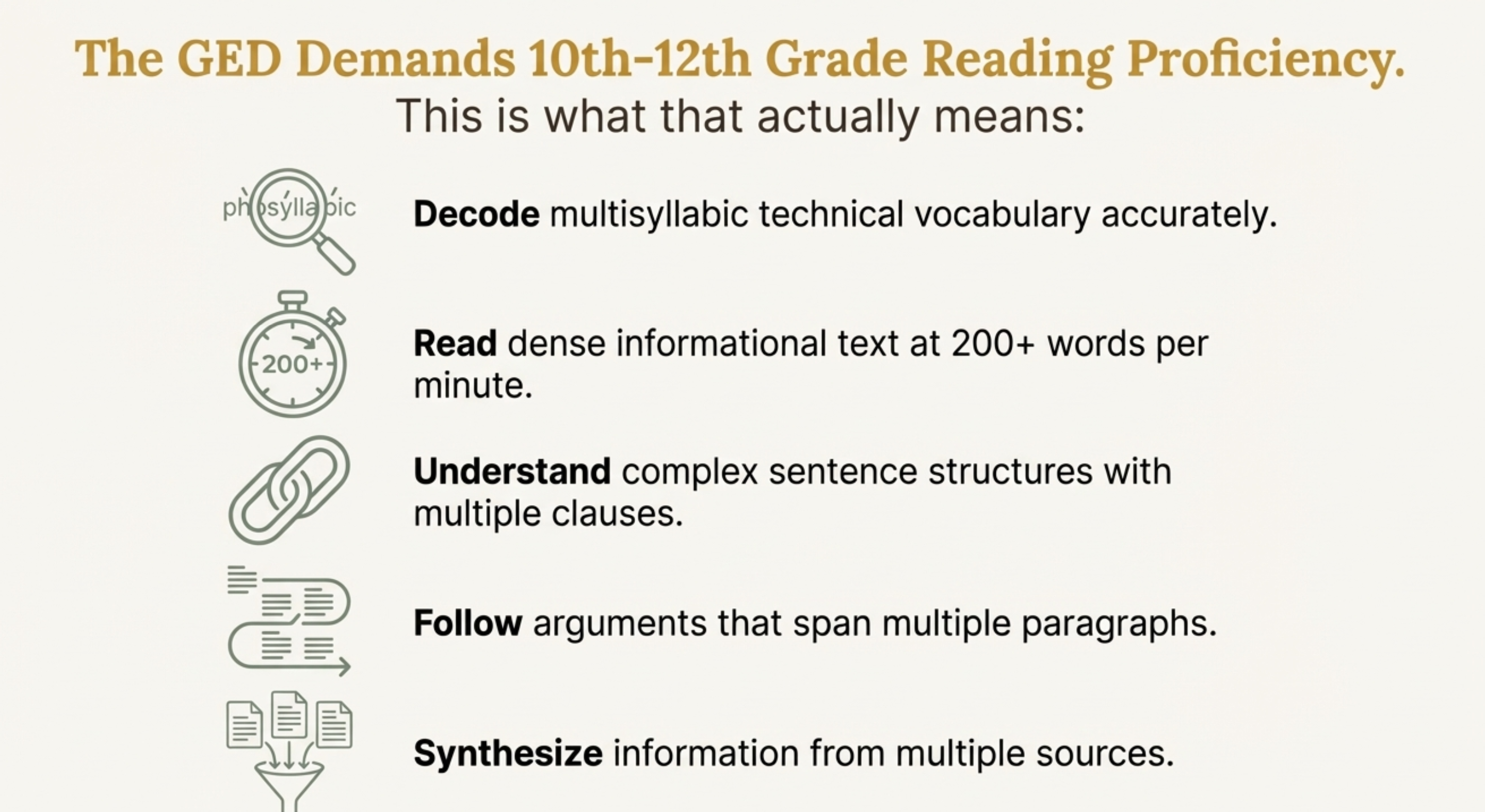
Students reading at this level can:
- Decode multisyllabic technical vocabulary accurately
- Read dense informational text at 200+ words per minute
- Understand complex sentence structures with multiple clauses
- Follow arguments that span multiple paragraphs
- Extract meaning from context when encountering unfamiliar words
- Synthesize information from multiple sources
If you struggle with any of these skills, you’ll find the GED extremely difficult—even if you understand the subject matter being tested.
The Reality for Many GED Students
Many adults pursuing their GED left high school reading at elementary or middle school level. Life circumstances—not lack of intelligence—interrupted their education before they developed strong reading skills. Years or decades later, they’re attempting to pass a test that requires reading proficiency they never developed.
GED preparation courses don’t assess your reading level. They don’t build reading skills. They assume you can already read the materials they provide. When students struggle, programs blame insufficient study time or lack of focus—never inadequate reading skills.
Why GED Programs Fail to Address Reading Skills
They Focus on Content, Not Skills
GED programs teach what’s on the test: historical events, scientific concepts, mathematical procedures, essay structures. They provide practice tests and study guides. What they don’t provide is reading instruction.
If you’re reading at a 6th grade level, giving you 10th grade reading material doesn’t improve your reading—it just frustrates you. It’s like trying to run a marathon when you can barely jog a mile. The problem isn’t your effort; it’s that you haven’t built the necessary foundation.
They Don’t Test Reading Level
Most GED programs never assess your actual reading skills. They place you in classes based on prior education or a brief content assessment. They might discover you don’t know the Pythagorean theorem, but they won’t discover you struggle to decode the word “Pythagorean.”
They Assume Basic Literacy
GED programs assume students can read—they just need content knowledge. This assumption leaves behind the very students who need the most help. When these students fail, programs rarely identify reading skills as the issue. Instead, they recommend more studying, more practice tests, more content review—none of which addresses the real problem.
Instructors Aren’t Trained in Reading Instruction
GED instructors are typically subject matter experts in history, science, or mathematics. They’re not trained to teach foundational reading skills. Even well-meaning instructors can’t help students build phonics knowledge, decoding skills, or reading fluency—they simply don’t have the training or curriculum to do so.
The Hidden Reason You Struggle With Reading
Many GED students blame themselves for reading difficulties. But the truth is simpler: you weren’t taught the code. See why millions of adults struggle with reading—and how systematic phonics can finally unlock the skill you need to pass the GED.
It’s Not Your Fault: The Blame Game
When GED students fail repeatedly, they internalize the failure. “I’m not smart enough.” “I can’t focus.” “I’m just not a good student.” These beliefs are heartbreaking—and wrong.
The Truth About Why You’re Struggling

You’re struggling because you’re trying to pass a test that requires 10th-12th grade reading skills when you’re reading at a lower level. That’s not a character flaw or intelligence deficit—it’s a skills gap.
Consider this parallel: if someone asked you to play a Chopin piano piece but you’d never learned to read music or practice scales, would you blame yourself when you couldn’t do it? Of course not. You’d recognize you need foundational music skills first.
Reading works the same way. You need systematic instruction in phonics, decoding, fluency, and comprehension strategies. Once you build these skills, the GED content becomes accessible.
Why Adults Struggle to Identify This Problem
Most adults with weak reading skills have developed sophisticated coping mechanisms. You might:
- Avoid reading whenever possible
- Ask others to read important documents
- Rely heavily on verbal instructions
- Memorize rather than read
- Pretend to understand when you don’t
These strategies got you through daily life, so you don’t think of yourself as someone with “reading problems.” But GED tests don’t allow workarounds. You must read complex texts independently under time pressure. That’s when the skills gap becomes painfully obvious.
What the GED Actually Requires: Reading Across All Subjects
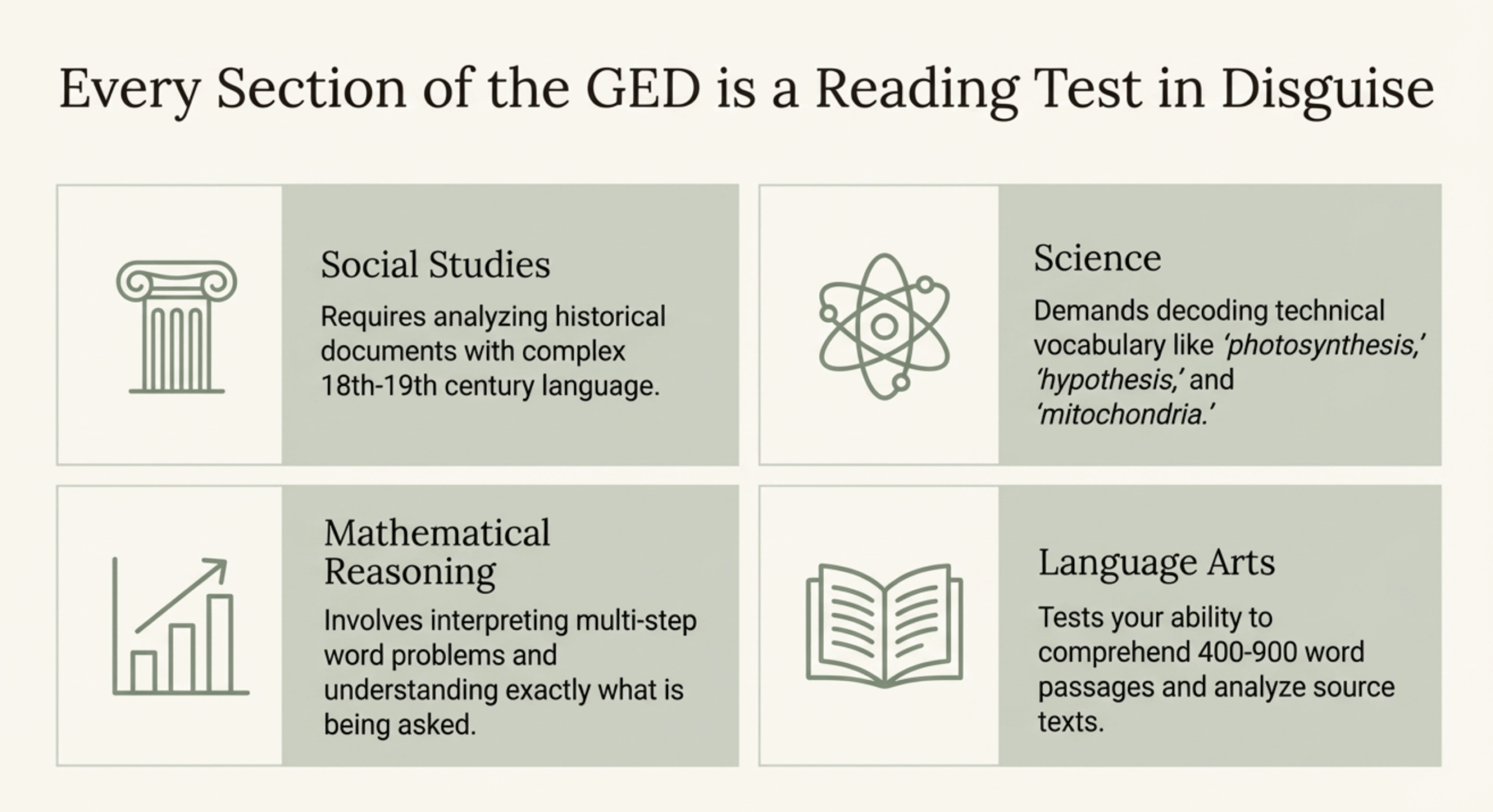
Every section of the GED is fundamentally a reading test. Understanding these demands helps clarify why strong reading skills are essential.
GED Reasoning Through Language Arts
This section explicitly tests reading comprehension, requiring you to:
- Read passages of 400-900 words
- Identify main ideas and supporting details
- Draw inferences from text
- Analyze author’s purpose and tone
- Compare information across multiple texts
You must also write a 300-500 word essay, which requires not just writing skills but the ability to read and analyze source texts provided.
GED Social Studies
Don’t be fooled by the subject name—this section tests your ability to read and interpret:
- Historical documents with complex 18th-19th century language
- Charts, graphs, and data tables
- Political cartoons requiring cultural knowledge
- Dense informational passages about government, economics, and geography
Without strong reading skills, you can’t access the information needed to answer questions—even if you understand the historical concepts.
GED Science
Science passages contain technical vocabulary and complex explanations:
- Experimental procedures with step-by-step instructions
- Scientific reports with specialized terminology
- Data interpretation from charts and graphs
- Cause-and-effect relationships spanning multiple paragraphs
If you can’t decode words like “photosynthesis,” “hypothesis,” or “mitochondria” accurately, you can’t understand the passages—no matter how much science content you’ve studied.
GED Mathematical Reasoning
Even math requires reading skills:
- Word problems with multiple sentences of text
- Instructions for multi-step procedures
- Interpreting graphs and data tables
- Understanding what question is being asked
Many students who “know the math” fail because they can’t accurately read what the problem is asking them to do.
The Solution: Build Reading Skills First
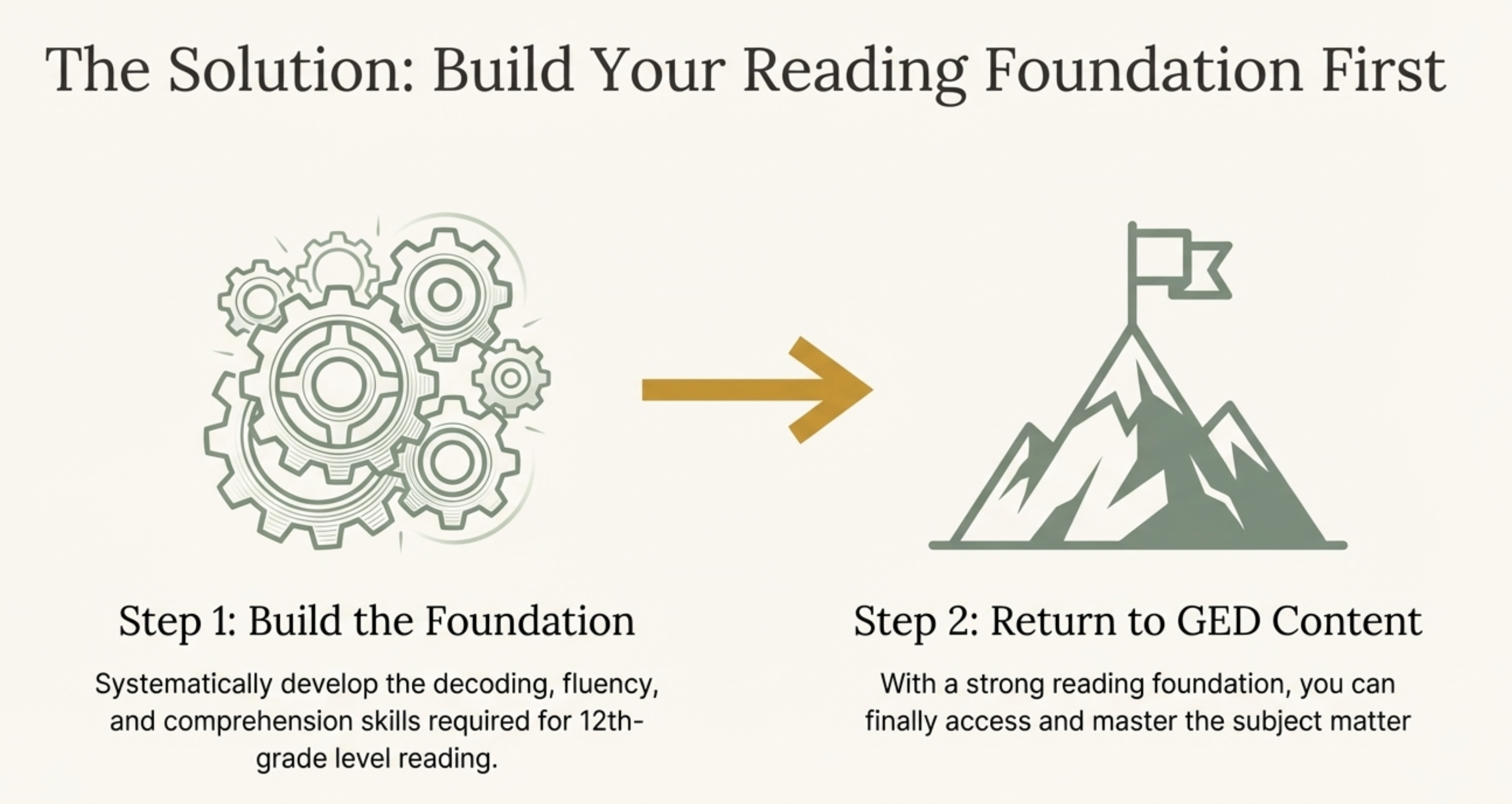
The path to GED success for students with weak reading skills isn’t more GED practice tests. It’s building the foundational reading skills that make GED content accessible.
Start with Systematic Phonics Instruction
Phonics isn’t just for children. Adults with reading difficulties need the same systematic instruction in letter-sound relationships, decoding strategies, and spelling patterns. The difference is that adults need age-appropriate materials and can progress more quickly once they understand the system.
Build Decoding Automaticity
You need to decode words accurately and quickly enough that your mental energy goes toward comprehension, not sounding out individual words. This automaticity comes from extensive practice with systematic progression from simple to complex words.
Develop Reading Fluency
Fluent reading—reading smoothly at appropriate speed with good expression—is essential for comprehension. GED passages are long, and you’re working against time limits. Slow, labored reading makes it nearly impossible to understand and remember what you’ve read.
Then Return to GED Content
Once you’ve built strong reading skills, GED content study becomes productive. You can actually read the history passages, science articles, and math word problems. The content instruction works because you can access the materials.
How Long Does This Take?
Building foundational reading skills requires time and consistent practice. Most adults working 20-30 minutes daily see significant progress within 6-12 months. Yes, this means delaying your GED test. But would you rather fail again immediately, or build the skills that ensure success?
How Our Program Builds GED-Ready Reading Skills
Designed Specifically for Adults
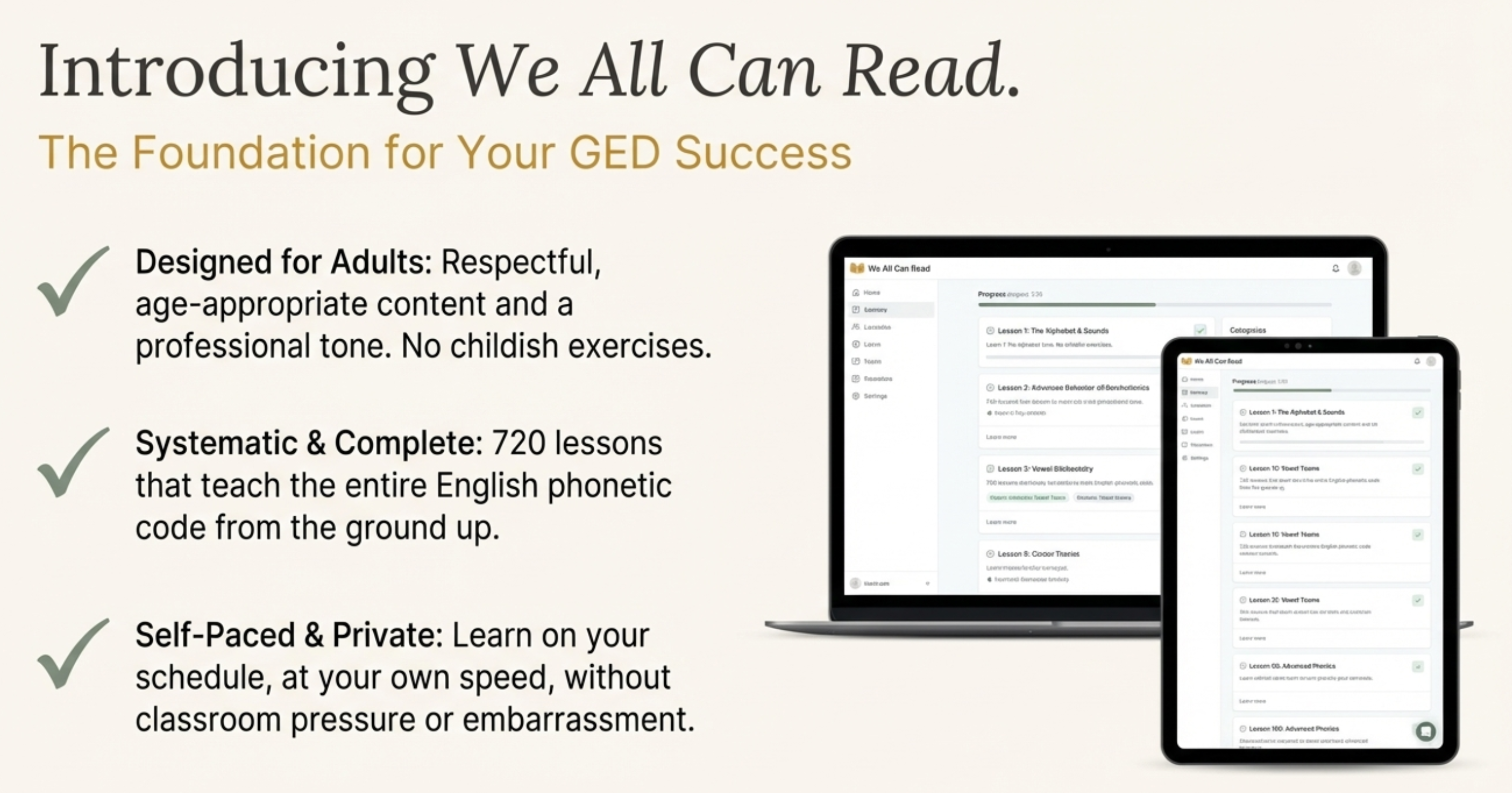
Our program was created from the beginning for older students and adults—not children. Every lesson uses:
- Age-appropriate content and examples
- Mature visual design and formatting
- Vocabulary relevant to adult experience
- Professional tone that respects your intelligence
You’re learning foundational skills, but you’re not treated like a child in the process.
Systematic, Complete Phonics Instruction
Our 720 lessons teach the entire English phonetic code systematically:
- All single letter sounds and letter combinations
- Consonant blends and digraphs
- Short and long vowel patterns
- Vowel teams, diphthongs, and vowel-r combinations
- Syllable division and spelling rules
- Strategies for decoding multisyllabic words
By completing the program, you master the complete system underlying English reading and spelling—the foundation GED success requires.
Self-Paced Online Learning
Work independently at home on your own schedule:
- No need to coordinate class times
- Progress at your own pace
- Repeat lessons as needed for mastery
- Private learning without classroom embarrassment
- Available 24/7 on computer, tablet, or smartphone
Building Both Reading and Spelling
Every lesson includes spelling practice, which reinforces reading skills. The GED writing test requires correct spelling, so this dual focus serves you twice: better reading skills and better writing skills.
Affordable Alternative to Tutoring
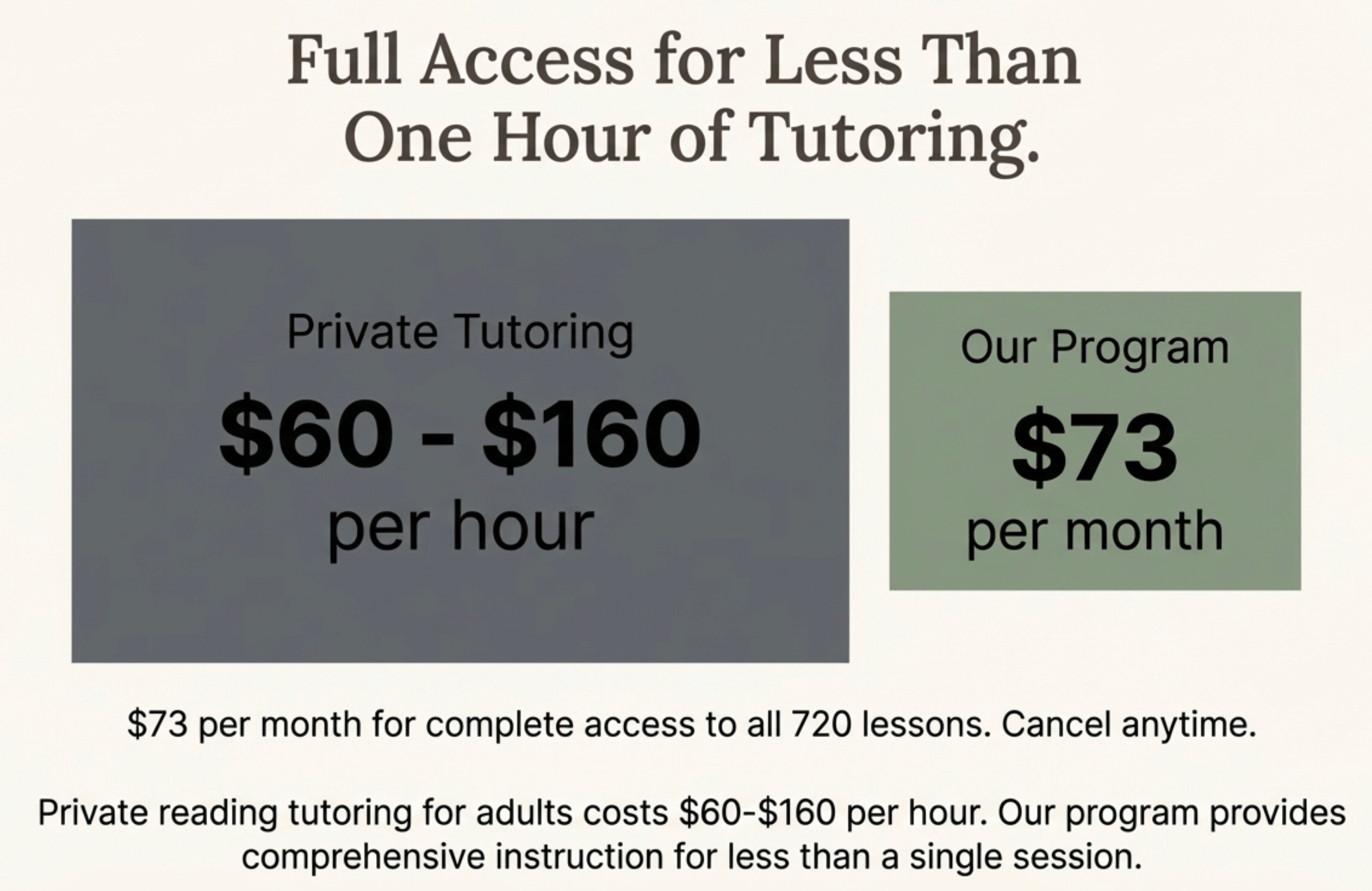
Private reading tutoring for adults costs $60-$160 per hour. Our program provides comprehensive instruction for $73 per month—less than the cost of a single tutoring session. You can build the reading skills you need without financial burden.
Success Stories from Adult Learners
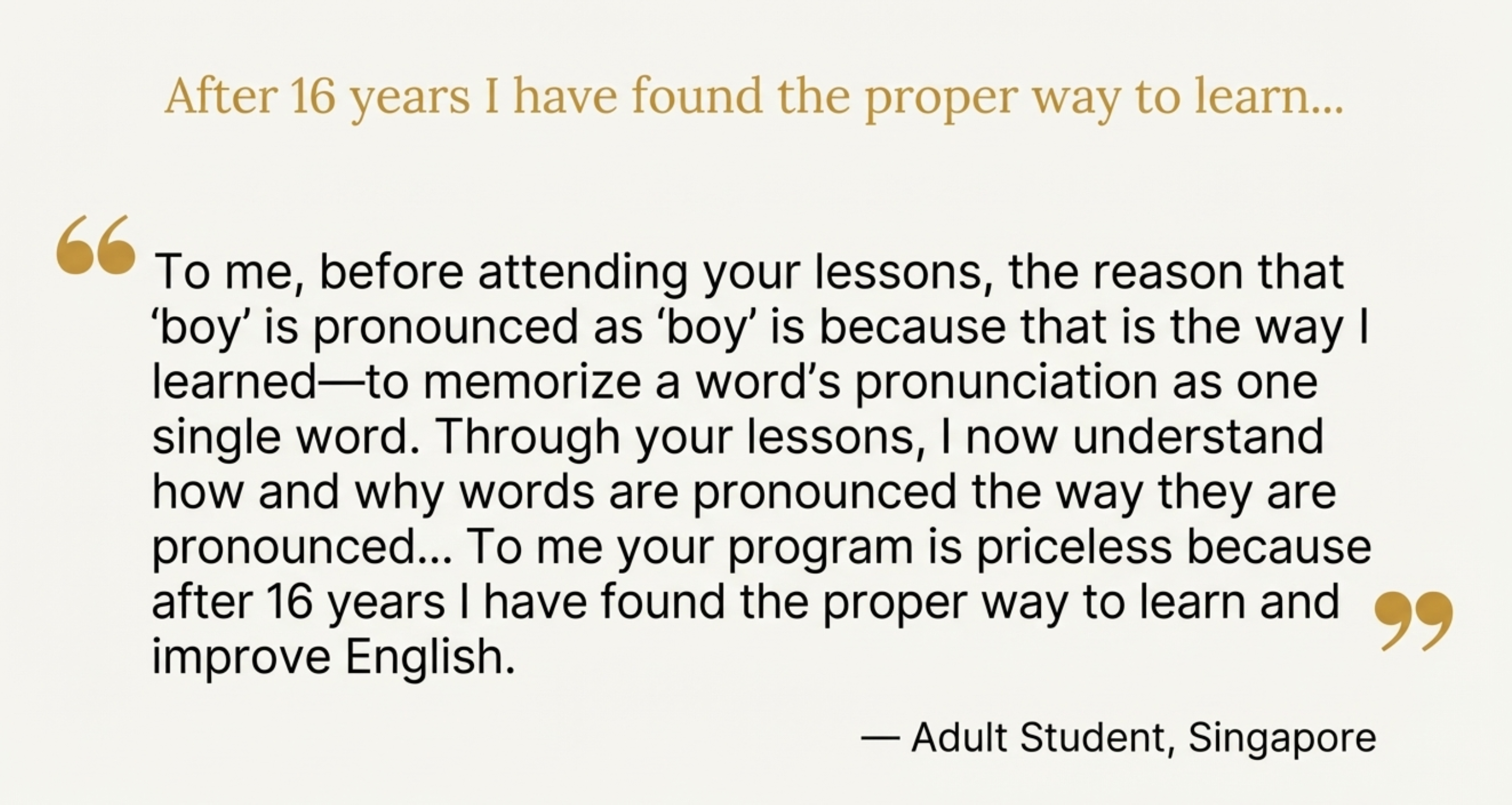
“After 16 years I have found the proper way to learn and improve English.”
“You did an excellent job! I am really thankful for what you have taught me in understanding how words are pronounced which I think is a basic foundation and requirement to learn to speak and write English properly. I have been struggling for the past 16 years without understanding how words are pronounced!
To me, before attending your lessons, the reason that ‘boy’ is pronounced as ‘boy’ is because that is the way I learned—to memorize a word’s pronunciation as one single word. Through your lessons, I now understand how and why words are pronounced the way they are pronounced.
You have been very systematic and patient in your lessons which I think all students who seriously want to learn phonics will gain the full benefit of it. I did not skip a single lesson!
To me your program is priceless because after 16 years I have found the proper way to learn and improve English. I am confident that it (knowing phonics) will help me tremendously in improving my vocabulary.”
— Adult Student, Singapore
Read more success stories from adult learners →
Your Path to GED Success

If you’ve failed the GED because of weak reading skills, here’s your path forward:
Step 1: Acknowledge the Real Problem
Stop blaming yourself for lack of intelligence or effort. Recognize that you need to build reading skills before tackling GED content. This isn’t failure—it’s identifying the actual problem so you can solve it.
Step 2: Build Your Reading Foundation
Work through systematic phonics instruction, building the decoding, fluency, and comprehension skills the GED requires. Commit to 20-30 minutes of daily practice. The time investment now saves you from repeated GED failures.
Step 3: Return to GED Content Study
Once you’ve built strong reading skills, return to GED content preparation. You’ll find the materials suddenly make sense. History passages become readable. Science articles become comprehensible. Math word problems become solvable.
Step 4: Pass the GED with Confidence
With solid reading skills underlying your content knowledge, you’ll approach the GED confidently. The test that seemed impossibly difficult becomes challenging but achievable.
Start Building Your Reading Skills Today
Try 10 Free Lessons
Experience our adult-focused approach with the first 10 lessons completely free. No credit card required, no obligation. These introductory lessons teach consonant sounds and the first short vowel, demonstrating our systematic instruction and age-appropriate format.
See for yourself how explicit phonics instruction—designed specifically for adults—can build the reading skills you need for GED success.
Full Program Access: $73/Month
Complete access to all 720 systematic lessons:
- 720 lessons teaching the complete English phonetic code
- 100+ hours of video instruction
- 141 fluency reading lessons for practice
- 400+ printable worksheets for writing and spelling
- 203 mastery quizzes ensuring comprehension
- Self-paced progression—work at your own speed
- All materials accessible on any device
Cancel anytime. One month costs less than one hour of private tutoring.
Stop Failing, Start Building
You’ve probably failed the GED because you were trying to do the impossible: pass a test requiring 10th-12th grade reading skills when you needed to build those skills first. That’s not your fault—it’s the failure of GED programs to identify and address the real problem.
Now you understand what’s actually wrong, and you can fix it. Build your reading skills systematically, then tackle the GED with the foundation you need to succeed.
Your GED is waiting. So is the better job, the college admission, the personal pride of finishing what you started. The only thing standing between you and that goal is reading skills—and reading skills can be developed at any age.
More Resources for Adult Learners
Adult Phonics Program → Our complete program designed specifically for adult learners
ESL Phonics for English Language Learners → Systematic phonics instruction for non-native English speakers
Questions about building reading skills for GED success? Contact us or explore our frequently asked questions.
Learn more: Explore our systematic teaching methodology