How to Sound Out Words: Simple Step-by-Step Method for Any Age

Watch: How to Sound Out Words Step-by-Step
Click the plus symbol to view audio transcript of the above video.
While this guide explains the theory of sounding out words, putting it into practice requires systematic instruction. Our complete adult phonics curriculum provides the structured practice you need to master decoding skills, with video lessons, worksheets, and mastery quizzes at every step.
Why Most People Can’t Sound Out Words (And It’s Not Their Fault)

The Guessing Game We Call Reading
In many classrooms, students are taught to look at the first letter of a word, look at the picture, and guess. They’re encouraged to use “context clues” and “skip words they don’t know.” This approach—sometimes called “whole language” or “balanced literacy”—creates readers who can recognize memorized words but fall apart when they encounter unfamiliar ones.
The result?
- Students who read well in first grade but struggle in third grade when texts become more complex
- Adults who can read familiar texts but panic when faced with technical documents, medical instructions, or academic materials
- Readers who avoid reading because it’s exhausting and frustrating
What’s Missing: Systematic Phonics Instruction
Sounding out words requires understanding the alphabetic principle: letters represent sounds, and those sounds blend together to form words. This seems simple, but it’s systematically taught to very few students.
Most people never learn:
- All the sounds each letter and letter combination can represent
- How to segment words into individual sounds
- How to blend those sounds back together fluently
- The patterns and rules that govern English spelling
Without this foundation, reading becomes a memory exercise rather than a decoding skill. And when memory fails (as it inevitably does with thousands of words), reading becomes impossible.
The Science Behind Sounding Out Words
Your Brain on Phonics
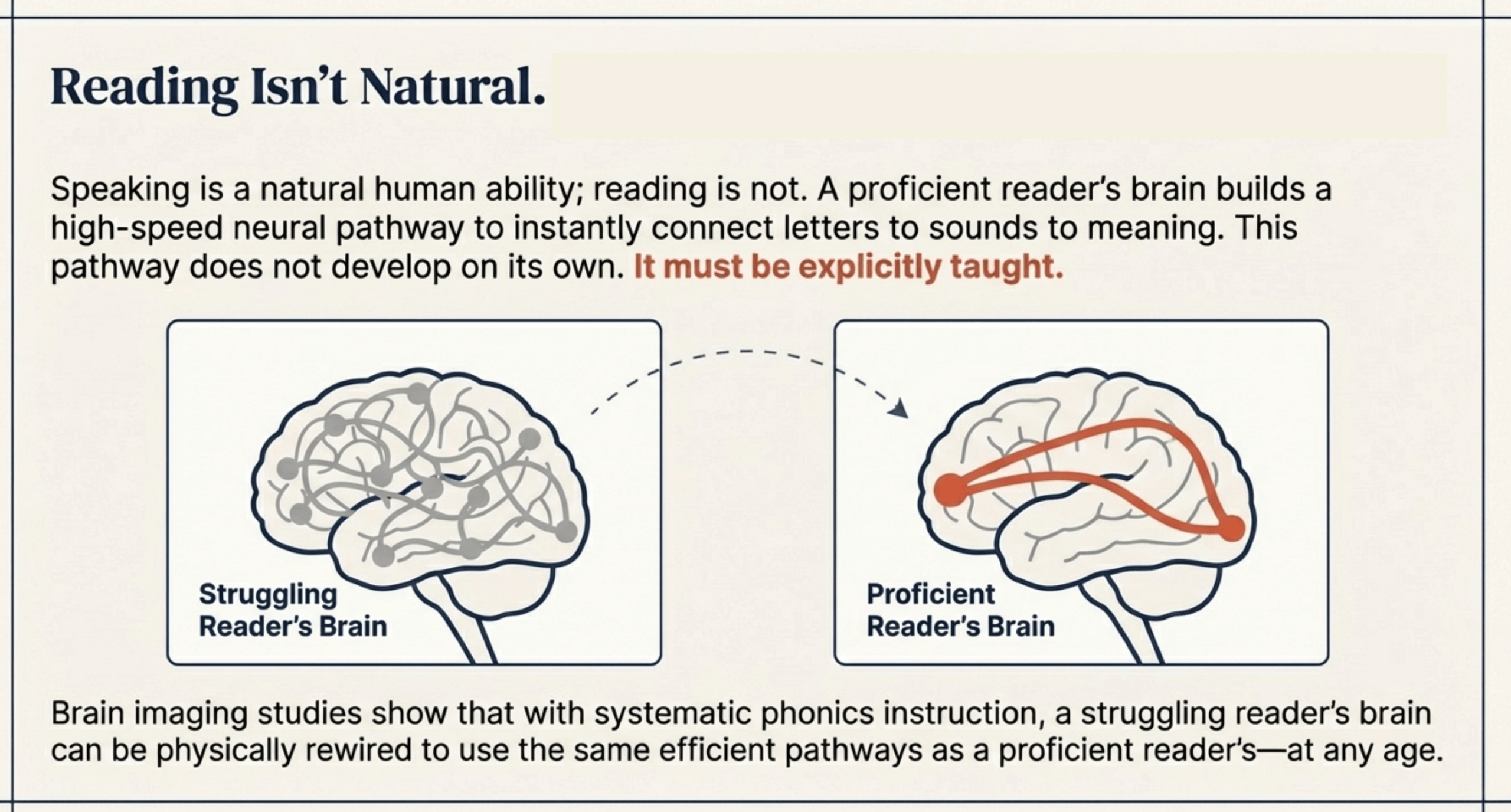
When proficient readers see a word, their brain automatically:
- Recognizes the letters (orthographic processing)
- Maps those letters to sounds (phonological processing)
- Blends the sounds into a word (phonological assembly)
- Accesses the word’s meaning (semantic processing)
This happens in milliseconds. But here’s what research shows: this process must be explicitly taught. It doesn’t develop naturally from reading exposure alone.
Studies using brain imaging show that struggling readers use different neural pathways than proficient readers. The good news? With systematic phonics instruction, struggling readers’ brains can be rewired to use the same efficient pathways as proficient readers—regardless of age.
Phonemic Awareness: The Foundation
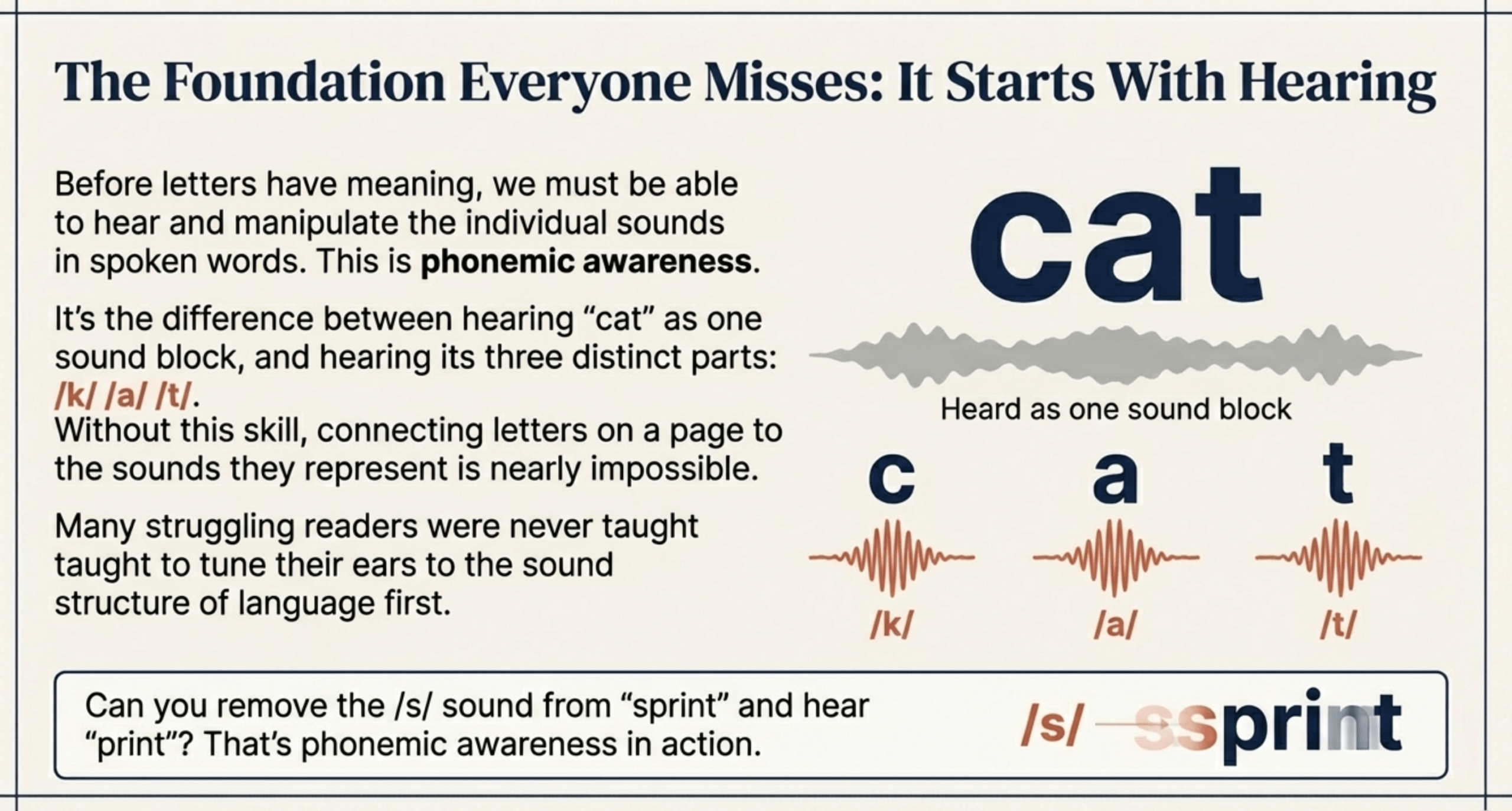
Before you can sound out words, you need phonemic awareness—the ability to hear and manipulate individual sounds in spoken words. This is separate from knowing letter names or shapes.
For example, can you hear the three sounds in “cat”? /k/ /a/ /t/? Can you blend /s/ /u/ /n/ into “sun”? Can you remove the /s/ from “sun” and hear “un”?
Many struggling readers lack this foundational awareness. They hear words as whole units, not as sequences of sounds. Without phonemic awareness, connecting letters to sounds is nearly impossible.
Learn more about Teaching Phonemic Awareness →
How to Sound Out Words: The Step-by-Step Method

Breaking Down the Process

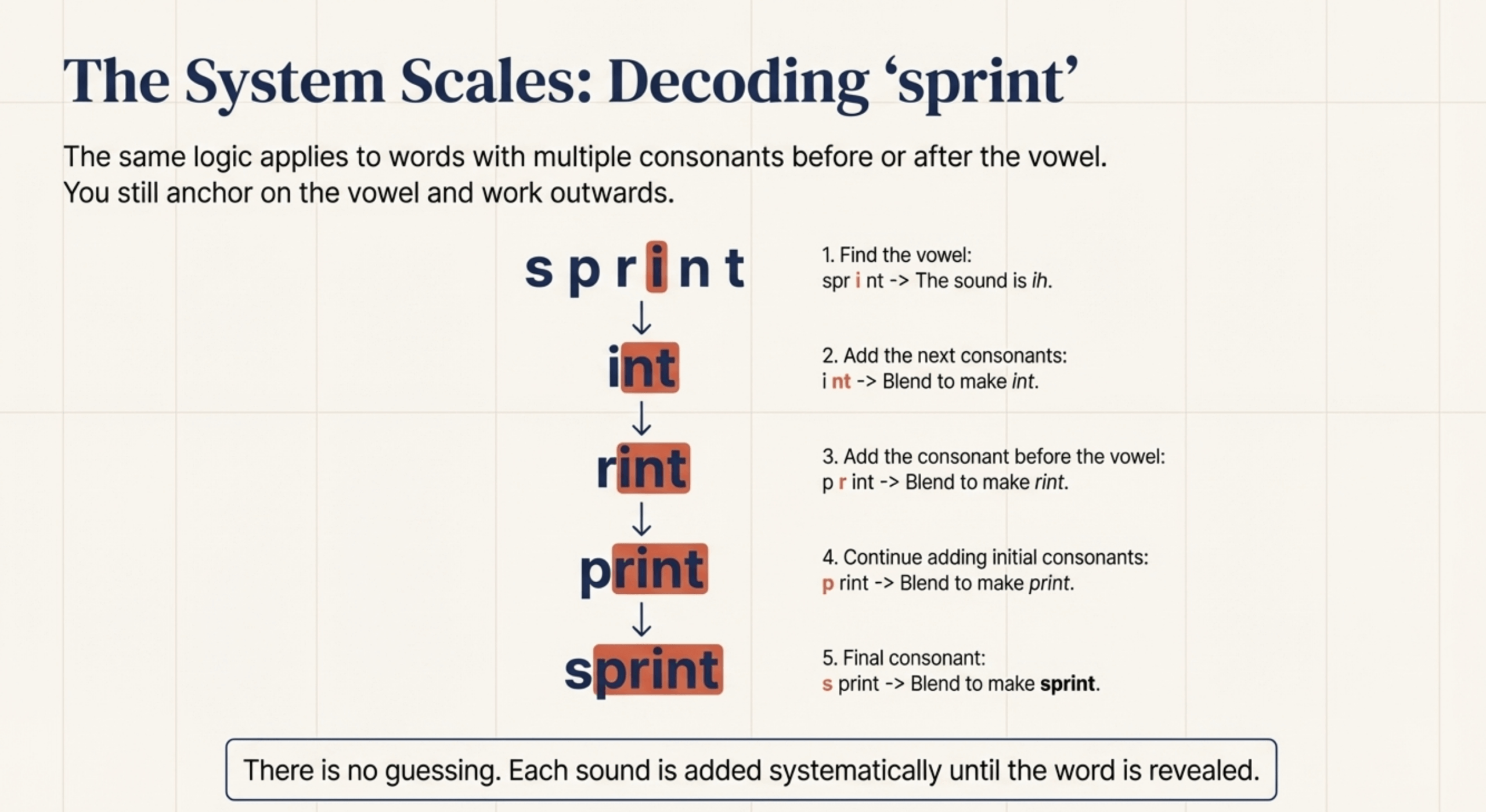
The method demonstrated in the video at the top of this page follows a specific, logical sequence:
Step 1: Identify the Vowel
Every syllable in English must contain a vowel sound. The vowel is the “heart” of the syllable—everything else clusters around it. Start by locating the vowel letter(s) in the word.
Why start with the vowel? Because it’s the anchor. Once you identify the vowel, you can work forward and backward from there.
Step 2: Identify What Comes After the Vowel
Look at the consonant(s) that follow the vowel. These consonants “close” the syllable and often determine whether the vowel makes its short or long sound.
Step 3: Blend the Vowel and Following Consonant(s)
Practice blending the vowel sound with the consonant sound(s) that follow it. This creates the “back end” of the syllable.
Example: In “cat,” blend /a/ and /t/ to get “at.”
Step 4: Add the Beginning Consonant(s)
Now look at the consonant(s) before the vowel. Blend these beginning sounds onto the vowel-consonant combination you already created.
Example: Add /k/ to “at” to get “cat.”
Step 5: Practice Until It’s Automatic
Initially, this process feels slow and mechanical. That’s normal. With practice, your brain begins to recognize patterns, and decoding becomes faster and more automatic.
Why This Method Works
This approach is based on syllable structure—specifically, the VC (vowel-consonant) pattern that forms the core of English syllables. By starting with the vowel and working outward, you’re following the natural structure of the language.
This is fundamentally different from “left-to-right sounding out,” which can lead to distorted pronunciations and confusion.
Beyond Single-Syllable Words: Decoding Longer Words
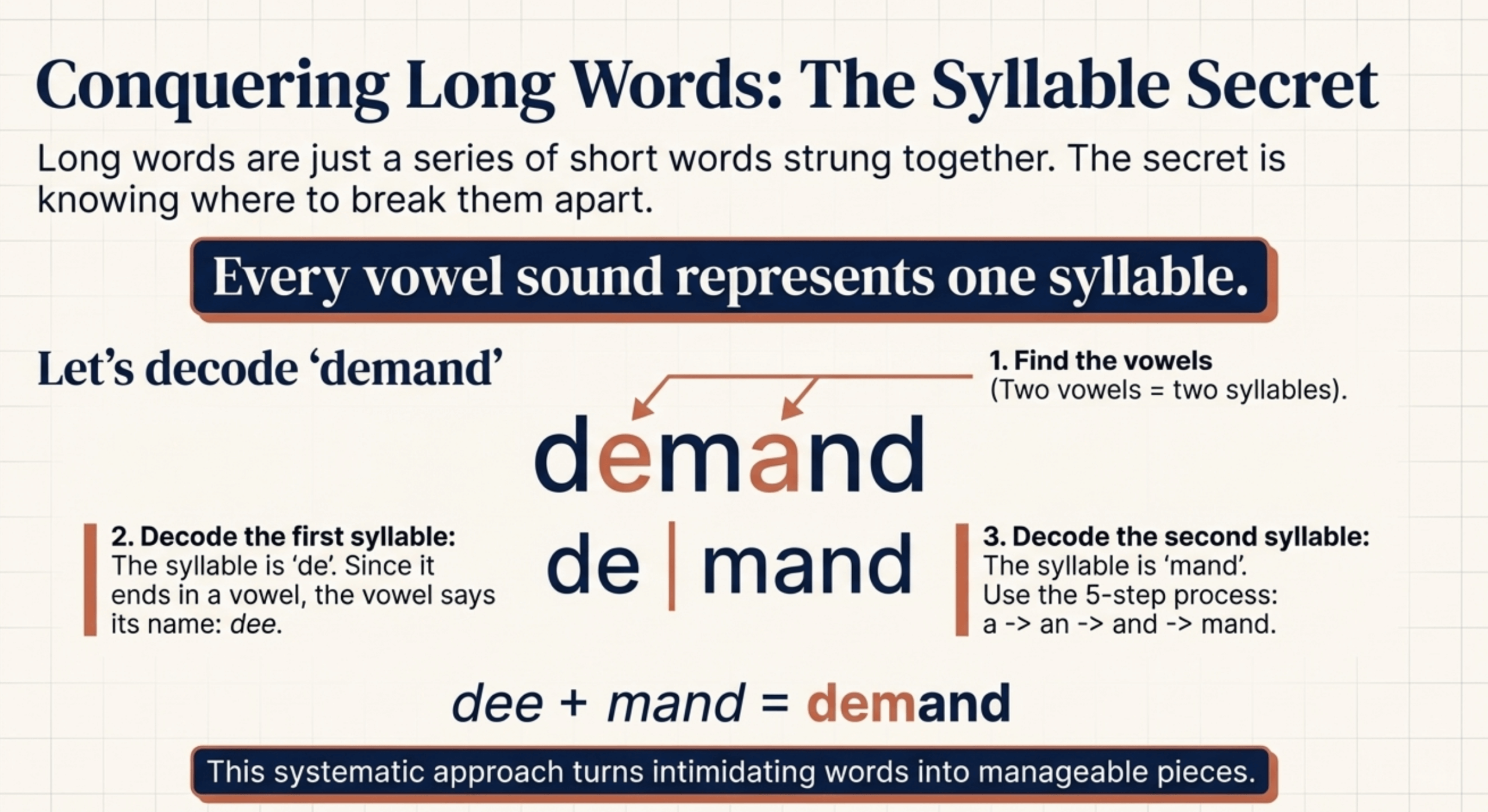
Every Vowel Sound = One Syllable
The key to reading longer words is recognizing that each vowel sound represents a syllable. A word with three vowel sounds is a three-syllable word.
The process:
- Identify all the vowel sounds in the word
- Divide the word into syllables
- Decode each syllable using the same method shown above
- Blend the syllables together
Example: “Fantastic”
- Three vowel sounds: a, a, i
- Three syllables: fan-tas-tic
- Decode each: /fan/ /tas/ /tik/
- Blend: fan-tas-tic
Syllable Division Patterns
English follows predictable patterns for dividing words into syllables:
VC/CV (closed syllable pattern): Words like “napkin” divide between the two consonants: nap-kin
V/CV (open syllable pattern): Words like “robot” divide before the consonant: ro-bot
Learning these patterns—which are taught systematically in our curriculum—eliminates guesswork and makes even complex words manageable.
The Two-Way Street: Sounding Out Words for Reading AND Spelling
Decoding vs. Encoding
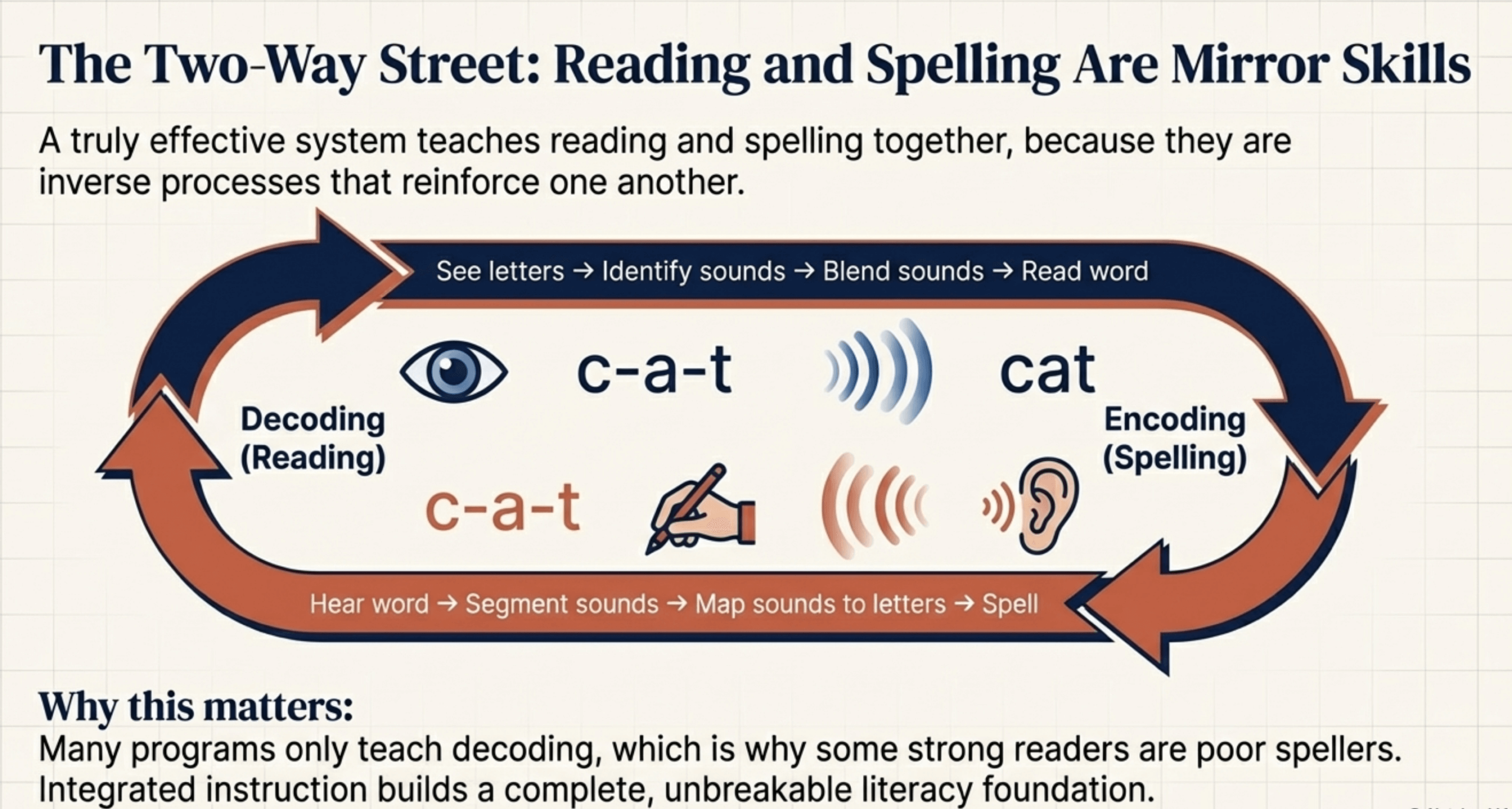
Here’s something most people don’t realize: sounding out words for reading (decoding) and sounding out words for spelling (encoding) are mirror processes. They should be taught together.
Decoding: See letters → Identify sounds → Blend sounds → Read word
Encoding: Hear word → Segment sounds → Map sounds to letters → Spell word
When you practice both simultaneously, each skill reinforces the other. This is why our curriculum dedicates half of every lesson to spelling dictation.
Many students can read words they can’t spell because they’ve only developed the decoding side. This creates a gap in their literacy foundation.
Learn more: Discover why strong readers often struggle with spelling and how integrated instruction solves this problem.
Read: The Spelling Code →
Common Challenges and Solutions
“The Sounds Don’t Blend Smoothly”
Problem: Students produce choppy, disconnected sounds: “Cuh-ah-tuh” instead of “cat.”
Solution: This happens when consonants are given their “letter name” sound instead of their pure sound. The /k/ sound is a quick stop, not “kuh.” Teaching pure consonant sounds—without added vowel sounds—is critical.
Practice sustained sounds (like /m/, /s/, /f/) first. Then work on stop sounds (like /p/, /t/, /k/) that should be quick and sharp.
“I Know the Sounds but Can’t Read the Word”
Problem: Students can identify each sound in isolation but struggle to blend them together.
Solution: This indicates weak phonological blending skills. Practice blending activities separate from reading:
- Start with two-sound words: “at,” “in,” “up”
- Move to three-sound words: “cat,” “sit,” “bug”
Build blending fluency before introducing complex spelling patterns.
“It Works for Simple Words but Not Complex Ones”
Problem: Students can decode three-letter words but struggle with consonant blends, digraphs, or multi-syllable words.
Solution: This indicates gaps in the systematic sequence. Students are being asked to decode patterns they haven’t been explicitly taught.
English has complex patterns that must be taught in order:
- Consonant blends (str-, -nch, -ld)
- Consonant digraphs (sh, ch, th, wh)
- Vowel teams (ai, ea, oa, oo)
- R-controlled vowels (ar, er, ir, or, ur)
Each pattern should be taught explicitly, practiced in isolation, then integrated into reading and spelling.
Why This Isn’t Taught in Most Schools
The Reading Wars
For decades, education has been caught in the “reading wars”—a debate between phonics-based instruction and meaning-based approaches. Many schools adopted “balanced literacy” programs that minimize systematic phonics instruction in favor of reading exposure and context strategies.
The result? According to the National Assessment of Educational Progress, only about one-third of U.S. students read proficiently by the end of fourth grade. For disadvantaged students and students with dyslexia, the numbers are even worse.
The Science Is Clear
Decades of research—including brain imaging studies, longitudinal studies, and randomized controlled trials—show that systematic, explicit phonics instruction is the most effective way to teach reading. Yet many teachers were never trained in these methods.
If you or your child struggles to sound out words, it’s not because of lack of intelligence or effort. It’s because you weren’t taught the code systematically.
How Our Program Teaches Decoding Systematically
The Orton-Gillingham Approach
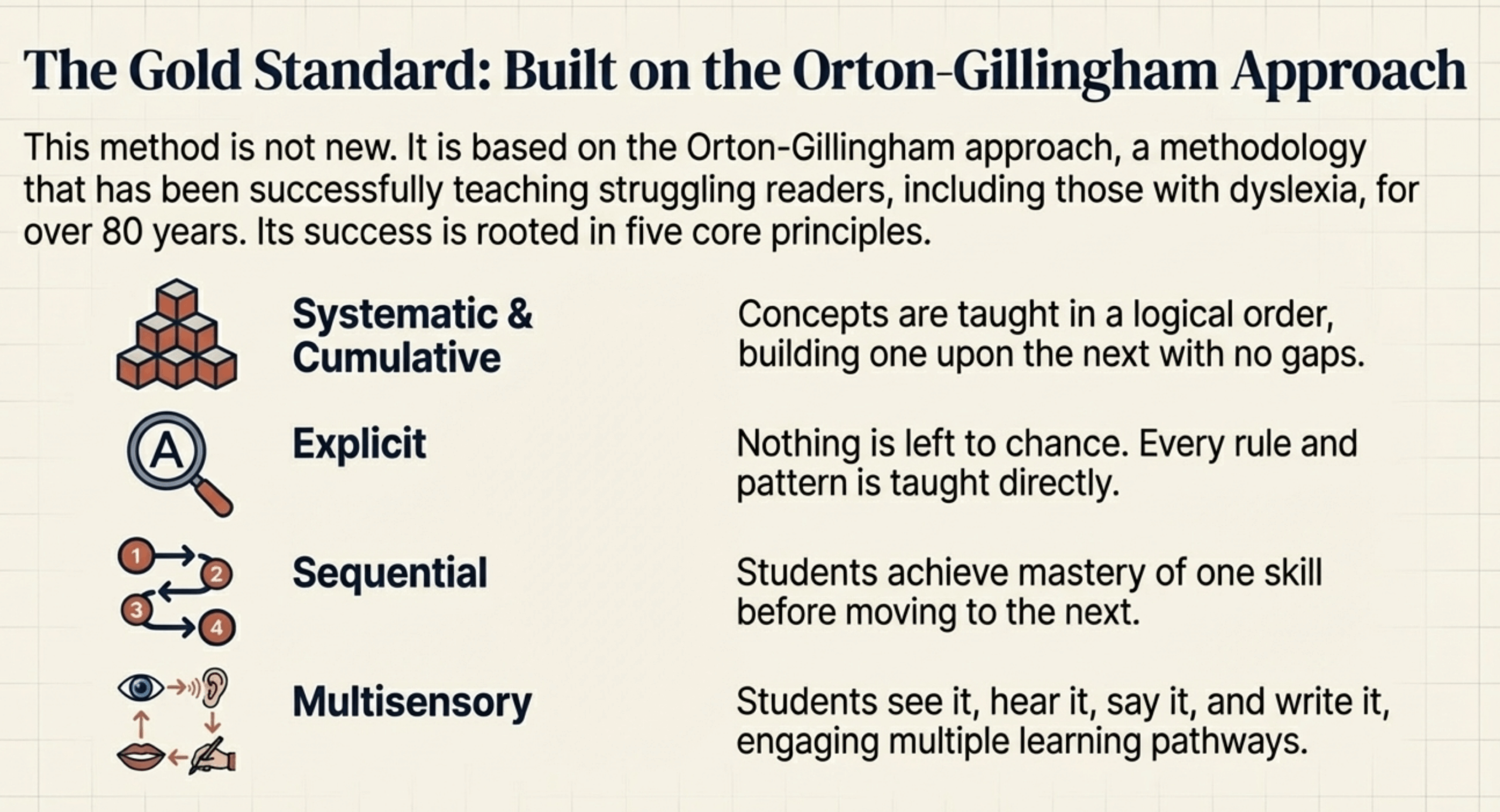
Our curriculum follows the Orton-Gillingham method, which has been teaching struggling readers—including those with dyslexia—for over 80 years. This approach is:
Systematic: Concepts are introduced in a logical order, building from simple to complex with no gaps.
Sequential: Each new concept builds on previously mastered skills. Students don’t move forward until they’ve demonstrated mastery.
Explicit: Nothing is left to chance. Every sound-spelling pattern is taught directly, with no expectation that students will “figure it out.”
Cumulative: Previously learned patterns are constantly reviewed and integrated into new lessons.
Multisensory: Students see, hear, say, and write each pattern, engaging multiple learning pathways simultaneously.
Learn more about Orton-Gillingham Principles →
720 Lessons, Systematic Progression
Our program doesn’t teach sounding out words in one lesson and then move on. It builds this skill systematically across 720 lessons:
Section One: Consonant sounds and the first short vowel
- Students learn pure consonant sounds
- Master the short ‘a’ sound
- Practice blending three-sound words
- Begin spelling dictation simultaneously
Section Two: Remaining short vowels and consonant blends
- Each short vowel is taught explicitly
- Consonant blends are introduced systematically
- Multi-syllable words begin
Sections Three to Five: Advanced patterns including vowel teams, silent letters, and complex syllables
By the end, students can decode any word in English—even words they’ve never seen before—because they know the code.
Integrated Spelling from Day One
Remember: decoding and encoding are two sides of the same coin. Half of every lesson is dedicated to spelling dictation. Students hear a word, segment it into sounds, and write those sounds using the correct letters.
This simultaneous practice dramatically accelerates reading development because students are practicing the sound-symbol relationships in both directions.
Experience Systematic Instruction for Yourself
See how our integrated approach to reading and spelling builds complete literacy skills. Start with 10 free lessons.
This Works at Any Age
For Adults Who Struggle to Read
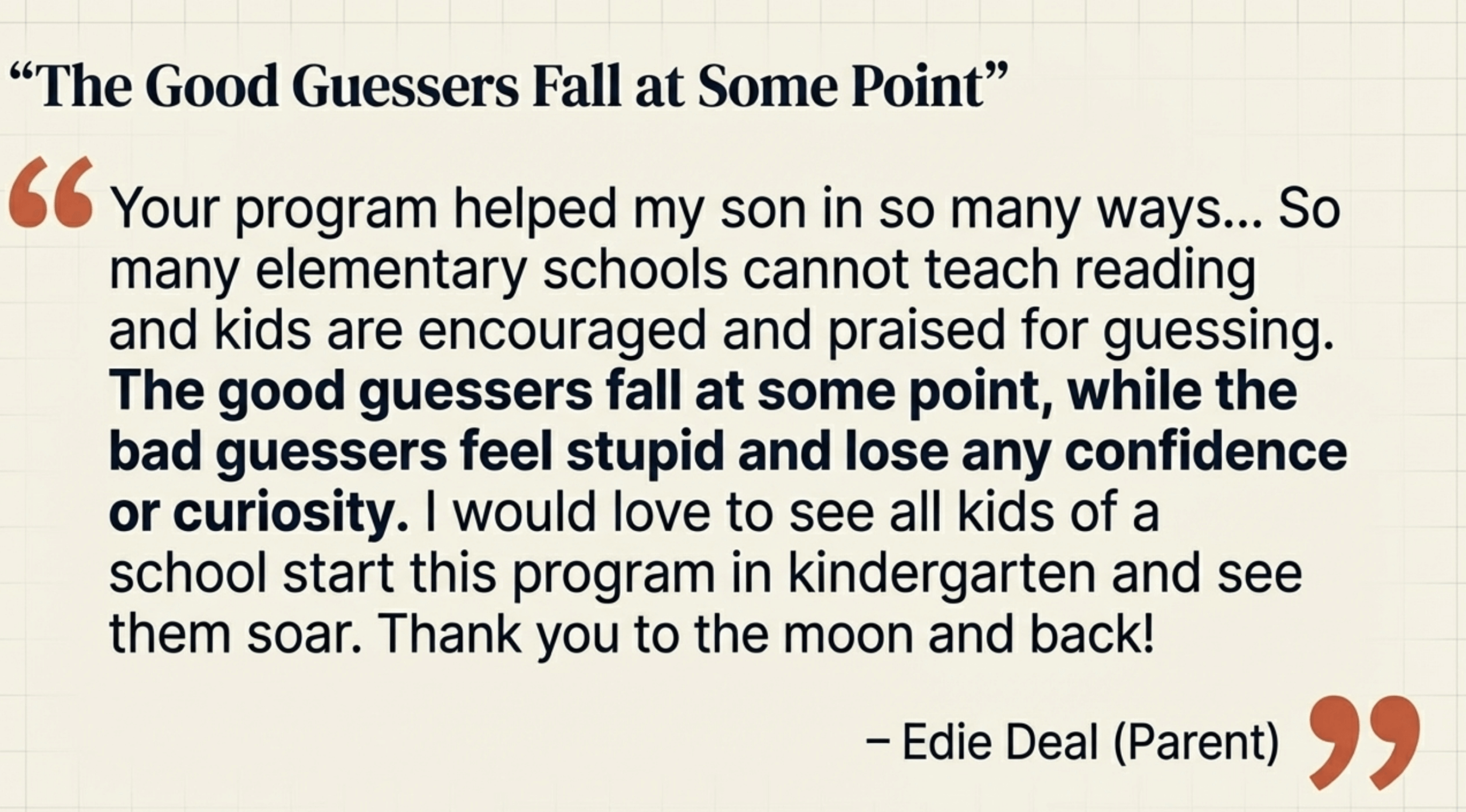
If you’re an adult who never learned to read well, know this: it’s never too late. Your brain retains the ability to form new neural pathways throughout life. Adults often progress faster than children because they:
- Have stronger motivation
- Can understand the logic of the system
- Have larger vocabularies to draw upon
- Can practice independently
Our adult students regularly complete the program in 1-2 years with 20-30 minutes of daily practice. Most students experience noticeable progress after completing just our first 10 lessons.
Learn more about our Adult Phonics Program →
For Parents of Struggling Readers
If your child is struggling in school, supplementing at home with systematic phonics can close the gap. Our self-paced video lessons do the teaching, so you don’t need to become a reading specialist. Your role is to:
- Ensure consistent daily practice (20-30 minutes)
- Encourage effort and celebrate progress
- Monitor quiz results to identify areas needing extra practice
Many parents see dramatic improvement within the first month.
Read: Help for Struggling Readers: 9 Essential Strategies →
For Homeschool Families
Homeschool families appreciate having a complete, systematic curriculum that handles the teaching through video lessons. You don’t need a teaching degree or special training. The curriculum provides:
- 720 video lessons teaching every concept explicitly
- 400+ printable worksheets for practice
- 203 mastery quizzes with instant feedback
- Progress tracking for multiple students
Discover our Homeschool Solution: Confident Reading Starts Here →
The Connection to Reading Fluency
From Accurate Decoding to Automatic Reading
Learning to sound out words accurately is just the first step. The goal is reading fluency—the ability to read smoothly, quickly, and with proper expression.
How do you get from careful decoding to fluent reading?
1. Accuracy First
Students must first decode words correctly, even if slowly. Rushing to fluency before accuracy is established creates guessing and reinforces errors.
2. Controlled Text
Students should practice reading texts that contain ONLY spelling patterns they’ve been explicitly taught. Asking students to read books with patterns they haven’t learned forces guessing.
Our program includes 245 decodable reading passages embedded within our 720 core lessons plus a supplemental reader which provides an additional 141 passages of decodable text correlated to our core lessons.
3. Repeated Reading
Reading the same passage multiple times builds automatic word recognition without memorization or guessing. Each reading becomes smoother and faster.
4. Gradual Release
As decoding becomes automatic for common patterns, students can focus more attention on comprehension and expression. This happens naturally with systematic practice.
Why Nonsense Words Matter
The True Test of Decoding Skill
Here’s a test: Can you read these words?
- flitch
- scrant
- whimp
- blundge
These are nonsense words—they have no meaning. But if you can decode them correctly, it proves you actually know the phonics code. You’re not relying on memorization or guessing from context.
This is why our program heavily emphasizes nonsense word reading and spelling. It ensures students are truly mastering the sound-symbol relationships, not just memorizing whole words.
Learn more: Why Nonsense Words Are Critical →
Common Myths About Sounding Out Words

Myth #1: “Phonics doesn’t work for English because it’s too irregular.”
Truth: English is about 85% regular and predictable. The remaining 15% of “irregular” words often follow less common but still systematic patterns. With comprehensive phonics instruction, students can decode the vast majority of English words.
Myth #2: “Sounding out words is too slow. Good readers don’t sound out.”
Truth: Proficient readers’ brains automatically process phonics—they’ve just automated the skill. Asking beginning readers to skip phonics is like asking someone to run before they can walk.
Myth #3: “Some people just aren’t ‘phonics learners.'”
Truth: Reading is not a natural ability like speaking. Everyone—regardless of learning style—must learn the connection between letters and sounds to read an alphabetic language. There are no alternative pathways.
Myth #4: “If a child can’t read by third grade, they’ll never catch up.”
Truth: With systematic instruction, older students and adults can absolutely learn to read. It may take intensive instruction, but the brain remains plastic enough to form new reading pathways.
Getting Started: Your Next Steps
Assess Your Current Skills
Not sure where you stand? Take our free phonics assessment quiz to identify specific gaps in your phonics knowledge.
Take the Free Phonics Quiz →
Explore the Complete Program
Our full program provides everything you need:
- 720 systematic video lessons
- 400+ printable practice worksheets
- 203 mastery quizzes with instant feedback
- 141 controlled fluency reading passages
- Unlimited students for one household
- Cancel anytime
Program Overview →
Frequently Asked Questions
How long does it take to learn to sound out words?
This depends on your starting point. Students with no phonics background typically need 3-6 months of daily practice to develop solid decoding skills for single-syllable words. Mastering all English spelling patterns typically takes 1-2 years.
I’m an adult who can’t read. Is it too late for me?
Absolutely not. Adults often progress faster than children because of stronger motivation and the ability to understand the logic behind the patterns. Our adult students range from ages 18 to 80+.
My child has dyslexia. Will this approach work?
Yes. Our Orton-Gillingham-based approach was specifically developed for students with dyslexia. The multisensory, systematic method is considered the gold standard for dyslexia intervention.
Can I use this to help my child while they’re in school?
Yes. Many parents use our program as supplemental instruction. Twenty to thirty minutes daily at home can fill gaps and accelerate progress.
Do I need to be good at teaching?
No. Our video lessons do the teaching. Students learn directly from the instructor in the videos. Your role is simply to ensure regular practice and monitor progress.
The Bottom Line
Sounding out words isn’t magic, and it’s not something you’re born knowing how to do. It’s a systematic skill built on understanding the relationship between letters and sounds in English.
If you or someone you care about struggles to read unfamiliar words, the solution isn’t more reading practice or better guessing strategies. The solution is systematic phonics instruction that teaches the code explicitly, one pattern at a time, with integrated spelling practice.
Whether you’re 8 or 80, whether you’re learning for yourself or helping someone else, the path forward is the same: systematic, cumulative instruction in phonics and spelling.
You absolutely can learn to sound out any word. You just need the right instruction.
Related Resources:
- The Literacy Code: Why Adults Struggle with Reading
- Teaching Phonemic Awareness: The Foundation
- Systematic Phonics Instruction: How the Alphabet Works
- The Spelling Code: Why Spelling Matters
- Why Nonsense Words Are Critical
- Orton-Gillingham Principles
What People Are Saying:
“I have used your reading curriculum in a program for at-risk young men ages sixteen and older. While implementing your reading program, some of the positive changes I have observed in my students are as follows:1. Improvement in reading skills which facilitated advancement in other academic areas2. Improvement in reading skills sufficient to pass the Florida High School Competency Test. (Students entering this program generally consider the HSCT their most formidable obstacle to graduation.)3. Increased confidence in personal potential and new hope for the future.”
Dorothy Easley/American Adult Education Center
Dade County Public Schools/Miami, FL
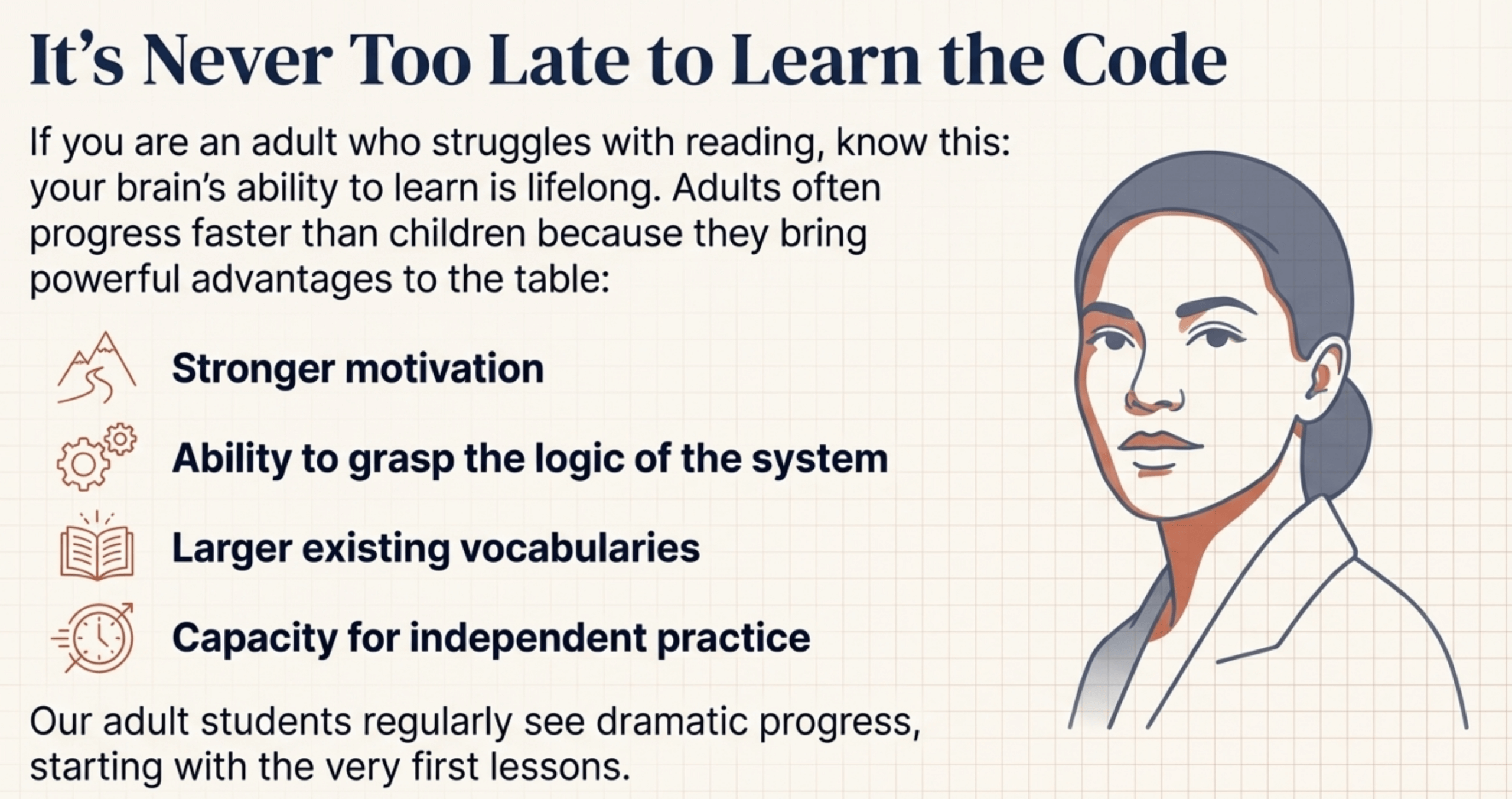
Your program helped my son in so many ways. It is an excellent program, and I cannot say enough about it. If you would like me to post a comment or review somewhere, please let me know. I think it has such value. My son started it in the summer of 1st grade, and he could have started it in kindergarten. So many elementary schools cannot teach reading and kids are encouraged and praised for guessing. The good guessers fall at some point, while the bad guessers feel stupid and lose any confidence or curiosity. I would love to see all kids of a school start this program in kindergarten and see them soar.
Thank you to the moon and back! – Edie Deal (Parent)
“My name is Dan Vonk, and I used We All Can Read in my remedial reading classes for many years. I have sung your praises to many groups over the years including the RVI Internship group (support services for special needs kids in Career/Tech classes) I worked with this past year while attaining my RVI endorsement. I was recently placed on a Whole Faculty Study Group in which we are investigating ways to improve reading comprehension among Special Education students. Of course, this put me back on my reading soapbox, and I again spoke of your program, which I’ve had so much success with in the past. I was hoping that you could send any info packet that you might have so that I might present it to my group for consideration. Thank you so much. I’ve seen many children dramatically improve their reading skills with your excellent program.“
Dan Vonk / RVI Coordinator
Camden County High School
Why This Method Works:
- Start with vowels – the key to every word
- Build systematically – no guessing required
- Works for complex words – even 5+ syllables
- Builds confidence – success with every word
Continue Reading: The 9 Essential Strategies
← Previous: What to Teach Struggling Readers: Letter Sounds & Spelling Rules
Next → Controlled Text in Reading is Essential
Questions about mastery-based instruction? Contact us.