Why Teachers Use “Fake Words” Like Flib and Zot to Teach Reading
What Are Nonsense Words?

Nonsense words (also called pseudowords or nonwords) are made-up words that follow English phonics rules but have no meaning. They look and sound like they could be real English words, but they don’t exist in the dictionary.
Quick Test: Can You Read These?
flib • shum • sprant • blidge • whamp
If you could read these words, you proved you know phonics—not just memorization.
These five words don’t mean anything. You’ve never seen them before. Yet if you know phonics, you can read them easily. That’s exactly why they’re so powerful for teaching and testing reading skills.
Why Nonsense Words Are Critical: The Fundamental Reason

The Problem with Real Words: You Can’t Tell HOW Someone Read Them
Here’s the challenge every reading teacher faces: when a student reads the word “cat” correctly, how did they actually read it?
They could have:
- Sounded it out using phonics (/k/ /a/ /t/ = cat) ✅
- Memorized it as a whole word from previous exposure ⚠️
- Guessed from context or pictures ⚠️
- Recognized it as a sight word they’ve seen hundreds of times ⚠️
When the word is “cat,” you can’t be sure which strategy they used. All four methods produce the same result: the student says “cat.”
Nonsense Words Eliminate All Strategies Except Phonics
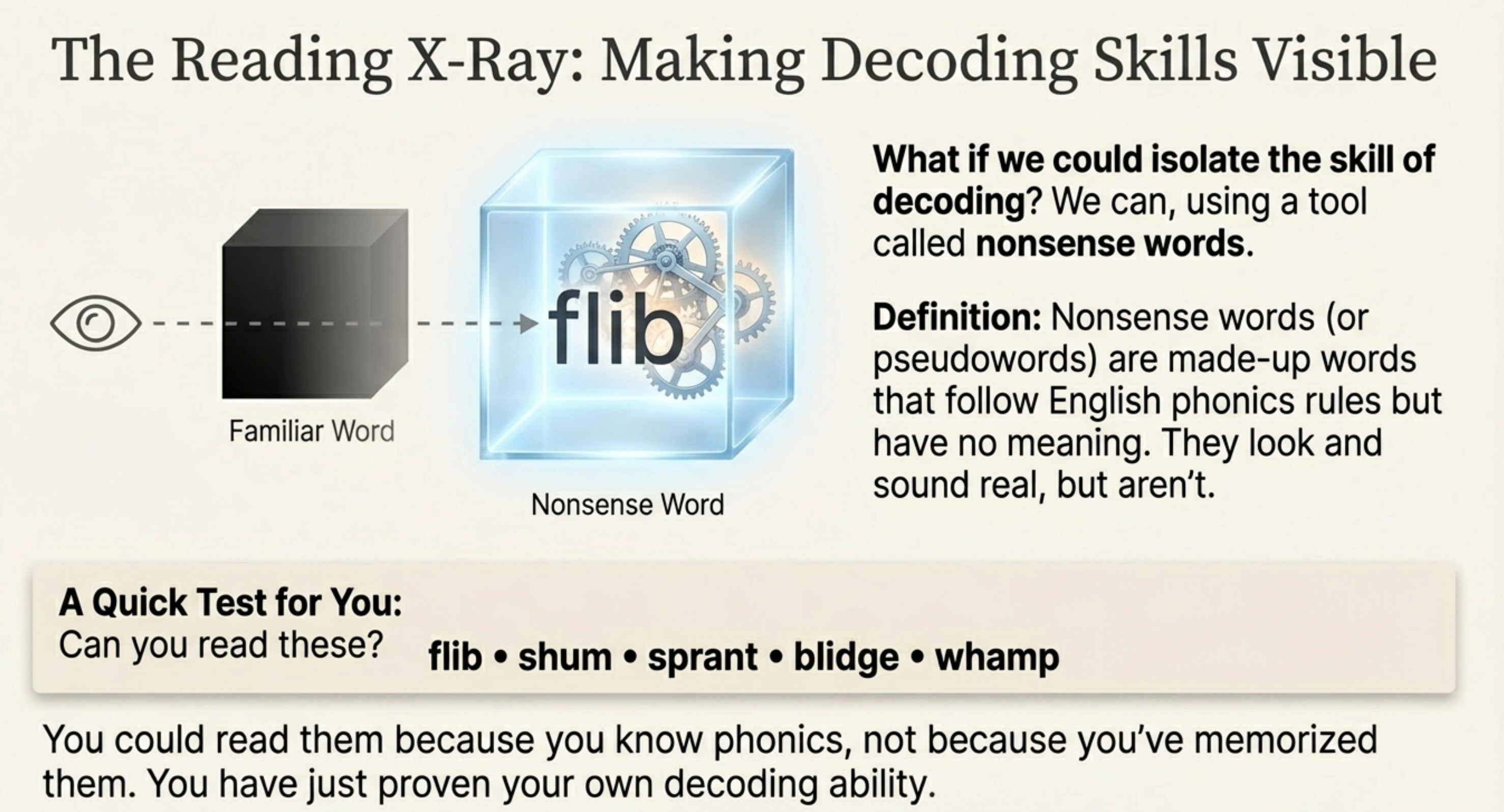
But when you ask students to read “flib,” there’s only ONE way they can do it: by using phonics to decode the letter-sound relationships.
They can’t memorize it (they’ve never seen it). They can’t guess from context (it has no meaning). They can’t recognize it as a sight word (it doesn’t exist).
Nonsense words force students to demonstrate true decoding skill—the ability to apply phonics knowledge to ANY word, familiar or unfamiliar.
This is why nonsense words are the gold standard for assessing whether someone actually knows the phonics code, or whether they’re just good at memorizing and guessing.
The Science Behind Nonsense Words

What Research Shows

Decades of reading research have established that nonsense word reading is one of the strongest predictors of reading ability. Here’s what the science tells us:
1. Nonsense Words Measure Phonological Decoding
Brain imaging studies show that when proficient readers encounter unfamiliar words, they activate specific neural pathways for phonological processing—mapping letters to sounds and blending them. Nonsense words isolate this exact skill.
2. They Predict Future Reading Success
Students who can decode nonsense words in early grades show significantly better reading comprehension in later grades. Why? Because they have the foundational skill needed to tackle unfamiliar vocabulary in advanced texts.
3. They Identify Students at Risk
Students who can read familiar words but struggle with nonsense words are relying on memorization, not decoding. These students hit a “wall” in third or fourth grade when texts contain too many unfamiliar words to memorize.
4. They Separate True Dyslexia from Other Reading Difficulties
Difficulty with nonsense words, even when real word reading is adequate, is a hallmark sign of dyslexia. It indicates a phonological processing deficit that requires specialized intervention.
The Matthew Effect in Reading
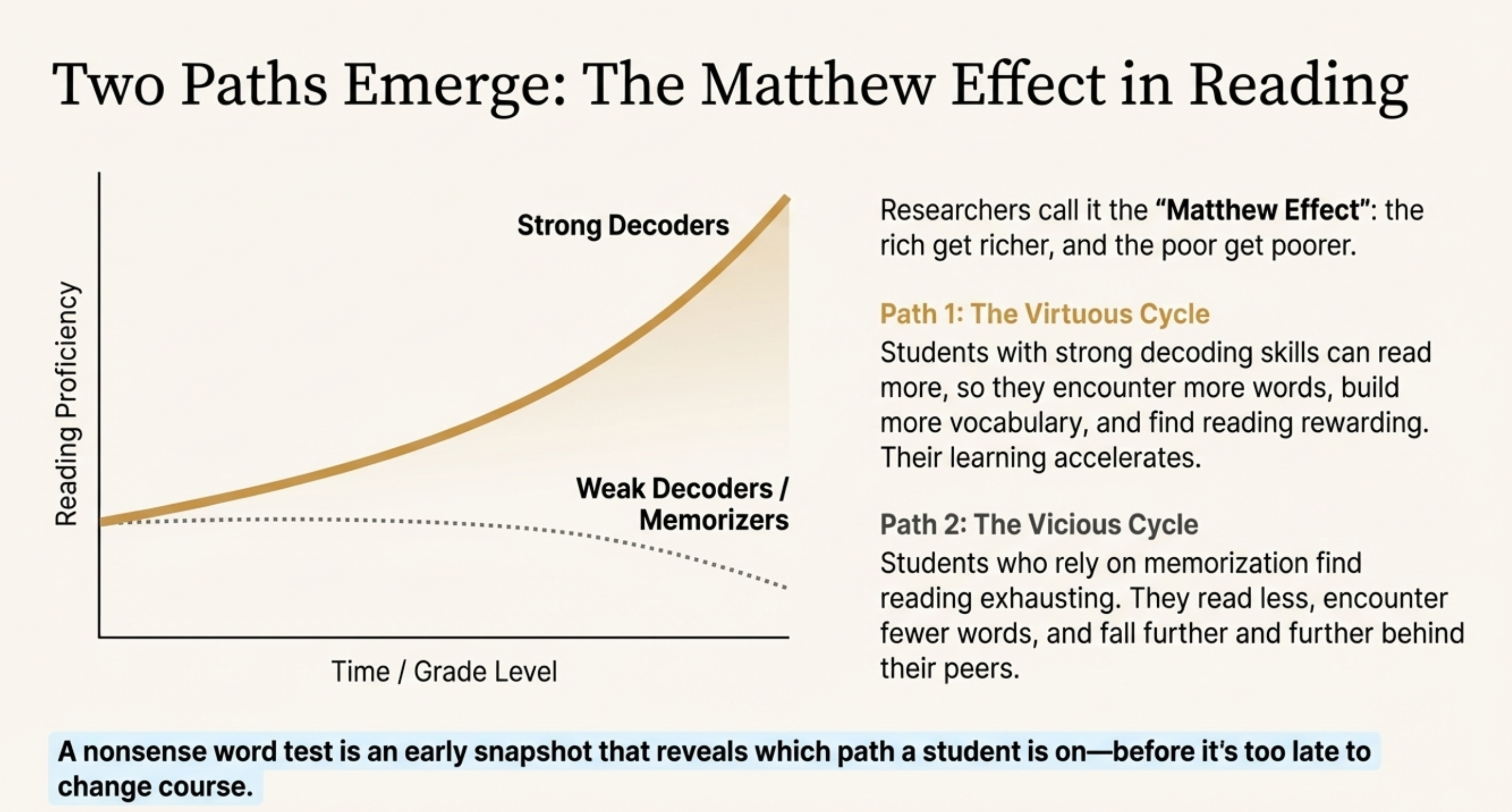
Researchers have documented what’s called the “Matthew Effect” in reading: students with strong decoding skills read more, encounter more words, and accelerate their learning. Students who rely on memorization read less (because it’s exhausting), encounter fewer words, and fall further behind.
Nonsense words reveal which trajectory a student is on—before the gap in reading proficiency becomes overwhelming.
How Nonsense Words Expose Hidden Reading Problems
The “Good Memorizer” Who Can’t Really Read
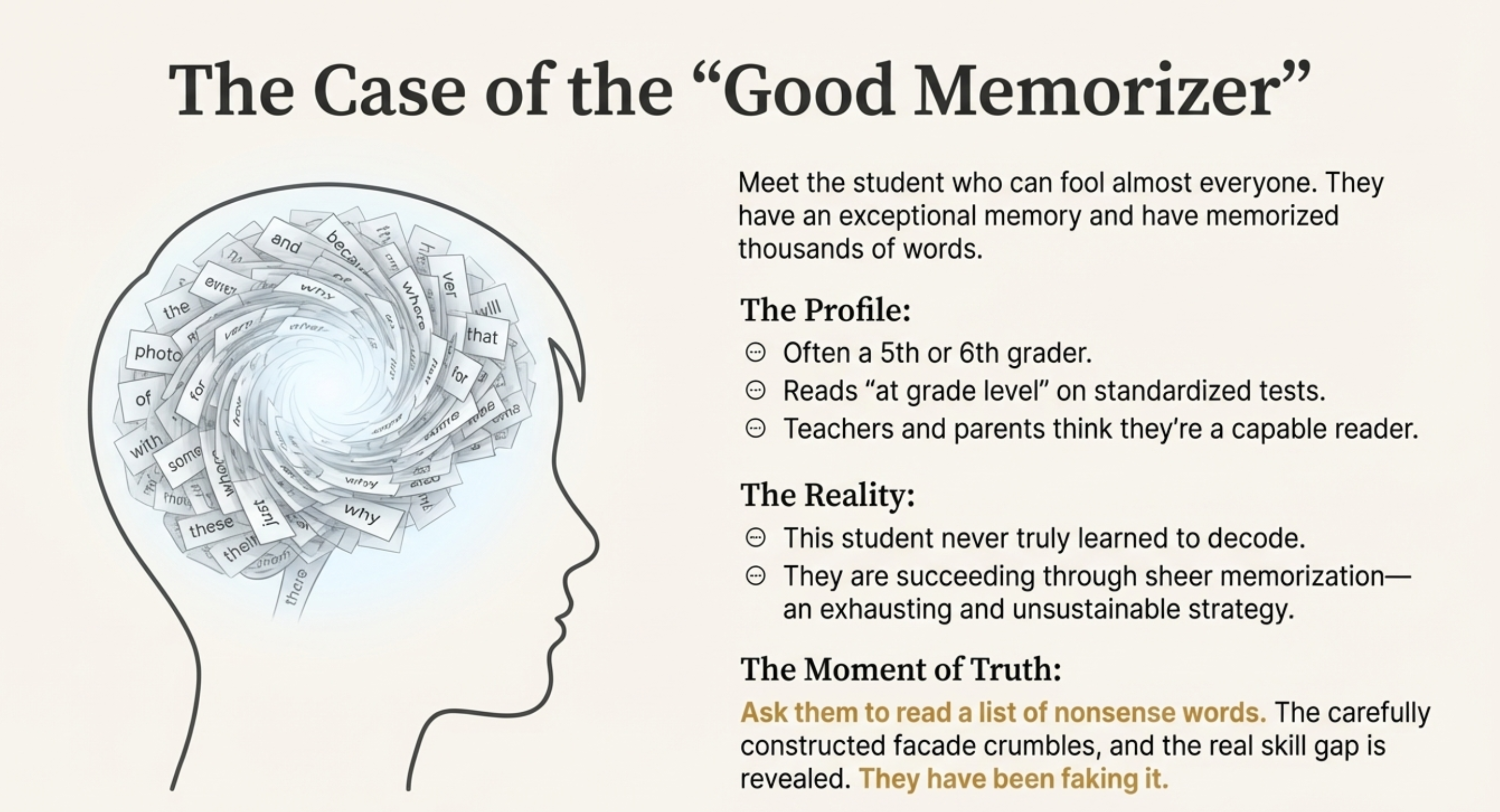
Consider this common scenario:
A fifth-grade student reads at grade level on standardized tests. Teachers think she’s fine. But she struggles with:
- Reading unfamiliar names in books
- Sounding out words in science textbooks
- Spelling even simple words correctly
- Reading fluently without exhaustion
What’s happening? She has an exceptional memory and has memorized thousands of words. But she never learned to decode. She’s succeeding through sheer memorization—an exhausting, unsustainable strategy.
Ask her to read nonsense words, and the truth emerges: she can’t decode unfamiliar letter patterns. She’s been faking it.
Why Older Students and Adults Especially Need Nonsense Words
The Memorization Ceiling
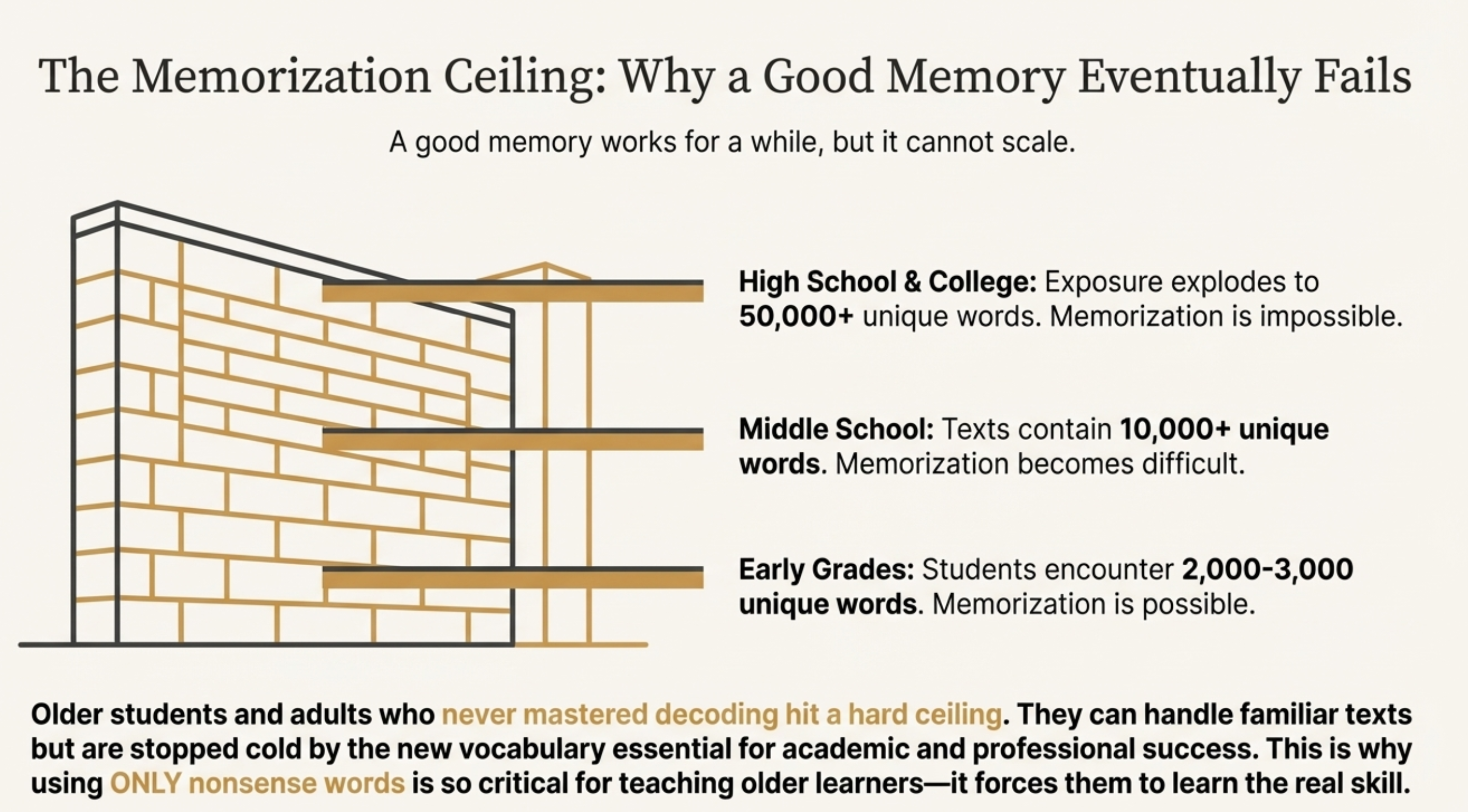
Younger students typically encounter 2,000-3,000 words in their reading materials. A student with a good memory can memorize these and appear to be reading fine.
But by middle school, students encounter 10,000+ words. By high school and college, texts contain 50,000+ unique words. No one can memorize them all.
Older students and adults who never learned to decode hit a ceiling. They can handle familiar texts but panic when faced with:
- Technical vocabulary in workplace documents
- Medical terminology at doctor’s offices
- Academic language in GED or college courses
- Unfamiliar names and places in news articles
Why We Use Nonsense Words with Older Students

When teaching phonics to sixth graders, high schoolers, or adults, asking them to read words like “cat,” “dog,” and “sit” is counterproductive. They memorized these words in first grade.
Two problems emerge:
1. False Confidence: Students think they’re mastering phonics when they’re actually just recalling memorized words. They don’t realize they’re not learning the actual decoding skill.
2. Premature Dismissal: Older students often conclude “this program is too easy” and quit before they’ve actually learned systematic decoding. They abandon instruction precisely when they need it most.
By using nonsense words in the first half of our program, we ensure older students must engage with the actual phonics code—no shortcuts, no memorization, no guessing.
How Our Program Uses Nonsense Words Systematically
Integrated Throughout 369 Lessons
Our curriculum includes nonsense words extensively in Sections One and Two (the first 369 lessons), representing approximately half the program. This isn’t random—it’s strategically designed.
Lesson Structure:
- Reading Practice: Half real words, half nonsense words
- Spelling Dictation: Heavy emphasis on nonsense words
- Mastery Quizzes: Nonsense words prove true understanding
Watch: How Nonsense Words Are Introduced
Click Here to View Video Transcript.
In Lesson 9, students learn the concept of nonsense words and why they’re essential for proving phonics knowledge. The above videos show exactly how we introduce this concept and walk students through their first encounter with a lesson containing nonsense words.
Progressive Complexity
Our nonsense words follow the same systematic progression as real words:
Early Lessons (1-100):
- Simple CVC patterns: flib, zot, mup
- Short vowels only
- 3-4 sounds per word
Middle Lessons (101-253):
- Consonant blends: sprant, blidge
- Digraphs: shum, whamp, choff
- More complex patterns
Later Lessons (254-369):
- Vowel teams: spraint, bloach
- Vowel Patterns: tade, soak, verd
- More complex spelling patterns
Each nonsense word is carefully constructed to test only patterns students have been explicitly taught—never asking them to decode what they haven’t learned.
Experience Nonsense Words in Our Lessons
Try our first 10 lessons free and see how nonsense words build true decoding skills from day one.
Start Your 10 Free Lessons →
Addressing Common Objections to Nonsense Words
“But These Aren’t Real Words! What’s the Point?”
That’s exactly the point. Real words can be memorized. Nonsense words prove you know the code.
Think of it this way: if you’re learning to play piano, you don’t just memorize one song. You learn to read music notation so you can play ANY song. Nonsense words are like sight-reading music—they prove you understand the underlying system, not just individual pieces.
“My Child Finds Them Frustrating”
Frustration often indicates the student has been relying on memorization or guessing. Nonsense words expose this gap, which feels uncomfortable at first.
But here’s the good news: within weeks of systematic practice, students develop confidence with nonsense words because they’re actually learning the code. The frustration transforms into empowerment.
Students tell us: “I can read words I’ve never seen before!” That’s the moment they realize they’re becoming real readers.
“Won’t This Confuse My Student About Real vs. Fake Words?”
Research shows this doesn’t happen. Students easily understand that some words are practice words and some are real words. In fact, many students enjoy the challenge of decoding nonsense words.
What DOES confuse students is trying to memorize thousands of words without understanding the phonics patterns that make them readable.
“Can’t I Just Skip the Nonsense Words?”
You can, but you’ll lose the diagnostic power. You won’t know if your student is actually decoding or just memorizing.
For younger students working through early phonics, mixing real and nonsense words works well. For older students and adults, we strongly recommend a heavy emphasis on nonsense words for decoding and spelling practice in the first half of the program.
Nonsense Words for Spelling: The Other Side of the Coin
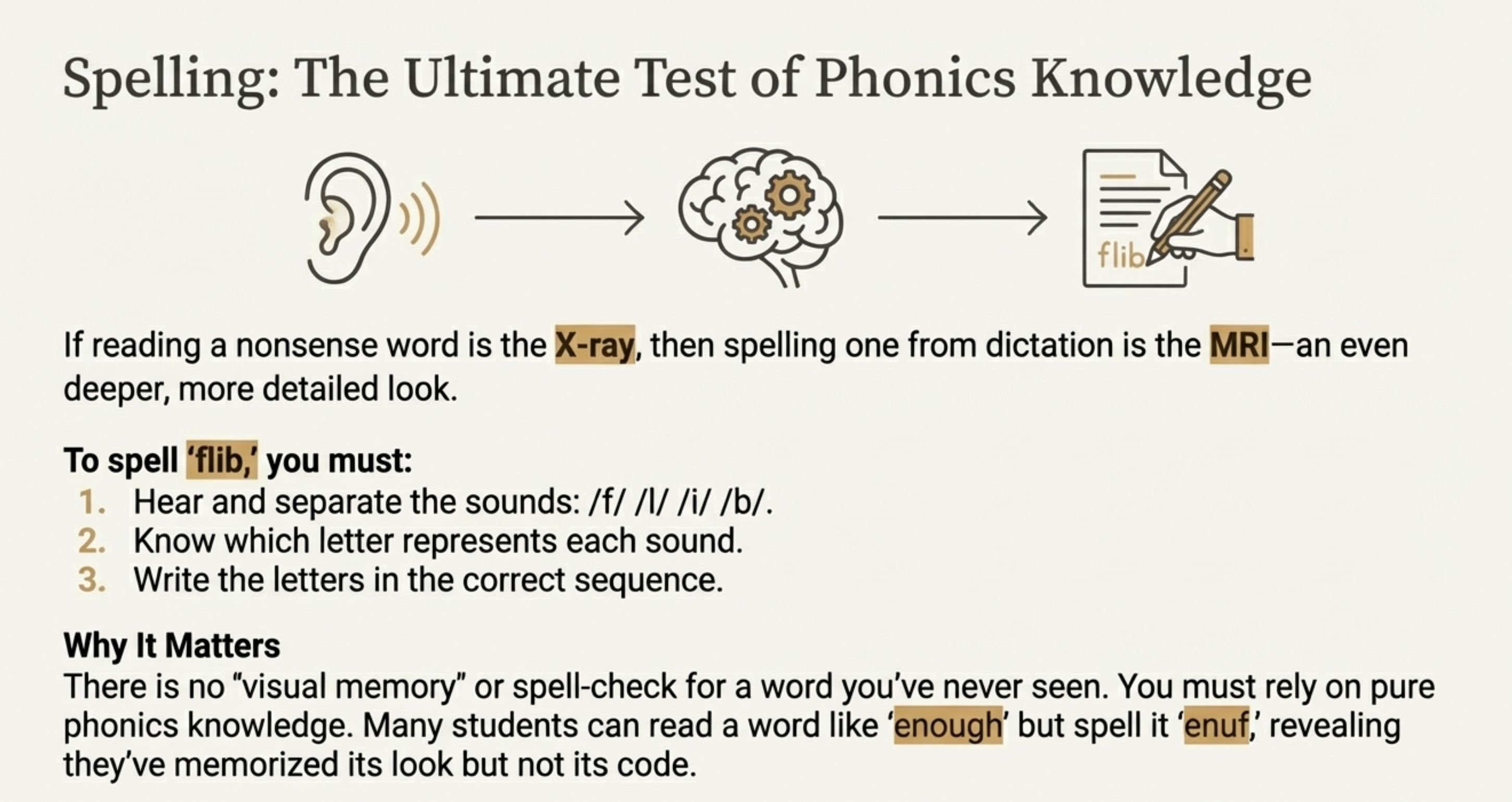
Encoding Reveals Even More
If nonsense word READING proves decoding skill, nonsense word SPELLING proves encoding skill—and encoding is even more demanding.
When you spell a nonsense word like “flib,” you must:
- Hear and segment the individual sounds (/f/ /l/ /i/ /b/)
- Know which letter(s) represent each sound
- Choose the correct spelling when multiple options exist
- Write the letters in the correct sequence
There’s no spell-check in your brain for nonsense words. You can’t rely on visual memory (“That doesn’t look right”). You must use pure phonics knowledge.
Why Spelling Dictation Uses Nonsense Words
Many students can read words they can’t spell. They recognize “enough” when they see it, but spell it “enuf” when asked to write it from dictation.
Why? They memorized what “enough” looks like (for reading) but never learned the sound-symbol relationships (for spelling).
Nonsense word spelling dictation forces students to learn the code in both directions: reading AND writing.
Learn more about the connection between reading and spelling:
The Spelling Code: Why Encoding Matters →
Nonsense Words in Assessment and Diagnosis

How Schools and Reading Specialists Use Nonsense Words
Nonsense words appear in virtually every research-based reading assessment:
DIBELS (Dynamic Indicators of Basic Early Literacy Skills)
Uses Nonsense Word Fluency (NWF) as a core measure of phonics skill in K-3.
CORE Phonics Survey
Includes extensive nonsense word reading to identify specific phonics gaps.
State Reading Tests
Many states include nonsense word sections in K-2 screening assessments.
Orton-Gillingham Assessments
All O-G-based evaluations use nonsense words to diagnose reading difficulties.
Dyslexia Screening Tools
Nonsense word reading difficulty is a key diagnostic indicator for dyslexia.
What Nonsense Word Performance Reveals
Strong nonsense word reading indicates:
- Solid phonemic awareness (ability to hear and manipulate sounds)
- Mastery of letter-sound correspondences
- Efficient phonological processing
- Strong foundation for future reading success
Weak nonsense word reading indicates:
- Gaps in phonics knowledge
- Reliance on memorization or context
- Need for systematic phonics intervention
- Potential risk for reading difficulties
Real-World Applications: When Nonsense Word Skill Matters
Every Day, You Encounter “Nonsense Words”
Think nonsense words are just for testing? Consider how often you need to decode unfamiliar letter combinations:
Medical contexts:
- Prescription drug names: Atorvastatin, Lisinopril, Gabapentin
- Medical conditions: Gastroesophageal, Fibromyalgia
- Anatomy terms: Sternocleidomastoid, Phalangeal
Professional contexts:
- Technical terminology in manuals
- Software and technology terms
- Industry-specific jargon
Academic contexts:
- Scientific vocabulary: Photosynthesis, Mitochondria
- Historical names and places
- Foreign language words in English texts
Daily life:
- Unfamiliar brand names
- Names of people from diverse backgrounds
- Place names when traveling
These aren’t nonsense words, but they’re unfamiliar words you’ve never memorized. If you can’t decode nonsense words, you can’t decode these real words either.
How to Practice Nonsense Words at Home
For Parents and Teachers
If you want to practice nonsense words with your student, follow these guidelines:
1. Start with Simple Patterns
Begin with CVC (consonant-vowel-consonant) nonsense words like “fip,” “lod,” “mup.” Don’t jump to complex patterns before mastering simple ones.
2. Use Only Taught Patterns
Only include letter combinations your student has been explicitly taught. Don’t ask them to guess at unfamiliar patterns.
3. Practice Both Reading and Spelling
Have students both read nonsense words (decode) and spell them from dictation (encode). Both skills are essential.
4. Explain the Purpose
Help students understand WHY they’re practicing nonsense words. Say: “These practice words prove you really know the phonics code, not just memorized words.”
5. Celebrate Success
When students master nonsense words, they’ve achieved something significant. Celebrate this milestone: “You can read ANY word now, even ones you’ve never seen!”
Creating Your Own Nonsense Words
You can create nonsense words for practice by:
- Following the patterns your student has learned
- Substituting different consonants or vowels in real words
- Ensuring the nonsense word could plausibly be a real English word
Examples:
- If “cat” is real, “dat” or “vat” could be nonsense practice
- If “ship” is real, “phip” or “thip” could be practice
- If “spring” is real, “sprink” could be nonsense practice
The Bottom Line on Nonsense Words
Nonsense words aren’t a gimmick or a quirky teaching tool. They’re the most reliable way to answer the fundamental question every reading teacher must ask:
“Does this student actually know how to decode, or are they faking it through memorization?”
For struggling readers of any age, nonsense words expose the gaps that memorization has been hiding. For proficient readers, nonsense words confirm that their skills are built on a solid phonics foundation.
And for teachers and parents, nonsense words provide the diagnostic clarity needed to target instruction effectively.
The goal isn’t to read nonsense words for their own sake. The goal is to develop the decoding skills that allow students to read ANY word—familiar or unfamiliar, real or invented—with confidence and accuracy.
That’s what it means to be literate. That’s what nonsense words help us teach. And that’s why they’re critical.
See How Nonsense Words Build Real Skills
Our systematic program integrates nonsense word practice from the very beginning. Experience how this builds true decoding and spelling ability—not just memorization.
Try 10 Free Lessons Now →
No credit card required • Start immediately
Related Resources:
- How to Sound Out Words: Complete Guide
- Teaching Phonemic Awareness: The Foundation
- Systematic Phonics Instruction
- The Spelling Code: Why Encoding Matters
- Short Vowels and Nonsense Words
- Orton-Gillingham Principles
Frequently Asked Questions
At what age should students start practicing nonsense words?
Students can begin nonsense word practice as soon as they’ve learned a few consonant sounds and one vowel sound—typically in kindergarten or first grade. Our program introduces nonsense words in Lesson 9, after students have learned basic consonant sounds and the short ‘a’ vowel.
How long does it take to get good at reading nonsense words?
With systematic daily practice, most students show significant improvement within 2-4 weeks. Students who initially find nonsense words frustrating typically become confident within one month of consistent practice.
My child can read real words but fails nonsense word tests. What does this mean?
This indicates your child is memorizing whole words rather than using phonics to decode. They need systematic phonics instruction to develop true decoding skills before the memorization strategy fails them in later grades.
Are nonsense words part of the Science of Reading?
Yes, absolutely. Research consistently shows that nonsense word reading is one of the strongest predictors of reading success and a key component of effective phonics assessment and instruction.
Do all reading programs use nonsense words?
No. Programs based on whole language or balanced literacy often avoid nonsense words, preferring authentic texts. But research-based programs following Orton-Gillingham, Science of Reading, or structured literacy approaches extensively use nonsense words for teaching and assessment.