Core Spelling Instruction
Integrated Phonics, Spelling, and Vocabulary Development
Effective literacy instruction requires systematic development of three interconnected core strands: phonics and decoding, spelling, and vocabulary. These aren’t separate skills taught in isolation—they’re deeply integrated components of comprehensive reading instruction that reinforce and strengthen each other throughout the learning process.
Our phonics program treats spelling as a core literacy strand equal in importance to reading and decoding. Students develop all three essential skills simultaneously through systematic, explicit instruction that reveals the logical structure underlying written English.
See Core Spelling Instruction in Action
Discover why systematic spelling instruction isn’t an add-on—it’s the other half of reading. Watch our visual guide that shows how strong readers can still struggle with spelling, and why integrated instruction changes everything.
What Is Core Spelling Instruction?
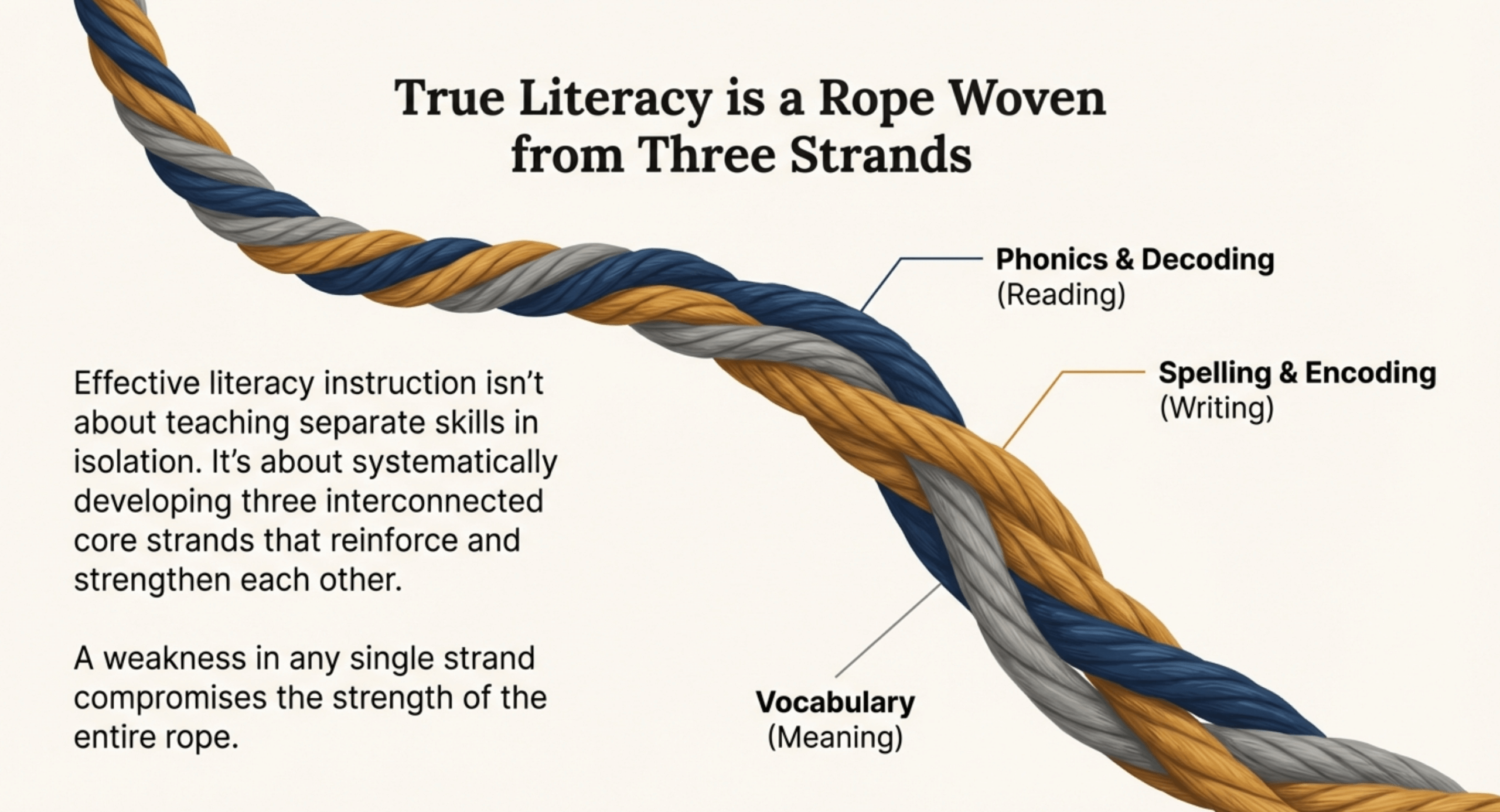
Core spelling instruction refers to systematic teaching of spelling as a fundamental literacy skill rather than as a secondary add-on to reading instruction. In this approach, spelling receives equal instructional time and emphasis alongside phonics and reading development.
Why “Core” Matters

The term “core” emphasizes that spelling isn’t optional or supplementary—it’s an essential component of literacy education. Students who receive core spelling instruction:
- Understand the logic of English spelling – Learn that spelling follows consistent, teachable patterns
- Develop stronger reading skills – Encoding (spelling) reinforces decoding (reading)
- Build deeper phonics knowledge – Representing sounds with letters strengthens sound-symbol understanding
- Improve writing abilities – Confident spellers write more freely and expressively
- Expand vocabulary – Learning to spell words includes learning their meanings

Traditional reading programs often treat spelling as memorization of word lists disconnected from phonics instruction. Core spelling instruction, in contrast, teaches spelling systematically as the reverse process of decoding—both built on the same phonetic foundation.
The Three Core Literacy Strands
Comprehensive literacy instruction develops three essential, interconnected strands simultaneously:

Strand 1: Phonics and Decoding (Reading)
Decoding is the process of looking at written words and accurately identifying them by associating sounds with letters and blending those sounds together. Students learn:
- Letter-sound correspondences
- How to blend sounds to read words
- Recognition of phonetic patterns
- Application of decoding skills to unfamiliar words
Strand 2: Spelling (Encoding)
Spelling reverses the decoding process. The word’s identity is already known—the challenge is representing that word accurately in writing. Students learn:
- How to segment words into individual sounds
- Which letters and letter combinations represent each sound
- Spelling patterns and rules
- How to map sounds to their correct written representations
Strand 3: Vocabulary Development
Vocabulary instruction teaches word meanings and builds the mental dictionary students use for both reading comprehension and written expression. Students develop:
- Understanding of word meanings in context
- Multiple vocabularies (oral, reading, spelling)
- Word relationships and connections
- Precise word usage in speaking and writing
How Spelling, Phonics, and Vocabulary Integrate

These three strands aren’t taught separately—they develop together through integrated instruction where each strand reinforces the others.
Spelling Reinforces Phonics
When students spell words, they must consciously apply their phonics knowledge in reverse. If a student has learned that the letter team “ai” represents the long /ā/ sound in reading, spelling words like “rain” and “train” requires applying that same knowledge actively. This encoding process deepens and solidifies phonics understanding far more effectively than reading alone.
Phonics Enables Spelling
Systematic phonics instruction provides the foundation for spelling success. Students who understand letter-sound relationships can spell phonetically regular words they’ve never seen before. Rather than memorizing thousands of words by sight, students apply phonetic principles to spell logically and accurately.
Vocabulary Enriches Both
Vocabulary development occurs naturally during spelling and phonics instruction. When students spell a word, they encounter it in a meaningful sentence that illustrates its usage. When they read new words, they add those words to their mental lexicon. The three strands build together, creating a comprehensive literacy foundation.
Is Spelling Part of Phonics or Vocabulary?
This common question reveals a misunderstanding about how literacy skills relate to each other. The answer: spelling is intrinsically connected to both phonics and vocabulary, but it’s also a distinct skill deserving focused instruction.
Spelling’s Relationship to Phonics
Spelling and phonics are opposite ends of the same process:
- Phonics (Decoding): Seeing letters → Identifying sounds → Blending to read words
- Spelling (Encoding): Hearing/knowing word → Identifying sounds → Writing letters to represent sounds
Both skills rely on understanding the alphabetic principle—the relationship between letters and the sounds they represent. Strong phonics instruction creates strong spellers, and spelling practice reinforces phonics knowledge.
Spelling’s Relationship to Vocabulary
Spelling and vocabulary connect because every spelling activity involves word meaning:
- Words are dictated within meaningful sentences, not in isolation
- Students hear and understand word meanings as they spell
- Context sentences demonstrate proper word usage
- Spelling vocabulary develops—pronunciations that match spellings
A student spelling the word “accommodate” in the sentence “The hotel can accommodate fifty guests” simultaneously practices spelling skills and vocabulary development.
Why Spelling Takes Longer to Master Than Reading

Many students decode words accurately months or even years before they spell those same words correctly. This isn’t unusual—spelling naturally requires more time to master than reading for several important reasons:
Spelling Demands Perfect Accuracy
In reading, a student can use context clues alongside phonics knowledge to identify words. If a reader encounters “restaurant” and decodes most of the sounds correctly, surrounding context helps confirm the word’s identity. But in spelling, there are no context clues. Every single letter must be correct—there’s no such thing as spelling a word “almost right.”
Spelling Requires Active Production
Reading is a receptive skill—students recognize patterns they’ve seen before. Spelling is a productive skill—students must actively generate the correct letter sequence from memory and phonetic knowledge. Production always requires more cognitive processing than recognition.
English Spelling Includes Complexities
Many English words contain spelling patterns that don’t match their pronunciation in casual speech. The word “restaurant” is pronounced /res-tuh-ront/ in conversation, but spelled with clear vowels in unaccented syllables. Students must develop a “spelling vocabulary”—pronunciations that match actual spellings rather than conversational pronunciations.
Despite these challenges, systematic spelling instruction based on phonetic principles enables students to become confident, capable spellers.
Our Approach to Core Spelling Instruction
Systematic and Explicit Teaching
Our program teaches spelling systematically alongside phonics from the very first lesson. Students don’t just read words—they spell them. Half of instructional time consists of spelling dictation where students:
- Hear a word spoken clearly
- Identify the number of sounds in the word
- Determine which letters represent each sound
- Write the word, tracking each sound with appropriate letters
- Hear the word used in a meaningful sentence
This systematic approach builds spelling proficiency step by step, ensuring students understand the logical principles underlying English spelling.
Understanding Over Memorization

The key to spelling mastery is understanding that spelling isn’t primarily about memorization—it’s about segmenting sounds and matching them to letters. We literally use letters to map the individual sounds in words.
Students learn to:
- Segment words into individual phonemes (sounds)
- Associate each sound with its correct letter or letter team
- Apply spelling rules and generalizations
- Recognize patterns across word families
- Understand why English words are spelled as they are
This understanding-based approach is far more powerful than rote memorization of word lists.
Integrated Phonics and Spelling

Every phonics lesson includes spelling practice. When students learn that “ch” represents the /ch/ sound in reading, they immediately practice spelling words with “ch.” When they learn to read words with the long /ā/ sound spelled “ai” and “ay,” they practice spelling words using both patterns.
This tight integration ensures that decoding and encoding skills develop together, reinforcing each other at every step.
Success with Integrated Spelling Instruction
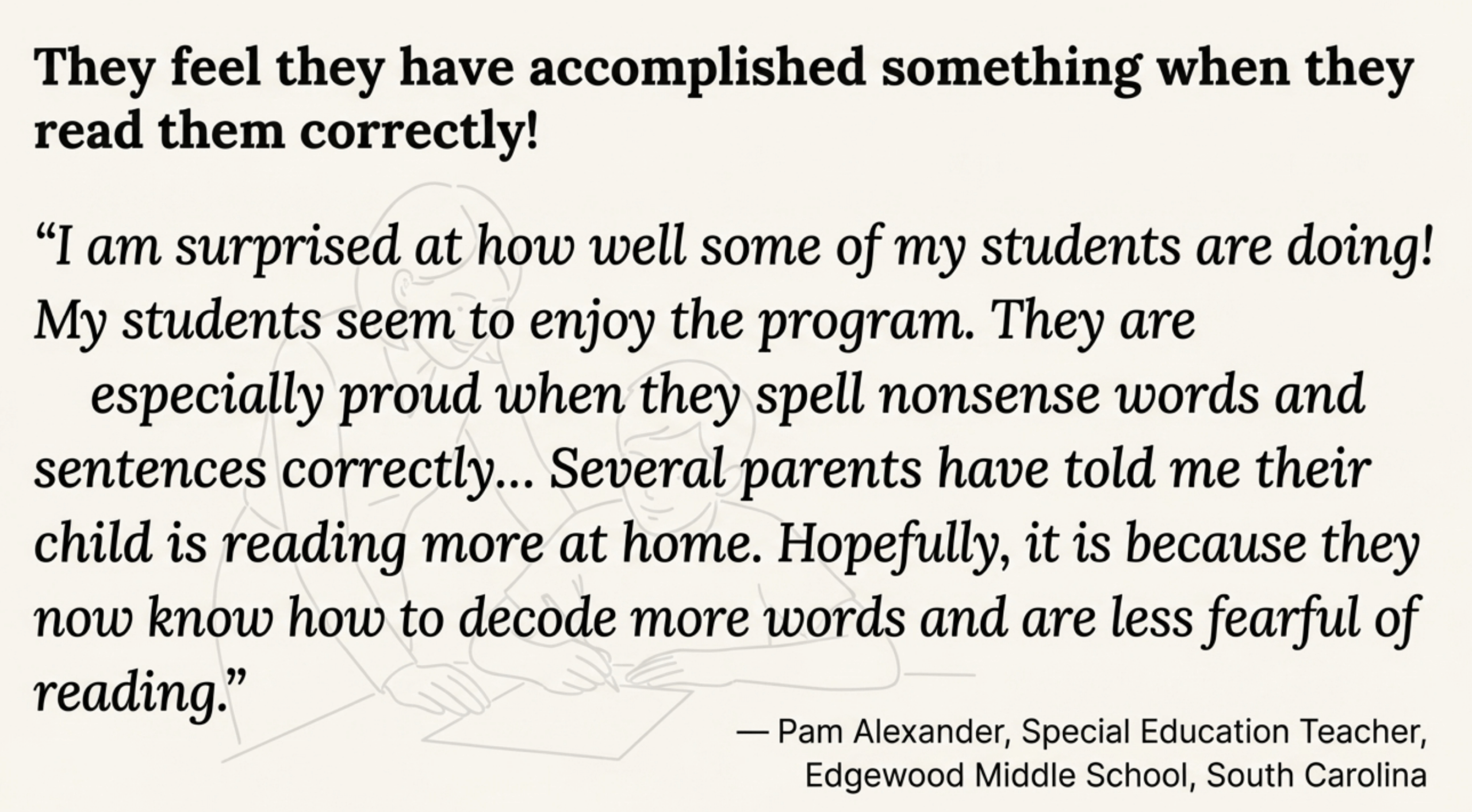
“They are especially proud when they spell nonsense words and sentences correctly!”
“I am surprised at how well some of my students are doing! My students seem to enjoy the program. They are especially proud when they spell nonsense words and sentences correctly. I bought small white boards for each of them. They do not use the boards for any other purpose than writing their words and sentences, so it seems like a treat to them.
They all want to read the nonsense words! They feel they have accomplished something when they read them correctly! I have shown many of the parents what we are doing and they are very excited. Several parents have told me their child is reading more at home. Hopefully, it is because they now know how to decode more words and are less fearful of reading.”
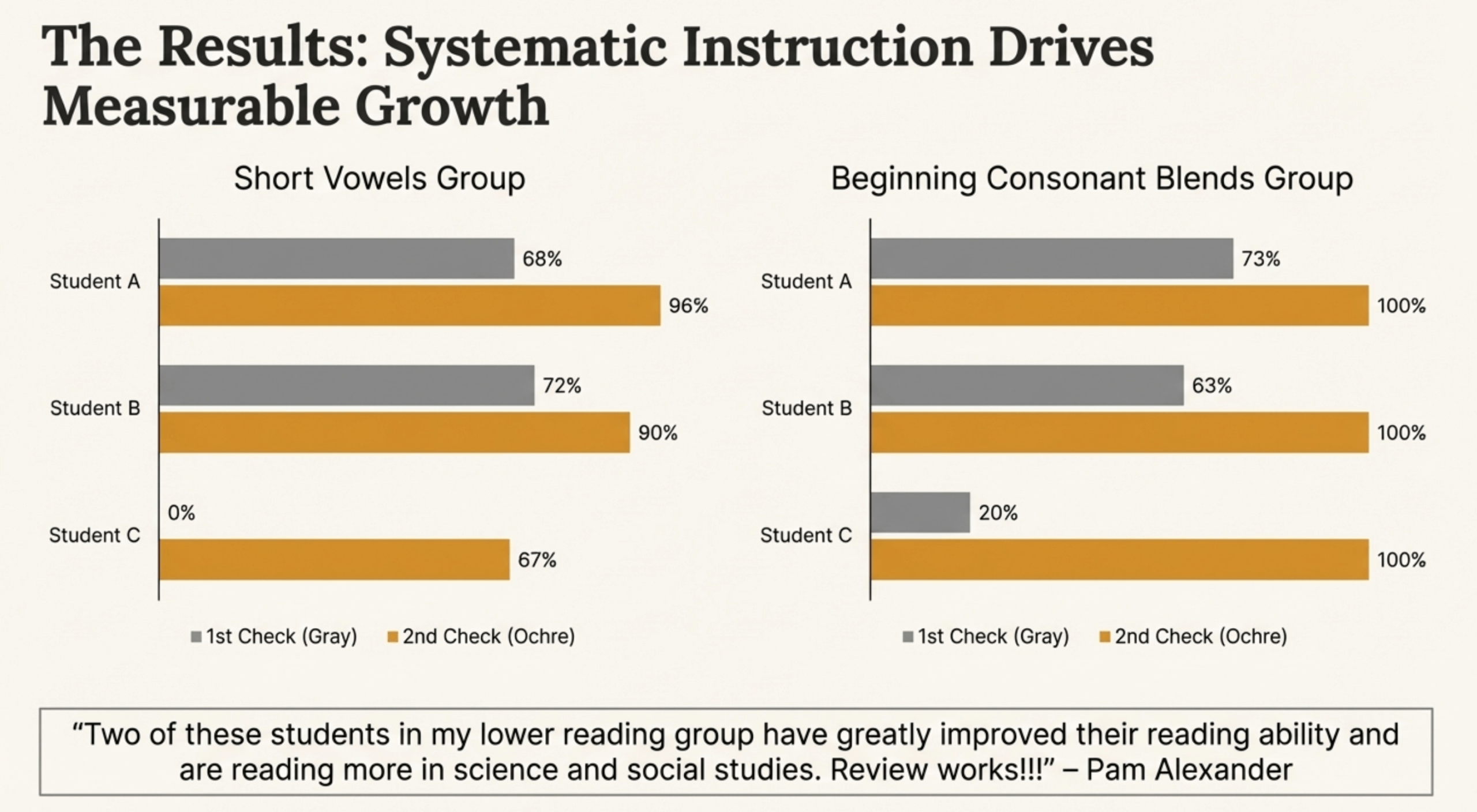
Post-Testing Results:
Short Vowels Group:
1st Check → 2nd Check
68% → 96%
72% → 90%
0% → 67% (student reading at K-1st grade level showed measurable improvement!)
Beginning Consonant Blends Group:
1st Check → 2nd Check
73% → 100%
63% → 100%
20% → 100%
“Two of these students in my lower reading group have greatly improved their reading ability and are reading more in science and social studies. Review works!!!”
— Pam Alexander, Special Education Teacher, Edgewood Middle School, South Carolina
Complete Curriculum Coverage
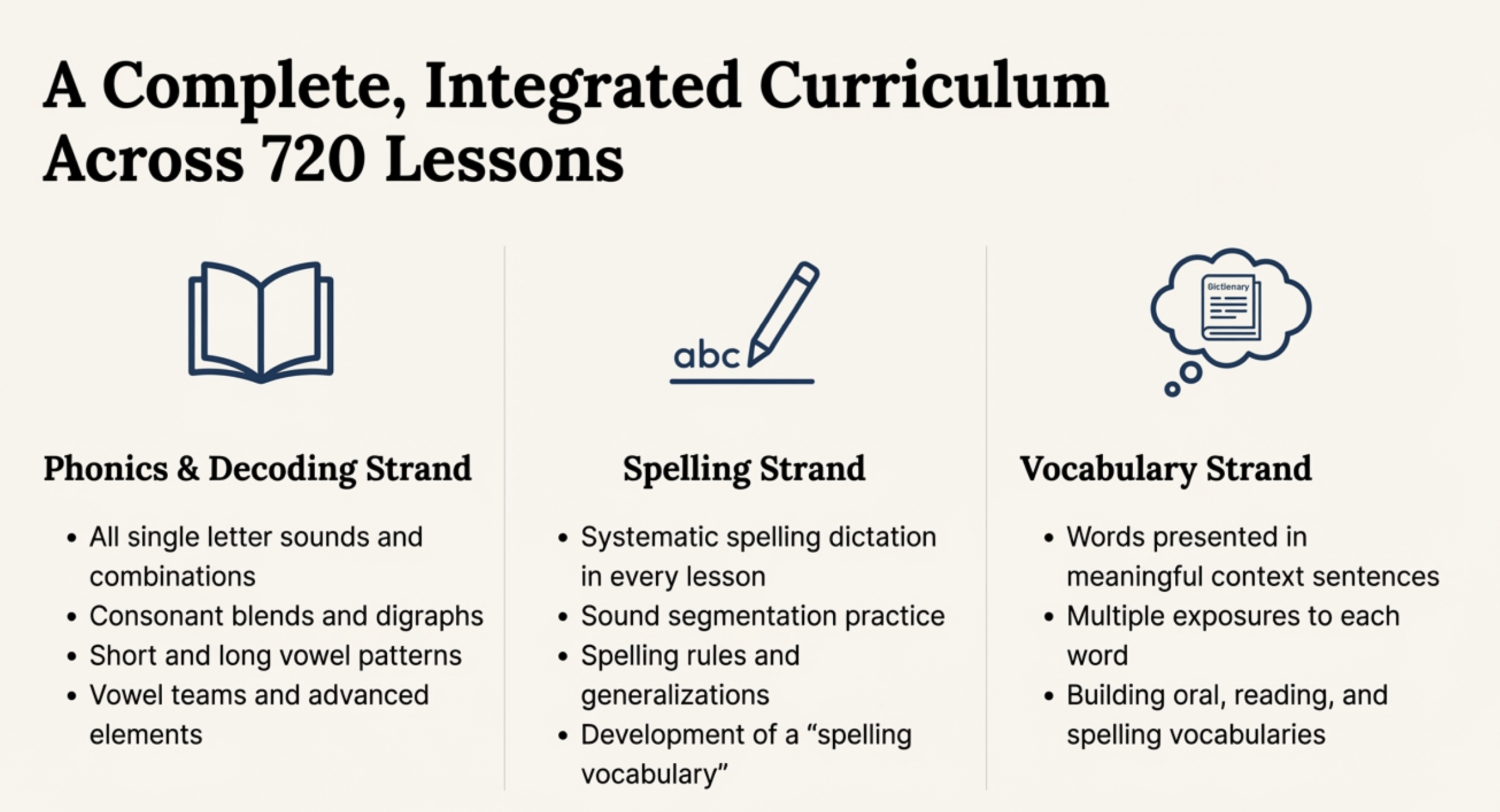
Our 720-lesson program provides comprehensive instruction across all three core literacy strands:
Phonics and Decoding Strand
- All single letter sounds and letter combinations
- Consonant blends and digraphs
- Short and long vowel patterns
- Vowel teams and diphthongs
- Advanced phonetic elements
Spelling Strand
- Systematic spelling dictation in every lesson
- Sound segmentation practice
- Spelling rules and generalizations
- Pattern recognition across word families
- Development of spelling vocabulary
Vocabulary Strand
- Words presented in meaningful context sentences
- Age-appropriate vocabulary throughout
- Multiple exposures to each word
- Understanding of word usage and meaning
- Building oral, reading, and spelling vocabularies
Spelling as a Foundation for Writing

Confident spellers become confident writers. Students who struggle with spelling often avoid writing because every sentence becomes an exercise in frustration. When students master spelling through systematic instruction, writing becomes a tool for expression rather than a source of anxiety.
Our approach helps students:
- Write more freely without constant spelling concerns
- Focus on content and ideas rather than mechanics
- Develop confidence in written expression
- Expand their written vocabulary to match their oral vocabulary
- Produce longer, more complex written work
Start Developing Core Literacy Skills Today
Try 10 Lessons Completely Free
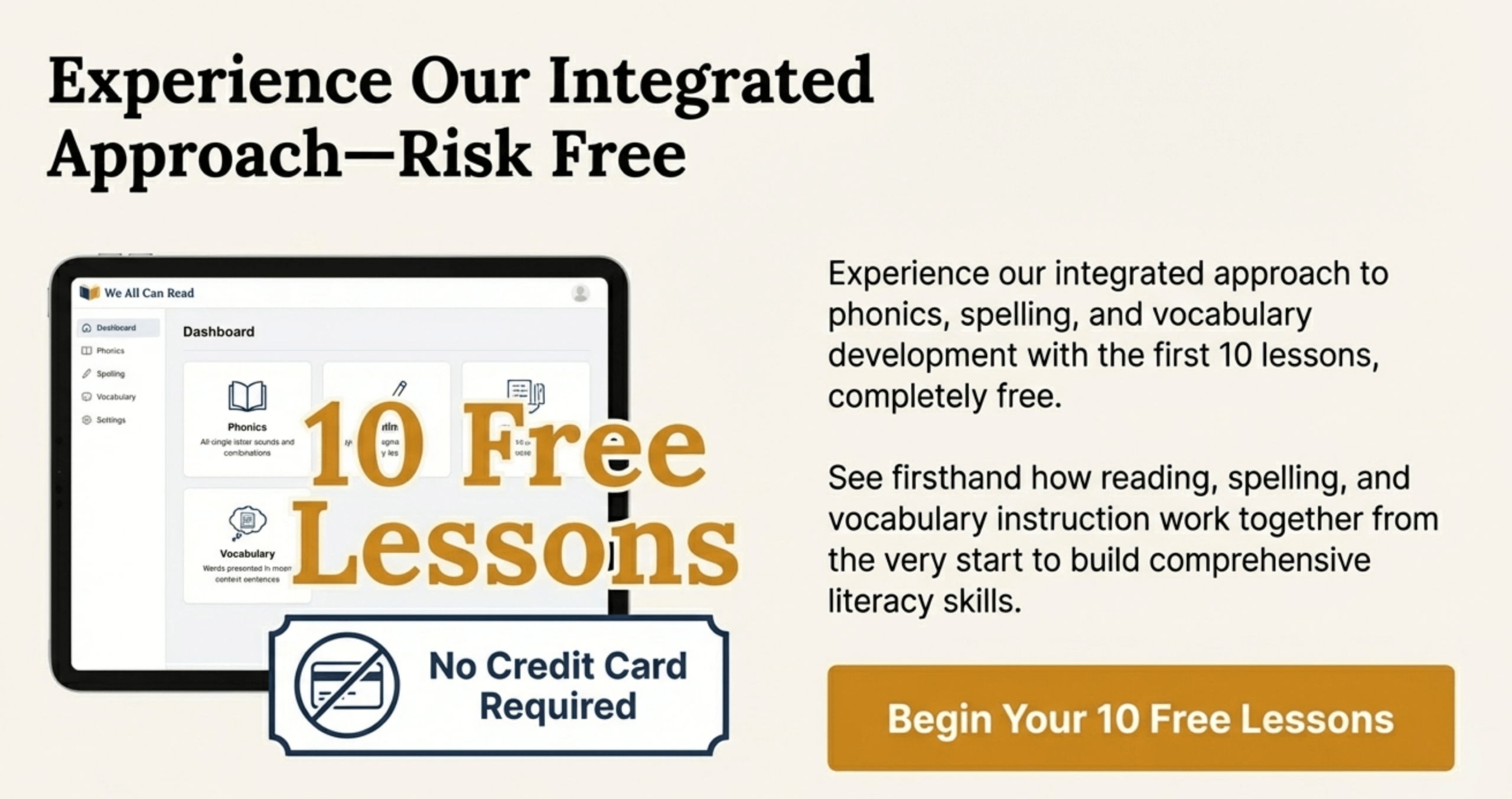
Experience our integrated approach to phonics, spelling, and vocabulary development with the first 10 lessons free—no credit card required. These introductory lessons demonstrate how reading, spelling, and vocabulary instruction work together to build comprehensive literacy skills.
Full Program Access: $73/Month
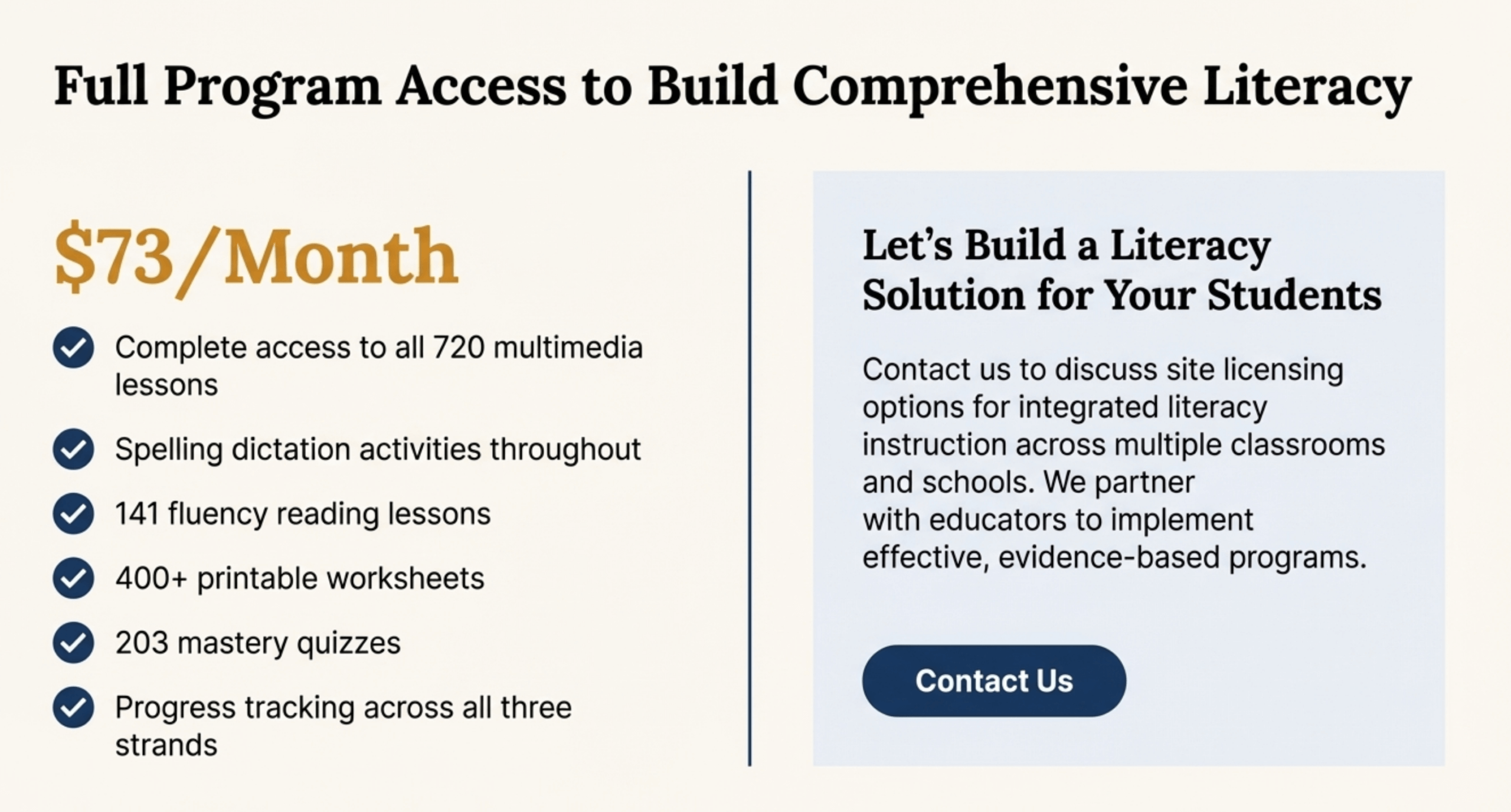
Complete access to all three literacy strands across 720 systematic lessons:
- 720 multimedia lessons teaching phonics, spelling, and vocabulary
- Spelling dictation activities throughout entire curriculum
- 141 fluency reading lessons with controlled vocabulary
- 400+ printable spelling and writing worksheets
- 203 mastery quizzes ensuring comprehension
- Progress tracking across all three strands
For schools: Contact us about licensing options for integrated literacy instruction across multiple classrooms.
Questions about core spelling instruction? Contact us or read more success stories.
Learn more: Explore Orton-Gillingham principles and systematic phonics instruction