Teach Spelling at Each Step
Why Spelling and Reading Must Be Taught Together
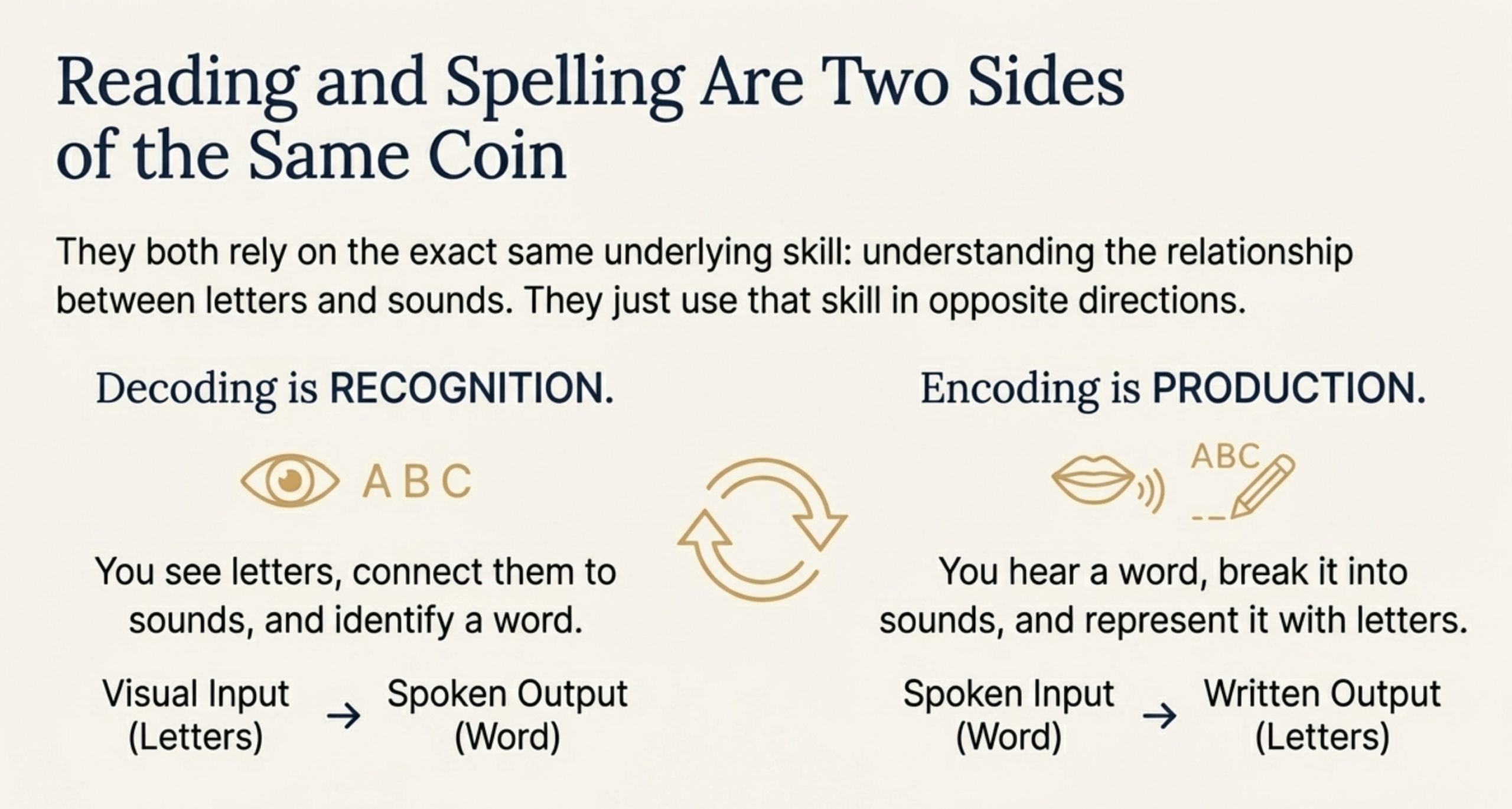
Most struggling readers receive reading instruction without corresponding spelling practice. This is a critical mistake. Spelling (encoding) and reading (decoding) are opposite sides of the same coin—both rely on understanding the relationship between letters and sounds. Teaching one without the other is like trying to teach someone to catch a ball without ever letting them throw it.
Research proves that spelling instruction accelerates reading development. Students who practice spelling words alongside reading them develop deeper phonics knowledge, stronger word recognition, and better reading comprehension than students who only practice reading.
Understanding Encoding vs. Decoding
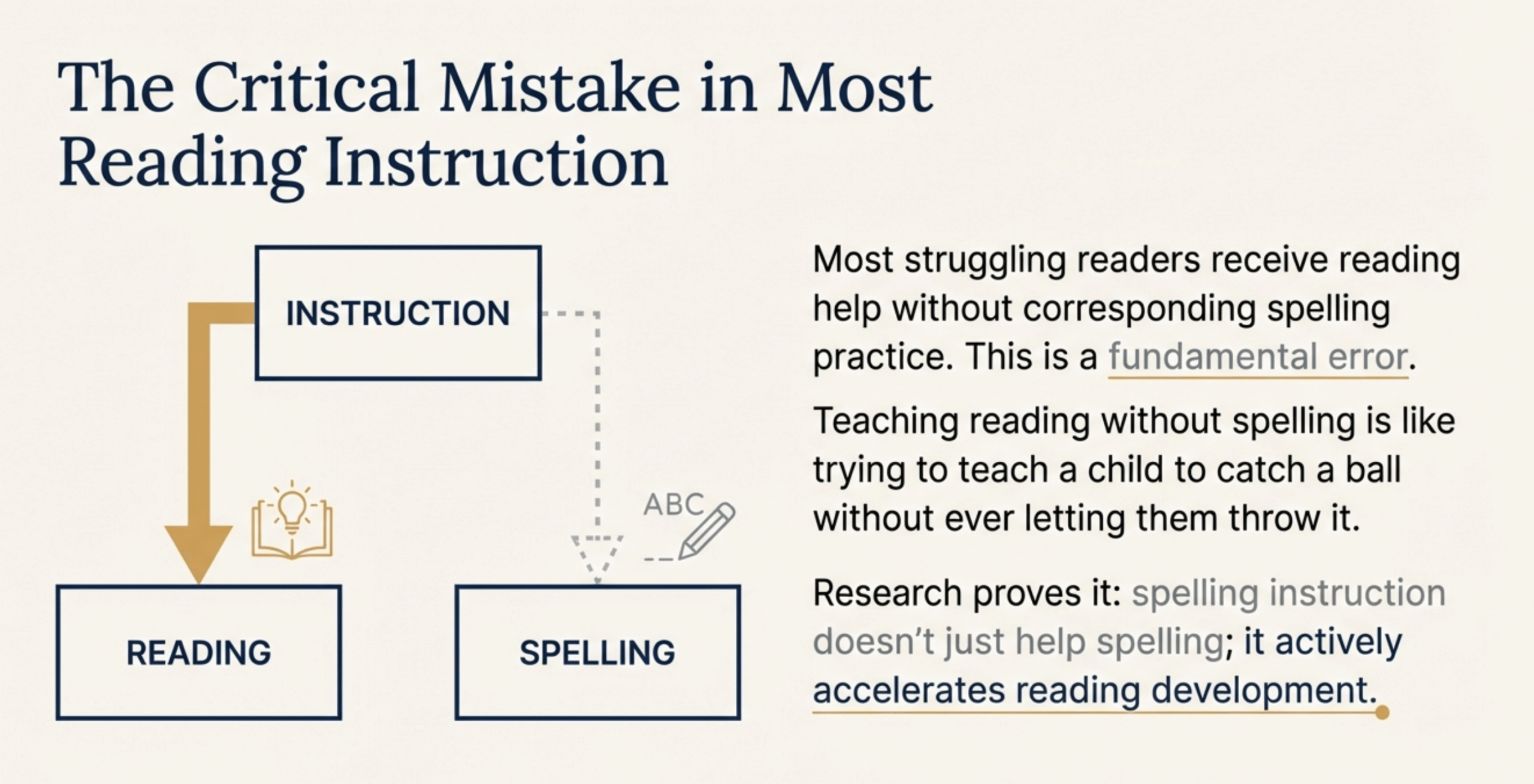
Decoding (Reading) Is Recognition
When your child reads, they:
- See letters on the page
- Associate sounds with those letters
- Blend sounds together to identify the word
- Recognize the word’s meaning
Decoding moves from visual input (letters) to spoken output (word pronunciation). The student starts with the written word and works toward identifying it.
Encoding (Spelling) Is Production
When your child spells, they:
- Hear a word spoken (or think of a word they want to write)
- Segment the word into individual sounds (phonemes)
- Determine which letters represent each sound
- Write those letters in correct sequence
Encoding moves from spoken input (word pronunciation) to written output (letters). The student starts knowing the word’s identity and must represent it accurately in writing.
Why Both Skills Are Essential
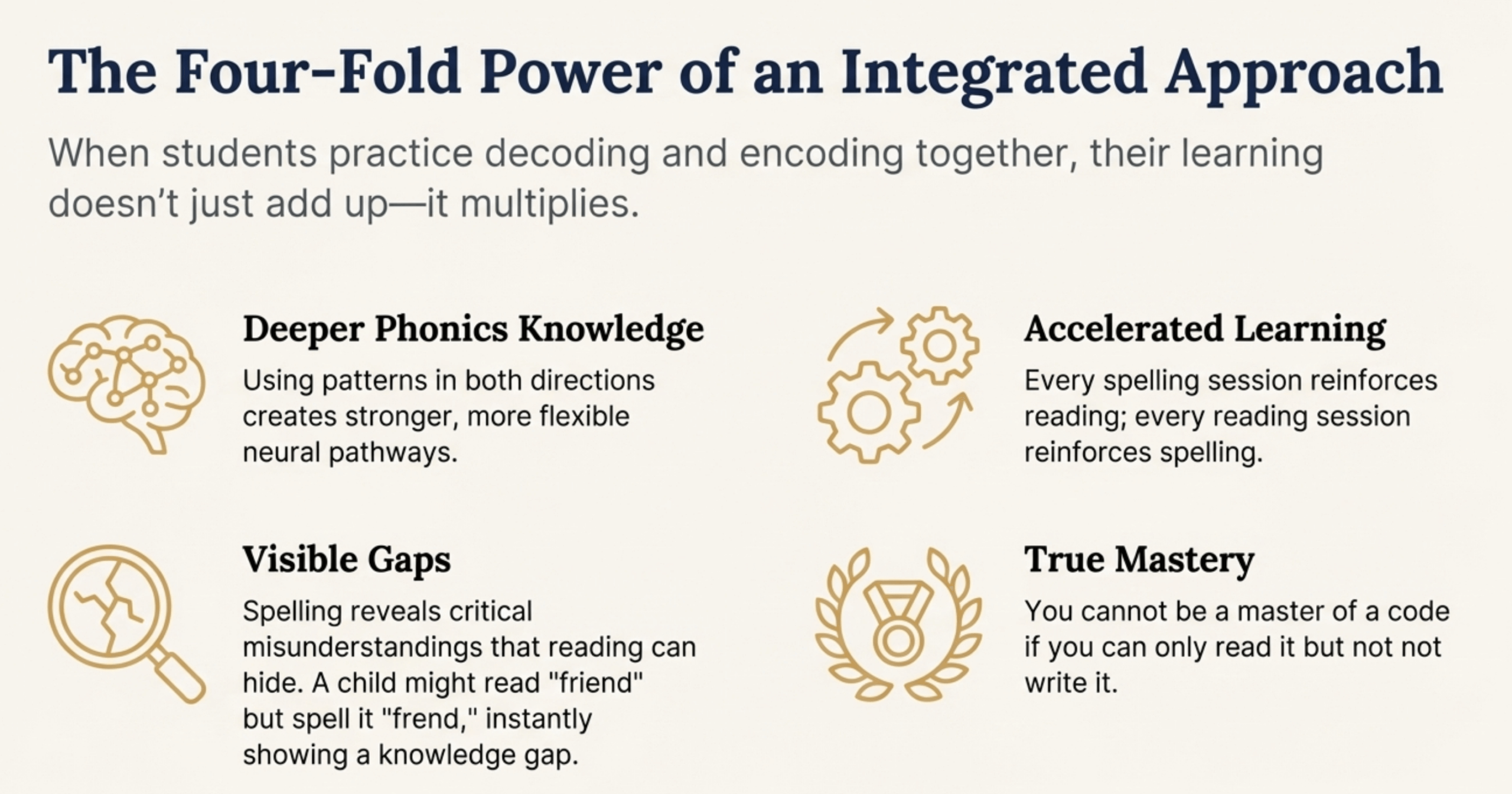
Decoding and encoding use the same phonics knowledge but in opposite directions. When students practice both:
- ✅ Phonics knowledge deepens – Using patterns in both directions creates stronger neural pathways
- ✅ Learning accelerates – Each spelling session reinforces reading; each reading session reinforces spelling
- ✅ Gaps become visible – Spelling reveals misunderstandings hidden during reading (students might read “friend” correctly but spell it “frend”)
- ✅ Mastery develops – True phonics mastery means applying knowledge in both encoding and decoding
The Science: Spelling Is Not Memorization
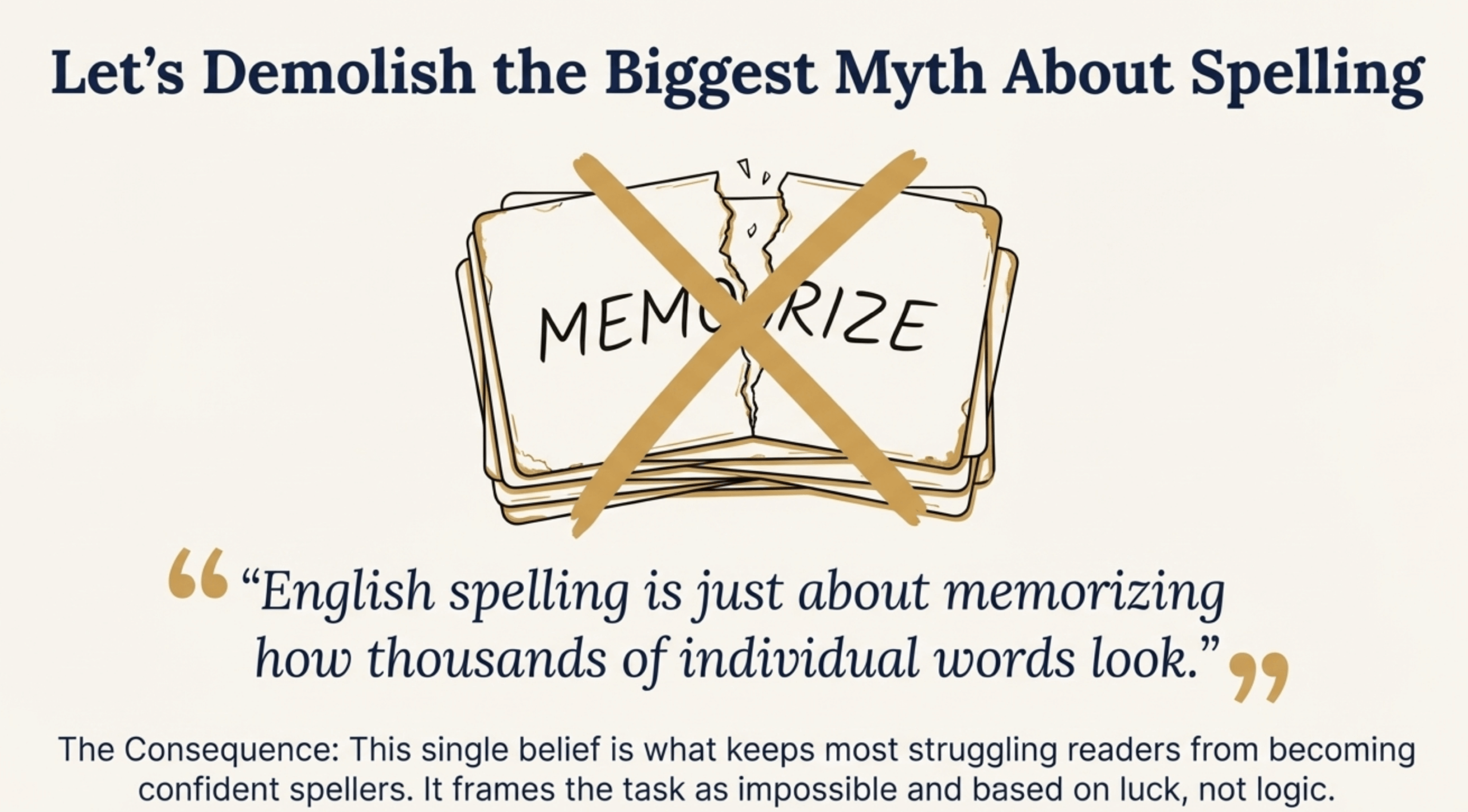
Many students—and parents—believe spelling is primarily about memorizing how individual words look. This fundamental misconception prevents struggling readers from becoming confident spellers.
English Spelling Is Highly Predictable
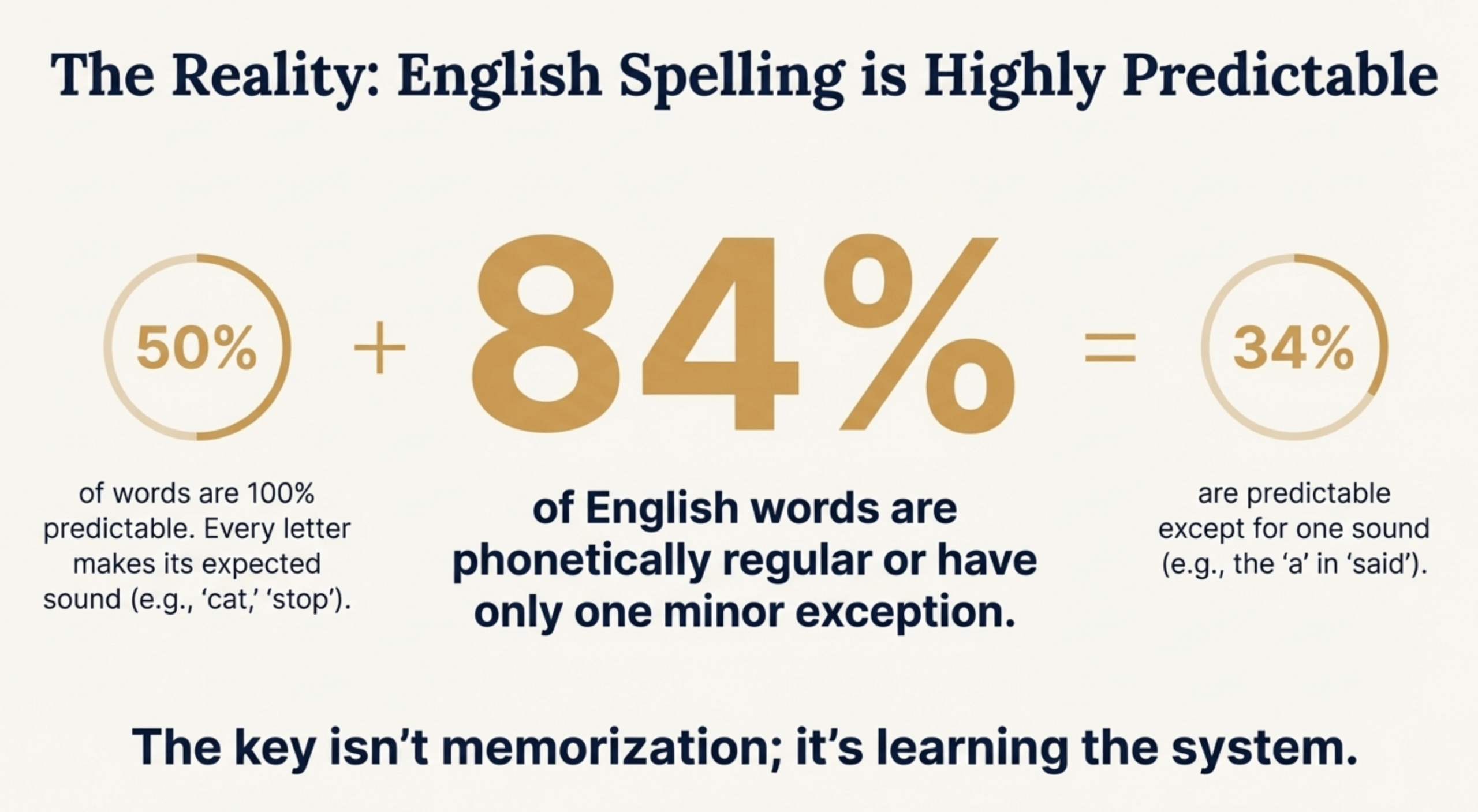
Research has established that English spelling is far more systematic than most people realize:
- 50% of English words are 100% phonetically predictable – Every letter matches its expected sound perfectly
- 34% are predictable except for one sound – Only one letter or pattern deviates from standard phonics rules
- 84% total are phonetically regular or mostly regular – Only 16% are truly irregular
This means struggling readers can spell the vast majority of English words by applying systematic phonics knowledge—not by memorizing thousands of individual words.
The Key to Spelling Mastery
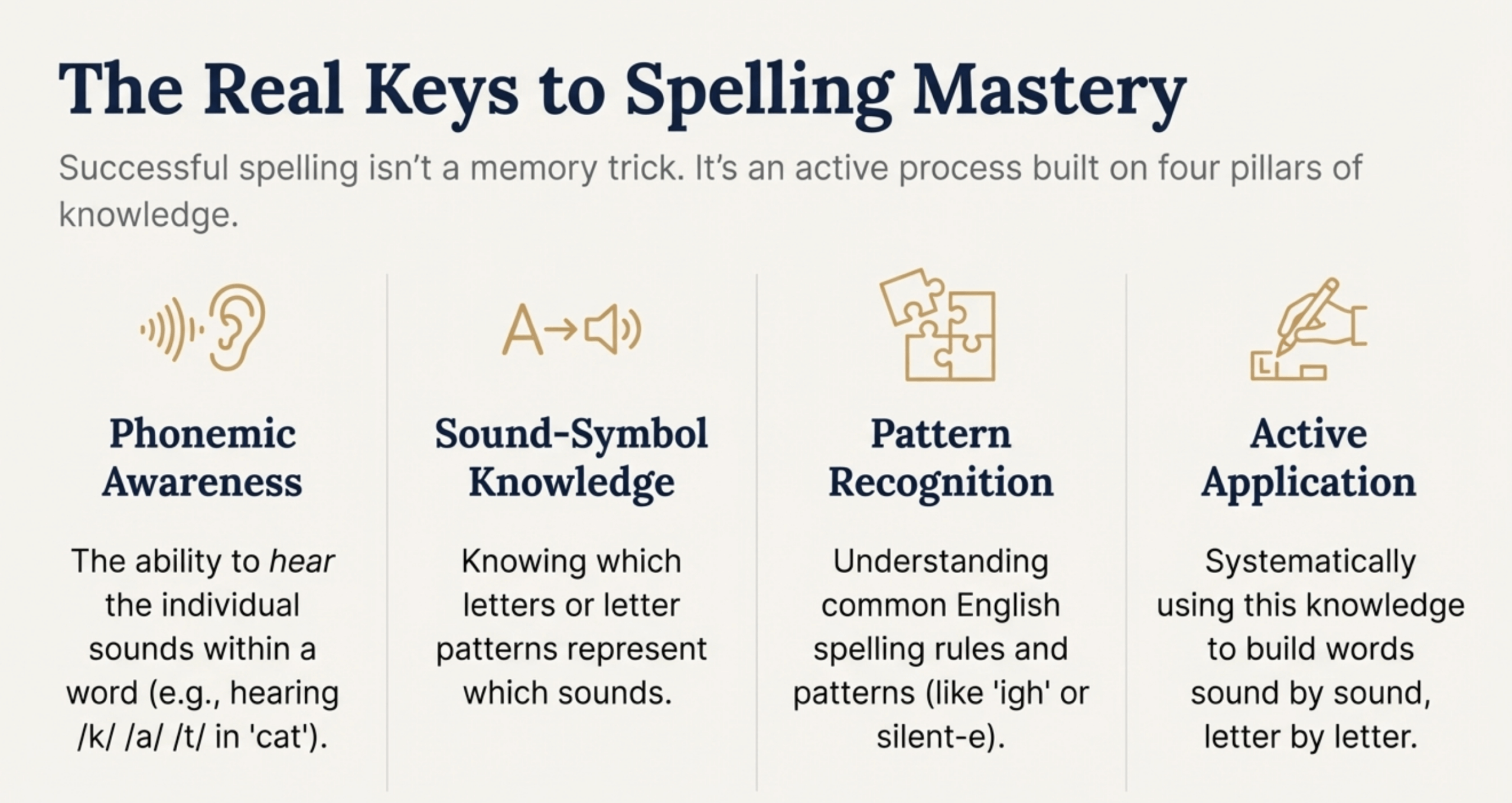
Successful spelling requires:
- Phonemic awareness – Hearing individual sounds within words
- Sound-symbol knowledge – Knowing which letters represent which sounds
- Pattern recognition – Understanding spelling rules and common patterns
- Active application – Using this knowledge to encode words
Students who understand this process don’t need to memorize every word they spell. They apply systematic knowledge to represent sounds with letters.
Why Spelling Takes Longer to Master Than Reading
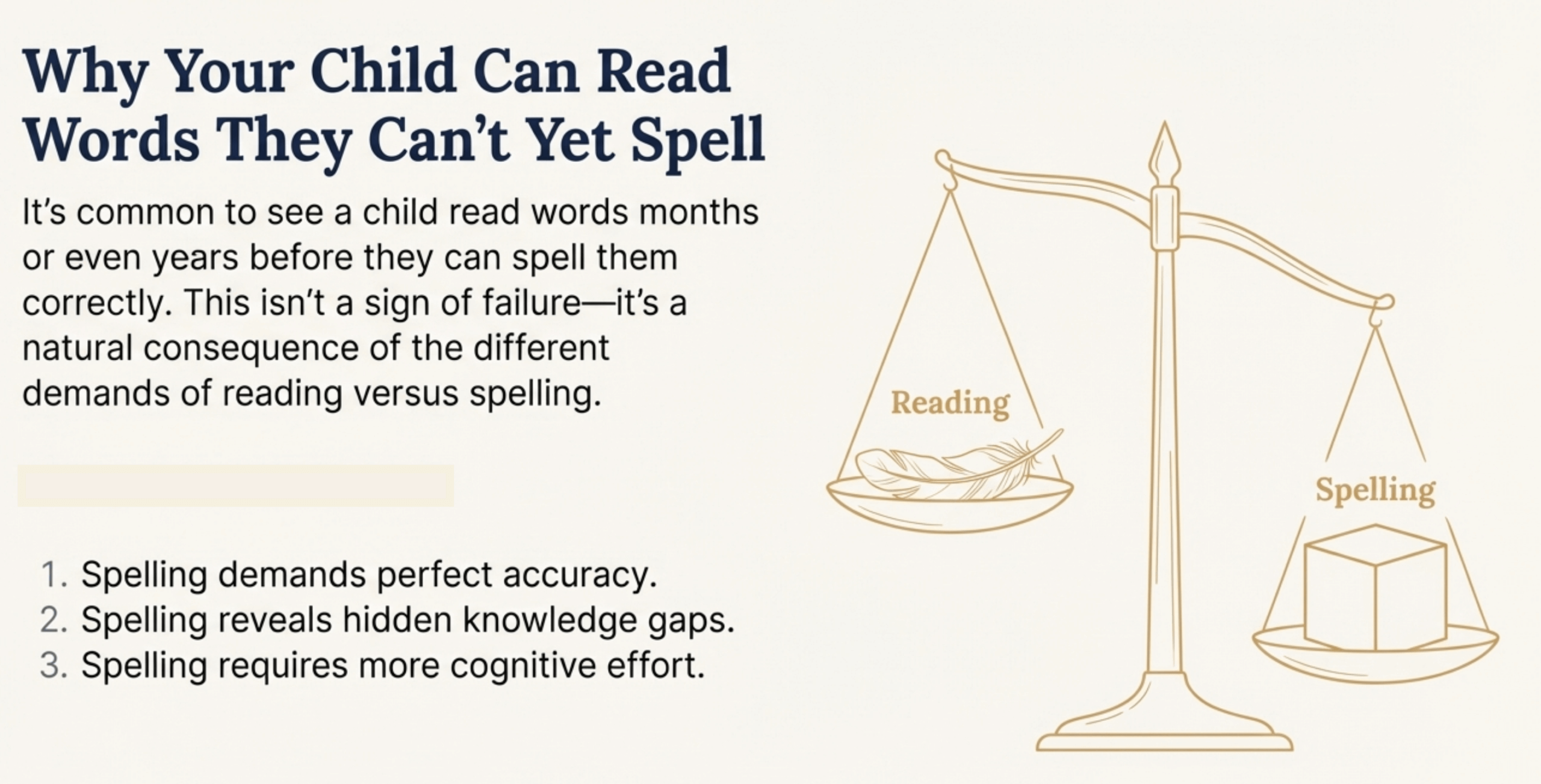
Parents often notice their child can read words months or even years before spelling those same words correctly. This isn’t unusual—spelling naturally requires more time to master.
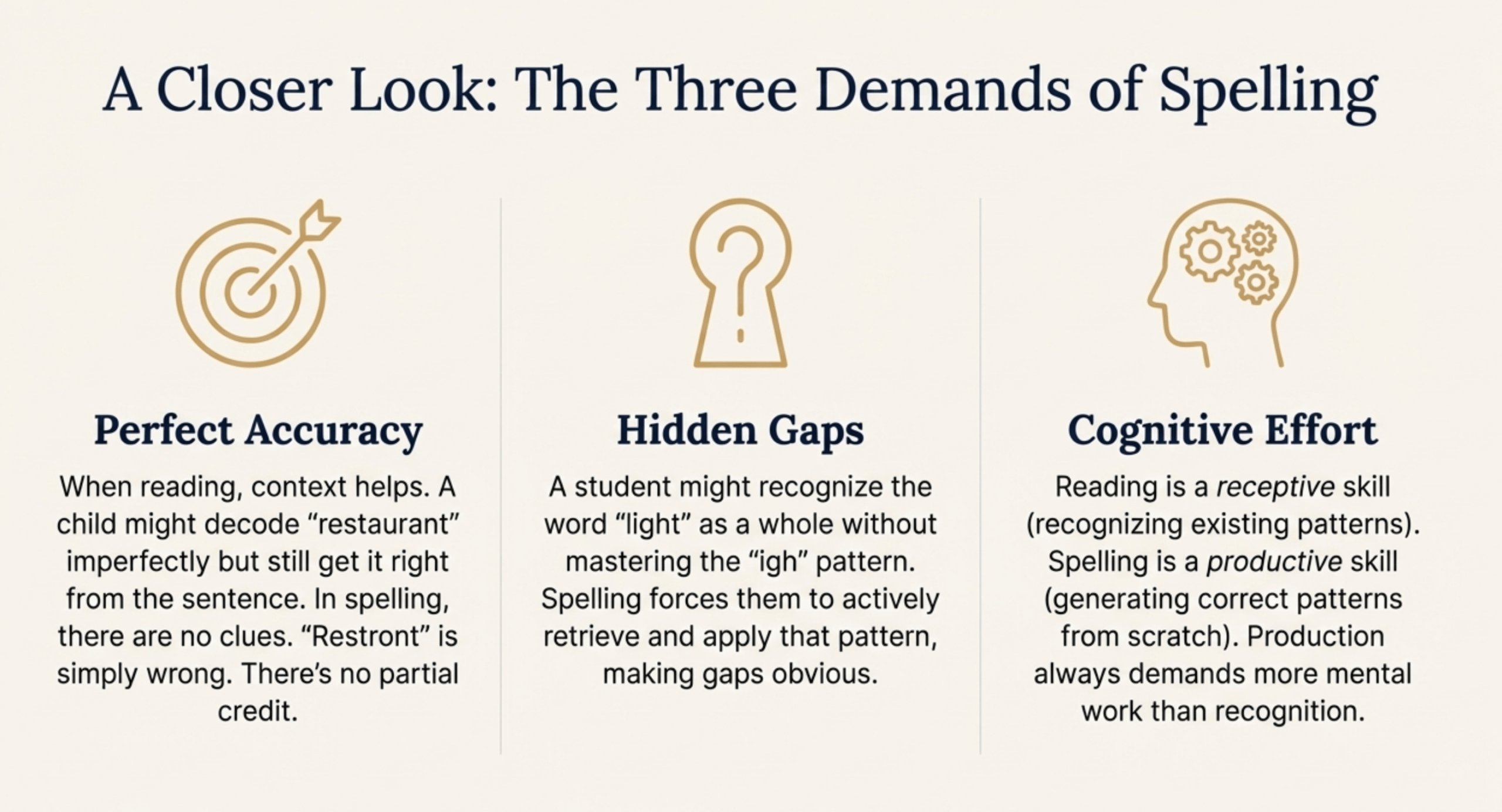
Spelling Demands Perfect Accuracy
When reading, a student can use context clues alongside phonics to identify words. If they decode “restaurant” as “rest-er-ont” but the sentence reads “We ate dinner at the ___,” context confirms the word despite imperfect decoding.
In spelling, there are no context clues. Every single letter must be correct. “Restront” is wrong. “Restarant” is wrong. “Resterant” is wrong. Only “restaurant” is right. There’s no partial credit in spelling.
Spelling Reveals Hidden Knowledge Gaps
Students might correctly read “light” by recognizing the whole word pattern without truly understanding that “igh” represents the long /ī/ sound. But when asked to spell “night” or “flight,” the gap becomes obvious. Spelling forces students to consciously apply phonics knowledge they might bypass during reading.
Spelling Requires More Cognitive Processing
Reading is a receptive skill—students recognize patterns they’ve seen before. Spelling is a productive skill—students must actively generate correct letter sequences from memory and phonics knowledge. Production always demands more cognitive effort than recognition.
How to Teach Spelling at Each Step
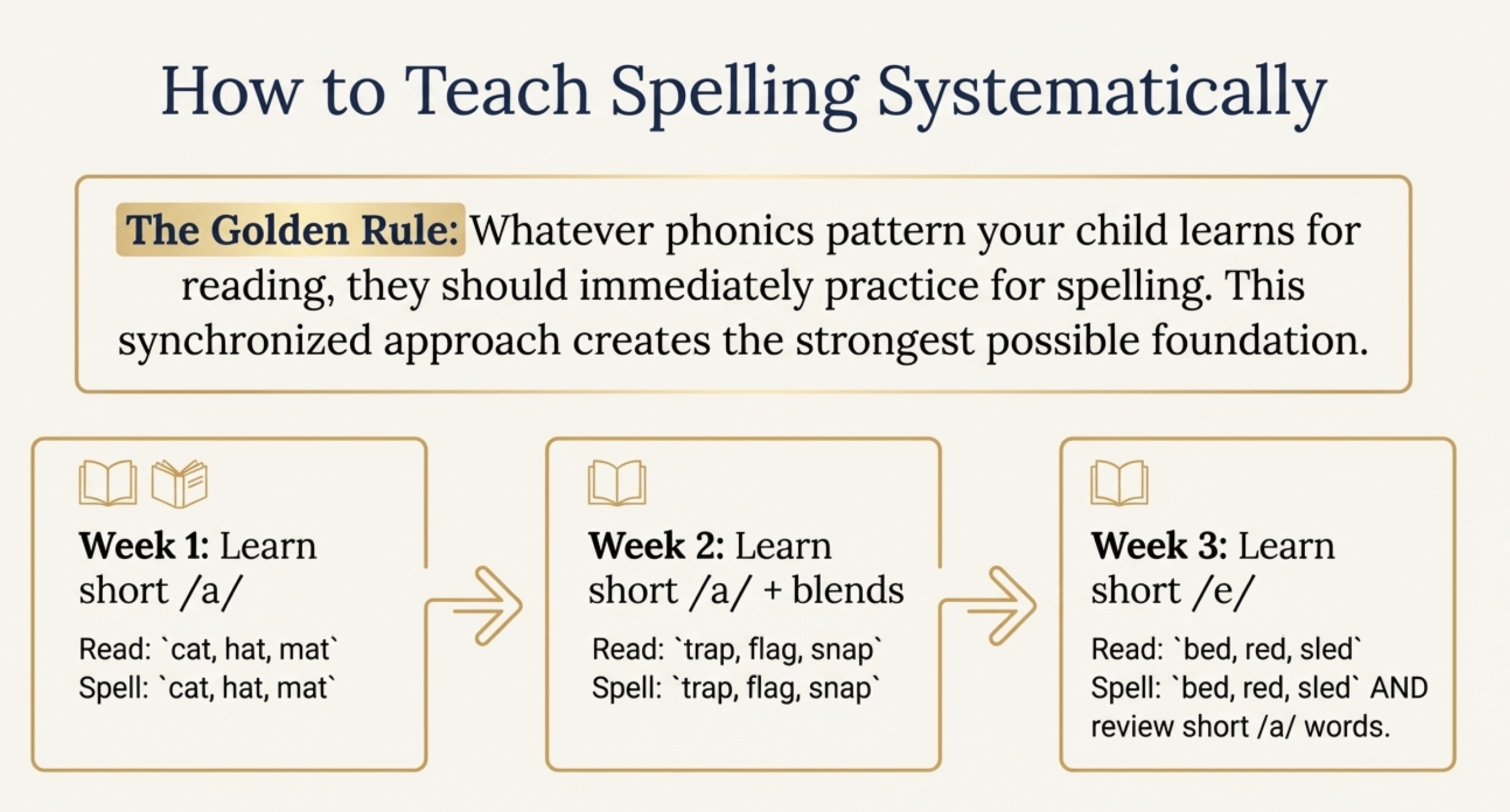
Spelling Should Mirror Reading Instruction
Whatever phonics pattern your child learns for reading, they should immediately practice for spelling. This synchronized approach creates the strongest phonics foundation.
Example progression:
Week 1: Short /a/ sound
- Reading practice: cat, hat, mat, sat, rat, bat
- Spelling practice: Dictate the same words for your child to spell
Week 2: Short /a/ with blends
- Reading practice: flat, trap, snap, flag, brat, clap
- Spelling practice: Dictate words with short /a/ and blends
Week 3: Short /e/ sound
- Reading practice: bed, red, fed, led, sled, bled
- Spelling practice: Mix short /a/ and short /e/ words in dictation
The Spelling Dictation Process
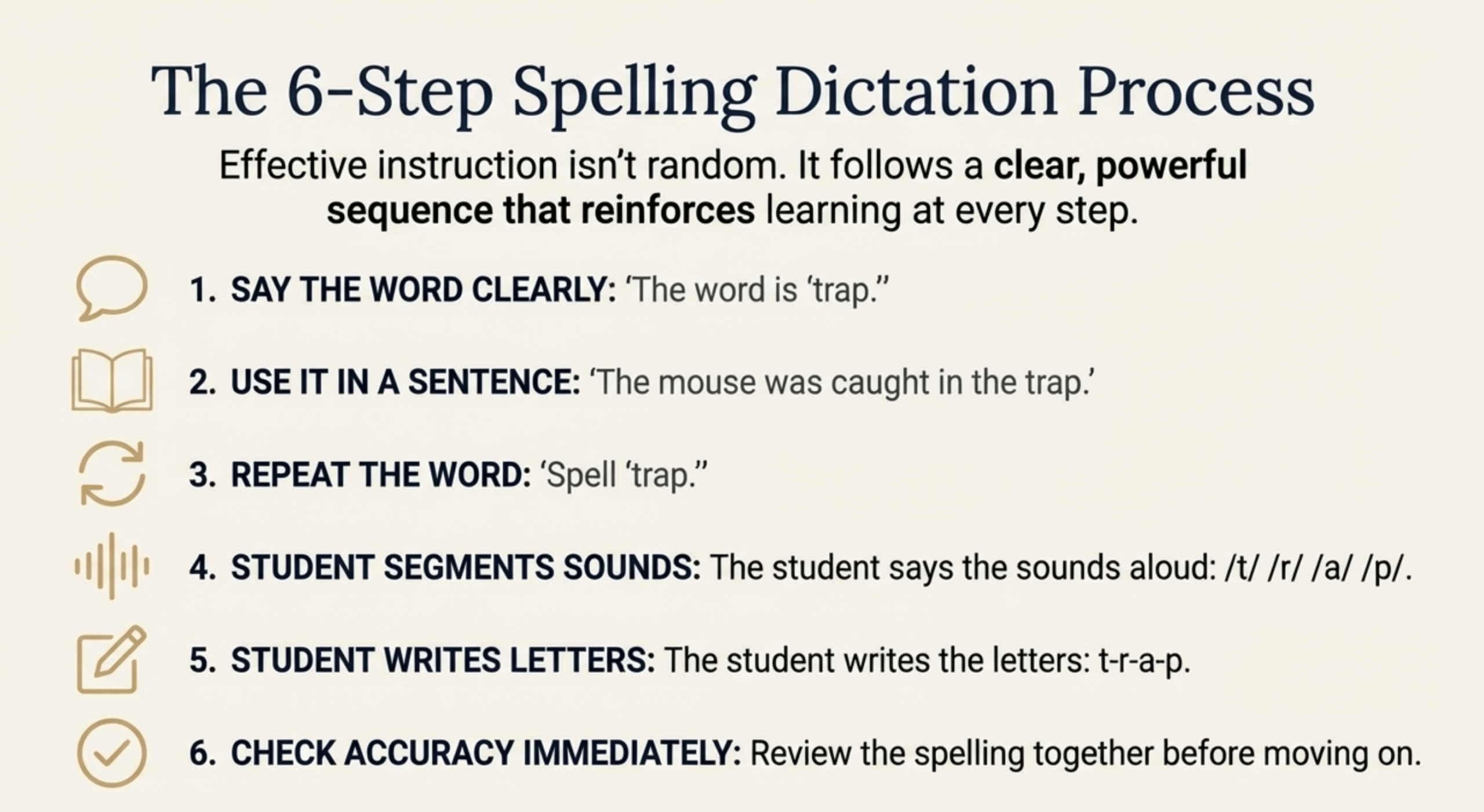
Effective spelling instruction follows a specific sequence:
Step 1: Say the word clearly
“The word is ‘trap.'”
Step 2: Use it in a sentence
“The mouse was caught in the trap.”
Step 3: Repeat the word
“Spell ‘trap.'”
Step 4: Student segments sounds
Student identifies: /t/ /r/ /a/ /p/ (4 sounds)
Step 5: Student writes letters
Student writes: t-r-a-p
Step 6: Check accuracy immediately
Review spelling together before moving to next word
Start Simple, Build Systematically
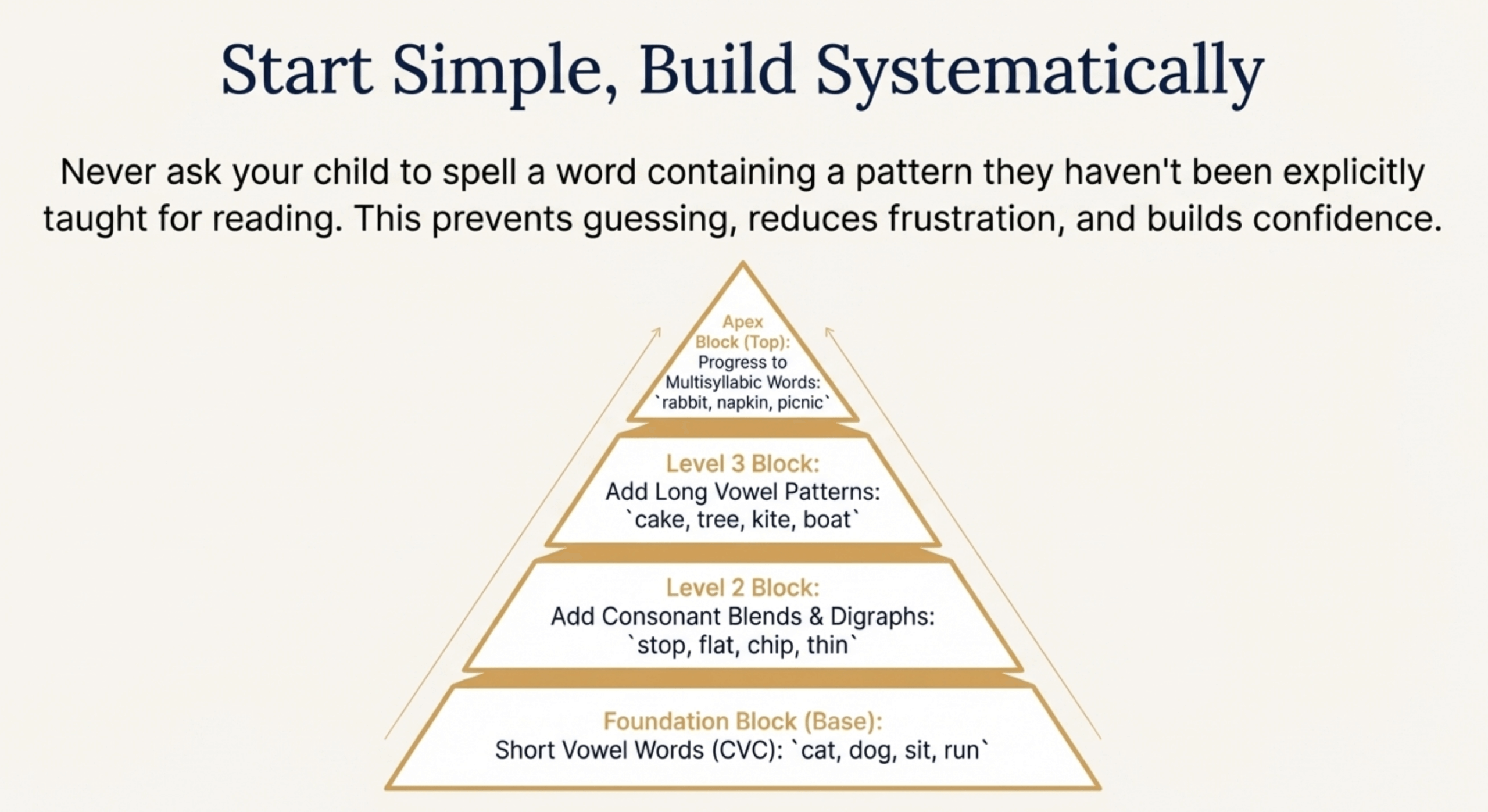
Begin spelling instruction with the same simple CVC (consonant-vowel-consonant) words your child learns for reading:
- Short vowel words: cat, dog, sit, run, bed
- Add consonant blends: stop, flat, trip, crab
- Add consonant digraphs: chip, shop, thin, whip
- Add long vowel patterns: cake, tree, kite, boat, cube
- Progress to multisyllabic words: rabbit, napkin, picnic
Never ask your child to spell words containing patterns they haven’t been explicitly taught. This prevents frustration and guessing, building confidence as skills develop systematically.
Common Spelling Instruction Mistakes to Avoid

Mistake 1: Weekly Spelling Lists Without Phonics Context
Traditional spelling instruction gives students 10-20 random words to memorize each week. Words often share no phonetic pattern, forcing pure memorization. Students might pass Friday’s test but forget words by Monday.
Better approach: Spelling words should all use the phonics pattern currently being learned. If teaching “ai” for long /ā/, all spelling words should contain “ai”: rain, train, snail, brain, stain.
Mistake 2: Accepting “Close Enough” Spelling
Some parents accept phonetically reasonable misspellings: “sed” instead of “said,” or “becuz” instead of “because.” While these attempts show phonetic thinking, accepting them prevents students from learning correct patterns.
Better approach: Acknowledge the phonetic logic (“I see why you spelled it that way!”) while teaching the correct pattern. “Said” is an irregular word that must be learned as an exception.
Mistake 3: Moving Too Fast
Parents eager to see progress might introduce new spelling patterns before previous ones are mastered. This creates confusion and gaps.
Better approach: Students should spell words with 80%+ accuracy before introducing new patterns. Extensive practice with each pattern builds automaticity.
Mistake 4: Neglecting Review
Once a spelling pattern is taught, it must be reviewed consistently in subsequent lessons. Skills fade without regular practice.
Better approach: Mix previously learned patterns into current spelling practice. If learning “oa” words, include some “ai” words from last week in dictation.
How Our Program Integrates Spelling Throughout

Our systematic phonics program treats spelling as an equal partner with reading from the very first lesson:
Half of Most Lessons Are Spelling Practice
Students don’t just read words—they spell them. Lessons include:
- Spelling dictation of individual words
- Spelling dictation of phrases and sentences
- Immediate feedback and correction
- Systematic review of previously learned patterns
Controlled Vocabulary Ensures Success
Just as our reading materials contain only taught patterns, spelling dictation uses only words students can spell using their current phonics knowledge. No guessing required—students apply what they’ve learned.
The Marking System Reveals Understanding
Students don’t just spell words—they mark them to show they understand the phonetic structure. This process requires conscious analysis of every sound and letter, deepening phonics knowledge far beyond simple memorization.
Progressive Complexity Builds Mastery
Spelling instruction progresses in careful stages:
- Level 1: words with short vowels
- Level 2: Consonant blends and digraphs
- Level 3: Long vowel patterns with silent-e
- Level 4: Vowel teams, r-controlled vowels
- Level 5: Advanced patterns, multisyllabic words
Each stage builds on previous mastery, ensuring students develop complete encoding skills alongside reading ability.
Continue Reading: The 9 Essential Strategies
← Previous: Why Decodable Text Is Essential
Next → How Spelling and Phonics Reinforce Each Other
Questions about teaching spelling to struggling readers? Contact us.