Reading Help for Adults: Where to Start When You Struggle
You’ve hidden your reading struggles for years. You’ve developed elaborate strategies to avoid reading aloud. You feel shame when forms need to be filled out. You depend on others for tasks that should be simple. You’re exhausted from pretending.
If this describes you, know this: You are not alone, and help is available.
Millions of adults struggle with reading. The difficulty you experience isn’t a reflection of your intelligence or worth. You struggle because you were never properly taught the foundational skills needed to read. And those skills can be learned at any age.
This guide addresses the questions you may be too embarrassed to ask: Where do I start? What kind of help do I need? How do I overcome the shame? Can I really learn to read as an adult?
The answers may surprise you with their simplicity and hope.
You’re Not Alone: The Reality of Adult Reading Struggles
Before we discuss solutions, let’s acknowledge the reality many adults face.
The Numbers Tell a Story
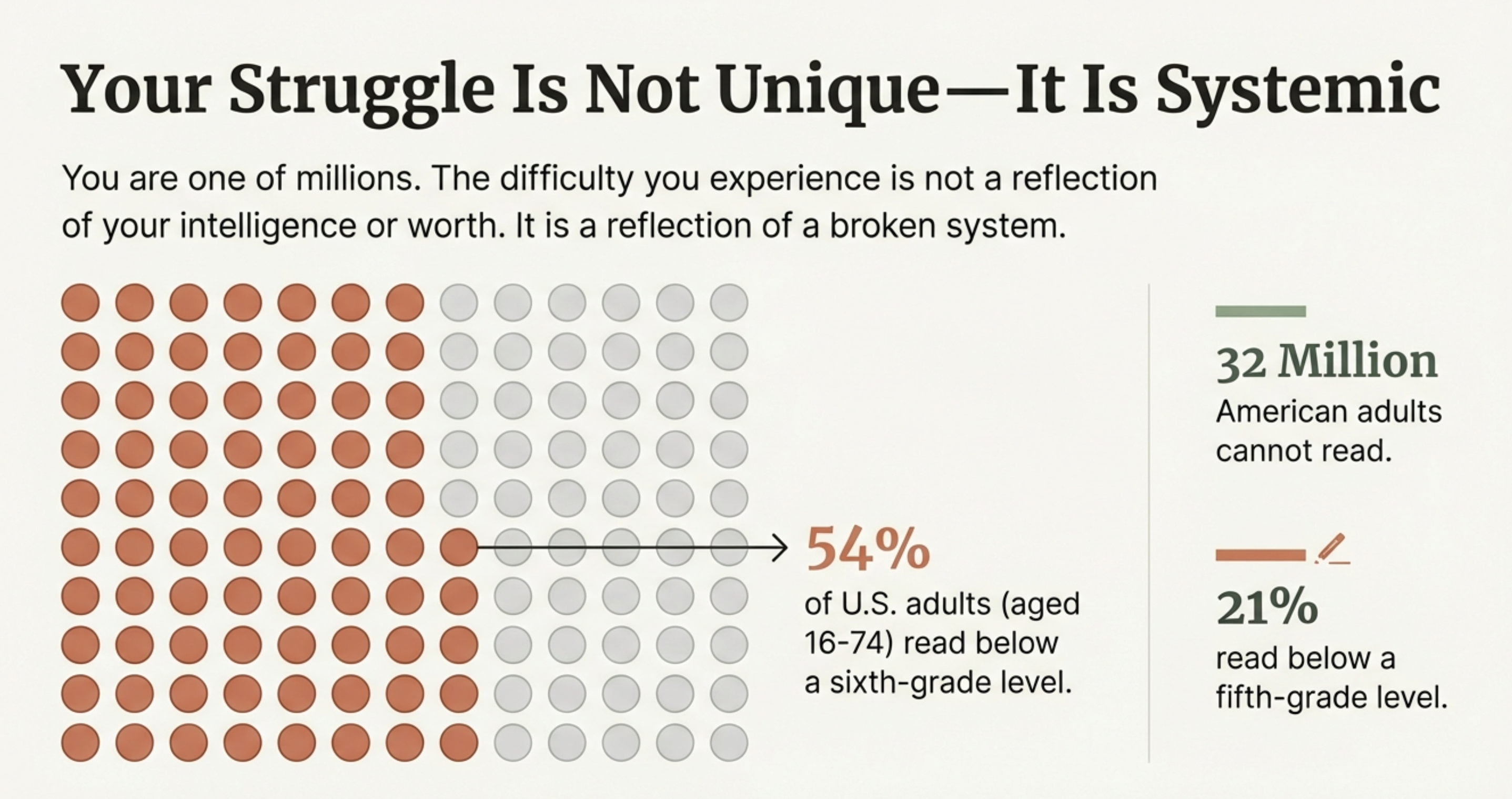
According to the National Center for Education Statistics:
- 54% of U.S. adults aged 16-74 read below a sixth-grade level
- 21% of adults read below a fifth-grade level
- Approximately 32 million American adults cannot read
You are one of millions. Your struggle is not unique, though it may feel isolating.
The Silent Struggle
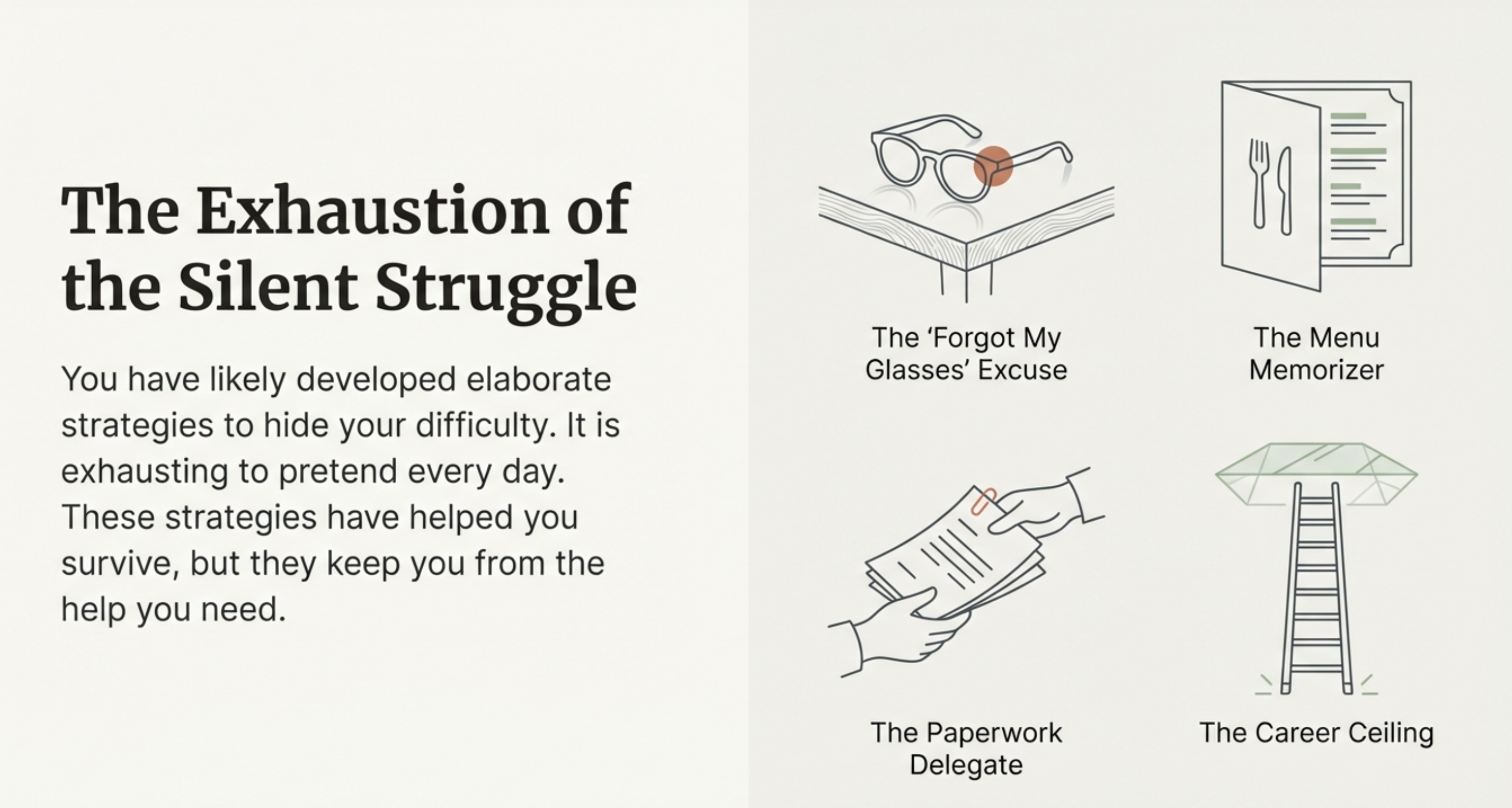
Most adults who struggle with reading don’t talk about it. You’ve likely developed strategies to hide your difficulty:
Common coping mechanisms:
- Claiming you forgot your glasses when asked to read something
- Having family members handle all paperwork
- Avoiding jobs that require reading
- Memorizing restaurant menus to avoid reading them
- Relying on pictures, videos, and verbal communication
- Making excuses to avoid reading to children
- Feeling anxious in situations that might require reading aloud
These strategies have helped you function, but they’ve also kept you from getting the help you need.
The Emotional Weight
The shame of struggling with reading as an adult is profound:
Fear of judgment. You worry that people will think you’re unintelligent or lazy if they discover you can’t read well.
Embarrassment. Simple tasks that others take for granted—reading a text message, filling out a form, reading instructions—become sources of stress and humiliation.
Lost opportunities. Job promotions you didn’t apply for. Educational paths you didn’t pursue. Experiences you avoided because they required reading.
Impact on family. The pain of not being able to help your children with homework or read them bedtime stories.
Isolation. Keeping this secret has likely meant keeping distance from people who could support you.
This emotional burden is real and valid. Acknowledging it is the first step toward change.
Why You Struggle: It’s Not Your Fault
Understanding why you struggle with reading is liberating. The reason isn’t about you—it’s about how you were taught.
You Weren’t Taught the Code
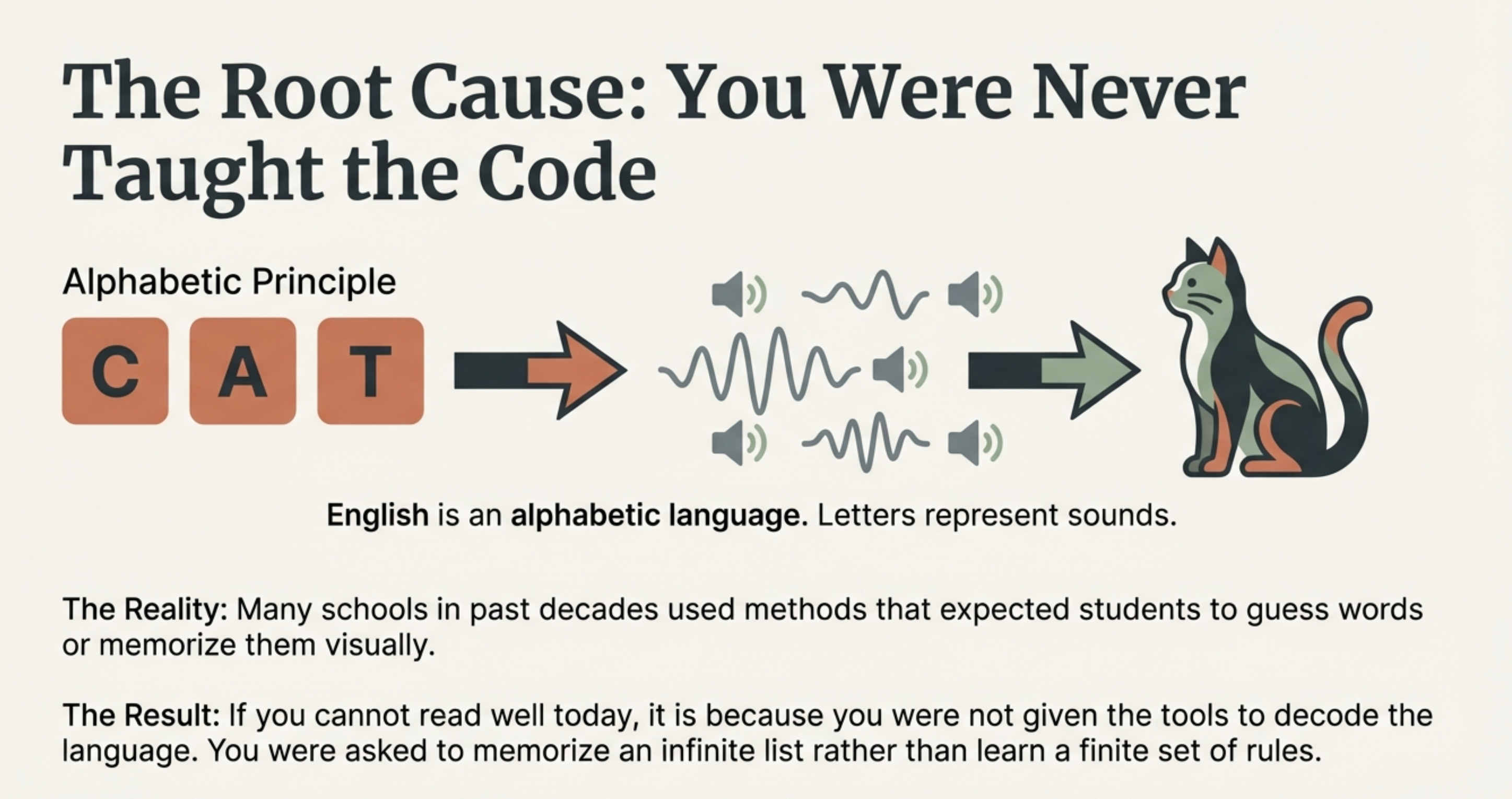
English is an alphabetic language. Letters and letter combinations represent sounds. Learning to read means learning this letter-sound code systematically.
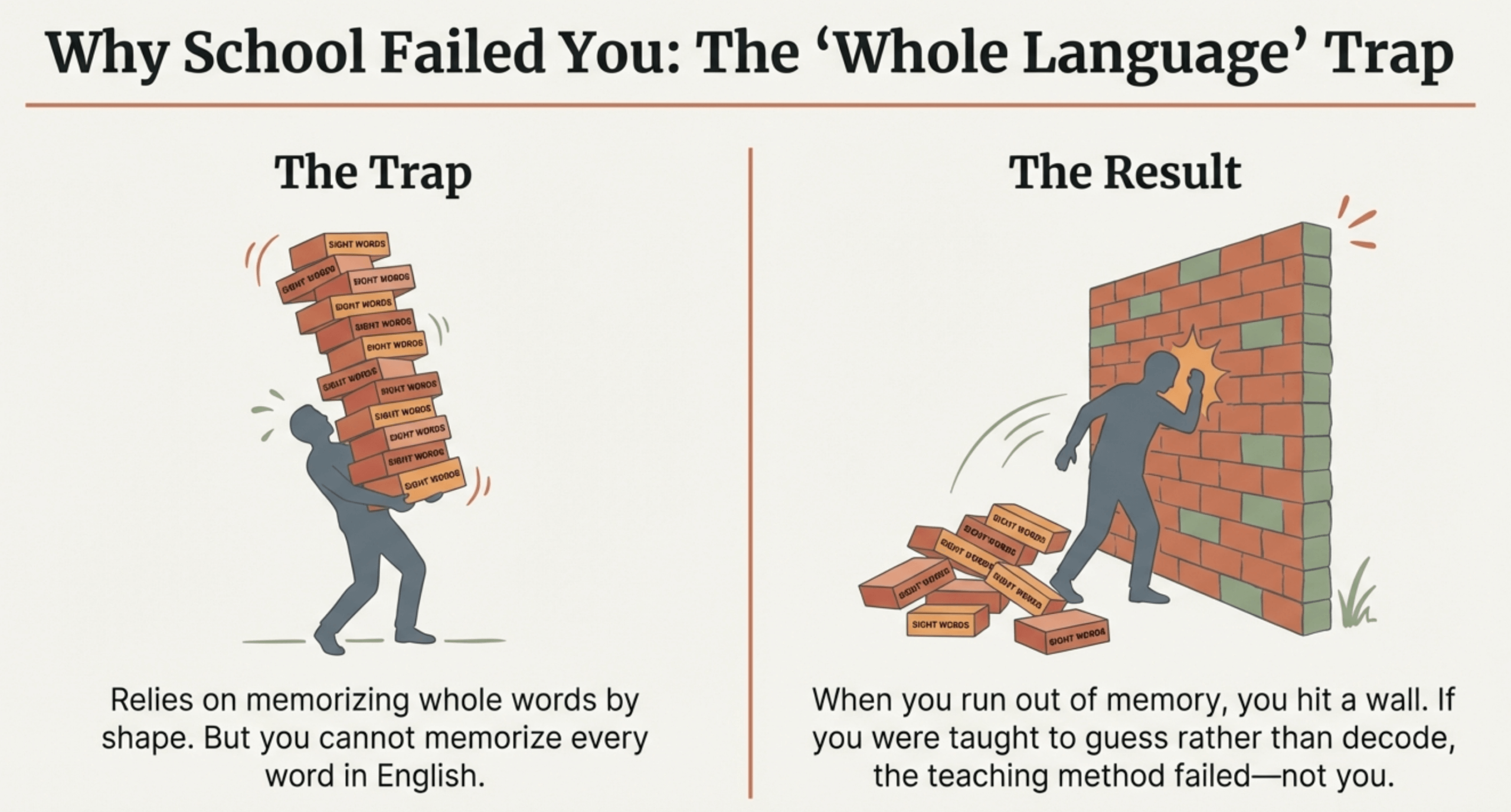
Many schools in past decades used teaching methods that didn’t explicitly teach this code:
Whole language approaches expected you to memorize whole words by sight or guess words from context and pictures. For some students, this worked. For others—including you—it didn’t.
Sight word memorization asked you to memorize hundreds of words without teaching you how to decode them. Memorization has severe limits. You can’t memorize every word in English.
“Balanced literacy” mixed various approaches without systematic phonics instruction, leaving critical gaps in your foundational skills.
If you were taught using these methods and they didn’t work for you, the problem was the teaching method—not you.
Different Learning Needs Were Ignored
Some students need explicit, systematic instruction in how letters represent sounds. They don’t figure it out intuitively. They need to be taught directly, step by step.
If you needed this type of instruction but received whole language or mixed methods instead, you were set up to struggle.
Additionally:
- If you have dyslexia or other learning differences, you especially needed systematic phonics but may never have received it
- If you moved frequently, changed schools, or had disrupted education, you may have missed crucial instruction
- If you were passed along despite not learning, the gaps only widened over time
You Did the Best You Could
You compensated. You developed workarounds. You survived school despite not being able to read well. That took intelligence, creativity, and resilience.
The fact that you’re here now, seeking help, shows courage. Many adults never take this step.
Types of Reading Help Available
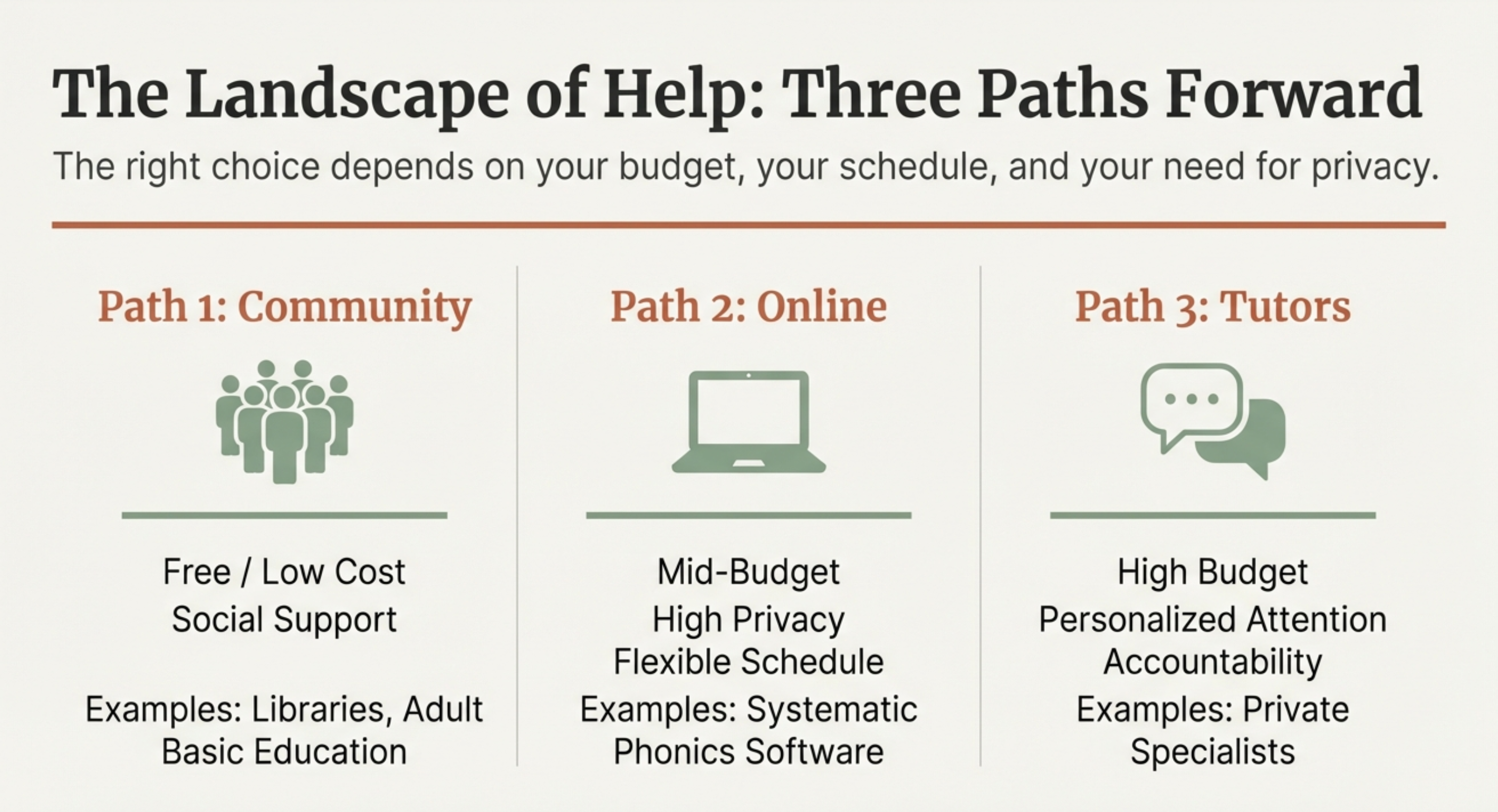
Understanding your options helps you make informed decisions about what kind of help will work for you.
Free and Low-Cost Options
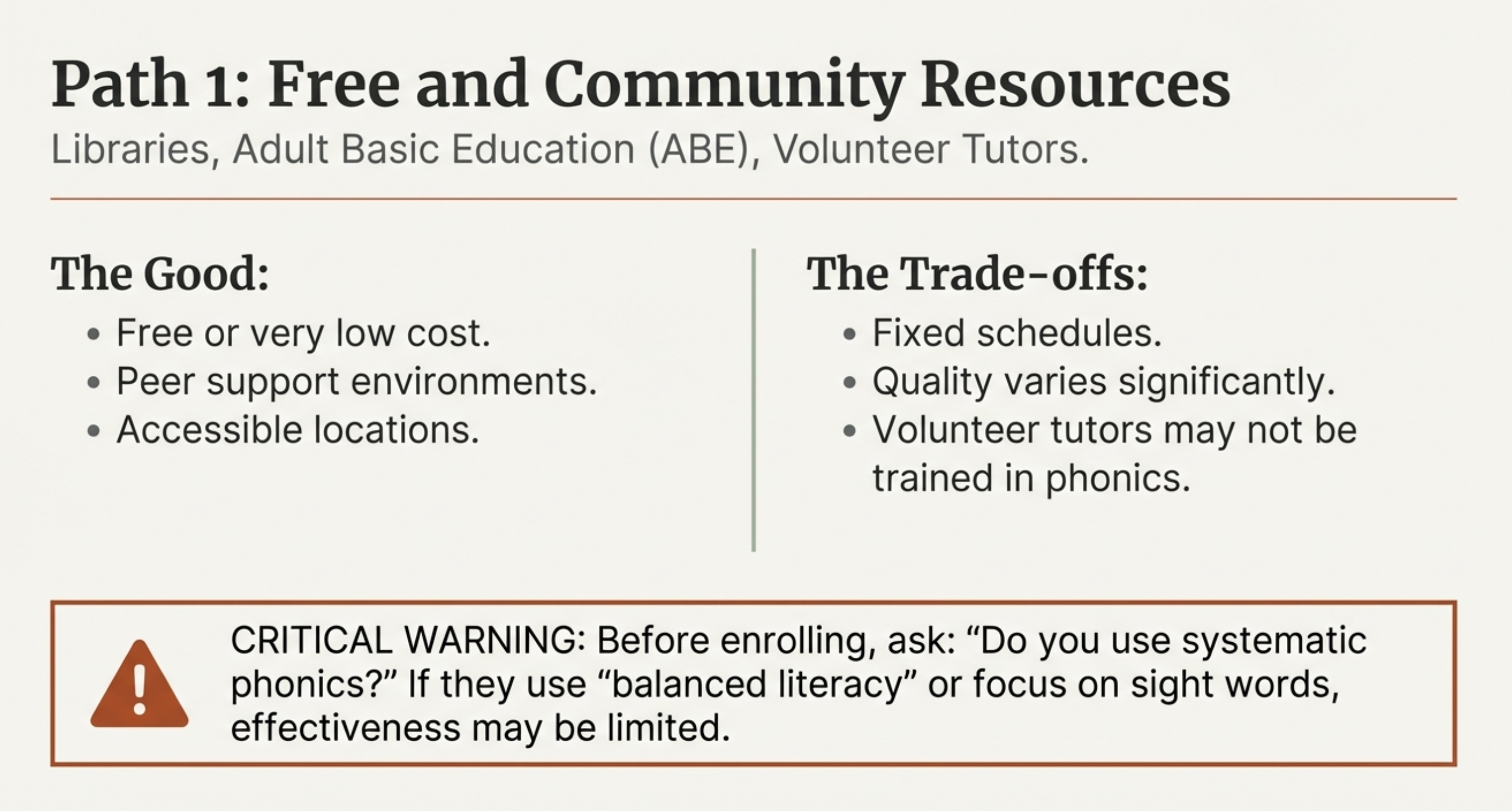
Adult basic education programs (ABE):
- Offered through community colleges, libraries, workforce centers
- Usually free or very low cost
- Group classes with instructor
- Schedules may be limited (evenings, weekends)
Pros: Free or affordable, peer support, instructor available for questions
Cons: Teaching methods vary widely (many don’t use systematic phonics), fixed schedules may conflict with work, quality depends on program and instructor
Important: Before enrolling, ask specifically what teaching method they use. If they don’t use systematic phonics, effectiveness may be limited.
Literacy volunteer programs:
- Organizations like ProLiteracy connect adult learners with volunteer tutors
- Free one-on-one or small group instruction
- Flexible locations (libraries, community centers, online)
Pros: Free, individualized attention, flexible locations
Cons: Tutor quality and training varies, may have waitlists, not all volunteers use effective teaching methods
Library resources:
- Many libraries offer adult literacy programs
- Free access to learning materials
- Quiet, judgment-free environment
- Computer access if you don’t have your own
Pros: Free, accessible, private, supportive environment
Cons: Self-directed learning can be challenging, materials may not be comprehensive or systematic
Affordable Online Programs
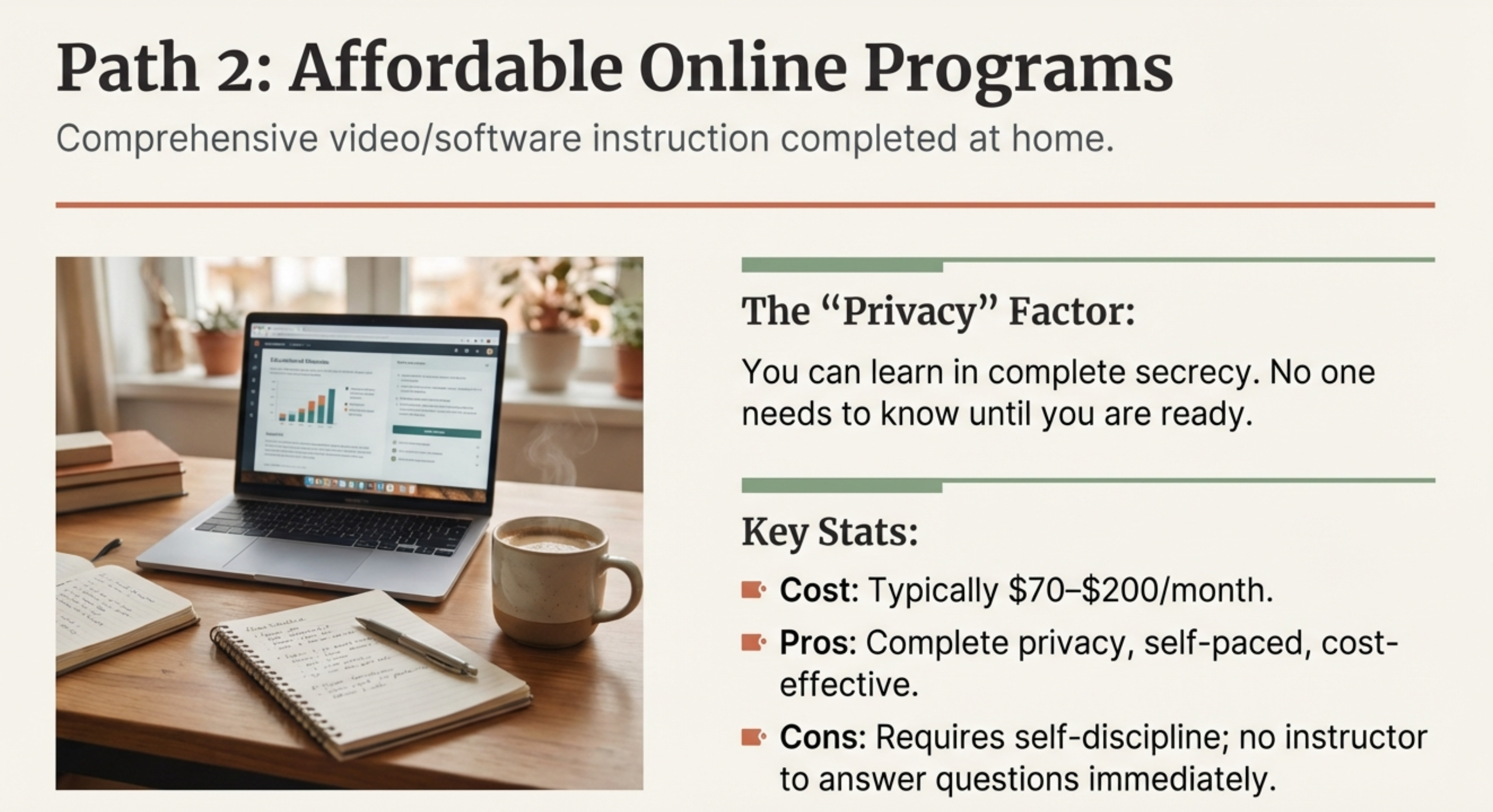
Self-paced systematic phonics programs:
- Comprehensive online instruction ($70-200/month typically)
- Learn on your own schedule from home
- Complete privacy
- Professional instruction through video lessons
Pros: Affordable, flexible, private, comprehensive if they use systematic phonics, learn at your own pace
Cons: Requires self-discipline, need internet access and device, no instructor to ask questions
Examples: We All Can Read ($73/month for comprehensive systematic phonics), various other online programs
Best for: Adults who need schedule flexibility, want privacy, are self-motivated, and want systematic instruction at reasonable cost
Professional Tutoring
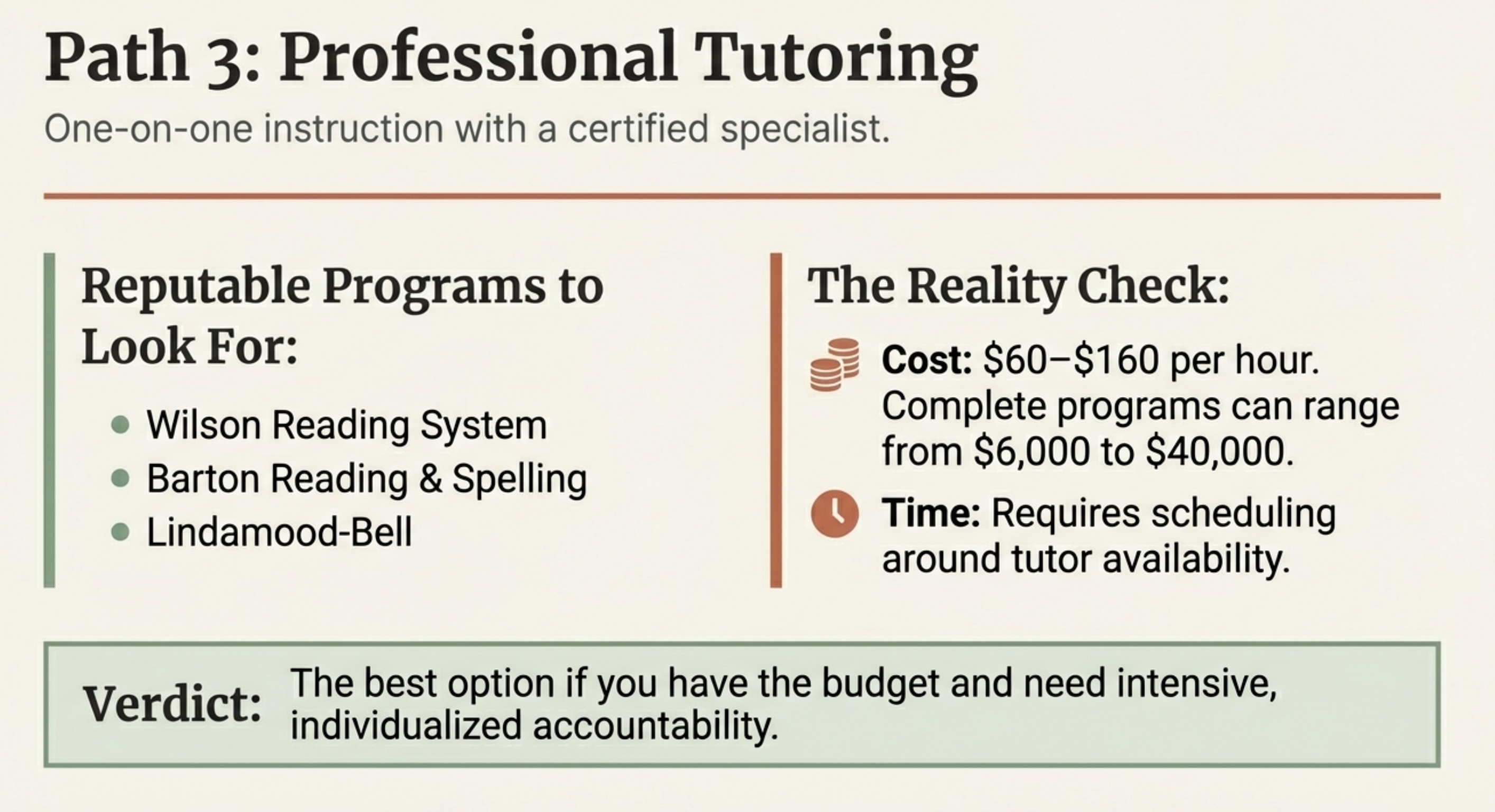
Private reading specialists:
- One-on-one instruction with certified tutor
- Individualized to your specific needs
- Regular scheduled sessions
Pros: Personalized instruction, immediate feedback, accountability, expert guidance
Cons: Expensive ($60-160/hour), requires scheduling around tutor availability, need to find qualified tutor in your area
Major programs requiring tutors:
- Wilson Reading System (certified Wilson tutors)
- Barton Reading & Spelling System (trained Barton tutors)
- Lindamood-Bell programs
- Private Orton-Gillingham tutors
Cost reality: Complete tutoring programs typically cost $6,000-$40,000 depending on program and duration
Best for: Adults who can afford professional tutoring, need intensive individualized support, or have specific learning challenges requiring expert attention
Hybrid Programs
Online programs with tutor support:
- Self-paced online lessons plus periodic tutor sessions
- More affordable than pure tutoring
- More support than pure self-study
Examples: Reading Horizons Elevate (online + instructor support), some community programs combining software with classes
Pros: Balance of flexibility and support, more affordable than private tutoring
Cons: Still relatively expensive ($2,000-8,000), requires coordination with instructor for sessions
What Kind of Help Actually Works
Not all reading instruction is equally effective for adults. Understanding what works helps you choose wisely.
The Evidence: Systematic Phonics
Decades of research show that systematic phonics instruction is the most effective approach for adults who struggle with reading.
What is systematic phonics?
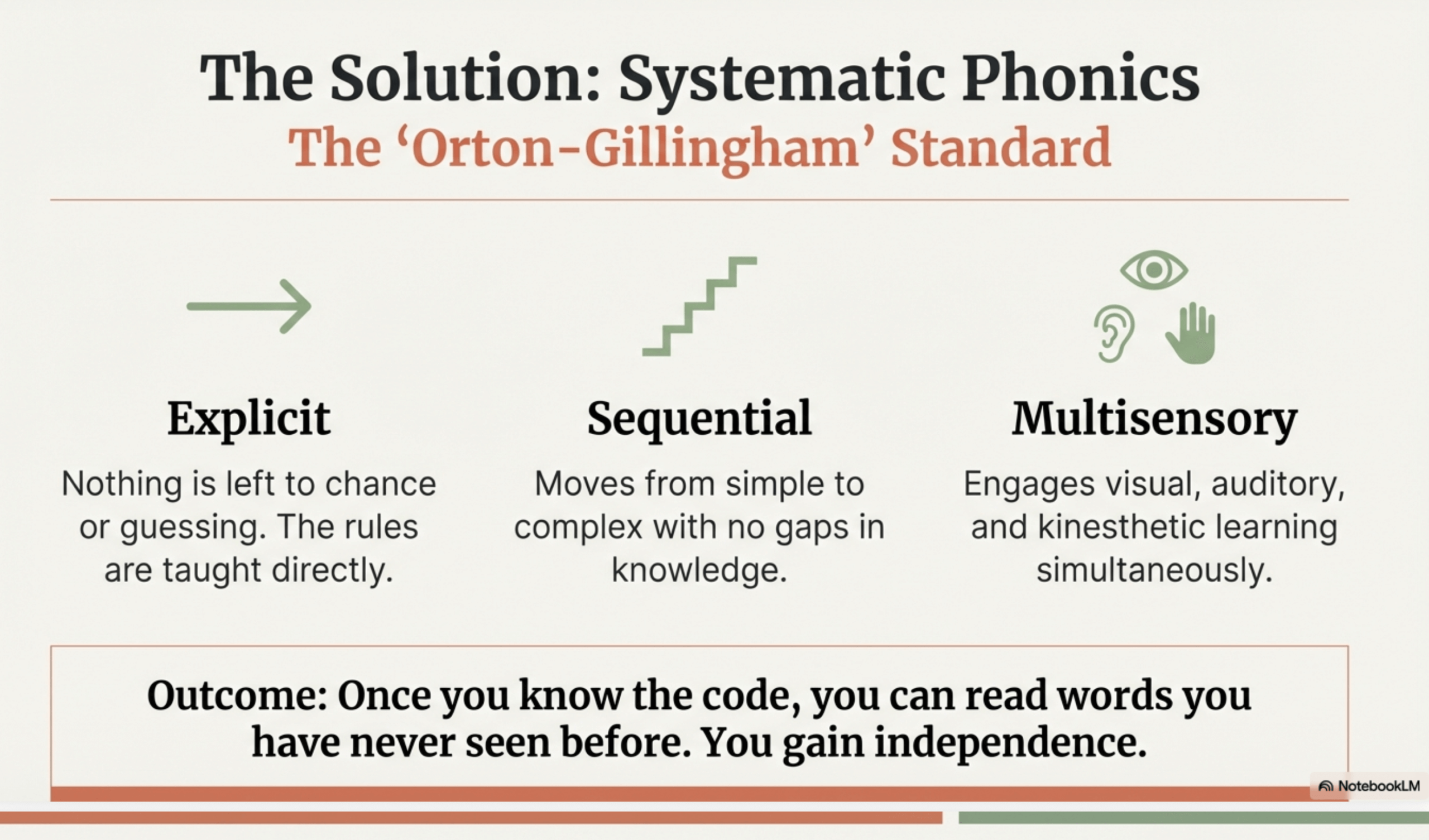
- Teaching the complete relationship between letters and sounds
- Presented in logical, sequential order
- Explicit instruction (nothing left to chance)
- From simple to complex with no gaps
- Extensive practice at each level
Why it works for adults:
Once you understand the code—how letters represent sounds—you can decode any word. You’re not limited to words you’ve memorized. You gain independence.
The Orton-Gillingham approach is a specific type of systematic phonics developed in the 1930s for struggling readers:
- Multisensory (engaging visual, auditory, kinesthetic learning)
- Systematic and sequential
- Cumulative (continuous review)
- Explicit and direct instruction
Programs following Orton-Gillingham principles have the highest success rates with adult learners.
What Doesn’t Work Well
Sight word memorization as the primary method. If memorizing words didn’t work in childhood, more memorization won’t work now. You can memorize some high-frequency words, but you need decoding skills for the thousands of other words in English.
Whole language or “balanced literacy” approaches. These are the methods that likely failed you in childhood. More of the same approach won’t produce different results.
Random phonics activities without systematic sequence. Scattered phonics lessons here and there don’t build comprehensive understanding. You need the complete code taught systematically.
Programs promising unrealistic speed. Learning to read as an adult takes genuine time and practice. Be skeptical of programs claiming you’ll “read fluently in 30 days.”
Overcoming the Emotional Barriers
The practical aspects of getting help are important, but the emotional barriers are often harder to overcome.
Addressing Shame and Embarrassment
The shame you feel is understandable but misplaced. You didn’t fail—the teaching methods failed you. Millions of intelligent, capable adults struggle with reading because they were taught using ineffective methods.
You’re taking a courageous step. Seeking help requires more courage than hiding. You’re choosing growth over comfort, change over familiar patterns.
Your worth isn’t determined by your reading ability. You have skills, knowledge, and value that have nothing to do with reading. Learning to read will add to your capabilities, not define your worth.
Managing Fear and Anxiety
Start small and private. You don’t need to announce to the world that you’re learning to read. Many adults learn successfully in complete privacy using online programs. No one needs to know until you’re ready to share.
Expect discomfort. Learning something new—especially something you’ve struggled with—will feel uncomfortable at times. This is normal and temporary. Discomfort is part of growth.
Celebrate small wins. Reading your first three-letter word correctly. Finishing your first lesson. Reading a sentence. Each small success builds confidence for the next step.
Remember your ‘why.’ Why do you want to learn to read? To help your children? Advance in your career? Read for pleasure? Keep your reason visible to maintain motivation through challenging moments.
Building Confidence
You can learn to read. Your brain retains the ability to form new neural pathways throughout life. Adult brains are actually well-suited for systematic phonics instruction because adults understand abstract concepts and can articulate what they don’t understand.
Others have succeeded from your starting point. Thousands of adults who couldn’t read have learned successfully. You’re not attempting something impossible—you’re joining others who’ve made this journey.
Progress is possible at any age. Whether you’re 25, 45, or 65, your brain can learn to read. Neuroplasticity—the brain’s ability to form new connections—continues throughout life.
Where to Start: Your First Steps
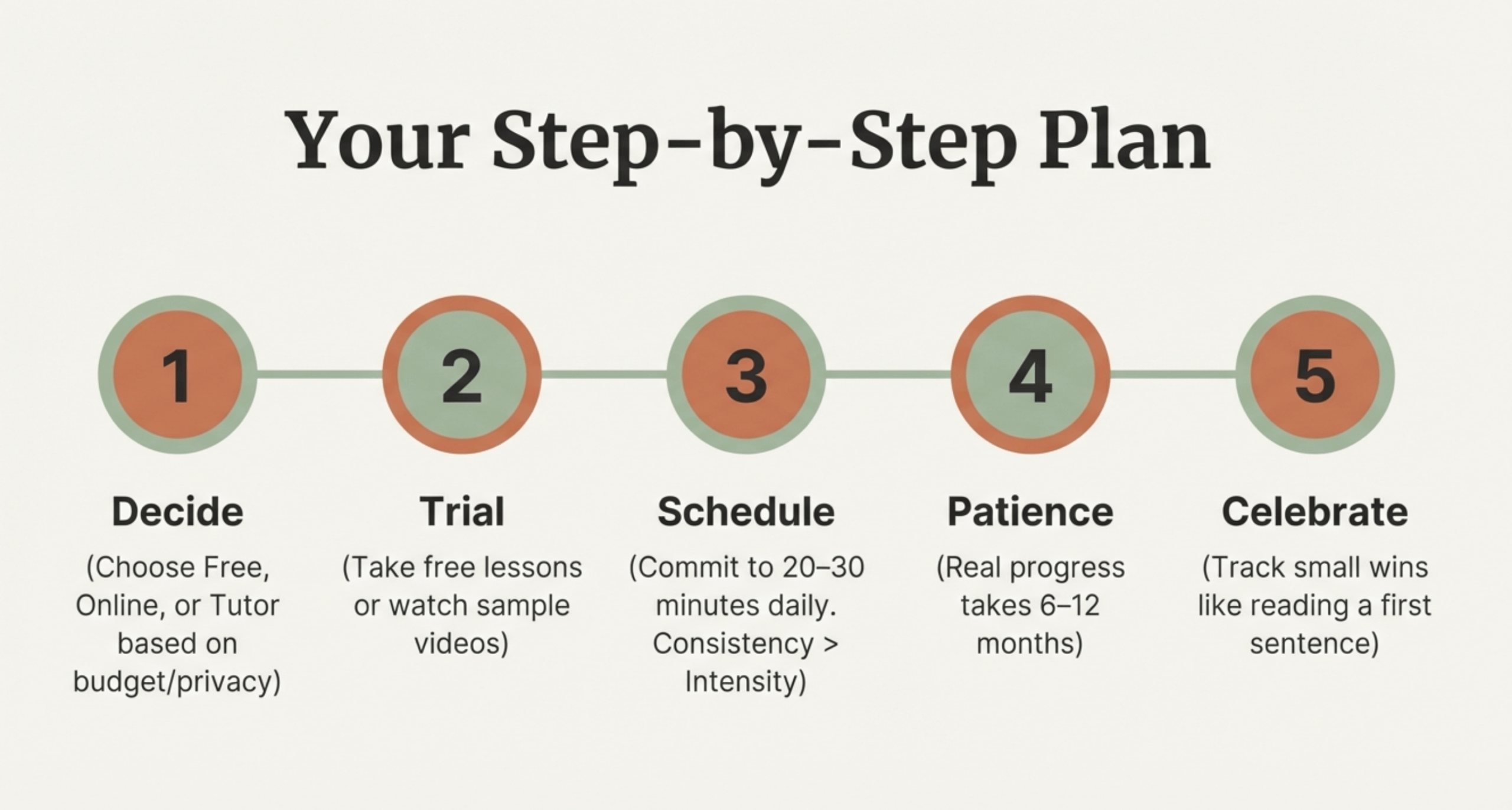
If you’re ready to get help, here’s a practical roadmap:
Step 1: Decide on Your Approach
Based on your situation, choose the format that fits:
If you have limited or no budget:
- Research free adult basic education programs in your area
- Ask specifically if they use systematic phonics instruction
- Check library programs and volunteer tutoring options
- Look for free online resources (though comprehensive free programs are rare)
If you can afford $50-200/month:
- Research online systematic phonics programs
- Look for programs offering free trial lessons
- Verify they use comprehensive phonics, not sight word memorization
- Choose programs allowing self-paced learning
If you can afford professional tutoring:
- Research certified reading specialists in your area
- Ask about their teaching methodology (look for Orton-Gillingham training)
- Understand total cost and time commitment
- Consider if the added cost provides enough benefit over good online programs
If you need maximum privacy:
- Online self-paced programs provide complete privacy
- Learn at home without anyone knowing
- No classroom anxiety or social pressure
If you need accountability and structure:
- Classes or tutoring sessions provide external motivation
- Regular appointments keep you consistent
- Social aspects of group learning can be supportive
Step 2: Verify the Teaching Method
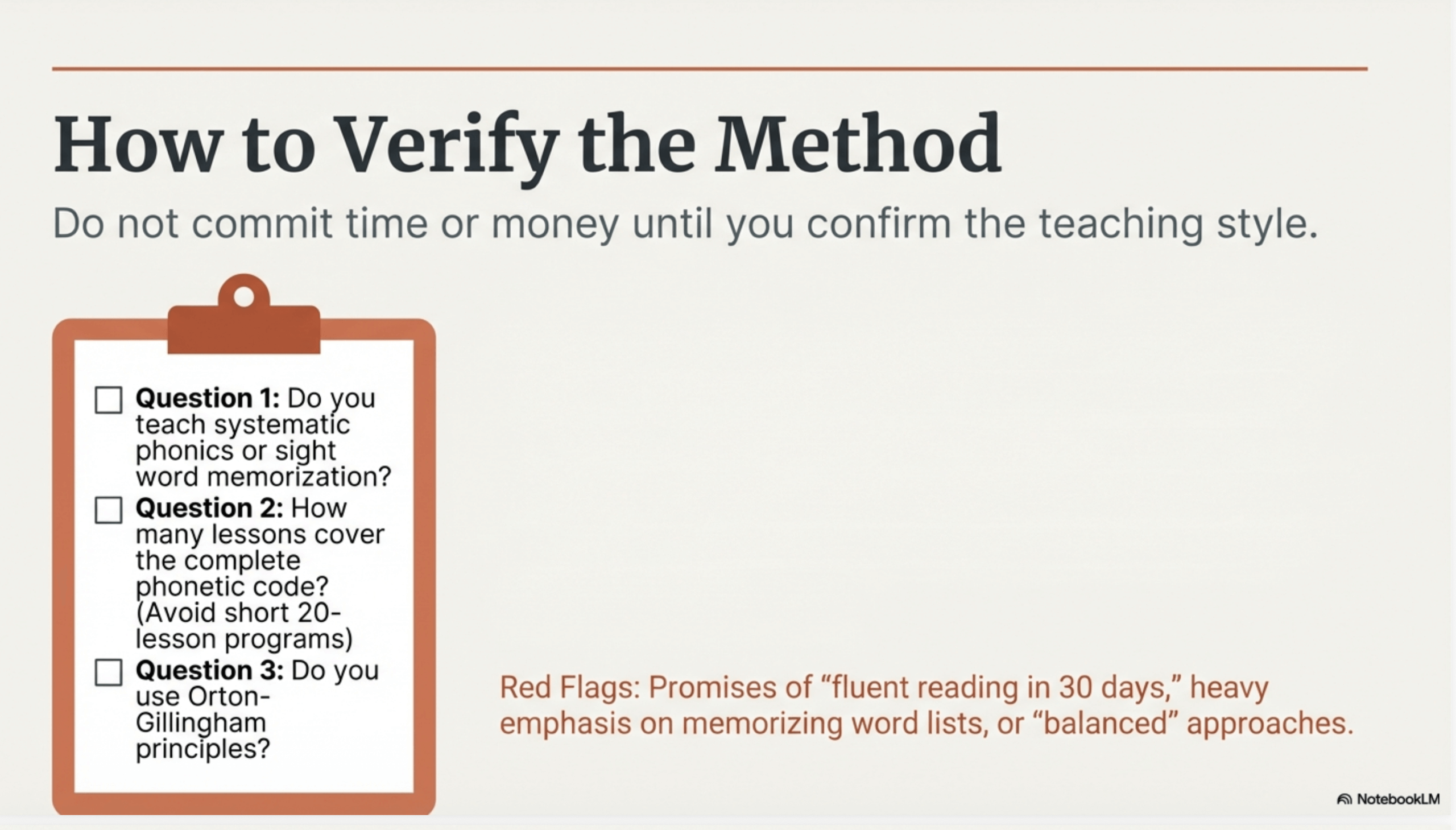
Before committing time or money, confirm the program uses systematic phonics:
Questions to ask:
- “Do you teach systematic phonics or use sight word memorization?”
- “How many lessons cover the complete phonetic code of English?”
- “What teaching methodology do you follow?” (Look for “Orton-Gillingham” or “systematic phonics”)
- “Can students decode unfamiliar words, or do they memorize specific words?”
Warning signs:
- Heavy emphasis on memorizing word lists
- “Balanced approach” (often means mixed methods)
- Only 20-50 total lessons (incomplete phonics coverage)
- Promises of extremely rapid results
Step 3: Start with a Trial
If possible, experience the teaching before fully committing:
For online programs:
- Take free trial lessons if offered
- Watch sample videos to see teaching style
- Verify content is age-appropriate for adults
For classes:
- Attend a sample session if allowed
- Talk to current students about their experience
- Observe the teaching method being used
For tutors:
- Have an initial consultation
- Ask about their training and methodology
- Discuss your specific situation and goals
Step 4: Commit to Consistent Practice
Once you’ve chosen your approach:
Set a realistic schedule:
- Daily practice works better than occasional marathon sessions
- Even 20-30 minutes daily creates progress
- Choose a specific time (before work, during lunch, evening)
- Treat study time as a non-negotiable appointment
Create your learning environment:
- Dedicated quiet space free from distractions
- Necessary materials ready and available
- Privacy if that’s important to you
Track your progress:
- Keep a simple journal of lessons completed
- Note words or concepts that clicked
- Celebrate milestones (first book read, first form filled out independently)
Step 5: Be Patient with Yourself
Realistic expectations:
- Progress takes time—typically 6-12 months for significant improvement with consistent daily practice
- Some concepts will be easier than others
- Difficulty is normal and temporary
- Small daily progress adds up to major achievement
When you struggle:
- Remember why you started
- Recognize struggle as part of learning, not proof you can’t do it
- Take breaks when needed, but return to practice
- Reach out for help if you’re stuck (instructor, tutor, program support)
Real Stories: Adults Who Got Help
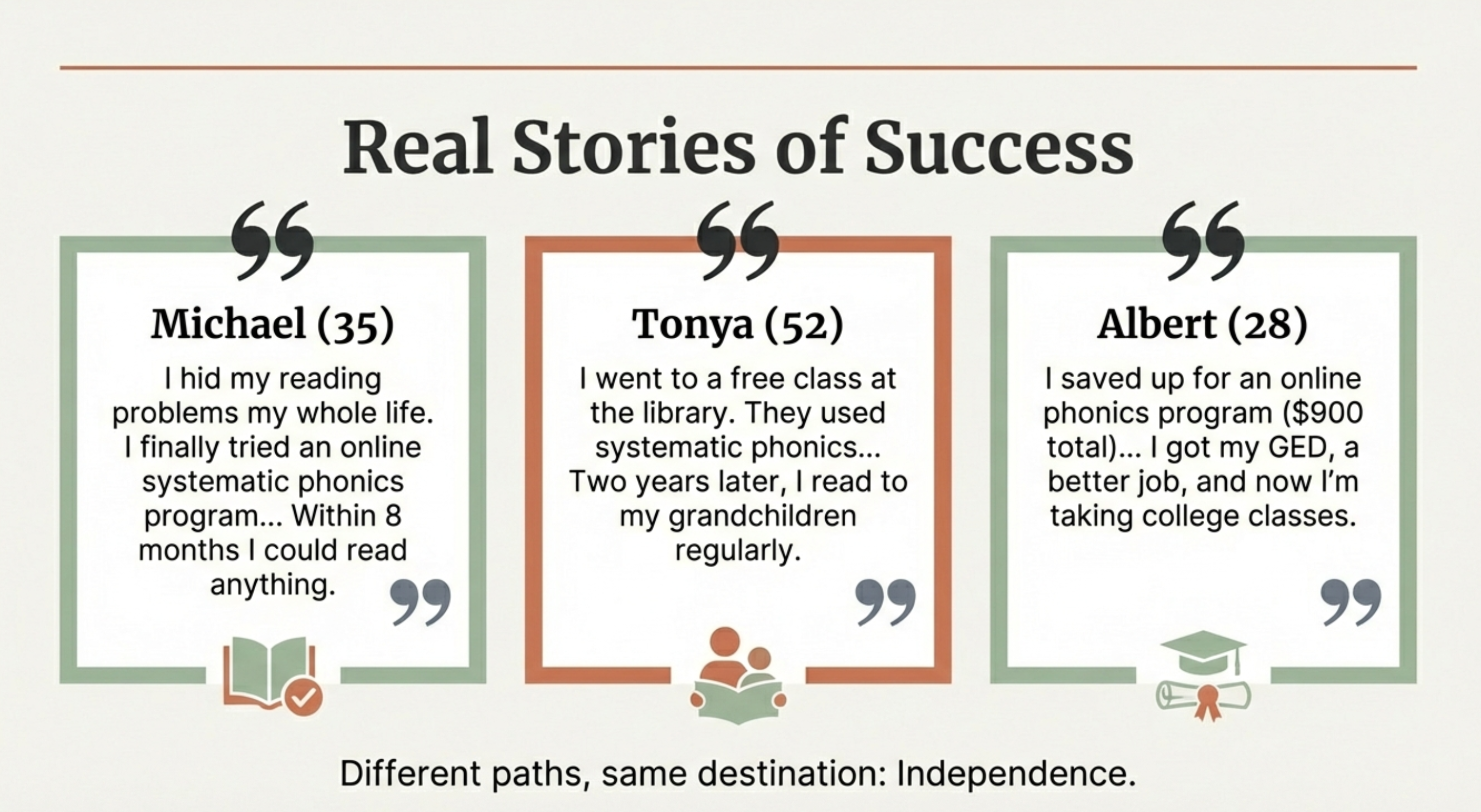
You’re not attempting something unprecedented. Many others have walked this path:
Michael, age 35: “I hid my reading problems my whole life. I finally tried an online systematic phonics program because I could learn privately at home. Within 3 months I was reading better than I ever had. Within 8 months I could read anything. I wish I’d started sooner.”
Tonya, age 52: “I went to a free adult education class at the library. They used systematic phonics which I’d never been taught in school. It was hard work, but the instructor was patient and the other students understood what I was going through. Two years later, I read to my grandchildren regularly.”
Albert, age 28: “I couldn’t read well enough to fill out job applications. I saved up for an online phonics program. It cost less than $900 total and changed my life. I got my GED, got a better job, and now I’m taking college classes. Reading opened doors I didn’t know existed.”
Rachel, age 43: “The shame was the hardest part. Once I got past that and actually started learning, I realized I wasn’t stupid—I was just never taught properly. The systematic phonics approach made sense in a way nothing in school ever did.”
For more detailed success stories: Adult Phonics Success Stories
Frequently Asked Questions
I’m too embarrassed to go to a class. What can I do?
Many adults learn successfully using online programs that provide complete privacy. You can learn at home without anyone knowing. Self-paced online systematic phonics programs allow you to work independently on your own schedule. Once you’ve made progress, you may feel more comfortable in group settings—or you may not need them.
How can I afford reading help?
Options exist at every price point. Free adult basic education programs are available in most communities. Online systematic phonics programs typically cost $70-200/month—far less than private tutoring at $60-160/hour. Consider it an investment in your future earning potential, quality of life, and independence.
Will people judge me for learning to read as an adult?
The people worth having in your life will respect your courage in learning, not judge your starting point. Many adults hide their reading struggles, so revealing yours and doing something about it often inspires others. That said, you don’t need to tell anyone if you prefer privacy. Many successful adult learners tell people only after they’ve made significant progress.
Am I too old to learn to read?
No. Adult brains retain neuroplasticity—the ability to form new neural pathways—throughout life. People in their 30s, 40s, 50s, 60s, and beyond have successfully learned to read. Age is not the barrier. Having the right instruction is what matters.
For detailed information about learning to read at different ages, including specific advantages and timelines for people in their 30s through 70s: Learning to Read at 30, 40, 50, 60, 70+
What if I’ve tried before and failed?
Previous failure almost always reflects ineffective teaching methods, not your ability to learn. If you were taught using sight word memorization or whole language approaches, those methods simply don’t work for many adults. Systematic phonics instruction is fundamentally different and has much higher success rates.
How long will it take?
This depends on your starting reading level and how much time you can commit to practice. With consistent daily practice (20-30 minutes), most adults starting from the beginning see significant improvement in 6-12 months. Adults who can read somewhat but struggle significantly often improve dramatically in 3-6 months.
What’s the difference between different programs?
The critical factor is teaching methodology. Programs using systematic phonics consistently achieve better results than those relying on sight word memorization or mixed methods. Beyond methodology, consider format (online vs. in-person), cost, schedule flexibility, and whether content is age-appropriate for adults.
Can I learn on my own, or do I need a tutor?
Many adults successfully learn using well-designed self-paced online programs. The key is choosing a program with comprehensive systematic phonics instruction and clear teaching. Tutoring can be effective but isn’t necessary if you have access to quality online instruction. One-on-one tutoring costs significantly more ($6,000-40,000 for complete programs) than online options ($600-2,000 typically).
Taking the First Step
The hardest part is often just beginning. You’ve lived with reading difficulties for years, maybe decades. Taking action requires confronting shame, fear, and uncertainty.
But consider the alternative: another year of limitation. Another year depending on others. Another year of avoiding situations because they require reading.
You deserve better.
You deserve to read emails independently. To help your children with homework. To advance in your career. To read for pleasure. To fill out forms without anxiety.
Help is available. The question is whether you’re ready to accept it.
What you need to do:
- Acknowledge that your reading struggle wasn’t your fault
- Recognize that adult brains can learn to read with proper instruction
- Choose a format that fits your situation and needs
- Verify the program uses systematic phonics
- Take the first step this week—not someday, this week
Where to start:
- Try 10 free systematic phonics lessons to experience the teaching method
- Learn how adults actually learn to read with step-by-step guidance
- Compare different program options to find the right fit
- Read success stories from adults who started where you are
- Understand how long it takes to set realistic expectations
The path forward is clearer than you think. Thousands of adults have walked it successfully. You can too.
The question isn’t whether you can learn to read. The question is: when will you start?
Additional Resources
Understanding Adult Reading Struggles:
- Why Can’t I Read Well as an Adult? – Understand the root causes
- Can Adults with Dyslexia Learn to Read? – Information for dyslexic adults
Program Information:
- Phonics for Adults: Complete Overview – How systematic phonics works
- Adult Phonics Cost Comparison – Compare program costs and value
Getting Started:
- How to Learn to Read as an Adult – Complete step-by-step guide
- Free Trial Lessons – Start learning today with no commitment