Why Can’t I Read Well as an Adult? The Real Reasons
If you’re asking yourself “Why can’t I read well?” you’re asking the right question. Understanding why you struggle is the first step toward solving the problem.
The answer may surprise you: The reason you can’t read well has nothing to do with your intelligence.
You struggle with reading because of how you were taught—or more accurately, what you weren’t taught. The foundational skills needed for reading were either never presented to you, or were taught using methods that don’t work for everyone.
This guide explains the real reasons adults struggle with reading, why traditional school methods failed you, and why understanding the cause gives you the power to fix it.
The Short Answer: You Were Never Taught the Code
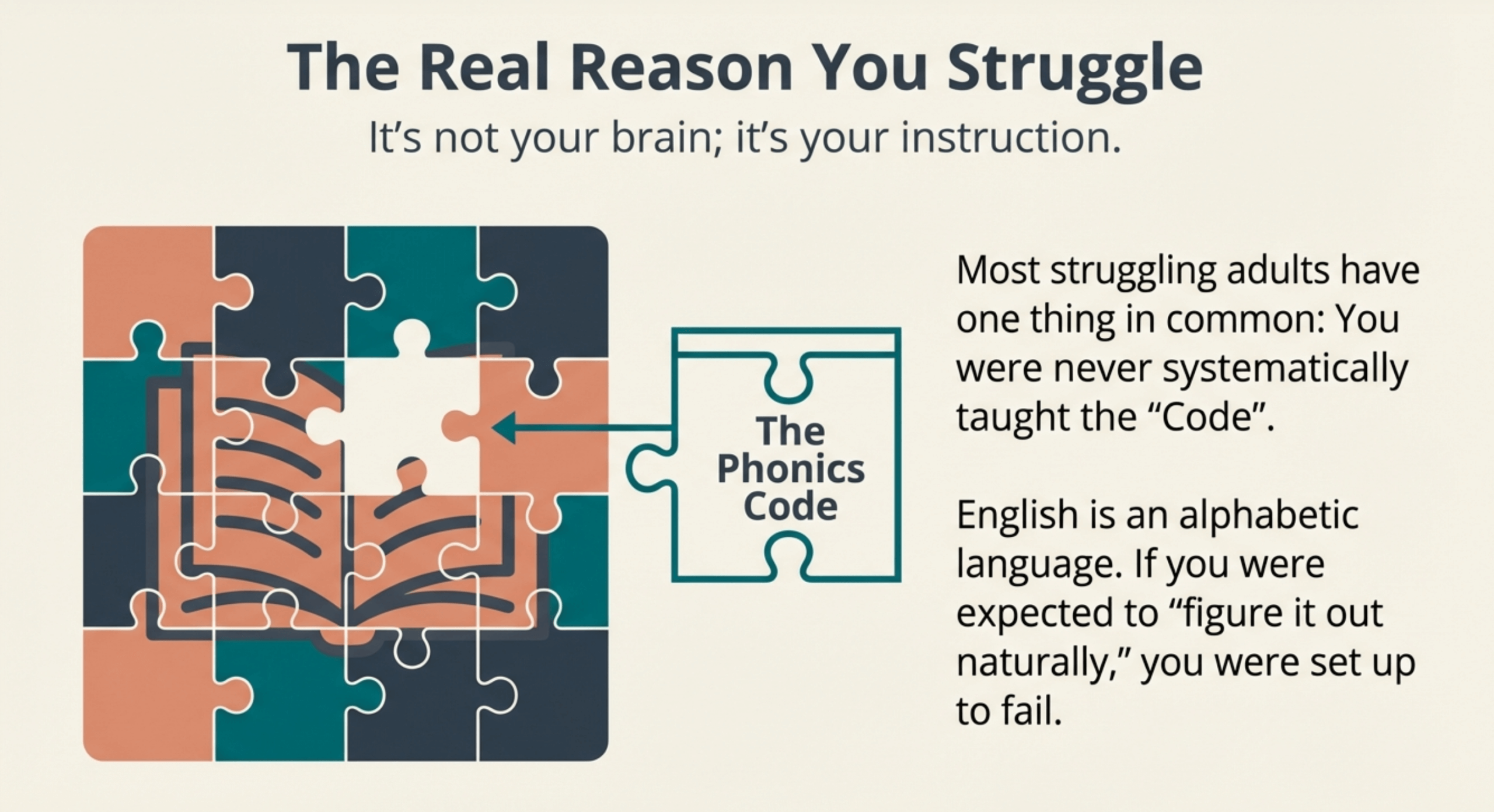
Here’s what most adults who struggle with reading have in common: They were never systematically taught how letters represent sounds in English.
English is an alphabetic language. Twenty-six letters combine to represent the sounds of spoken English. Learning to read means learning this letter-sound code—called phonics.
If you were taught this code systematically, explicitly, and completely, you learned to read.
If you weren’t—if you were expected to memorize whole words, guess from context, or “figure it out naturally”—you likely struggled.
The problem wasn’t you. The problem was the teaching method.
What Should Have Been Taught (But Wasn’t)
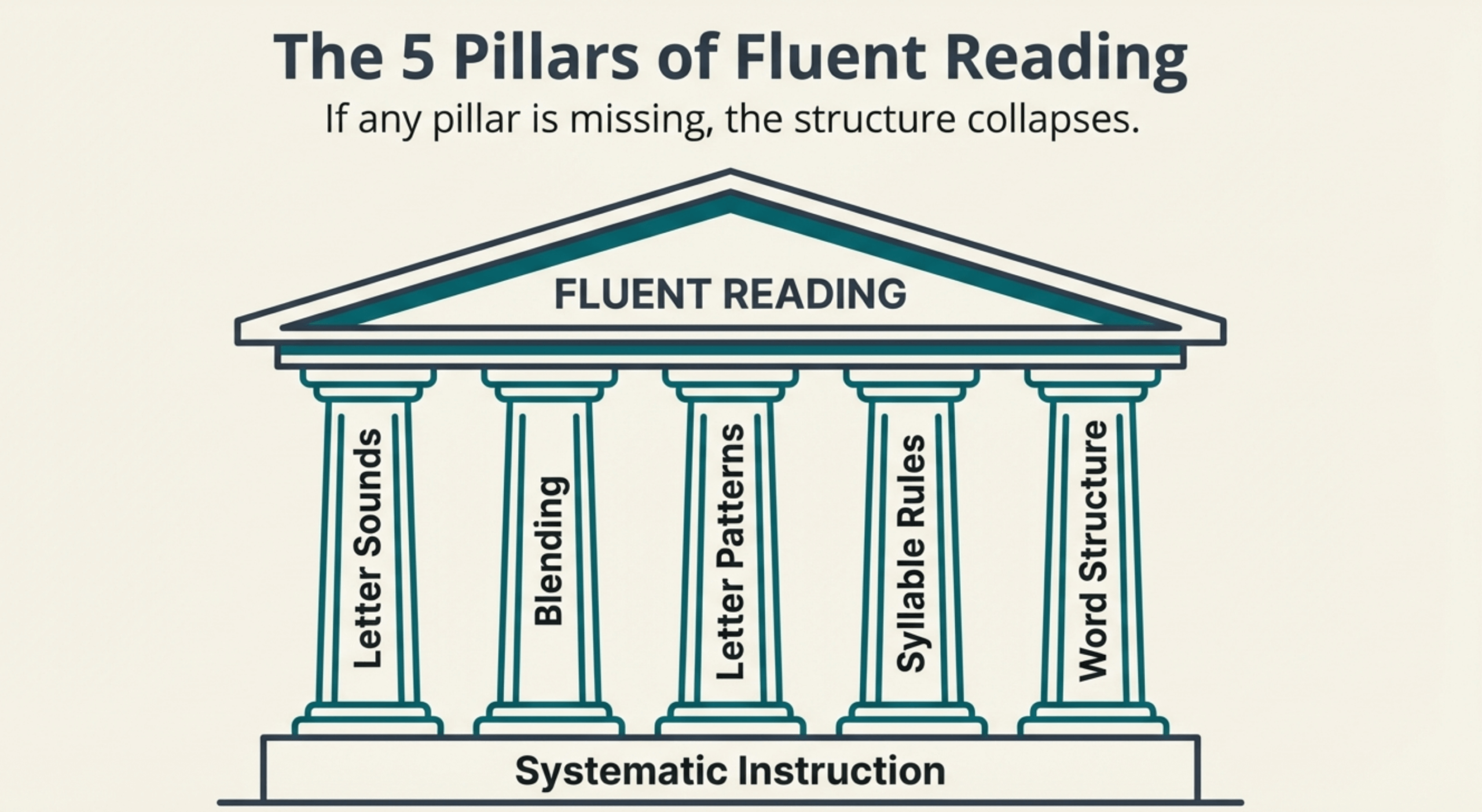
To read English fluently, you need to understand:
1. Individual letter sounds
- Each letter represents at least one sound
- The letter “m” makes the /m/ sound
- The letter “s” makes the /s/ sound
- And so on for all 26 letters
2. How to blend sounds together
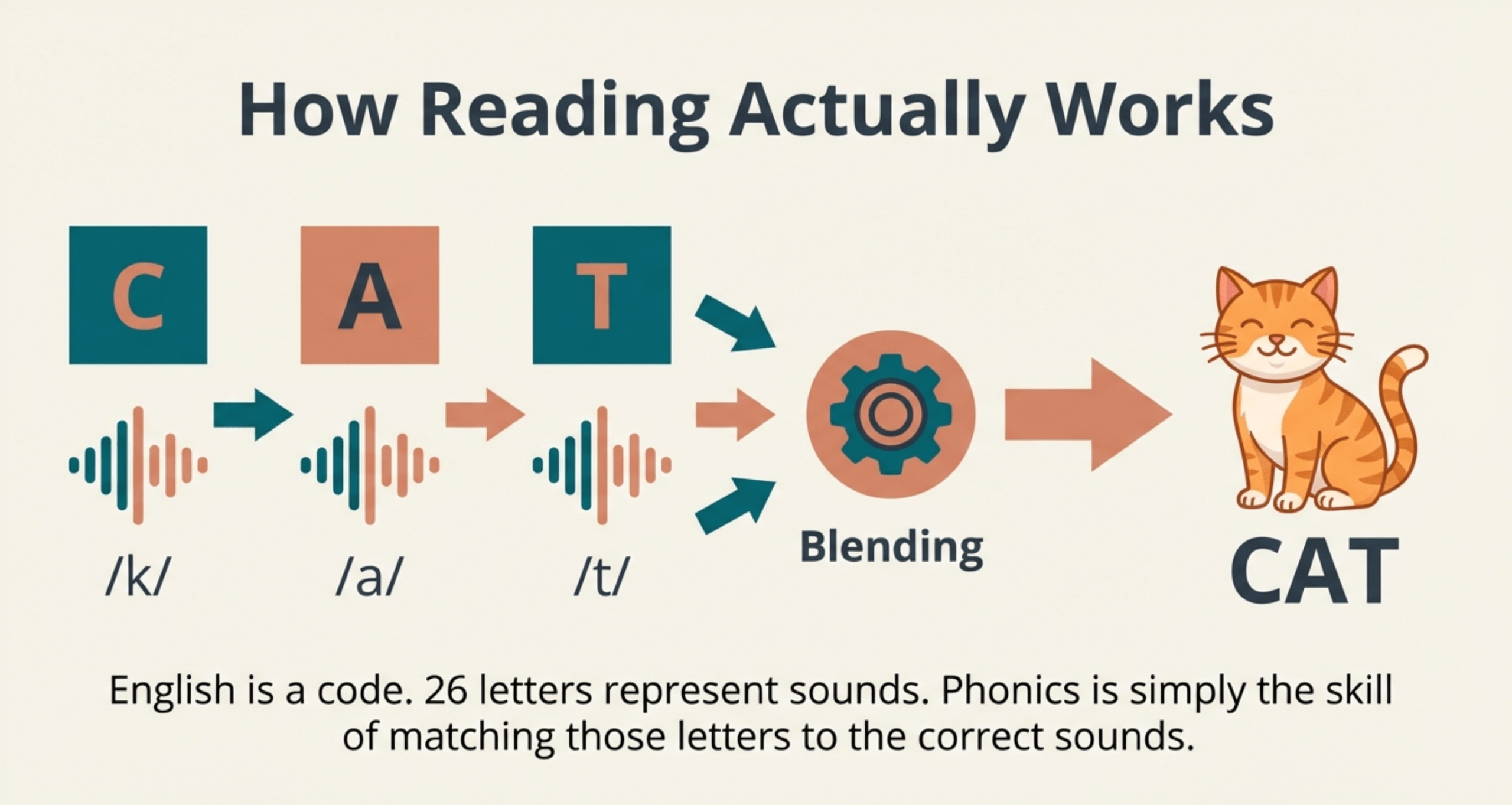
- The letters c-a-t represent three sounds: /k/ /a/ /t/
- Blending those sounds together makes the word “cat”
- This blending skill—called decoding—is fundamental to reading
3. Letter combinations and patterns
- Two letters can represent one sound: “sh” “ch” “th”
- Vowel teams follow patterns: “ai” “oa” “igh” “ea”
- These patterns are predictable and can be learned
4. Syllable rules
- How to break longer words into manageable chunks
- Where words divide into syllables
- How syllable patterns affect vowel sounds
5. Prefixes, suffixes, and word structure
- How word parts combine to create meaning
- Common prefixes like “un-” “re-” “pre-“
- Common suffixes like “-ing” “-ed” “-tion”
This complete system—all these components taught systematically from simple to complex—is what makes someone a fluent reader.
If any piece is missing, or if the pieces were taught randomly rather than systematically, gaps in understanding result. Those gaps make reading difficult or impossible.
The Teaching Methods That Failed You

Understanding which teaching approaches don’t work helps explain why you struggled.
Whole Language / Balanced Literacy
What it is: An approach that emerged in the 1980s-1990s based on the idea that children learn to read naturally, the way they learn to speak. Instead of teaching phonics systematically, whole language encouraged:
- Memorizing whole words by sight
- Guessing words from context
- Using pictures as clues
- Reading “authentic literature” rather than controlled phonics texts
Why it doesn’t work for everyone: Reading is NOT a natural ability like speaking. Speaking develops naturally because humans are neurologically wired for oral language. Reading is a cultural invention that requires explicit instruction in how written symbols represent sounds.
Some children figure out the letter-sound code on their own, even without systematic phonics instruction. Others—including you—need explicit teaching. Without it, they struggle.
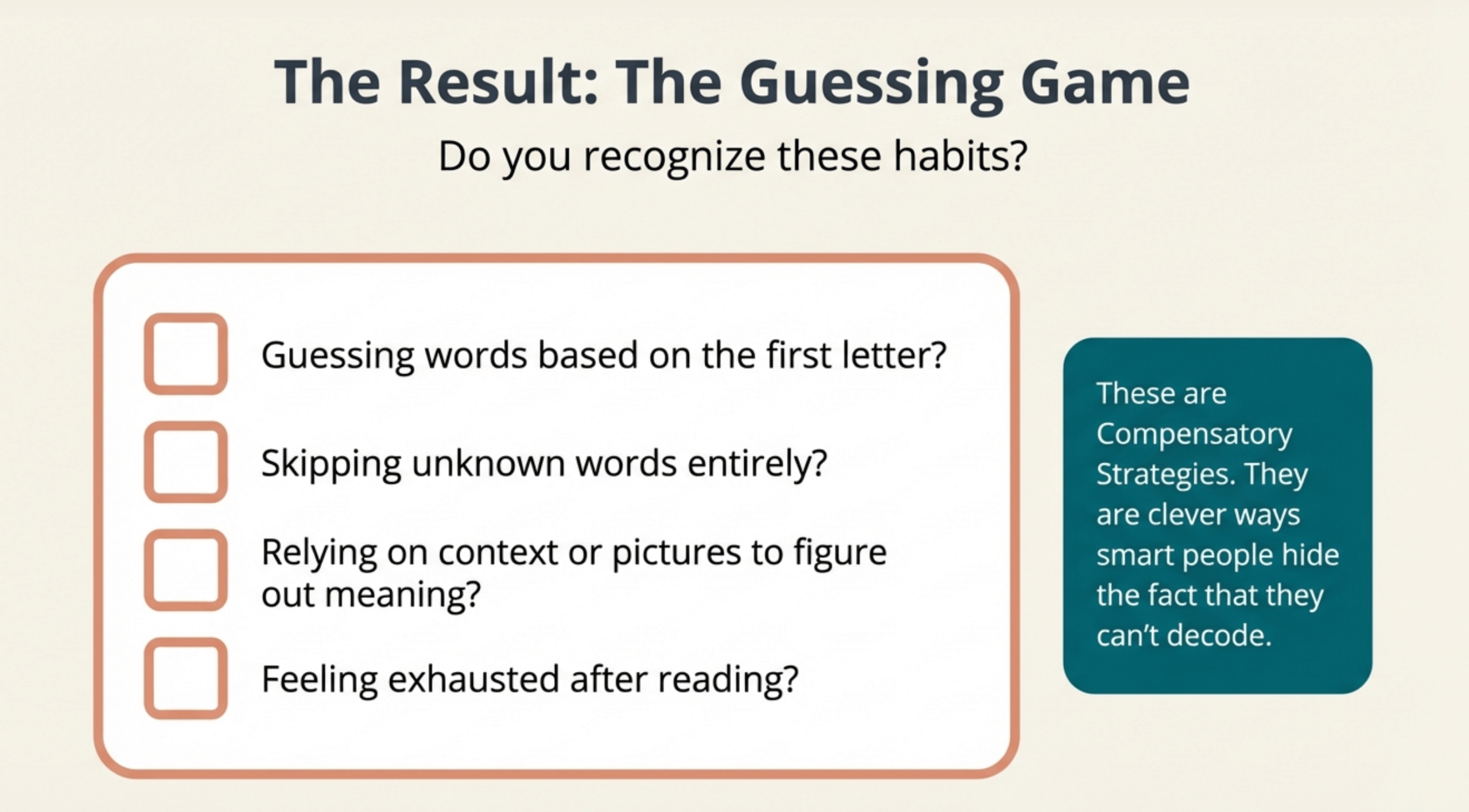
The result: Students taught with whole language approaches learned to memorize a few hundred common words but couldn’t decode unfamiliar words. When they encountered words they hadn’t memorized, they guessed based on context or the first letter. This guessing worked sometimes but failed frequently, making reading slow, frustrating, and error-prone.
If you find yourself:
- Guessing at words rather than sounding them out
- Skipping words you don’t recognize
- Relying heavily on context to figure out meaning
- Struggling with unfamiliar words even if they follow patterns you should know
…you were likely taught using whole language methods.
Sight Word Memorization
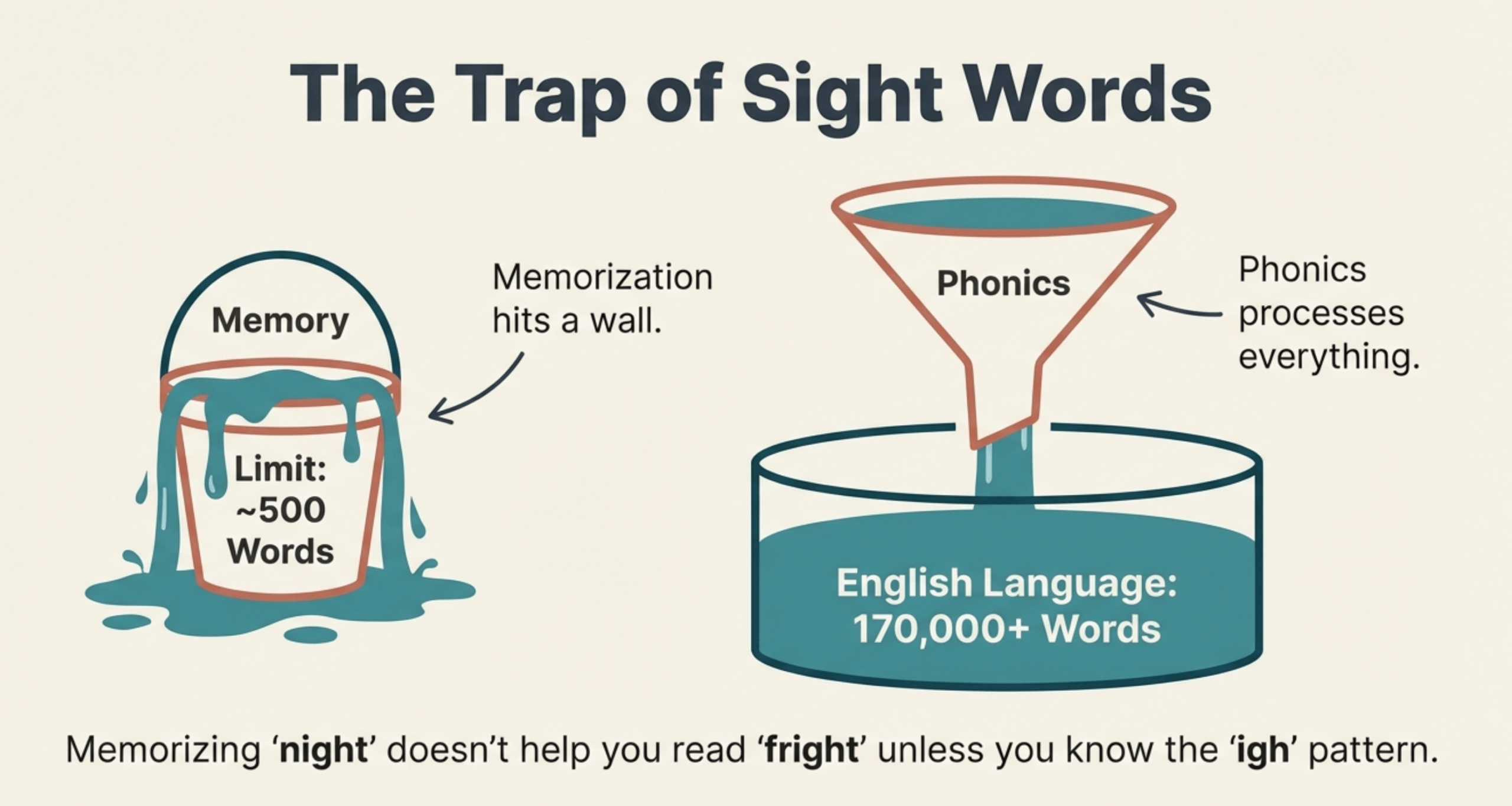
What it is: An approach focusing on memorizing high-frequency words (called “sight words”) without teaching the phonics patterns that explain why those words are spelled the way they are.
Students were given lists of words to memorize: “the,” “was,” “said,” “of,” “they,” and hundreds more.
Why it has severe limitations: Human working memory can handle memorizing hundreds, even thousands of words. But English has a vocabulary of over one million words and over 170,00 words currently in use. You cannot possibly memorize them all.
Additionally, memorizing words without understanding why they’re spelled that way doesn’t build transferable skills. If you’ve memorized “night,” that doesn’t help you read “flight,” “fright,” or “delight” unless you understand the “igh” pattern.
The result: Students who were taught primarily through sight word memorization hit a wall. They could read simple texts with familiar words but struggled dramatically when texts became more complex. They had no strategy for unfamiliar words except more memorization.
If you can read simple, familiar words but struggle with longer or unfamiliar words, sight word memorization was likely the primary method used with you.
Mixed Methods Without Systematic Phonics
What it is: Some schools used a “balanced” approach that included some phonics but didn’t teach it systematically or completely. Students might learn basic letter sounds and simple three-letter words (cat, dog, run) but then shift to memorization and guessing for more complex patterns.
Why it leaves gaps: Incomplete phonics instruction is almost as problematic as no phonics instruction. If you learn how to read “cat” but never learn the “igh” pattern, you can’t read “night.” If you learn short vowels but not long vowels, you’re stuck with very simple words.
The gaps in knowledge compound. Each new reading challenge you encounter requires patterns you were never taught.
The result: Students taught with incomplete phonics could read at a basic level but never became fluent. They struggled with grade-level texts, avoided reading whenever possible, and developed compensatory strategies to hide their difficulties.
If you can read somewhat but have persistent difficulties with spelling, longer words, or reading fluently, you likely received incomplete phonics instruction.
Other Contributing Factors
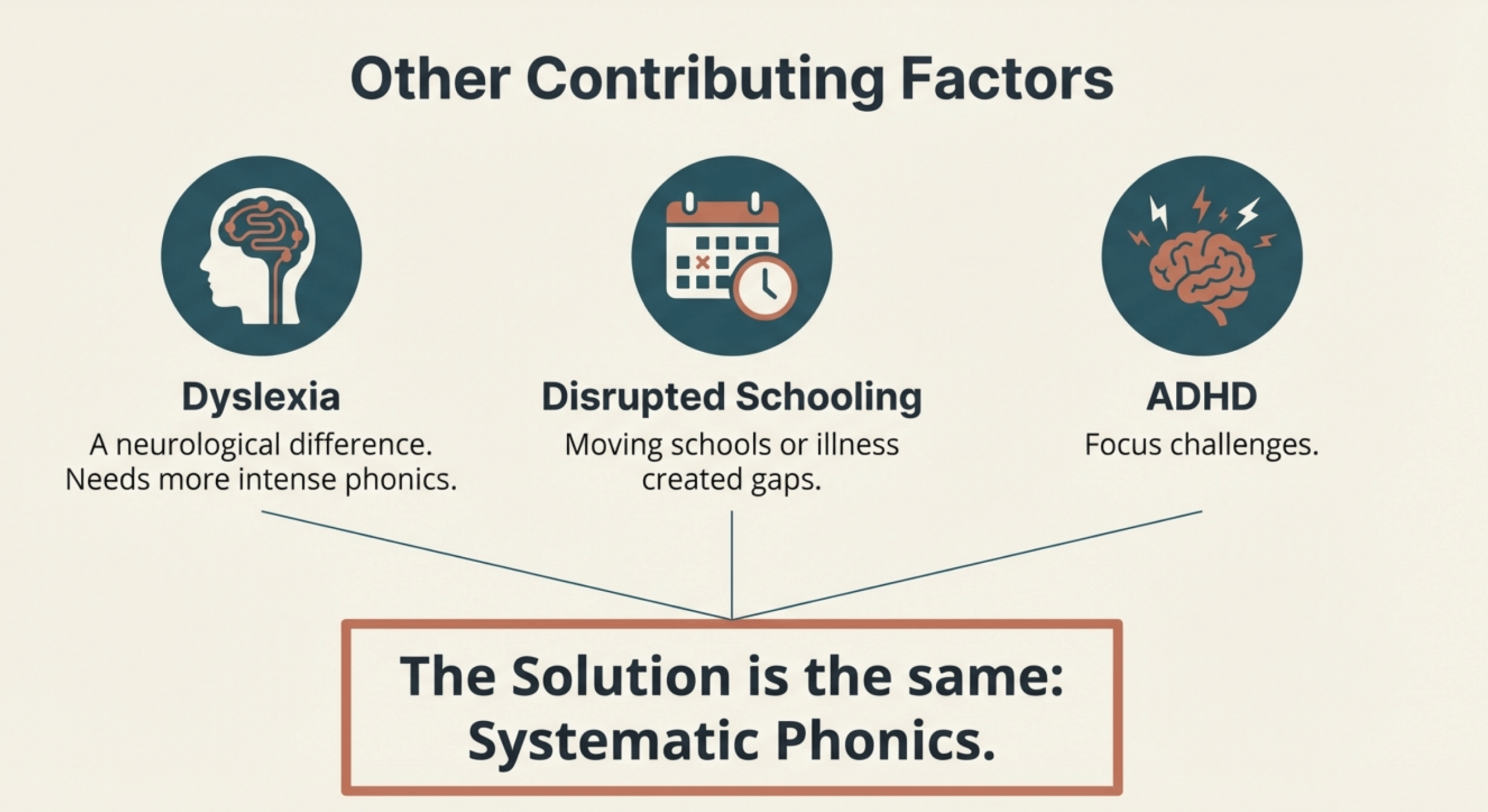
While inadequate phonics instruction is the primary reason most adults struggle with reading, other factors can contribute:
Learning Differences
Dyslexia: A neurological condition affecting how the brain processes written language. People with dyslexia have particular difficulty connecting letters to sounds and may struggle with:
- Phonological awareness (hearing and manipulating sounds in words)
- Rapid word recognition
- Spelling
- Reading fluency
Important: Dyslexia does NOT mean you can’t learn to read. It means you need particularly explicit, systematic phonics instruction using multisensory methods. The Orton-Gillingham approach was specifically developed for dyslexic learners and is highly effective.
If you have extreme difficulty with reading despite good intelligence in other areas, dyslexia may be a factor. However, even with dyslexia, systematic phonics instruction works—you just may need more intensive practice.
Learn more: Can Adults with Dyslexia Learn to Read?
Other learning differences:
- ADHD can make sustained reading practice challenging
- Processing speed differences affect reading fluency
- Working memory limitations impact comprehension
These conditions make learning to read more challenging but don’t prevent it. Systematic instruction combined with appropriate strategies can help overcome these challenges.
Disrupted Education
Frequent school changes: If you moved frequently or changed schools often, you may have missed crucial instruction. Different schools teach reading at different times. Changing schools during critical learning periods can create gaps.
Absences during key instruction: Extended illness, family disruption, or other factors causing absences during the primary grades (K-2) when reading is taught can result in missing foundational instruction that’s never made up.
English as a second language: If you learned English as a second language and weren’t taught phonics systematically in either your first language or English, you may lack the foundational skills in both languages.
Being Passed Along Despite Not Learning
Social promotion: Many schools promote students to the next grade even when they haven’t mastered grade-level material. If you were passed along despite not learning to read, the gaps only widened with each year.
Compensatory strategies: Intelligent students who can’t read become excellent at compensation:
- Memorizing what the teacher says
- Getting information from pictures and videos
- Having others read to them
- Avoiding reading whenever possible
These strategies allow students to progress through school without actually learning to read. The problem is hidden but not solved.
Vision or Hearing Issues
Undiagnosed vision problems: If you couldn’t see the board clearly or had undiagnosed eye tracking issues, you may have missed visual instruction critical to learning phonics patterns.
Hearing difficulties: Phonics instruction requires hearing sounds clearly. Undiagnosed hearing loss or auditory processing issues can interfere with learning letter-sound connections.
Important: If you suspect vision or hearing issues, get tested. However, most adults who struggle with reading don’t have these issues—they simply weren’t taught phonics systematically.
Why Intelligence Has Nothing to Do With It
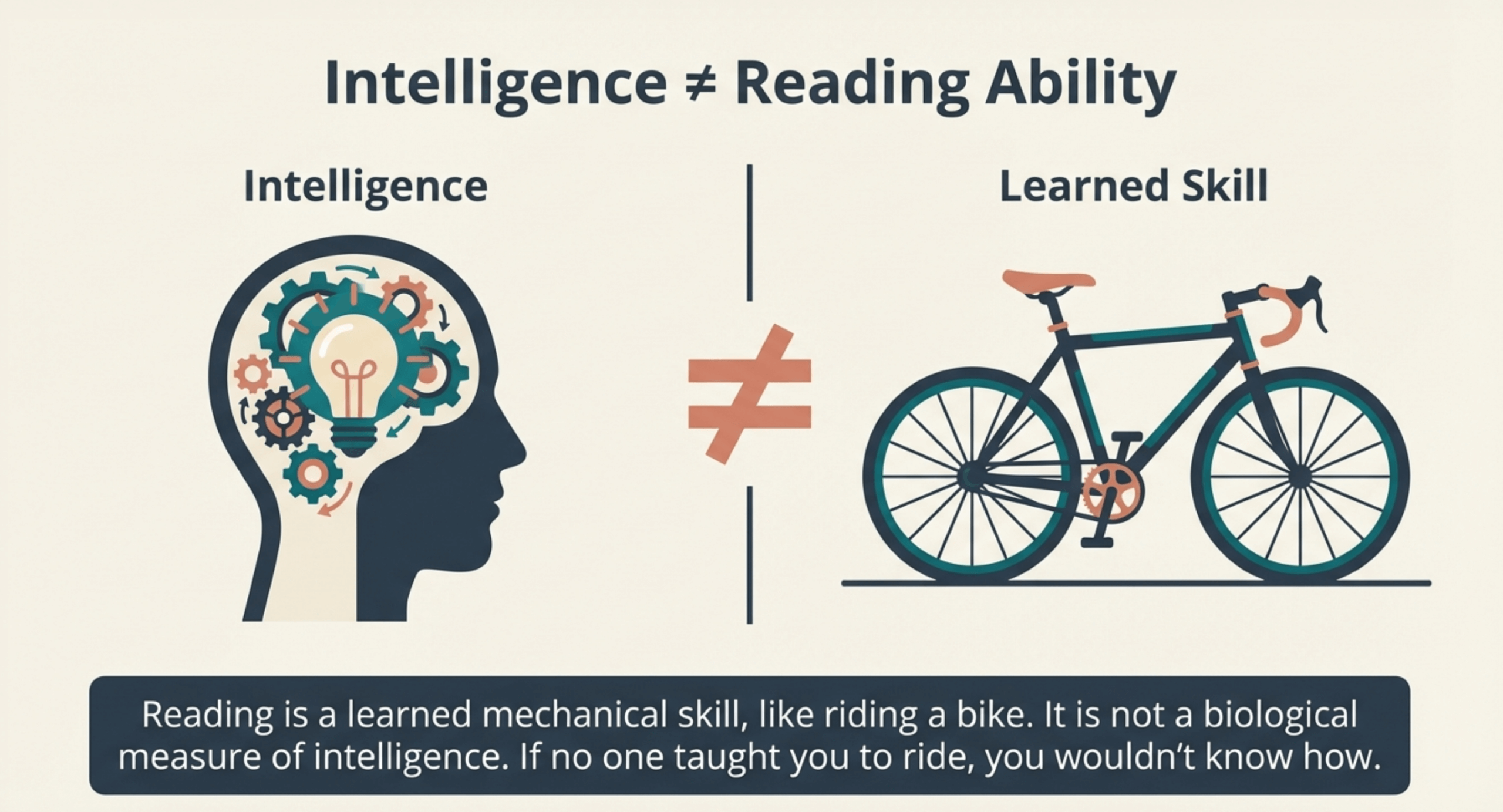
One of the most important things to understand: Reading difficulty is not related to intelligence.
You can be highly intelligent and struggle with reading. In fact, many people with reading difficulties have above-average intelligence in other areas. They’re excellent problem-solvers, creative thinkers, mechanically skilled, socially adept, or talented in numerous ways.
Why intelligent people can’t read:
Reading is a learned skill, not an innate ability. It’s more like riding a bike than like growing taller. Everyone can learn to ride a bike with proper instruction and practice, regardless of intelligence. Similarly, everyone can learn to read with proper instruction and practice.
If you weren’t taught how to ride a bike and then struggled to figure it out on your own, that wouldn’t mean you lack the intelligence to bike—it would mean you lack the instruction.
The compensation that hides the problem:
Intelligent people who can’t read well become masters at compensation. They:
- Develop excellent memory to compensate for inability to read notes
- Excel at verbal communication since they can’t rely on written
- Become skilled at reading social cues to avoid reading situations
- Find careers that minimize reading requirements
This compensation requires high intelligence. But it also masks the reading problem, making it seem like you’re functioning fine when you’re actually working much harder than you should need to.
The Good News: Understanding the Cause Gives You the Solution
Now that you understand why you can’t read well, you can address the actual problem.
The problem: You were never systematically taught the complete phonics code of English.
The solution: Learn the phonics code systematically now.
Why this works for adults:
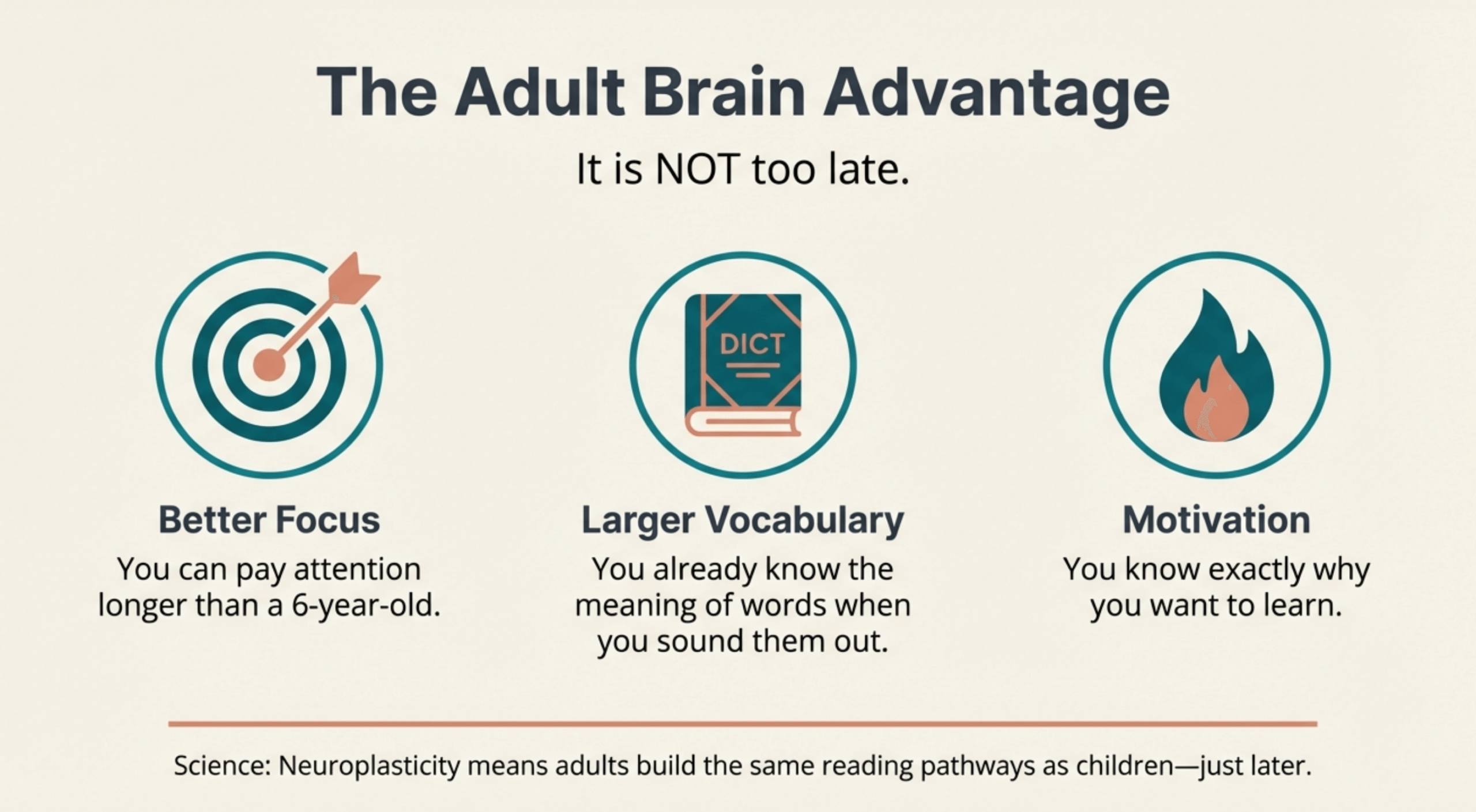
Adult brains are actually well-suited for systematic phonics instruction:
- You understand abstract concepts (letters are symbols representing sounds)
- You already have rich vocabulary in spoken language
- You can articulate exactly where you’re confused
- You’re motivated and understand why learning to read matters
- You can dedicate focused attention to learning
Brain imaging studies show that adults who learn to read develop the same neural reading pathways that fluent readers have. The pathways form later in life, but they do form.
It’s never too late.
What You Need to Do Differently This Time
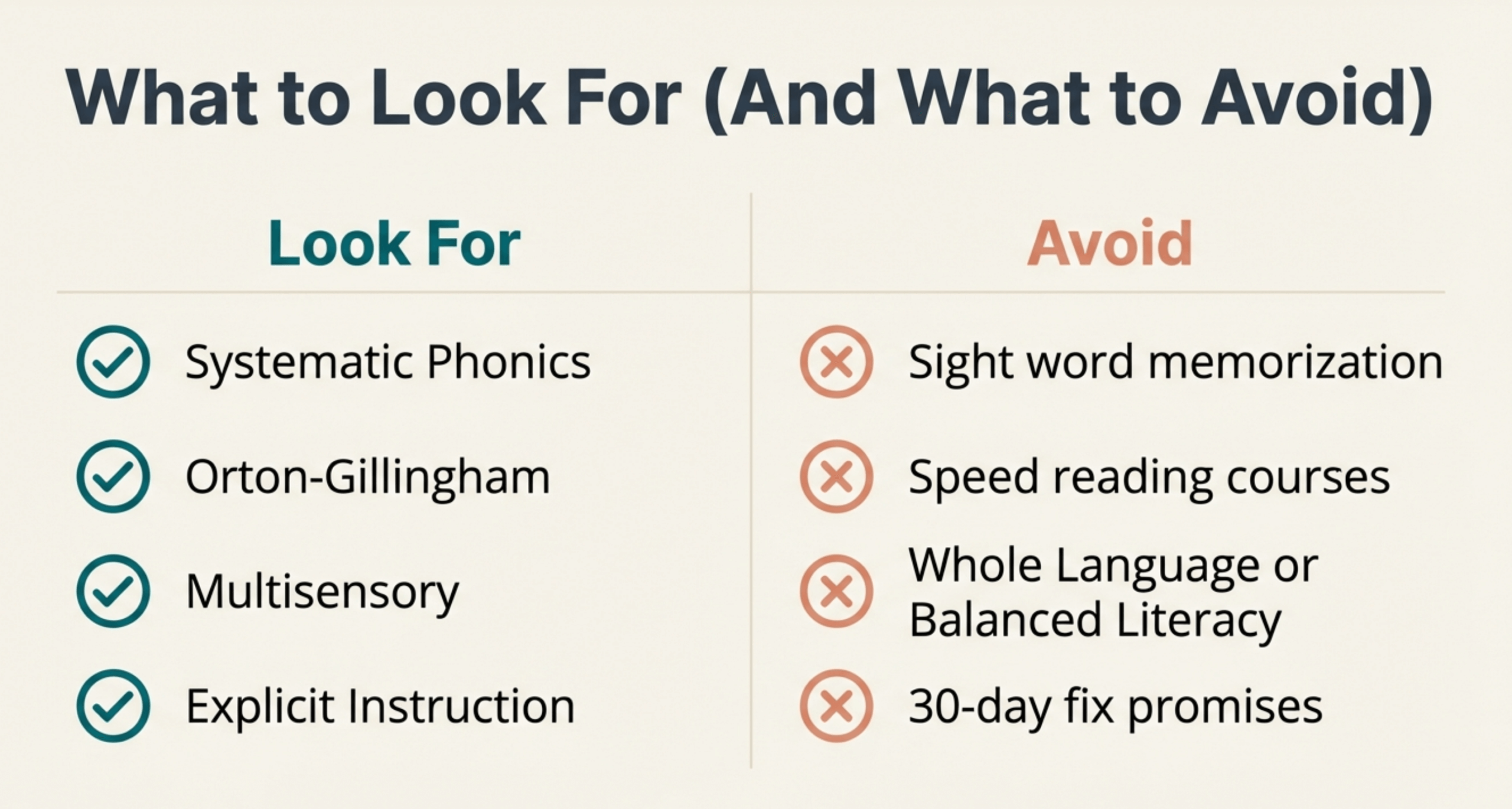
Since inadequate phonics instruction was the problem, proper phonics instruction is the solution.
What to look for:
Systematic phonics program:
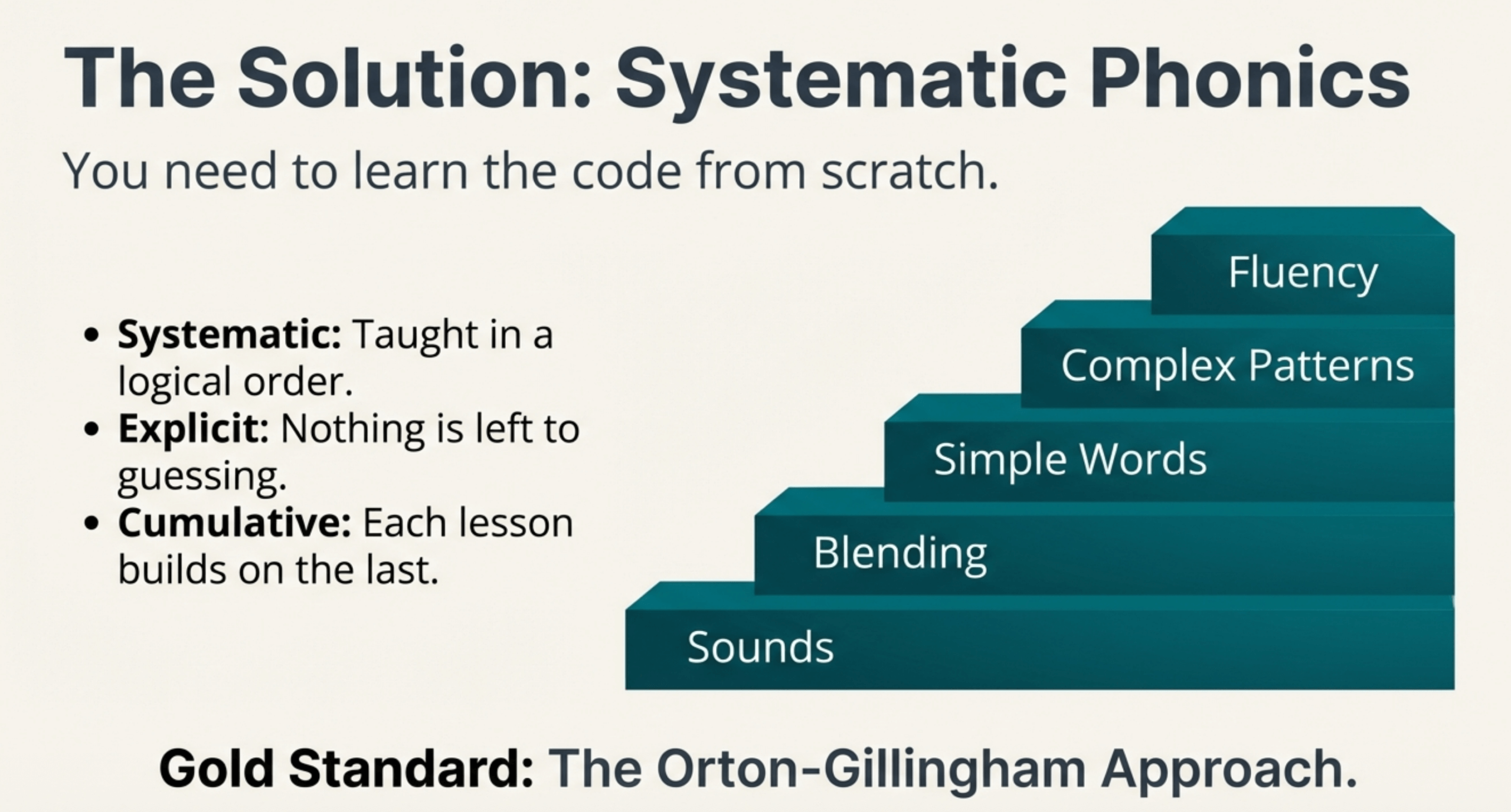
- Teaches the complete phonics code from simple to complex
- Sequential—each concept builds on previous learning
- Explicit—nothing left to chance, everything taught directly
- Comprehensive—covers all phonics patterns, not just basics
Orton-Gillingham approach: Programs following Orton-Gillingham principles have the highest success rates with struggling adult readers. These programs are:
- Multisensory (engaging visual, auditory, kinesthetic learning)
- Systematic and cumulative
- Explicit and direct
- Designed originally for dyslexic learners but effective for all struggling readers
Age-appropriate content: Adults need materials that respect their intelligence and maturity. Avoid programs that are simply children’s materials with “adult” labels.
Sufficient practice: You need extensive practice reading words, sentences, and passages using the phonics patterns you’ve learned. Reading practice builds fluency and automaticity.
What to avoid:
Don’t repeat the same failed methods:
- Programs emphasizing sight word memorization
- Approaches using primarily context clues and guessing
- “Balanced literacy” or mixed methods
- Programs with incomplete phonics coverage
Don’t fall for quick fixes: Learning to read as an adult requires genuine time and effort. Be skeptical of programs promising you’ll “read in 30 days.” Most adults need 6-12 months of consistent practice for significant improvement.
How Long Does It Take?
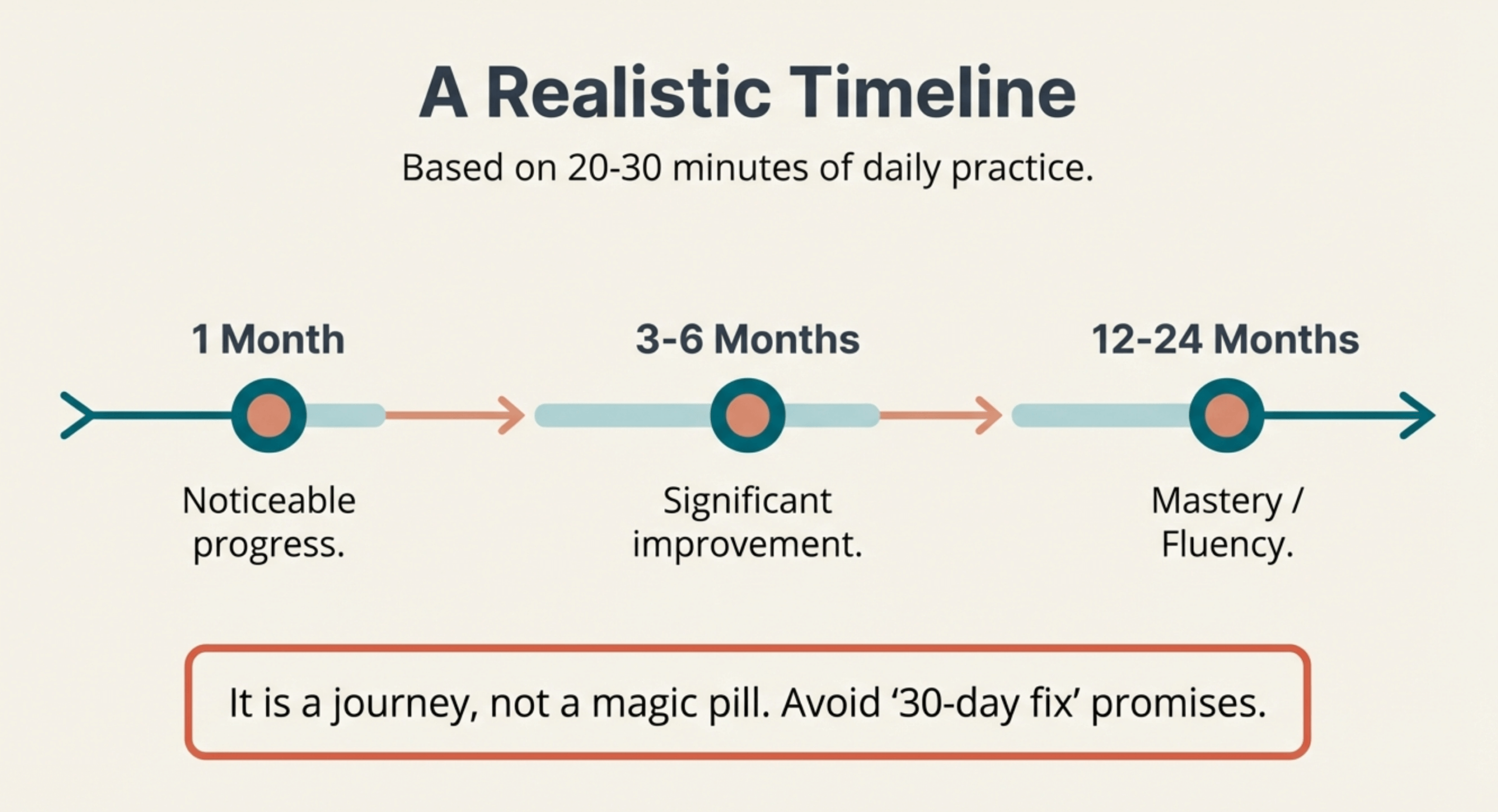
Realistic timeline:
With consistent daily practice (20-30 minutes), most adults see:
- Noticeable progress: 1 month
- Significant improvement: 3-6 months
- Functional reading ability: 6-12 months
- Complete mastery: 12-24 months
Factors affecting timeline:
- Your starting reading level
- How much time you can practice daily
- Whether you have learning differences requiring additional practice
- The quality and completeness of instruction
- Your consistency
The key: steady, consistent practice using systematic phonics instruction.
Learn more: How Long Does It Take Adults to Learn Phonics?
Real Stories: Adults Who Discovered Why
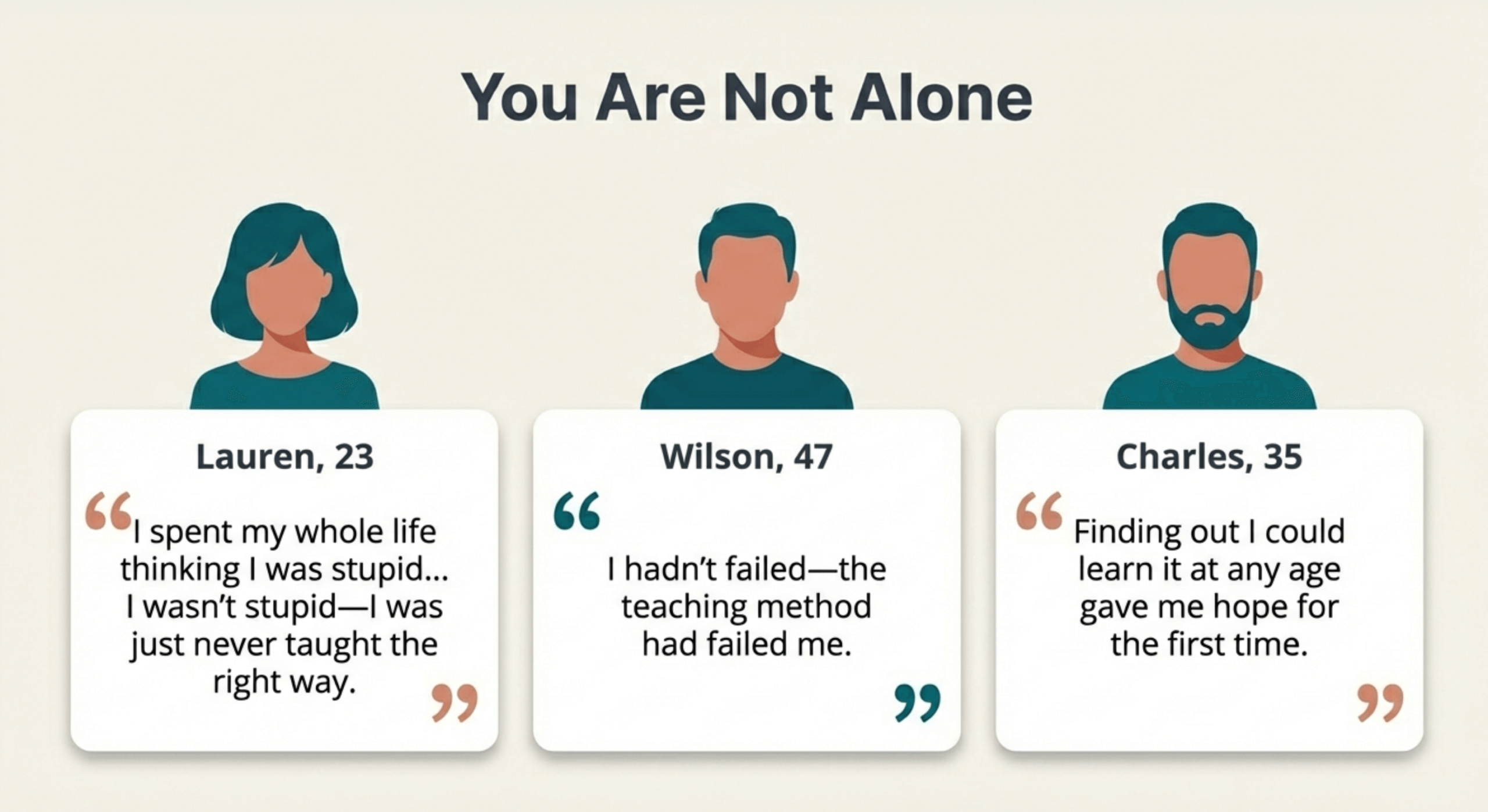
Understanding the real reason for their reading struggles changed everything for these adults:
Lauren, age 23: “I spent my whole life thinking I was stupid because I couldn’t read. Then I learned about systematic phonics and realized I was never taught the code. I wasn’t stupid—I was just never taught the right way. That understanding freed me to actually learn without shame.”
Wilson, age 47: “When I discovered that whole language was used in my elementary school, everything clicked. I hadn’t failed—the teaching method had failed me. Once I learned phonics systematically as an adult, reading finally made sense.”
Charles, age 35: “I always thought something was wrong with my brain. Finding out that I just needed systematic phonics instruction—and that I could learn it at any age—gave me hope for the first time.”
Wanda, age 38: “Understanding why I struggled removed the shame. I wasn’t broken. I just needed to be taught what I’d missed. That shift in perspective made all the difference.”
Read complete success stories: Adult Phonics Success Stories
You Can Fix This
Now you know the truth:
Why you can’t read well: You weren’t systematically taught the phonics code that underlies English reading and spelling.
Why that’s not your fault: The teaching methods used in your school failed you. You did the best you could with inadequate instruction.
Why there’s hope: The phonics code can be learned at any age. Your brain retains the ability to form new reading pathways. Adults learn systematic phonics effectively—often faster than children because of greater cognitive maturity.
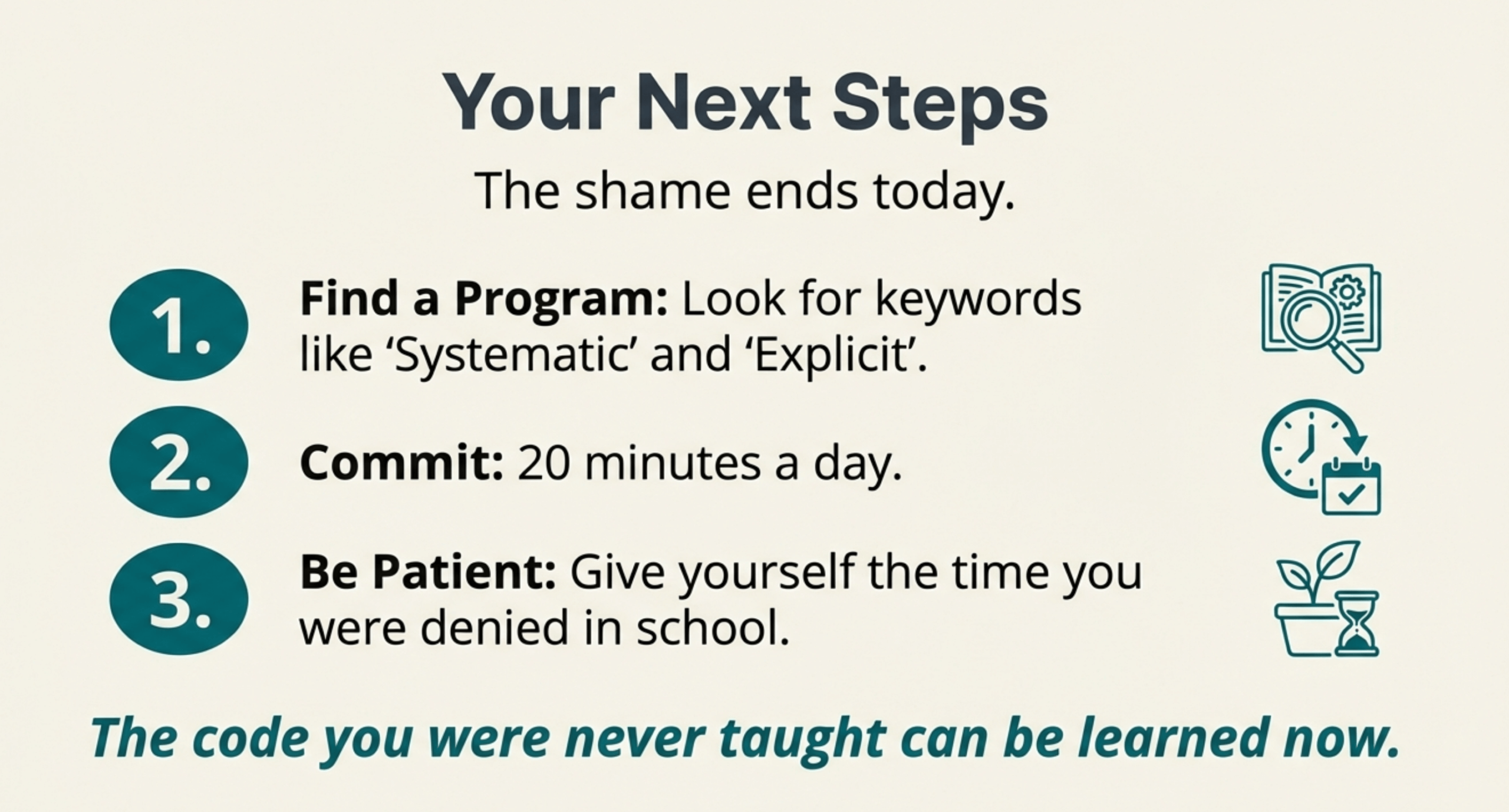
What you need to do: Find a comprehensive systematic phonics program, commit to consistent practice, and give yourself time to learn what you should have been taught decades ago.
The reading difficulties you’ve experienced your entire life can end. The question is whether you’re ready to take the steps to change it.
Your Next Steps
Understand the solution:
- How to Learn to Read as an Adult – Complete step-by-step guide
- Phonics for Adults – How systematic phonics works
Find the right program:
- Best Adult Reading Programs – Compare your options
- Adult Phonics Cost Comparison – What different approaches cost
Get started:
- Try 10 Free Lessons – Experience systematic phonics instruction
- Reading Help for Adults – Where to get support
Address specific concerns:
- Can Adults with Dyslexia Learn to Read? – If you suspect dyslexia
- How Long Does It Take? – Set realistic expectations
Get inspired:
- Adult Phonics Success Stories – See what’s possible
Frequently Asked Questions
If I wasn’t taught phonics in school, why were some of my classmates able to read?
About 60% of students will learn to read adequately regardless of teaching method. They figure out the phonics code on their own, even if it’s not explicitly taught. The other 40%—including you—need explicit, systematic phonics instruction. They don’t “get it” intuitively and struggle when phonics isn’t taught directly. This doesn’t reflect intelligence—it reflects learning style and how the brain processes written language.
Could I have dyslexia?
Possibly. Dyslexia affects a very small portion of the population. Key indicators include: extreme difficulty learning to read despite good intelligence, trouble with phonological awareness (hearing and manipulating sounds), difficulty spelling even common words, and struggles with reading fluency even after years of practice. However, even without dyslexia, inadequate phonics instruction causes reading difficulties. The good news: systematic phonics (particularly Orton-Gillingham methods) works for both dyslexic and non-dyslexic struggling readers.
Why didn’t anyone notice I was struggling and give me the right help?
Several reasons: Large class sizes make individual attention difficult. Intelligent students develop compensation strategies that mask the problem. Social promotion policies pass students along despite reading difficulties. Many teachers weren’t trained in systematic phonics and didn’t know what you needed. Schools often lack resources for intensive intervention. Additionally, if you were quiet and compliant, you were less likely to get attention than disruptive students.
Is it too late to learn now?
Absolutely not. Adult brains retain neuroplasticity—the ability to form new neural connections—throughout life. Brain imaging shows that adults who learn to read develop the same reading networks that childhood readers have. Adults often progress faster than children because of better metacognitive skills, greater motivation, and ability to understand abstract concepts. Whether you’re 25, 45, or 65, you can learn to read.
For detailed information about learning at specific ages with success stories and timelines: Learning to Read at 30, 40, 50, 60, 70+
Will I ever read as well as people who learned as children?
With systematic instruction and consistent practice, yes. While your reading pathways form later in life, they can become just as functional. Many adults who learn to read later achieve complete fluency and go on to college, career advancement, and reading for pleasure. The key is comprehensive instruction covering all phonics patterns and sufficient practice to build automaticity.
What if I can read somewhat but still struggle?
You likely received incomplete phonics instruction. You learned basic patterns but have gaps in your knowledge. The solution is the same: comprehensive systematic phonics instruction covering all patterns, including the advanced ones you missed. Many adults who “can read somewhat” see dramatic improvement when they fill in the missing pieces.
How do I explain to people why I can’t read well?
You don’t owe anyone an explanation, but if you choose to share: “I wasn’t taught to read using methods that worked for how my brain learns. I needed systematic phonics instruction but received whole language approaches instead. I’m learning now using the right method.” This is accurate and removes shame from the explanation.
Can systematic phonics really make a difference after all these years?
Yes. Research consistently shows that systematic phonics instruction is effective for adult learners, even those who have struggled for decades. The key is finding comprehensive instruction and committing to consistent practice. Thousands of adults have successfully learned to read using systematic phonics after years or decades of struggle.
Final Thought:
You can’t read well because of inadequate phonics instruction—not because of your intelligence, not because of your effort, not because of any inherent limitation.
Understanding this removes the shame and opens the path forward.
The code you were never taught can be learned now. You have the ability. You need the instruction.
The question is: are you ready to finally get what you should have received decades ago?
Start here: Try 10 free systematic phonics lessons and experience what proper reading instruction feels like.