Orton-Gillingham Principles
Understanding the Orton-Gillingham Teaching Sequence
One of the most important aspects of Orton-Gillingham instruction is the carefully planned sequence in which phonetic elements are introduced. The Orton-Gillingham method follows a systematic order based on phonetic utility and complexity.
This carefully-sequenced introduction of phonetic elements ensures students build a solid foundation before progressing to more complex patterns. Understanding this instructional sequence is crucial for parents, teachers, and tutors implementing Orton-Gillingham instruction.
While Orton-Gillingham instruction traditionally requires a trained tutor, we’ve adapted these proven principles for independent adult learners. Our online adult phonics curriculum delivers the same systematic, multisensory approach through video lessons you can complete at your own pace.
The Orton-Gillingham approach was specifically developed in the 1930s to help dyslexic students learn to read. While these principles benefit all learners, they’re especially powerful for those with dyslexia because they address the specific neurological differences in how dyslexic brains process language. Discover why Orton-Gillingham works for dyslexic adults and what results to expect.
Why the Sequence of Instruction in Orton-Gillingham is Critical
The Orton-Gillingham sequence of instruction isn’t arbitrary—it’s designed with specific pedagogical reasoning:
- Build from simple to complex: Single consonants before consonant blends, short vowels before long vowels
- Enable early reading success: Teaching high-utility letters first allows students to begin reading simple words quickly
- Systematic progression: Each new element builds on previously mastered skills
The Missing Piece: Simultaneous Multisensory Encoding
Orton-Gillingham emphasizes that decoding (reading) and encoding (spelling) must be taught together—not as separate skills. Our program dedicates half of every lesson to systematic spelling instruction, making encoding an equal partner to decoding.
The Orton-Gillingham Sequence of Instruction
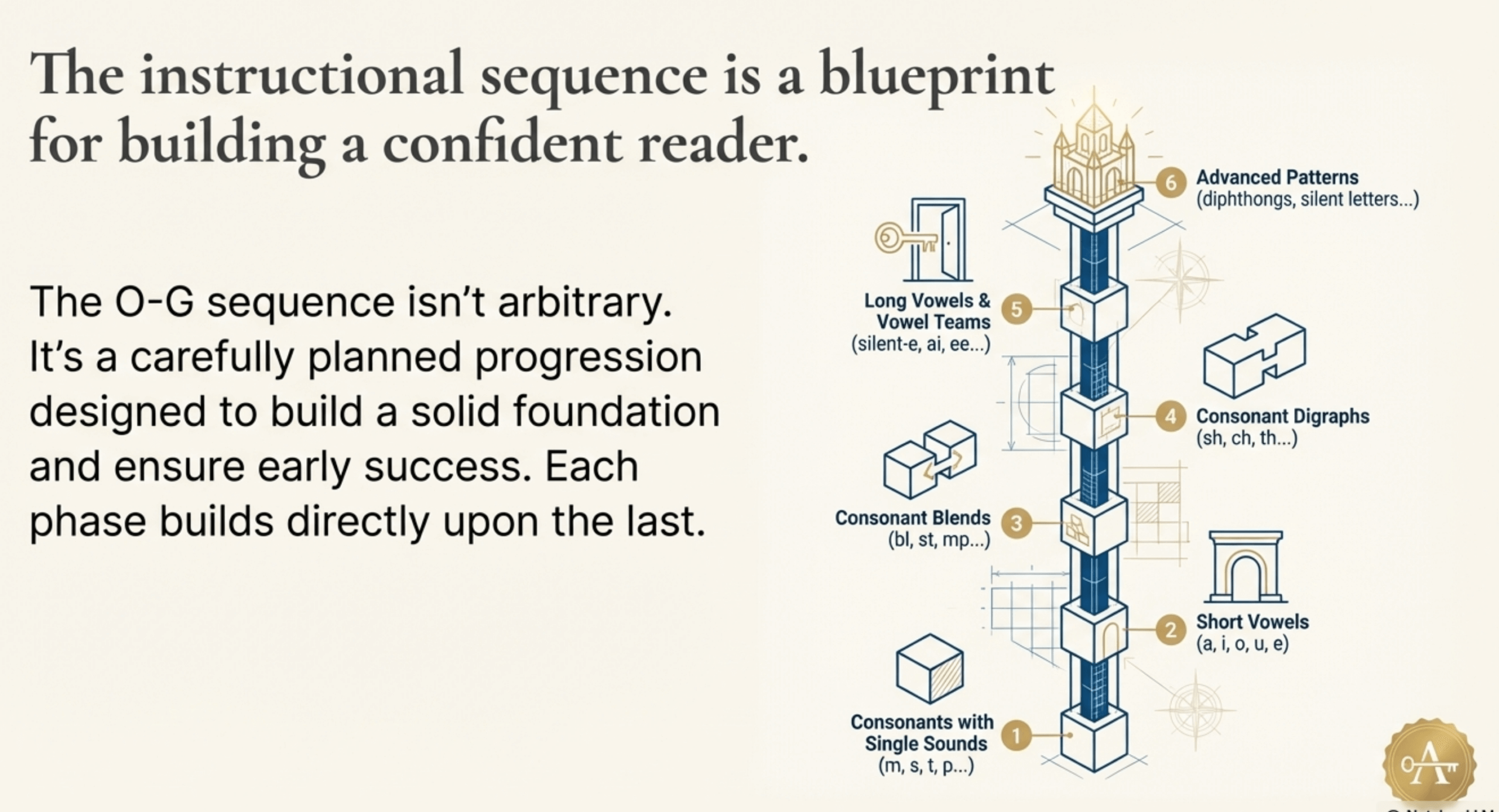
While specific programs may vary slightly, the general Orton-Gillingham instructional sequence follows this progression:
Phase 1: Consonants with Single Sounds
Letters taught: m, s, p, t, n, c (hard sound), d, f, l, h, g (hard sound), b, j, k, r, v, w, x, y, z, qu
These consonants are introduced first because they have one primary sound and high utility in forming words. Students learn both the letter name and the sound it represents.
Phase 2: Short Vowels
Letters taught: a (short), i (short), o (short), u (short), e (short)
Short vowels are taught one at a time with extensive practice between each introduction. Students learn to read and spell simple CVC (consonant-vowel-consonant) words like “cat,” “sit,” and “mop.”
Phase 3: Consonant Blends
Letter combinations taught
(beginning consonant blends): bl, cl, fl, gl, pl, sl, br, cr, dr, fr, gr, pr, tr, sc, sk, sm, sn, sp, st, sw
(ending consonant blends): lb, ld, lf, lk, lm, lp, lt, sk, sp, st, ct, ft, mp, nd, nt, pt, ps
Unlike digraphs, blends maintain both letter sounds but combine them smoothly. Students practice blending these at the beginning and end of words.
Phase 4: Consonant Digraphs
Letter combinations taught: sh, ch, th (voiced and unvoiced), wh, ck, ng
Students learn that two letters can work together to make one new sound. These high-frequency digraphs appear in countless English words.
Phase 5: Long Vowels and Vowel Teams
Patterns taught: silent-e (make, time, note), vowel teams (ai, ay, ee, ea, oa, ow), vowel-r combinations (ar, er, ir, or, ur)
This phase introduces the complexity of multiple ways to spell the same sound and multiple sounds for the same spelling pattern.
Phase 6: Advanced Patterns
Patterns taught: diphthongs (oi, oy, ou, ow), other vowel teams (oo, au, aw, ew), silent letters, and less common patterns
Understanding Letter Teams in Orton-Gillingham

Letter teams (both vowel and consonant teams) are combinations of two or more letters that work together to represent a single sound. These are systematically introduced after students have mastered single letter-sound correspondences.
Common letter teams include:
- Vowel teams: ai, ay, ea, ee, ie, oa, oe, ue, ui (and others)
- Consonant teams (digraphs): sh, ch, th, wh, ph
- Vowel-r teams: ar, er, ir, or, ur
- Diphthongs: oi, oy, ou, ow, au, aw
Each letter team is explicitly taught with visual, auditory, and kinesthetic reinforcement. Students learn when to use each team and practice reading and spelling words containing these patterns.
The Orton-Gillingham Method Explained
The Orton-Gillingham approach has been successfully teaching students to read since the 1930s. Developed by neuropsychiatrist Dr. Samuel Orton and educator Anna Gillingham, this method was specifically designed for students with dyslexia and reading difficulties, though it benefits all learners.
Core Philosophy
The Orton-Gillingham method teaches intensive, systematic phonics using multisensory techniques. Rather than memorizing whole words by sight, students learn the alphabetic principle—the direct and consistent relationship between letters and the sounds they represent in English.
This foundational understanding enables students to decode unfamiliar words independently rather than guessing based on context or pictures.
Why Orton-Gillingham Works
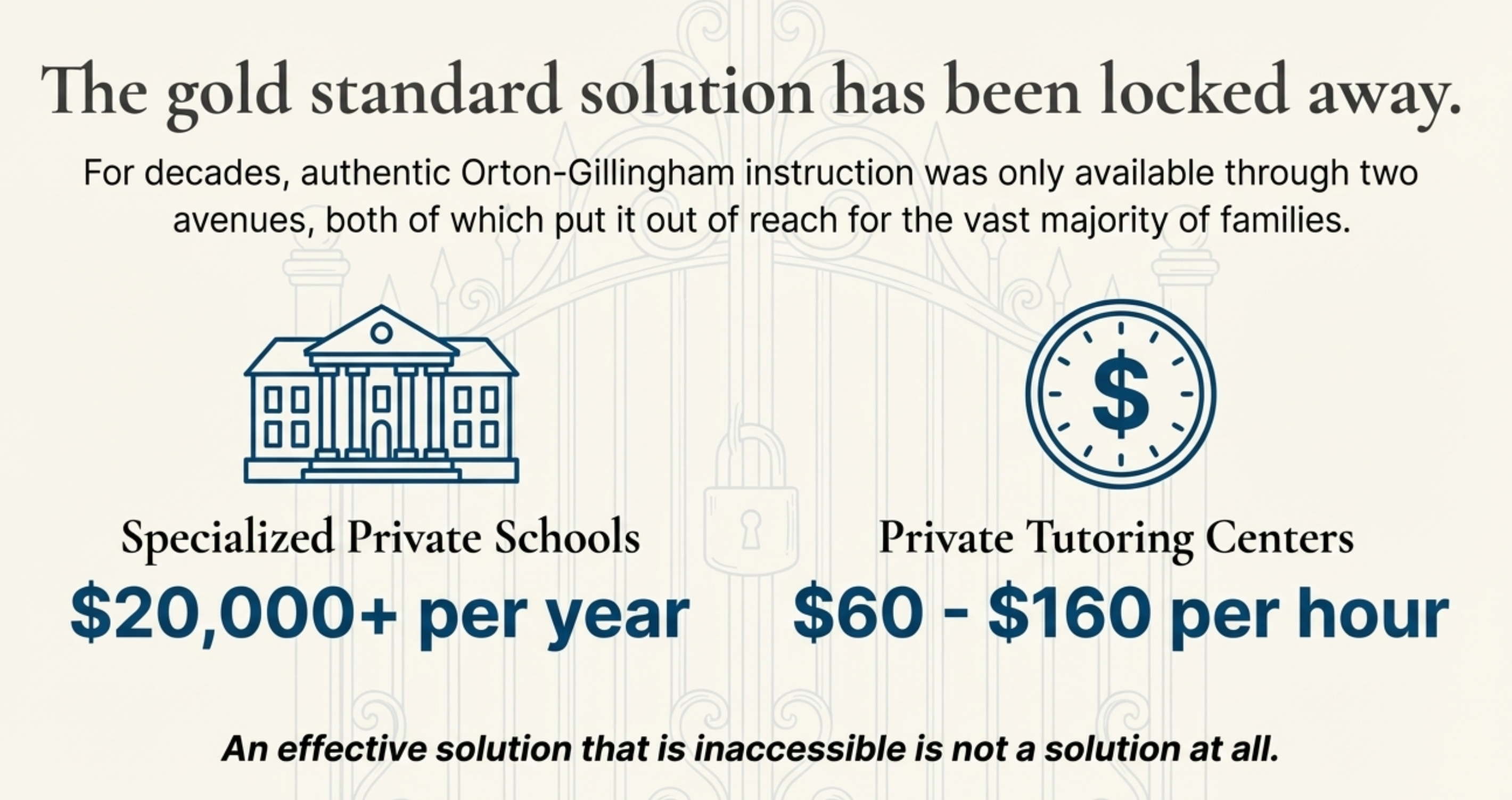
Traditional reading instruction has historically been available only through expensive private schools for learning disabled students, specialized language clinics, and private tutoring centers—often costing $20,000+ per year for schooling or $60-$160 per hour for tutoring.
The Orton-Gillingham method remains the gold standard for teaching students with dyslexia and reading difficulties because it addresses how the brain processes written language. By teaching the structure and logic of English systematically, students develop both skills and confidence.
The Eight Orton-Gillingham Principles
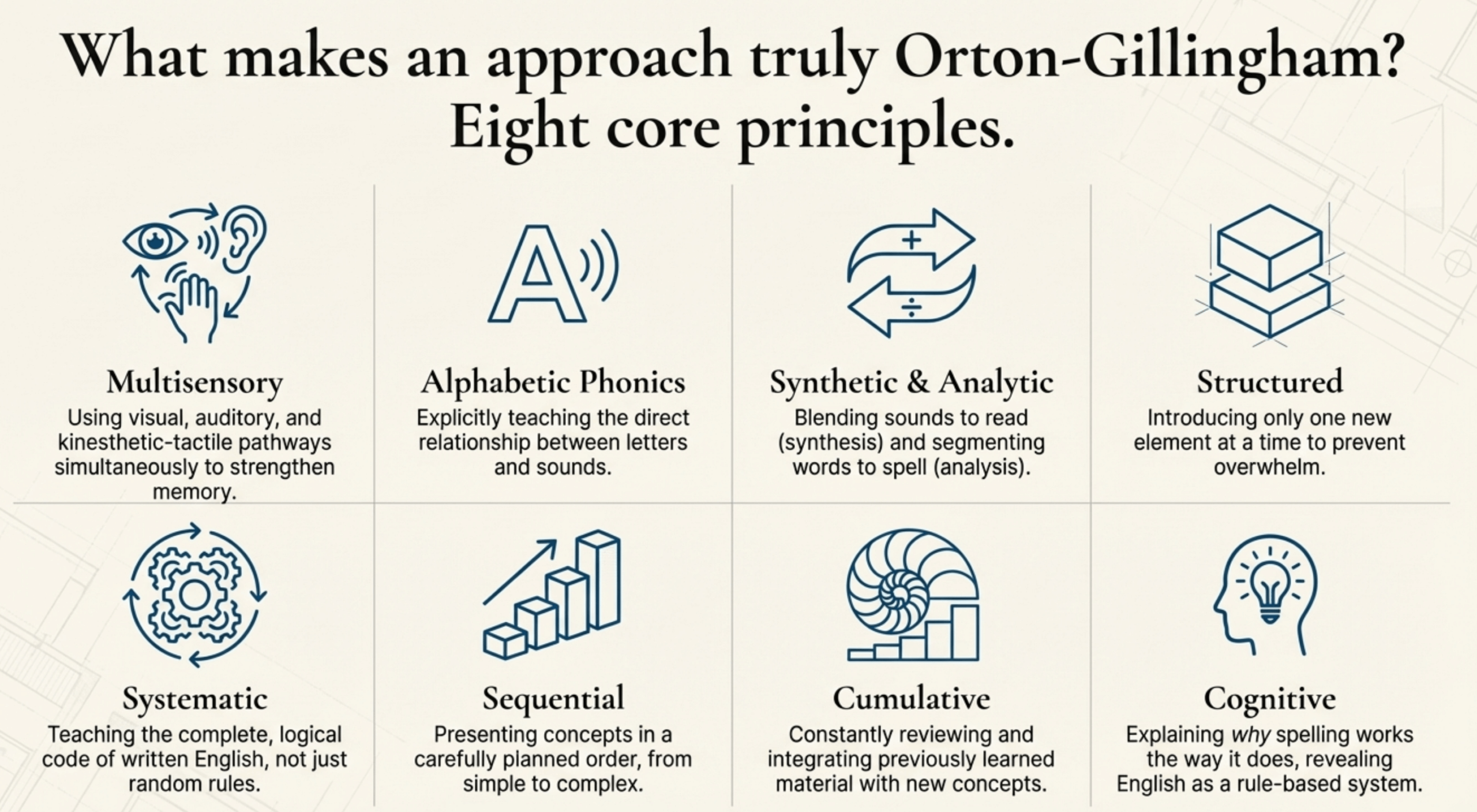
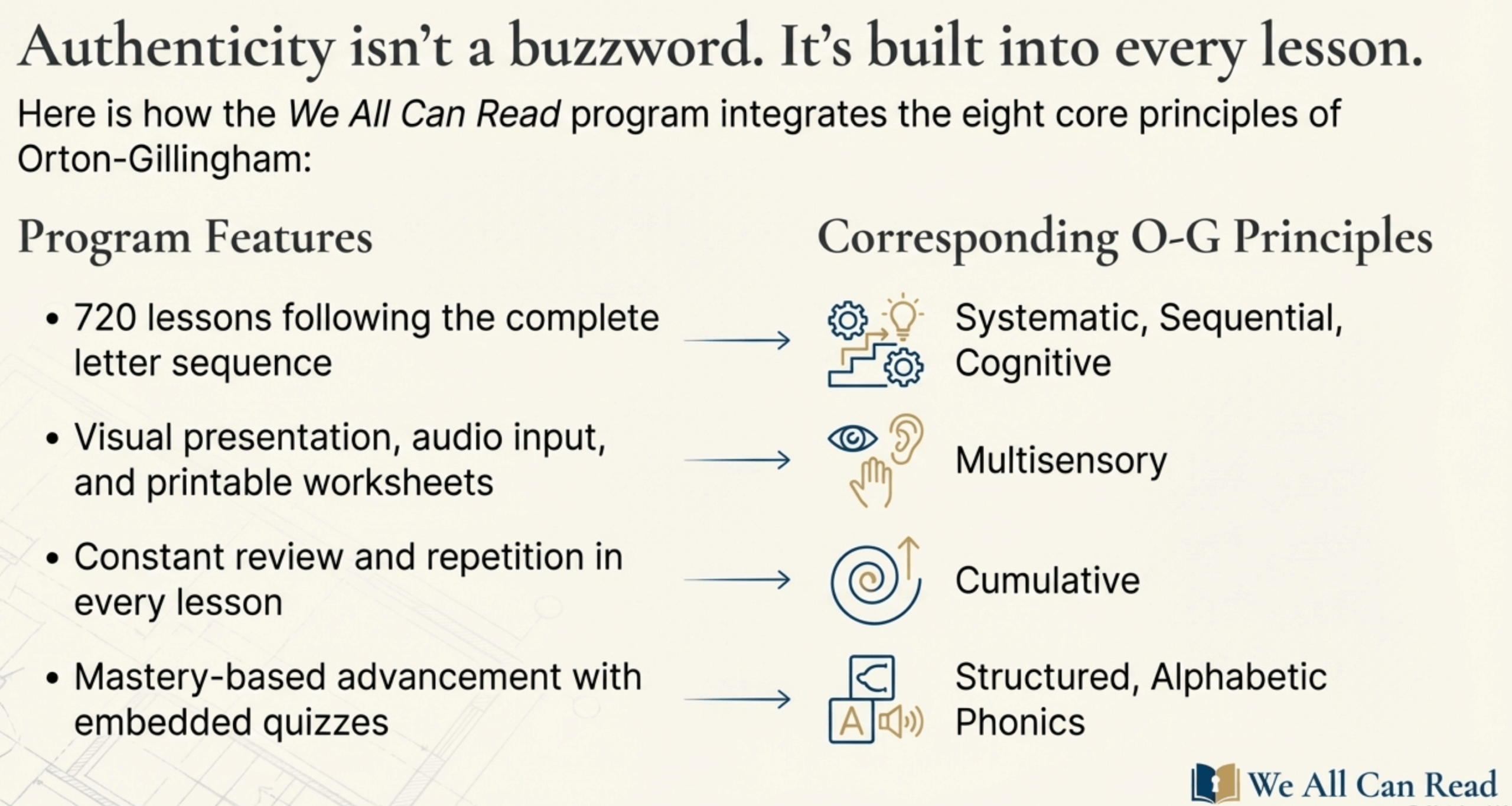
The International Dyslexia Association identifies eight key principles that define authentic Orton-Gillingham instruction. The We All Can Read program integrates all of these principles into every lesson:
1. Multisensory
Students simultaneously use visual (seeing), auditory (hearing), and kinesthetic-tactile (touch and movement) pathways to learn. For example, students see the letter, hear the sound, say the sound aloud, and write the letter while saying it. This multi-pathway approach strengthens memory and retention.
2. Alphabetic Phonics
Students explicitly learn the direct relationship between English letters and the sounds they represent. Nothing is assumed—every sound-symbol correspondence is directly taught and practiced.
3. Synthetic and Analytic
Students learn both to synthesize (blend individual sounds together to read words) and to analyze (segment words into their component sounds to spell them). This dual approach builds both reading and spelling skills simultaneously.
4. Structured
Each lesson introduces only one new element at a time, ensuring students aren’t overwhelmed. New concepts are taught in isolation before being combined with previously learned material. This structured approach prevents confusion and builds confidence.
5. Systematic
The entire system of English phonics is taught comprehensively. Students don’t learn random phonics rules—they learn the complete code underlying written English in a logical order.
6. Sequential
Concepts are presented in a carefully planned order from simple to complex. The teaching sequence follows the natural progression of language development and phonetic complexity.
7. Cumulative
Once introduced, each element is systematically reviewed throughout the remainder of the program. Previously learned material isn’t abandoned—it’s continually reinforced and integrated with new learning.
8. Cognitive
Students are taught why English spelling works the way it does. They learn that English, despite its reputation, is actually logical and rule-based. Understanding the reasoning behind spelling patterns helps students remember and apply rules independently.
How We All Can Read Implements Orton-Gillingham Principles
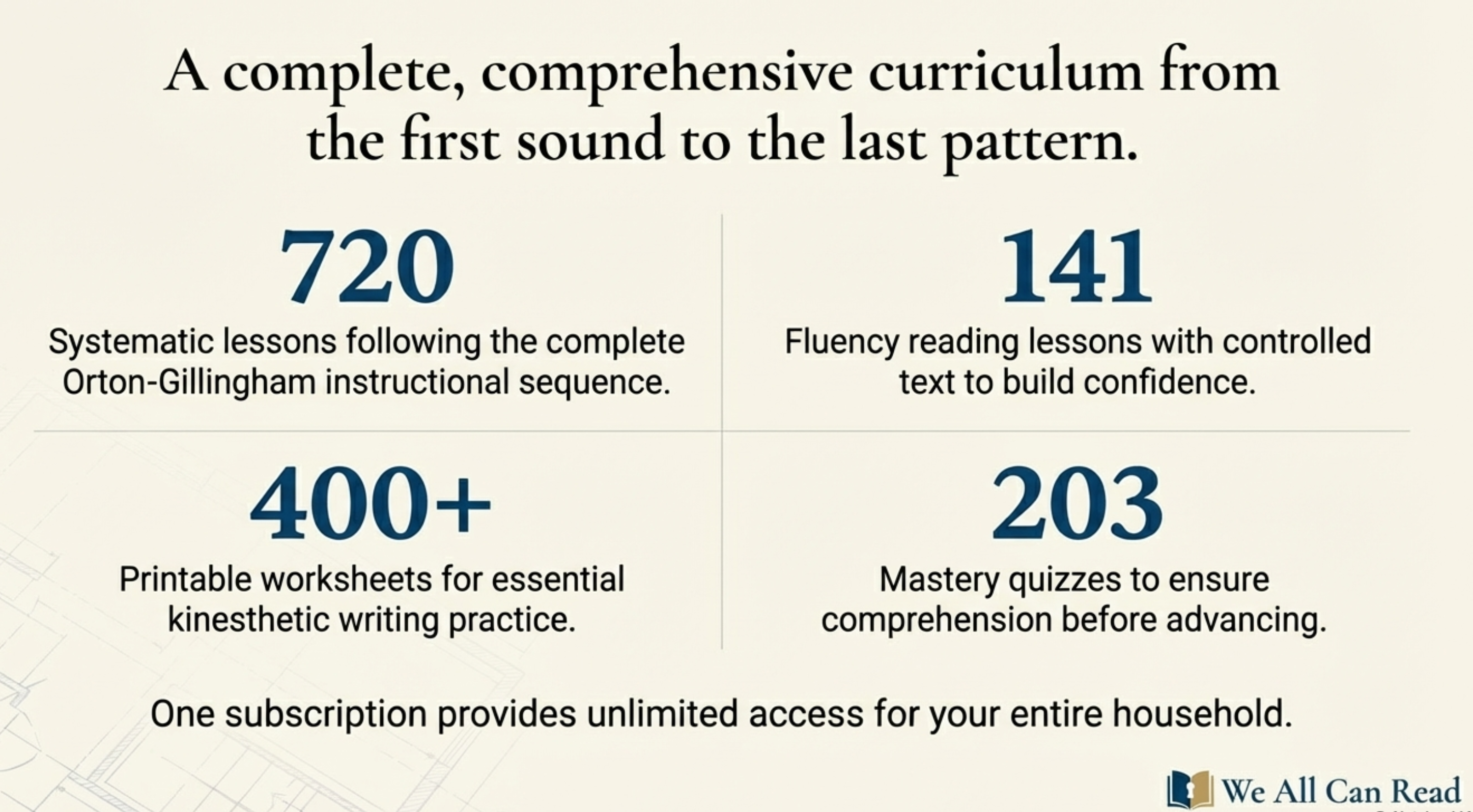
The We All Can Read program is specifically designed to make authentic Orton-Gillingham instruction accessible to families, schools, and tutors in a cost-effective online format.
Complete Letter Sequence Coverage
Our 720-lesson curriculum follows the systematic Orton-Gillingham instructional sequence outlined above. The chart below presents all major letters and letter teams taught in our program in their proper instructional order.

Multisensory Online Instruction
Each lesson combines:
- Visual presentation: Students see letters and words clearly displayed
- Auditory input: Audio recordings demonstrate correct pronunciation
- Verbal response: Students read aloud and repeat sounds
- Kinesthetic practice: Printable worksheets provide writing practice
Systematic Progression with Built-in Review
Every lesson builds on previous learning with constant review and repetition. Students cannot advance until they demonstrate mastery through embedded quizzes, ensuring no gaps in their phonics foundation.
Affordable Access to Quality Instruction
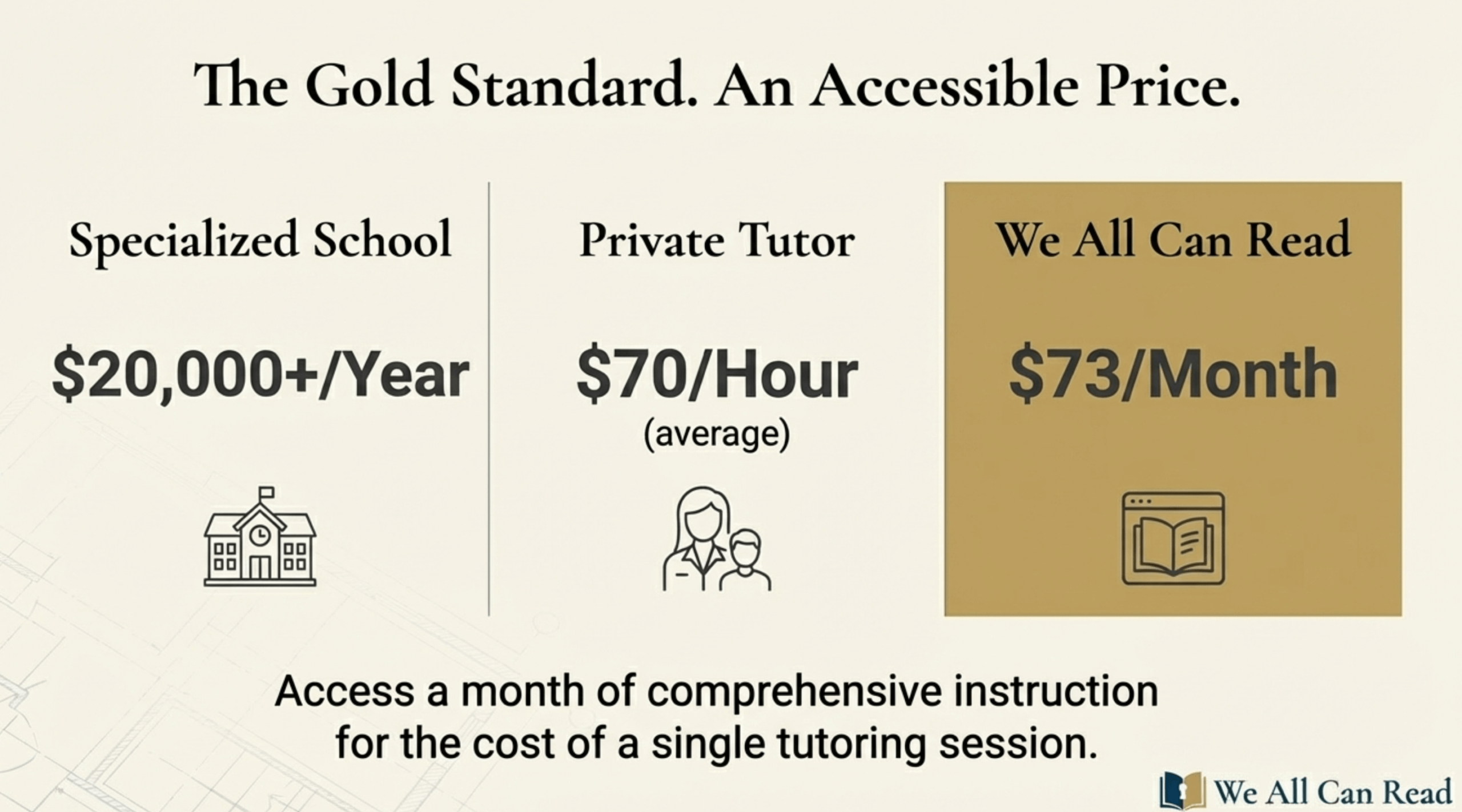
At $73/month, families can access comprehensive Orton-Gillingham instruction for a fraction of the cost of private tutoring or specialized schools. One subscription provides unlimited access for an entire household, making it possible for multiple children within the family to benefit simultaneously.
Success with Orton-Gillingham Instruction
“This program is unique in its approach and its affordability. The only school in the area that uses similar teaching methods costs over $20,000 a year to attend. Comparable tutoring in our area costs $70 an hour. I can get a month’s worth of tutoring through We All Can Read for that same amount.”

“We’re only a fraction of the way through the program, but I’ve already seen great improvement in my children’s reading ability. I have multiple children using the program at different levels—some with learning disabilities and some without.
I’ve run the program by both a local Orton-Gillingham trained tutor as well as a speech and language pathologist that works with kids with dyslexia, and they both said it looked like a great, comprehensive program. Many parents are opting for other online, subscription based reading programs that are mostly fluff and games. I’ve tried many of them. Despite the great reviews and the fun graphics, none of them yielded significant results, even with daily use. In contrast, We All Can Read is a no-nonsense program that starts from the ground up, eliminates learning gaps, and does exactly what you need it to do.”
Annie Beth Brown Donahue, North Carolina
Read more letters from teachers and administrators using We All Can Read →
Who Benefits from Orton-Gillingham Instruction?
While originally developed for students with dyslexia, Orton-Gillingham instruction benefits all learners, including:
- Students with dyslexia or reading disabilities who need systematic, explicit instruction
- Struggling readers who missed foundational phonics in early grades
- English language learners who need clear explanation of English sound-spelling patterns
- Students with learning differences who benefit from multisensory instruction
- Any student who wants to become a confident, skilled reader and speller
Ideal for Multiple Settings
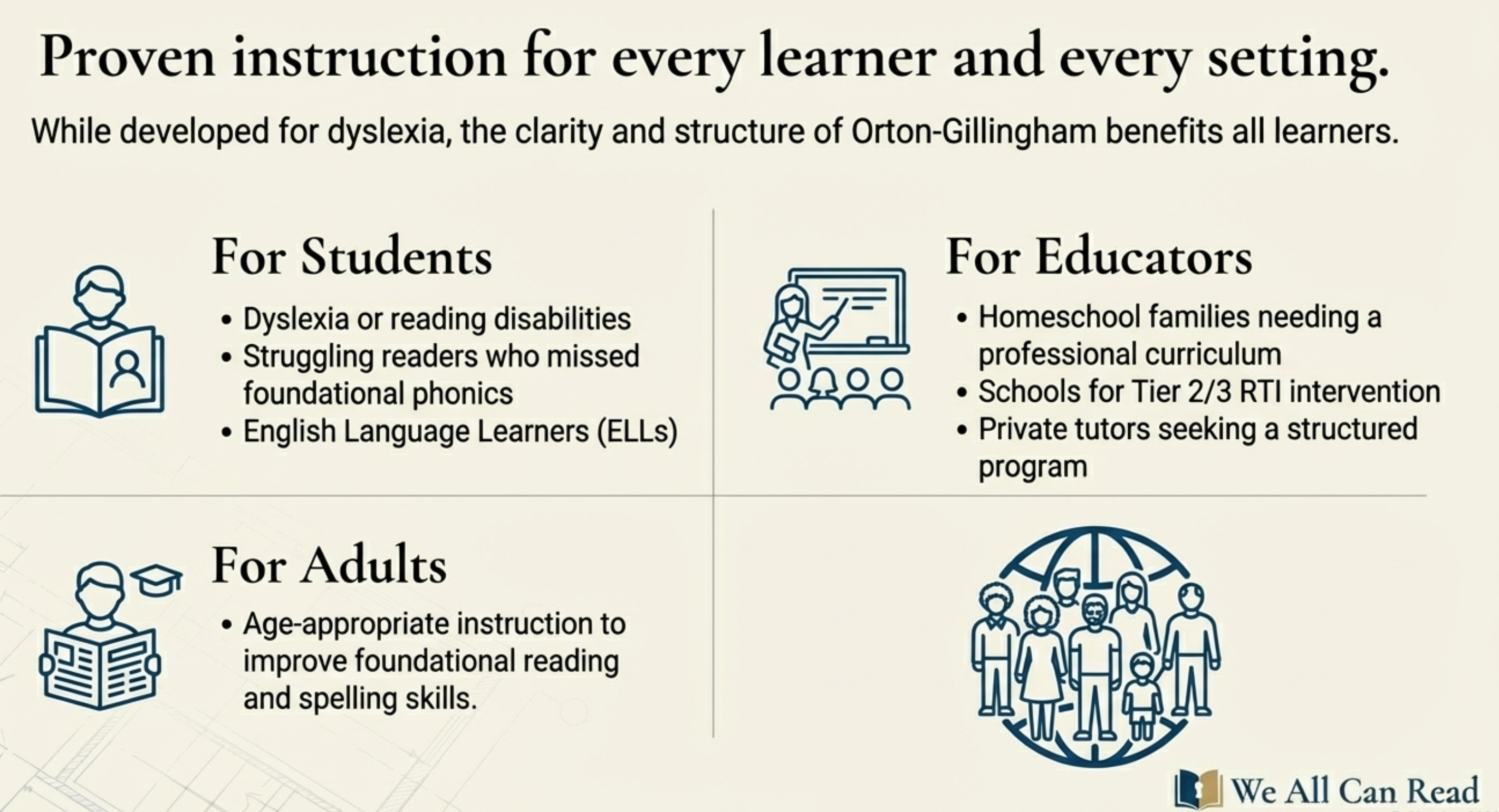
The Orton-Gillingham approach adapts to various educational contexts:
- Homeschool families: Parents can provide professional-quality reading instruction without specialized training
- Schools implementing RTI: Tier 2 and Tier 3 intervention for struggling readers
- Private tutors: Structured curriculum for one-on-one or small group instruction
- Adult learners: Age-appropriate instruction for adults improving their reading skills
Orton-Gillingham for Dyslexia and Learning Disabilities
While Orton-Gillingham instruction benefits all learners, it was specifically developed for students with dyslexia and learning disabilities. Understanding why this approach is particularly effective for struggling readers helps parents and educators make informed decisions about reading intervention.
Understanding Dyslexia and Reading-Based Learning Disabilities
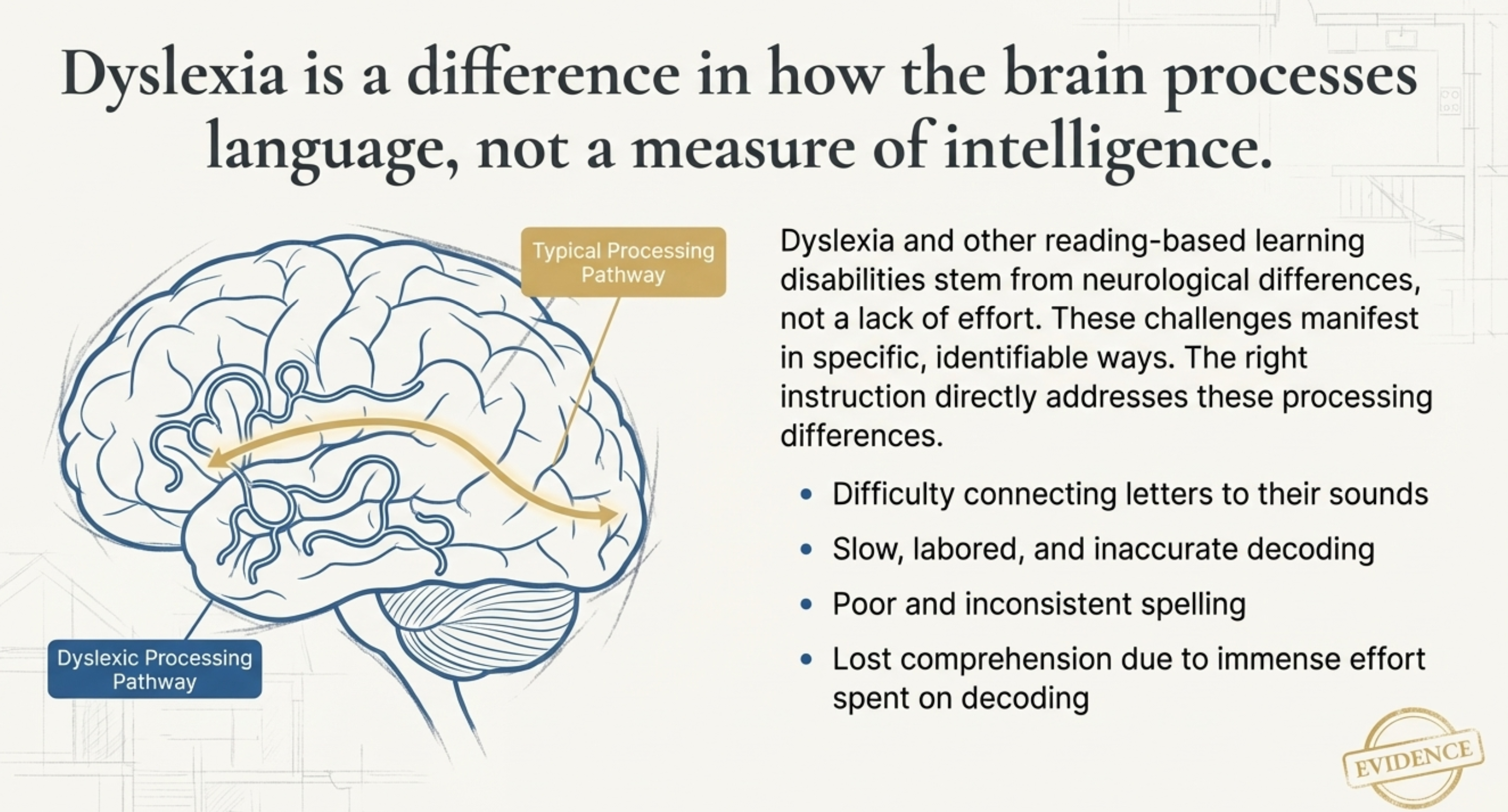
Dyslexia and reading-based learning disabilities (LD) are characterized by difficulty with accurate and fluent word recognition, poor spelling abilities, and weak decoding skills. These challenges typically stem not from lack of intelligence or effort, but from differences in how the brain processes written language.
Students with reading disabilities often experience:
- Difficulty connecting letters to sounds – The alphabetic principle doesn’t come naturally
- Slow, labored reading – Decoding each word takes significant effort
- Poor spelling – Unable to apply phonetic patterns consistently
- Avoidance of reading – The activity represents personal failure and shame
- Low vocabulary – Limited reading means less exposure to new words
- Comprehension struggles – So much energy goes to decoding that meaning is lost
Almost half of all students eligible for special education are classified as learning disabled in reading. For these students, traditional reading instruction that relies on memorization and context clues simply doesn’t work.
Why Orton-Gillingham Works for Dyslexia
Students with dyslexia and learning disabilities can absolutely learn to read and spell—but they require systematic, explicit, multisensory instruction in phonics. The Orton-Gillingham approach provides exactly this type of structured teaching.
Key Features That Help Dyslexic Learners:
Direct, Explicit Teaching
Nothing is assumed. Every sound-symbol relationship is taught explicitly and practiced extensively. Dyslexic students aren’t expected to “figure out” patterns—they’re taught directly.
Multisensory Reinforcement
Engaging multiple pathways (visual, auditory, kinesthetic-tactile) simultaneously strengthens memory formation. This is crucial for students whose single-pathway learning is impaired.
Systematic Progression
The carefully sequenced instructional order prevents confusion and ensures students build a solid foundation before progressing to complex patterns. No gaps are left in their phonics knowledge.
Extensive Practice and Review
Dyslexic students need more repetition than typical learners. The cumulative nature of Orton-Gillingham provides constant review and reinforcement of previously learned material.
Mastery-Based Advancement
Students don’t move forward until they’ve demonstrated mastery of current skills. This prevents the accumulation of gaps that plague many struggling readers.
It’s Never Too Late to Learn to Read
One of the most important truths about dyslexia and reading disabilities: it is never too late for a student to become a successful reader. Whether in late elementary, middle school, high school, or adulthood, the brain can still learn to read with proper instruction.
Our program was specifically designed for older students and adults who missed systematic phonics instruction in their early years. Every lesson presents information in a mature, age-appropriate format that respects the learner’s intelligence while teaching foundational skills.
Many Students Labeled “Dyslexic” Simply Lack Proper Instruction
An important caveat: not every struggling reader has an actual learning disability. Many students who fail to receive systematic phonics instruction by second grade never receive that foundation. As these students fall further behind through elementary and middle school, educators often assume they must be learning disabled or dyslexic.
These labels are sometimes used as catch-all terms for what is actually a methodological failure—the educational system’s failure to provide effective, systematic phonics instruction in the critical early years. When a child receives a “learning disabled” label, the responsibility for reading difficulties shifts from the school system to the child.
The good news: whether a student has an actual learning disability or simply missed proper early instruction, systematic Orton-Gillingham phonics instruction works. Almost any student at any age can become an independent reader with the proper foundation.
Affordable O-G Instruction for Dyslexic Students
Historically, Orton-Gillingham instruction has been available only through expensive private schools for learning disabled students (often $20,000+ per year) or specialized tutoring ($60-$160 per hour). This puts quality dyslexia intervention out of reach for most families.
Our online program makes authentic Orton-Gillingham instruction accessible at $73/month—less than the cost of a single tutoring session. Families can provide their dyslexic children with the systematic, multisensory phonics instruction they need without the prohibitive cost.
Success with Dyslexic Students
“We All Can Read allows parents who understand the unique needs of dyslexics to give appropriate intervention without the prohibitive cost of private tutoring.”
We homeschool my 10-year old dyslexic daughter and your program has been very helpful. We are making slow but steady progress! Thank you for your easy to use format and printable materials. We have recommended your program to many other homeschool families who have struggling readers.
So many reading programs do not address the specific needs of dyslexics. We All Can Read allows parents who understand the unique needs of dyslexics to give appropriate intervention without the prohibitive cost of private tutoring.
Sheila and Brennen M. / North Carolina
Essential Elements for Dyslexic Learners
Effective instruction for students with dyslexia and learning disabilities must include:
- Tightly-structured lessons – Clear, organized presentation of each element
- Multisensory techniques – Engaging all learning pathways simultaneously
- Comprehensive coverage – Teaching the complete English phonetic code systematically
- Age-appropriate materials – Mature format for older students and adults
- Sufficient practice – Adequate repetition to consolidate learning
- Sequential progression – Logical order from simple to complex patterns
Our 720-lesson curriculum incorporates all of these essential elements, making it possible for dyslexic students of all ages and grade levels to develop strong reading and spelling skills.
Get Started with Orton-Gillingham Instruction
Understanding the Orton-Gillingham instructional sequence and principles is the first step. Implementing this proven method is easier than ever with our comprehensive online program.
Try 10 Lessons Free
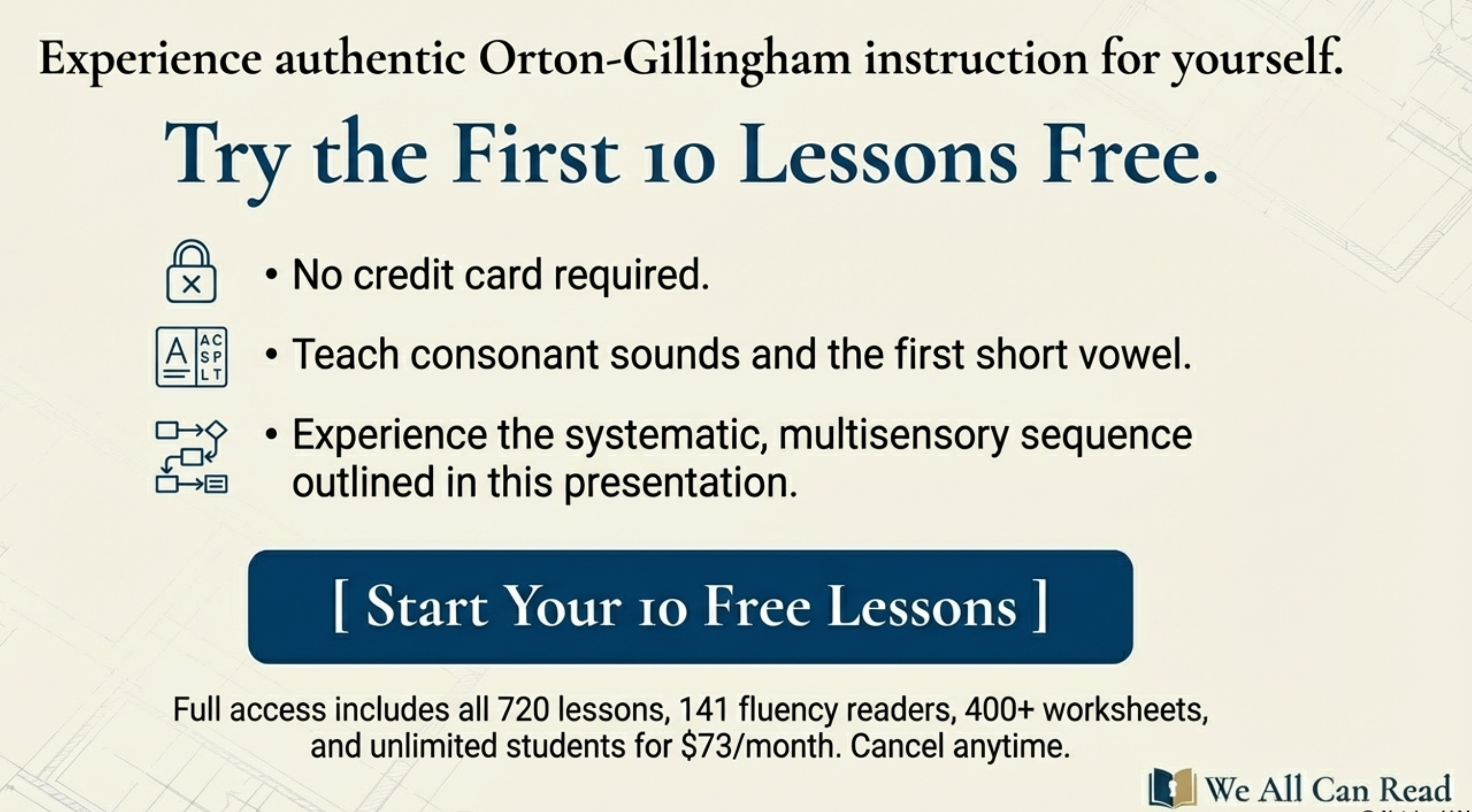
Experience authentic Orton-Gillingham instruction with our first 10 lessons—completely free with no credit card required. These introductory lessons teach consonant sounds and the first short vowel following the systematic sequence outlined above.
Complete Program Access: $73/Month
Full access includes:
- 720 lessons following the complete Orton-Gillingham letter sequence
- 141 fluency reading lessons with controlled text
- 400+ printable worksheets for multisensory practice
- 203 mastery quizzes ensuring comprehension
- Unlimited students in your household
- Cancel anytime
Questions about Orton-Gillingham instruction or our program? Contact us or read more success stories.
Continue learning: Read about remedial phonics programs for older students.→
Related topics: Core spelling instruction | Homeschool curriculum