Learning to Read at 30, 40, 50, 60, 70+: It’s Never Too Late!
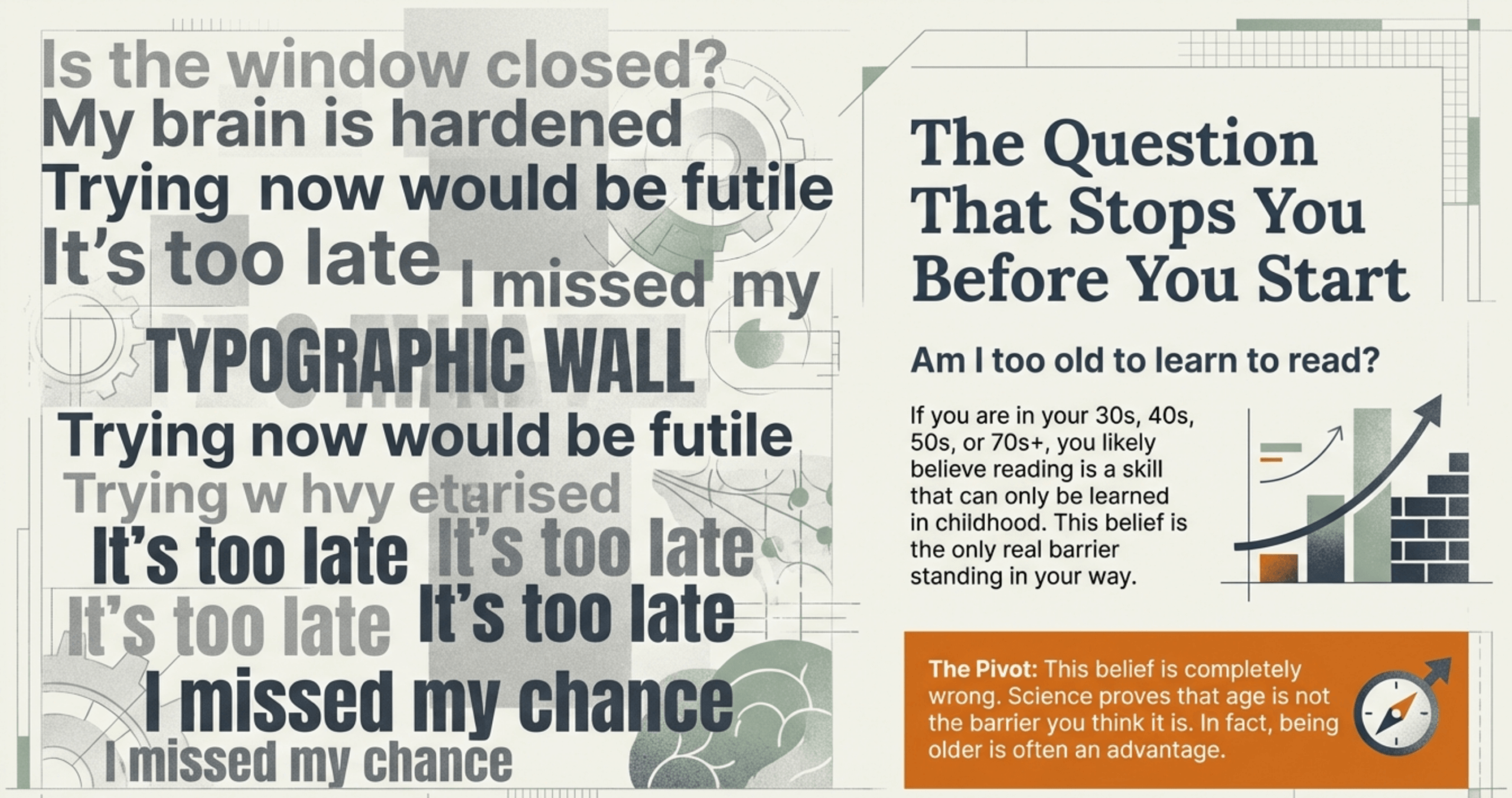
“Am I too old to learn to read?”
If you’re in your 30s, 40s, 50s, 60s, 70s, or beyond, you may believe that the window for learning to read has closed. You may think that reading is something that can only be learned in childhood, and that trying now would be futile.
This belief is completely wrong.
Adults of all ages successfully learn to read. The scientific evidence is clear: your brain retains the ability to form new reading pathways throughout your entire life. Age is not the barrier you think it is—in fact, in many ways, being older is an advantage when learning to read.
This guide addresses the specific concerns adults have about learning to read at different ages, explains the science of adult neuroplasticity, shares success stories from people in their 30s through their 70s who started where you are, and shows you why your age might actually help you learn faster.
The Science: Your Brain Can Still Learn to Read

Let’s start with the facts about adult brains and reading.
Neuroplasticity Doesn’t Stop at Childhood
For decades, scientists believed that the brain’s ability to change—called neuroplasticity—was limited to childhood. We now know this is false.
What research shows:
Brain imaging studies using MRI and PET scans demonstrate that adults who learn to read develop the same neural reading networks that childhood readers have. These pathways form later in life, but they form just as effectively.
Key findings:
- Adult brains create new neural connections throughout life
- The reading networks that form in adulthood function just as well as those formed in childhood
- Adults can achieve complete reading fluency even when starting from the beginning
- Age is not a predictor of success in adult literacy programs
What this means for you:
Whether you’re 25, 35, 45, 55, 65, or older, your brain has the capacity to learn to read. The neural pathways you need will form through systematic instruction and practice, regardless of your age.
The Reading Networks Form When You Learn
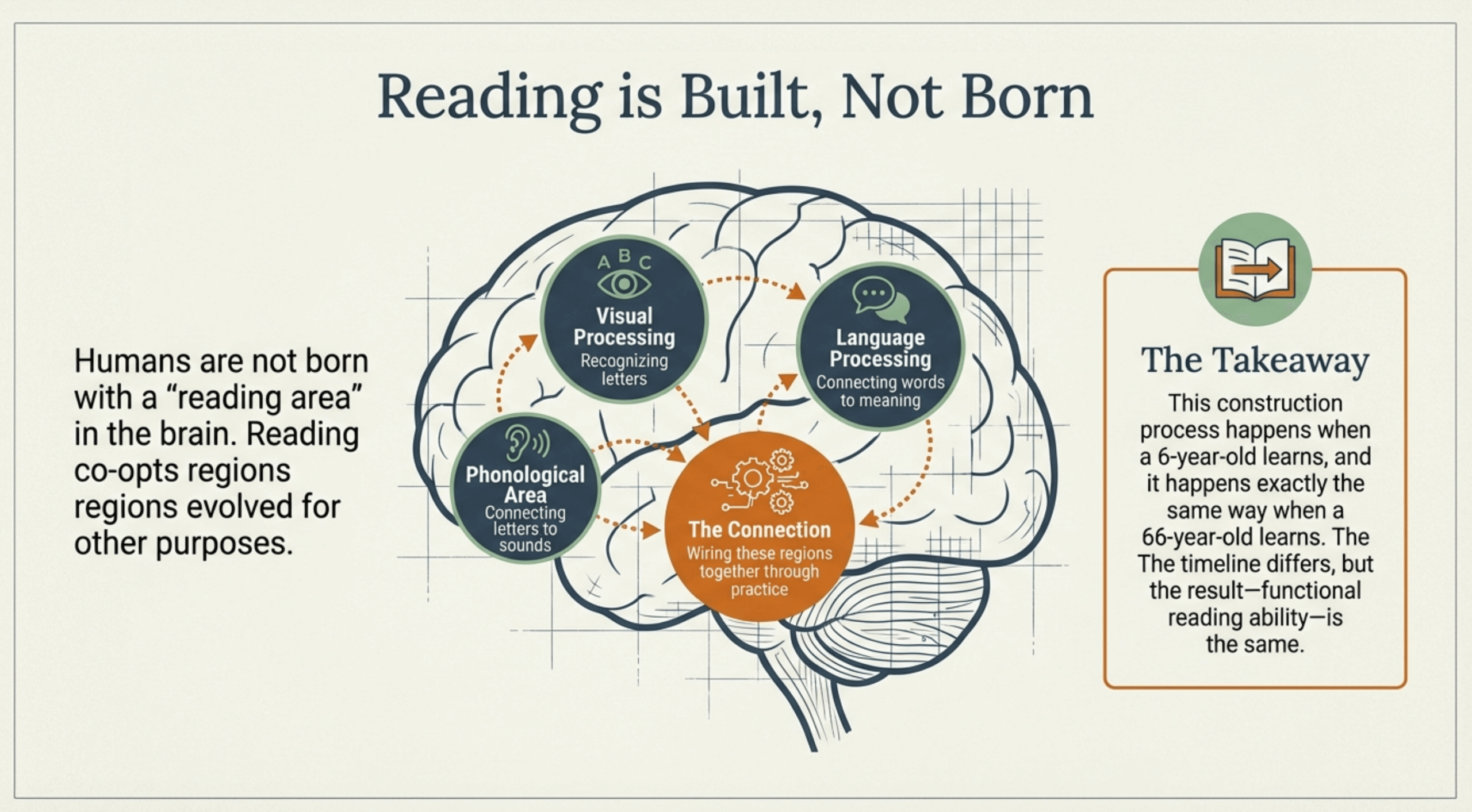
Reading is not a natural ability like speaking. Humans are not born with dedicated “reading areas” in the brain. Instead, reading co-opts and connects several brain regions that originally evolved for other purposes.
What happens when anyone learns to read (at any age):
- Visual processing regions learn to recognize letters and words
- Language processing areas connect written words to spoken language and meaning
- Phonological areas learn to connect letters to sounds
- These regions wire together through repeated practice
This process happens when children learn to read at age 6. It also happens when adults learn to read at age 36, 46, or 66. The timeline is different, but the result is the same: functional reading ability.
Adult Brains May Actually Have Advantages
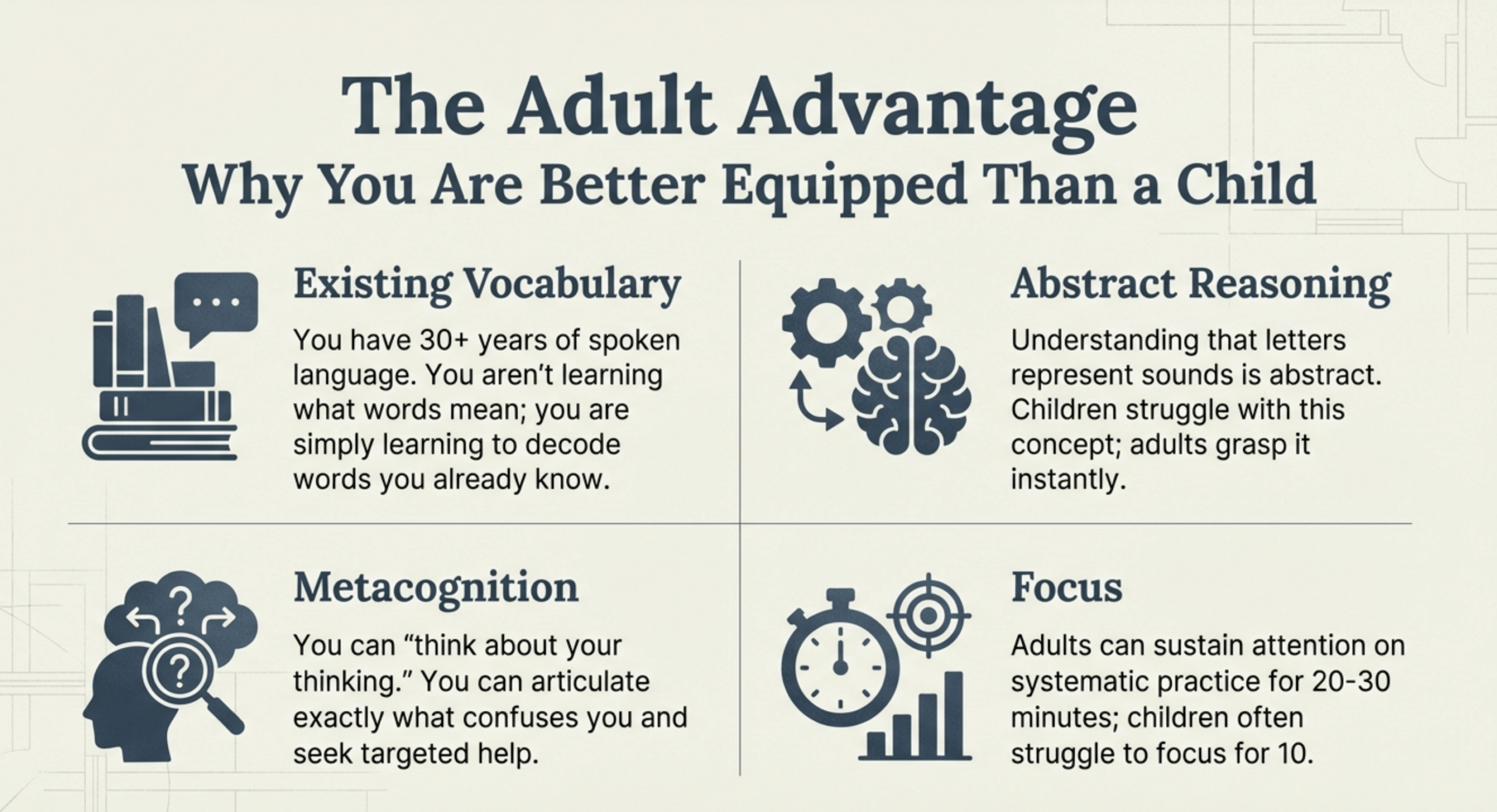
While children’s brains are more plastic in some ways, adult brains have specific advantages for learning to read:
Metacognitive abilities: Adults can think about their own thinking. When you encounter difficulty, you can identify exactly what confuses you and seek targeted help. Children often can’t articulate their confusion this precisely.
Abstract reasoning: Understanding that letters are symbols representing sounds requires abstract thinking. Adults grasp this concept immediately. Young children may struggle with the abstraction.
Existing vocabulary: You already have thousands of words in your spoken vocabulary. You’re not learning language AND reading simultaneously like children do. You’re just learning to decode words you already know and use.
Motivation and purpose: Adults have clear reasons for wanting to read—career advancement, helping children, independence, personal growth. This intrinsic motivation accelerates learning.
Focused attention: Adults can dedicate sustained, focused attention to learning. Children are learning multiple subjects simultaneously and may struggle to maintain focus on systematic phonics practice.
Learning to Read in Your 30s
If you’re in your 30s, you may feel like you’ve already missed too many opportunities because of your reading difficulties. You may worry that it’s “too late” to change your trajectory.
The reality: Your 30s are an excellent time to learn to read.
Why Your 30s Work Well
Cognitive maturity: Your brain has reached full development. Your executive function, working memory, and ability to sustain attention are at their peak. These cognitive strengths support learning.
Life experience: You have context for why reading matters. You’ve felt the limitations of not reading well in job applications, workplace documents, helping your children, and daily life. This understanding drives consistent practice.
Career motivation: Many people in their 30s are establishing or advancing careers. Reading skills directly impact job opportunities, promotions, and professional credibility. This practical motivation creates urgency.
Energy and time: While you likely have work and family responsibilities, many people in their 30s still have energy and can carve out 20-30 minutes daily for focused learning.
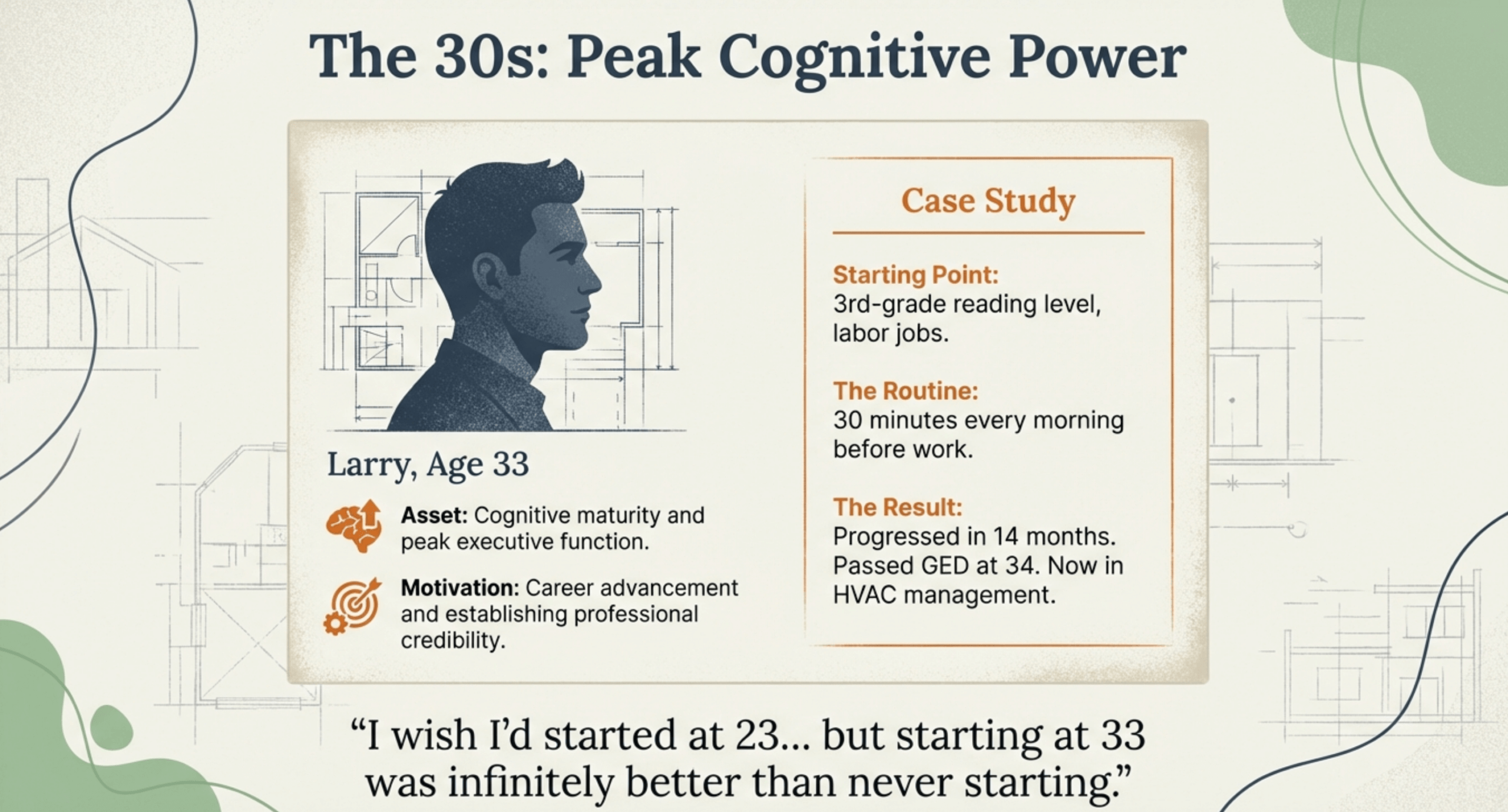
Success Story: Larry, Age 33
Larry couldn’t read beyond a third-grade level when he started systematic phonics instruction at age 33. He had dropped out of high school, worked labor jobs, and avoided anything requiring reading.
His journey:
- Started with comprehensive online phonics program
- Practiced 30 minutes each morning before work
- Progressed through the program in 14 months
- Passed his GED exam at age 34
- Enrolled in community college at age 35
- Now works in HVAC management requiring regular reading of technical manuals
Larry’s reflection: “I thought being 33 was too old to learn. But within three months I was reading better than I ever had in school. Within a year I could read anything. I wish I’d started at 23 instead of 33, but starting at 33 was infinitely better than never starting.”
Common Concerns in Your 30s
“I have young children and no time.” Twenty to thirty minutes daily is enough. Many parents practice early morning before children wake, during lunch breaks, or after children are in bed. Consistent short sessions work better than occasional long ones.
“What if people at work find out?” You don’t need to tell anyone. Many adults learn to read in complete privacy using online programs. Share only when you’re ready and comfortable.
“I’ve failed before. Why would this time be different?” Previous failures reflect inadequate teaching methods, not your ability. If you use systematic phonics instruction—which explicitly teaches what you missed—you won’t be repeating the same approaches that failed before.
Learning to Read in Your 40s
Your 40s bring different concerns and advantages. You may feel the weight of decades of struggling with reading, but you also have wisdom and determination that younger learners lack.
The reality: Adults in their 40s successfully learn to read regularly.
Why Your 40s Work Well
Clarity of purpose: By your 40s, you understand exactly why reading matters. Whether it’s helping teenagers with homework, advancing in your career, reading to grandchildren, or personal fulfillment, your motivation is crystal clear.
Discipline and consistency: People in their 40s often have developed strong self-discipline. You understand the value of showing up consistently, even when progress feels slow. This consistency is what makes learning successful.
Perspective on time: You realize that one year of focused effort can change the next 30+ years of your life. What seemed like a long commitment in your 20s now seems like a worthwhile investment.
Financial stability: Many people in their 40s have more financial resources than in their 20s or 30s, making it easier to invest in quality instruction if needed.
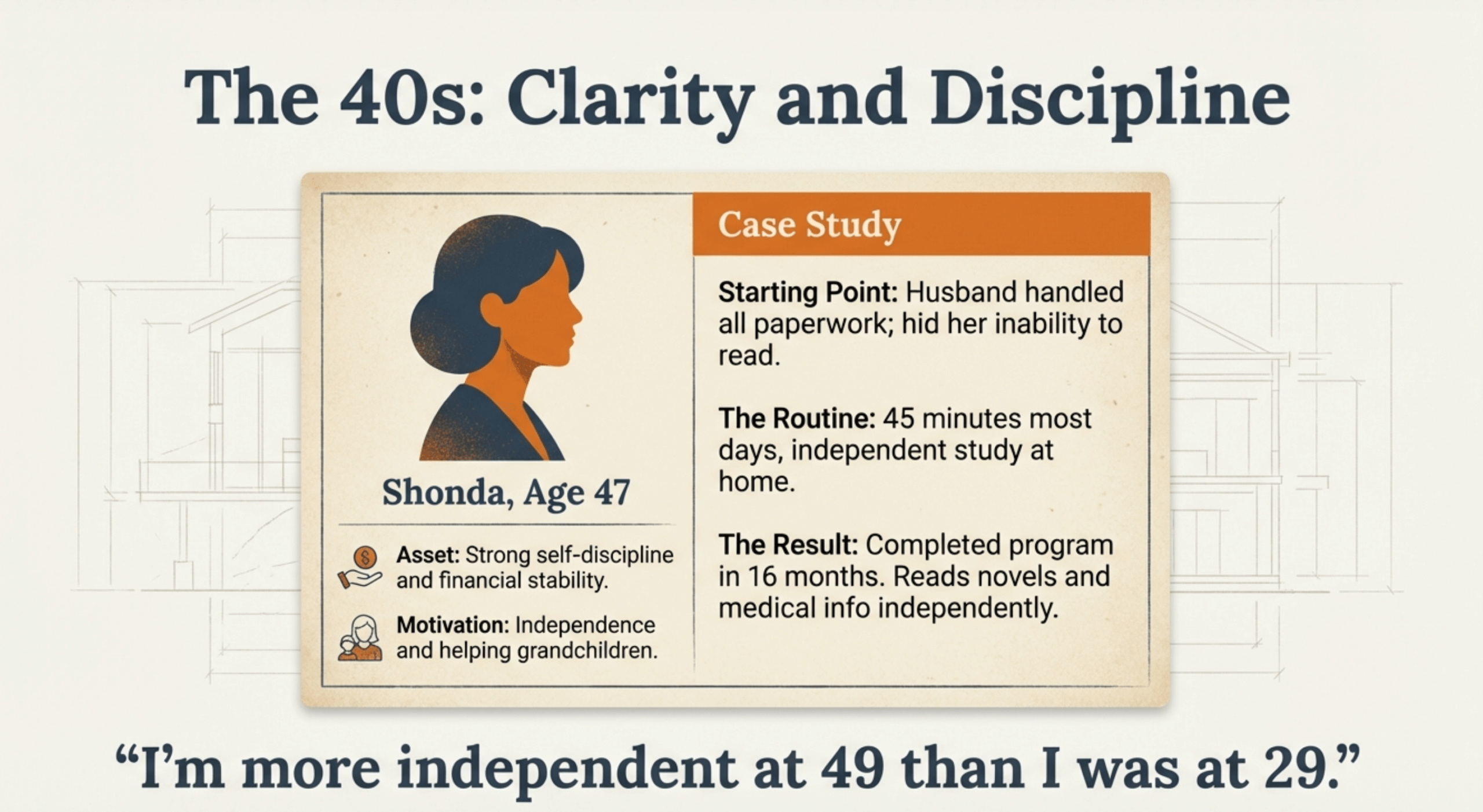
Success Story: Shonda, Age 47
Shonda had hidden her reading difficulties for her entire adult life. Her husband handled all paperwork, read instructions to her, and helped her navigate situations requiring reading.
Her journey:
- Started systematic phonics at age 47
- Worked through program independently at home
- Practiced 45 minutes most days
- Completed comprehensive program in 16 months
- Now reads independently—books, mail, medical information, everything
Shonda’s reflection: “At 47, I thought I’d lived most of my life already. But learning to read opened up the second half of my life in ways I never imagined. I read novels now. I read bedtime stories to my grandchildren. I handle my own medical appointments. I’m more independent at 49 than I was at 29.”
Common Concerns in Your 40s
“I’ve gone this long without reading. Do I really need it now?” Only you can answer what reading would mean for you. But consider: You likely have 30-40 years ahead. Reading opens opportunities in those decades—career advancement, helping family, personal enrichment, independence. The question isn’t whether you need it, but whether you want the freedom it provides.
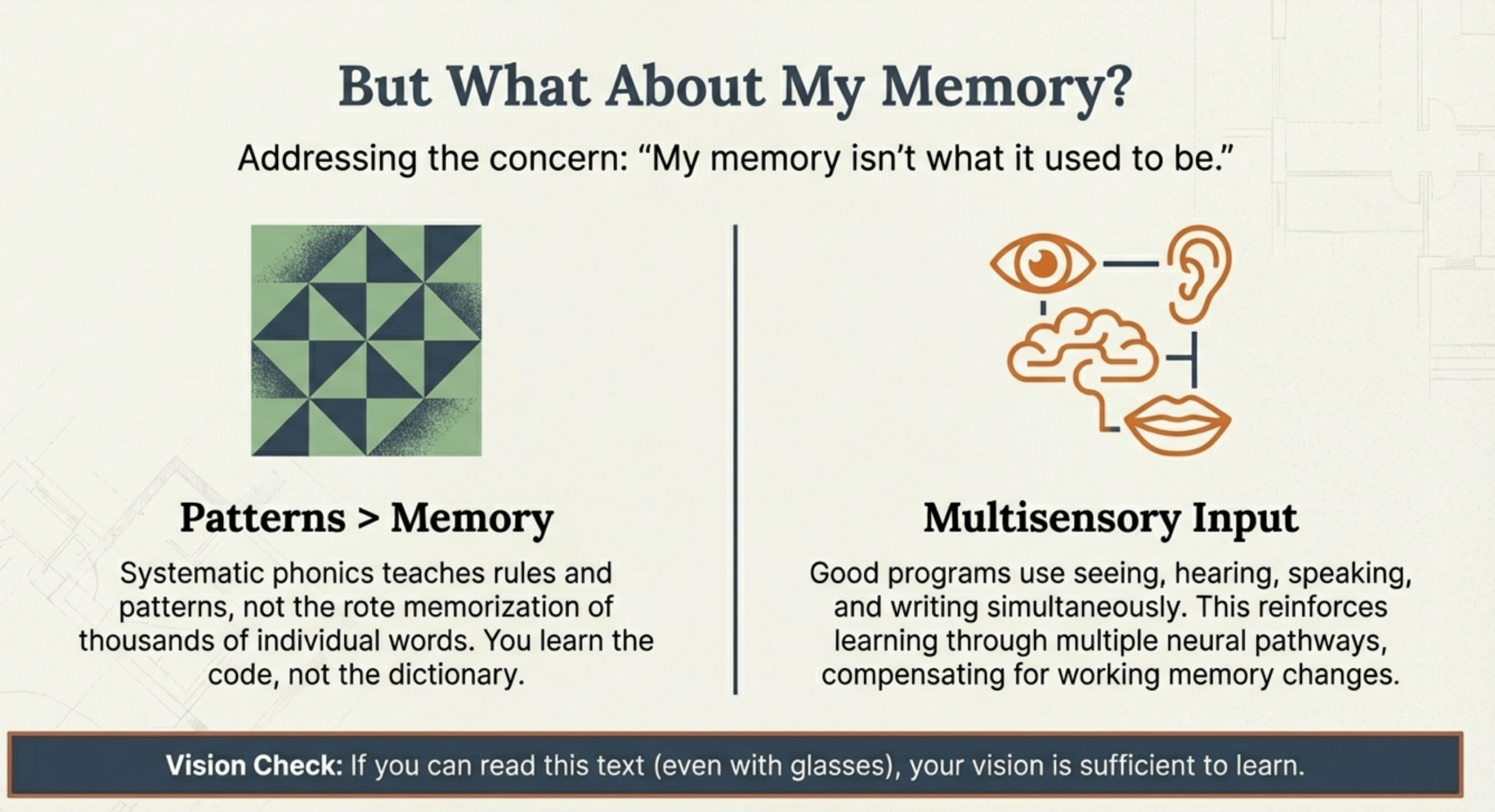
“My memory isn’t as good as it used to be.” Systematic phonics doesn’t rely heavily on memorization. It teaches you to understand patterns, which is different from memorizing. You’ll learn rules and patterns, not thousands of individual words. Additionally, multisensory instruction (seeing, hearing, speaking, writing) reinforces learning in multiple ways.
“What if I can’t keep up with the pace?” Self-paced programs let you work at exactly your speed. There’s no keeping up with a class or pressure from a tutor. Take as long as you need on difficult concepts. Move faster through familiar material. The pace is entirely yours.
Learning to Read in Your 50s, 60s, 70s, and Beyond
Your 50s, 60s, 70s, and beyond bring unique advantages for learning. You have perspective, patience, and often more time than in earlier decades.
The reality: Adults in their 50s, 60s, 70s, 80s, and beyond learn to read successfully.
Why Your 50s+ Work Well
Time availability: Many people in their 50s+ have more discretionary time than in earlier decades. Children may be grown. Career pressures may have eased. Retirement may provide dedicated learning time.
Patience and persistence: Older adults often have patience younger learners lack. You understand that worthwhile achievements take time. You’re willing to show up consistently without expecting overnight results.
Learning for intrinsic reasons: By your 50s+, you’re less concerned with impressing others. You’re learning for yourself—because you want to read, not because external pressures demand it. This intrinsic motivation is powerful.
Cognitive engagement: Learning new skills keeps the brain active and engaged. Reading instruction provides cognitive stimulation that supports overall brain health.
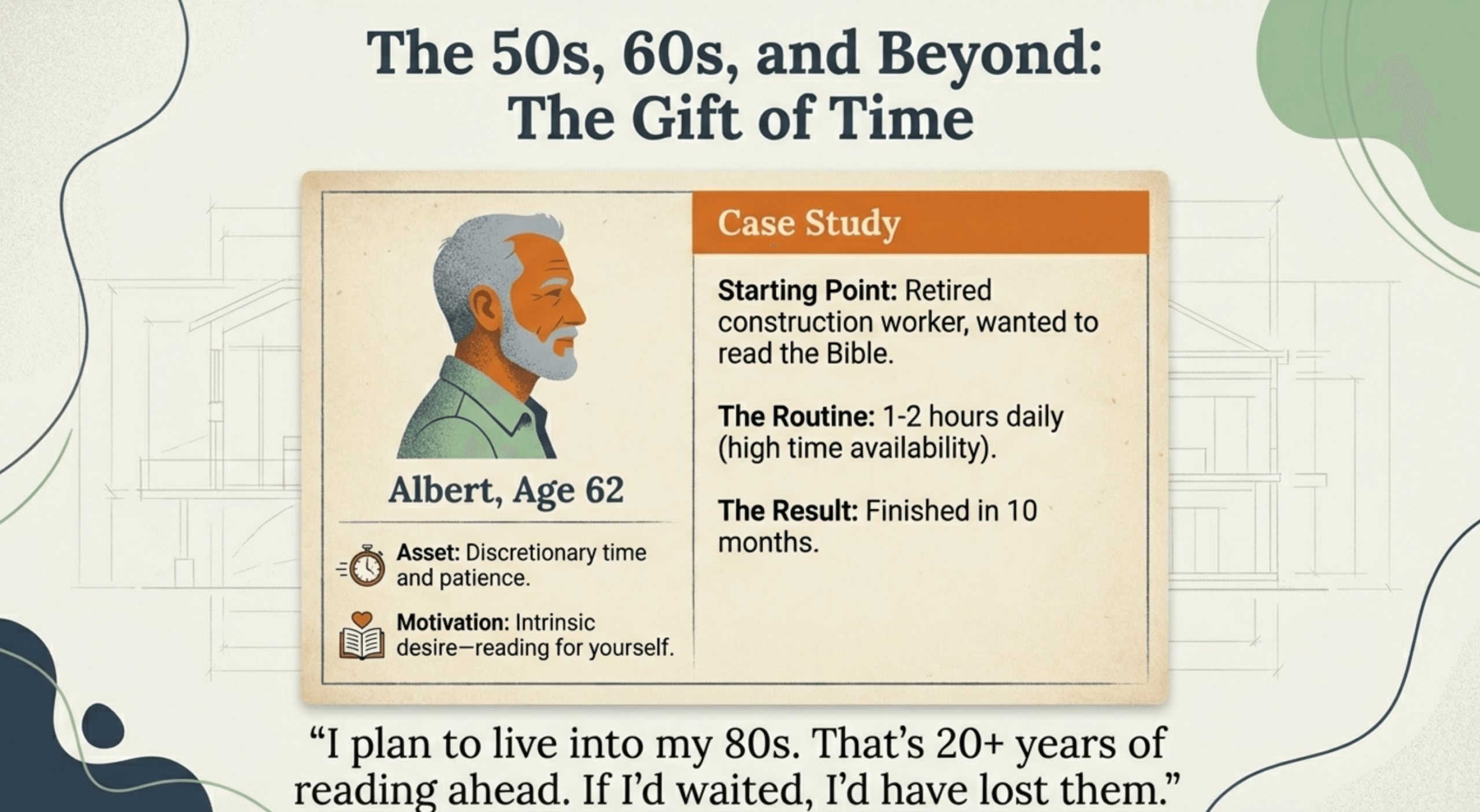
Success Story: Albert, Age 62
Albert retired from construction at age 60 having never learned to read beyond basic recognition. He wanted to read the Bible independently and understand written instructions for his hobbies.
His journey:
- Began systematic phonics instruction at age 62
- Dedicated 1-2 hours daily (had retired, so time available)
- Worked through program in 10 months
- Now reads regularly—Bible, news, hobby magazines, novels
Albert’s reflection: “People ask why I bothered learning to read in my 60s. I tell them I plan to live into my 80s at least. That’s 20+ years of reading ahead of me. Starting at 62 means I get those 20 years. If I’d waited, I’d have lost them.”
Common Concerns in Your 50s+
“My brain isn’t as sharp as it used to be.” While processing speed may slow slightly with age, this doesn’t prevent learning to read. In fact, systematic phonics instruction may be easier for older adults because it relies on pattern recognition and rule application, not rote memorization. Take your time—self-paced programs accommodate any speed.
“I don’t have as many years left to benefit.” If you’re 55 and live to 85, that’s 30 years of reading. If you’re 65 and live to 90, that’s 25 years. Those decades of independence, enjoyment, and capability are worth the 6-12 months it takes to learn. Every year you wait is one less year of reading.
“Won’t learning be harder at my age?” Some aspects are different, but many are easier. You have better focus than most young people. You understand abstract concepts immediately. You’re not distracted by social pressures or competing interests. You can dedicate sustained attention. These advantages often outweigh any age-related challenges.
The Advantages You Have Over Child Learners
It may seem paradoxical, but adults often learn to read more efficiently than children in several ways:
Cognitive Advantages
Abstract reasoning: Children ages 5-7 are still developing abstract thinking. Understanding that letters are symbols representing sounds is abstract. Adults grasp this instantly.
Metacognition: Adults can monitor their own learning, identify exactly what’s confusing, and seek targeted help. Children often can’t articulate their specific difficulties.
Existing language knowledge: You have 30, 40, 50+ years of spoken language experience. Massive vocabulary. Understanding of grammar and sentence structure. You’re not learning language—just learning to decode it.
Focused attention: Adults can sustain focused attention on systematic phonics practice for 20-30+ minutes. Many young children struggle to focus for even 10 minutes on systematic instruction.
Motivational Advantages
Clear purpose: You know exactly why you want to read—career, family, independence, personal growth. Children are told they need to learn but may not feel intrinsic motivation.
Appreciation for progress: Adults appreciate small victories. Reading your first three-letter word is thrilling. Children may not recognize the significance of progress.
Consistency: You can commit to daily practice because you understand the value. Children may resist practice or need external enforcement.
Practical Advantages
Self-directed learning: You can work independently using online programs. You choose when and where to practice. You control the pace. Children typically need adult supervision and external structure.
Privacy: Many adults prefer learning privately. Online programs allow you to work at home without anyone knowing until you’re ready to share. This removes social pressure.
Life experience: You bring decades of problem-solving experience to learning. You’ve overcome challenges before. You know how to push through difficulty. This resilience supports learning.
How Age Actually Affects the Learning Process
Understanding what age does and doesn’t affect helps set realistic expectations:
What Age Does NOT Affect
Ability to form reading pathways: Brain imaging shows that adults of all ages create functional reading networks through proper instruction. Age doesn’t prevent these networks from forming.
Potential for complete fluency: Adults can achieve the same level of reading ability as childhood readers, regardless of age. There’s no upper limit imposed by age.
Type of instruction needed: Whether you’re 25 or 75, you need the same thing: comprehensive systematic phonics instruction. Age doesn’t change what works.
What Age MIGHT Affect (Slightly)
Processing speed: Older adults may work through lessons slightly more slowly. This doesn’t affect mastery—just pace. Self-paced programs accommodate any speed.
Working memory capacity: Some older adults experience minor working memory changes. Multisensory instruction (seeing, hearing, speaking, writing simultaneously) compensates by reinforcing through multiple pathways.
Time to automaticity: Younger adults might develop automatic word recognition slightly faster. However, all ages achieve automaticity with sufficient practice.
Bottom line: Any age-related factors are minor and easily accommodated through self-paced instruction. The advantages adults have typically outweigh any small age-related challenges.
Realistic Timelines by Age
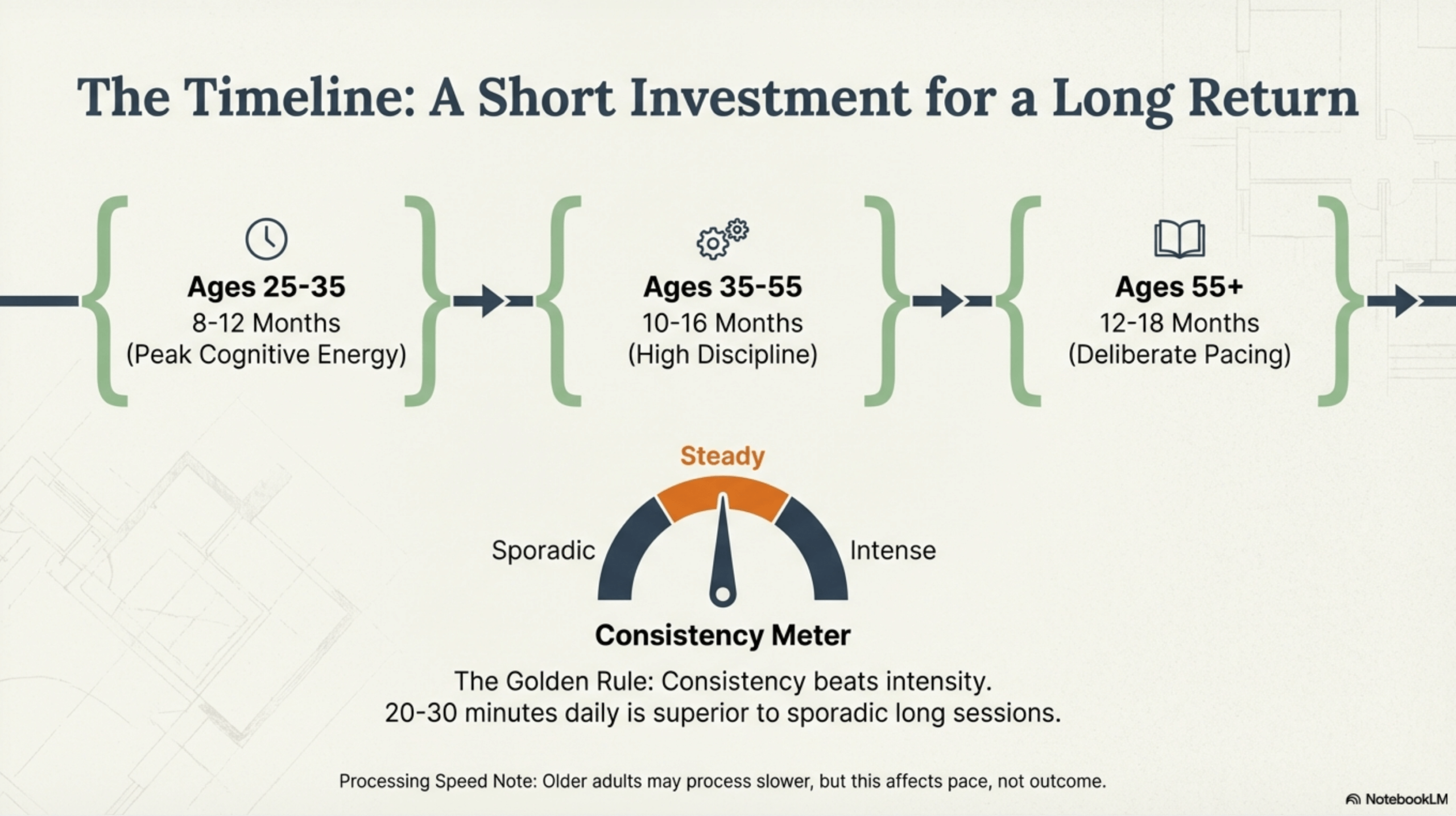
How long does it take to learn to read as an adult? Here are realistic expectations:
Ages 25-35
Typical timeline: 8-12 months for comprehensive program with daily practice Advantages: Peak cognitive function, energy, capacity for focused work Challenges: Often busy with career and young children Best approach: Short daily sessions (20-30 minutes) before work or after children sleep
Ages 35-45
Typical timeline: 10-14 months for comprehensive program with consistent practice Advantages: Strong motivation, discipline, clear purpose Challenges: Multiple responsibilities competing for time Best approach: Consistent shorter sessions, recognizing that steady progress beats sporadic intensity
Ages 45-55
Typical timeline: 12-16 months for comprehensive program with regular practice Advantages: Patience, perspective, appreciation for progress Challenges: May need slightly more repetition for automaticity Best approach: Self-paced program allowing extra time on challenging concepts
Ages 55-65
Typical timeline: 12-16 months for comprehensive program with dedicated practice Advantages: Often more time available, strong intrinsic motivation, patience Challenges: May process slightly more slowly (not a problem with self-paced instruction) Best approach: Take full advantage of time availability, work at comfortable pace without pressure
Ages 65+
Typical timeline: 14-18 months for comprehensive program with consistent practice Advantages: Often the most available time, deep intrinsic motivation, wisdom and patience Challenges: May work at a more deliberate pace (which ensures thorough understanding) Best approach: Embrace the journey without rushing, use extra time as an advantage for mastery
Important: These are averages. Individual variation is significant. Some adults at any age progress faster; others take longer. The key is consistent practice, not speed.
Stories Across the Decades
Real people at different ages who learned to read:
Michael, Age 28
“I could barely read when I started at 28. Now at 30, I’ve passed my GED and I’m taking college courses. Age wasn’t the issue—method was.”
Jennifer, Age 36
“Started learning at 36 with three kids under 10. Found 30 minutes every morning before they woke up. At 37, I read chapter books to them now.”
David, Age 44
“Thought 44 was too old. Decided I had 30+ years ahead and one year of learning could change those 30 years. Best decision I made in my 40s.”
Patricia, Age 53
“My grandchildren motivated me to learn at 53. Took 14 months, but now I read them bedtime stories. They’re so proud of their grandma.”
James, Age 61
“Retired and finally had time to address my reading. Started at 61, finished at 62. My 60s are completely different now—I read daily.”
Margaret, Age 68
“People thought I was crazy starting at 68. I’m 70 now and read novels regularly. I plan to live to 90 at least—that’s 20 years of reading I would have missed.”
Overcoming Age-Specific Doubts
“I’m too old to change my brain.”
The science says otherwise. Neuroplasticity continues throughout life. Your brain can and will form new reading pathways at any age with proper instruction and practice.
“What will people think?”
Most people will be impressed by your courage, not judgmental about your starting point. That said, you don’t need to tell anyone. Many adults learn privately using online programs and share only when comfortable.
“I don’t have enough time left to make it worthwhile.”
Do the math. If you’re 50 and live to 80, that’s 30 years. If you’re 60 and live to 85, that’s 25 years. If you’re 70 and live to 90, that’s 20 years. One year of learning provides decades of benefit. The question isn’t whether you have time—it’s whether you want those years to include reading.
“I’ve managed this long without reading. Why start now?”
Because you don’t have to just “manage” anymore. You can thrive. You can be independent. You can experience the satisfaction of reading for pleasure, the pride of helping family members, the career opportunities reading creates. Managing is surviving. Reading is living fully.
Your Age Is Not the Problem
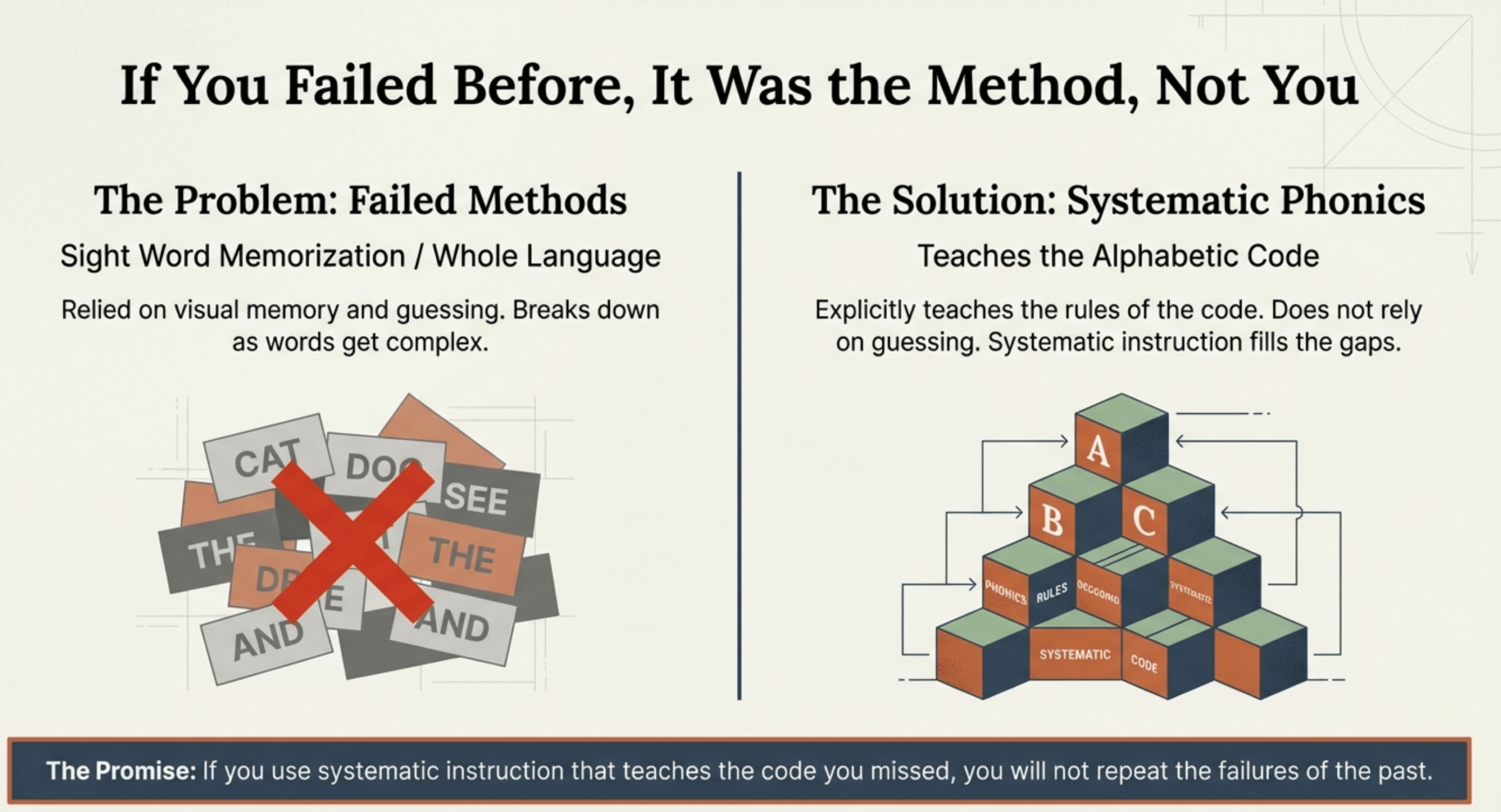
Here’s what you need to understand:
Age is not the barrier preventing you from learning to read.
The barrier is lack of proper instruction.
You could be 25 or 75—if you’re taught using the same failed methods from childhood (sight word memorization, whole language, mixed approaches), you’ll fail again.
You could be 25 or 75—if you’re taught using systematic phonics instruction that explicitly teaches the complete code you missed, you’ll succeed.
Age affects the timeline slightly. It doesn’t affect the outcome.
What You Need to Succeed (At Any Age)
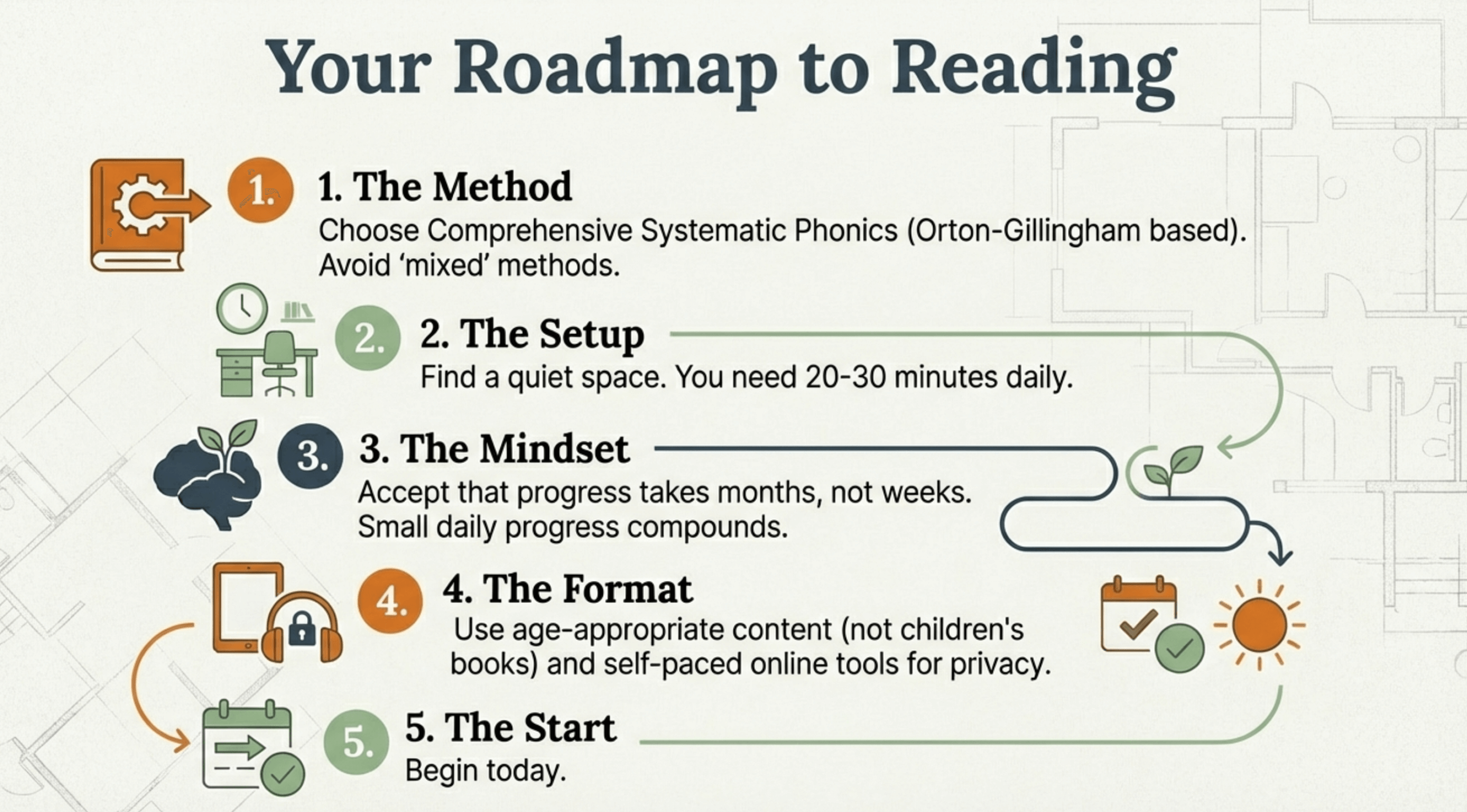
Regardless of your age, you need:
1. Comprehensive systematic phonics instruction
- Teaches the complete alphabetic code
- Sequential, from simple to complex
- Explicit instruction, nothing left to chance
- Based on Orton-Gillingham principles
2. Consistent daily practice
- 20-30 minutes is sufficient
- Daily beats sporadic longer sessions
- Consistency matters more than intensity
3. Realistic expectations
- Learning takes months, not weeks
- Progress isn’t always linear
- Difficulty is normal and temporary
- Small daily progress compounds
4. Quality instruction
- Age-appropriate content
- Clear video teaching (for online programs)
- Sufficient practice opportunities
- Multisensory approach
5. Belief that you can succeed
- Understanding that age doesn’t prevent learning
- Recognizing previous failures were about method, not you
- Commitment to seeing it through
Your Next Steps
Stop letting age be your excuse. It’s not the real barrier—lack of proper instruction is.
Understand what works:
- How to Learn to Read as an Adult – Complete guide to the process
- Why Can’t I Read Well as an Adult? – Understand the real reasons
Find the right program:
- Best Adult Reading Programs – Compare your options
- Phonics for Adults – How systematic phonics works
Start learning:
- Try 10 Free Lessons – Experience systematic phonics instruction
- Adult Phonics Cost Comparison – Understand investment needed
Get support:
- Reading Help for Adults – Where to find help
- Adult Success Stories – See what others achieved
Set expectations:
- How Long Does It Take? – Realistic timelines
Frequently Asked Questions
What’s the oldest age someone has learned to read?
There are documented cases of people learning to read in their 70s and 80s. While most adult literacy students are under 60, age itself doesn’t prevent learning. The key factors are motivation, access to proper instruction, and consistent practice—all of which are possible at any age.
Will I learn slower than younger people?
You might work through material at a slightly different pace, but “slower” isn’t necessarily negative. Older adults often have better focus, more patience, and clearer motivation—factors that support thorough learning. Additionally, self-paced programs accommodate any speed. There’s no competition or pressure.
Do I need special programs for older learners?
No. Adults of all ages need the same thing: comprehensive systematic phonics instruction. Age-appropriate content matters (materials designed for adults vs. children), but age 30 vs. age 60 doesn’t require different programs. The teaching method—systematic phonics—works at all ages.
Can I learn as well as I would have if I’d learned as a child?
Yes. Brain imaging shows that adults who learn to read develop the same functional reading networks as childhood readers. The pathways form later, but they work just as well. Many adults who learn to read later achieve complete fluency and read extensively for work and pleasure.
What if my memory isn’t as good anymore?
Systematic phonics teaches you to understand patterns and rules, not to memorize thousands of individual words. This approach is less memory-dependent than sight word memorization. Additionally, multisensory instruction (seeing, hearing, speaking, writing) reinforces learning through multiple pathways, reducing memory demands.
Should I be concerned about vision changes affecting learning?
If you can see well enough to read this text (with glasses if needed), you can learn to read. However, if you have significant vision changes or concerns, get an eye exam before starting. Proper vision correction makes learning more comfortable but doesn’t prevent learning.
Is it worth the time investment at my age?
Consider this: If learning takes one year and provides 20+ years of reading ability and independence, is that worthwhile? Only you can decide, but thousands of older adults have answered “yes” and report that learning to read was one of the best decisions of their later years.
What if people my age judge me?
You can learn completely privately using online programs. No one needs to know unless you choose to share. That said, most people who learn about your journey will be impressed by your courage and determination, not judgmental. Those who would judge aren’t worth your concern.
Final Truth:

You’re not too old. You never will be too old. Your brain can learn to read at any age.
The question isn’t whether your age allows it. The question is whether you’ll give yourself permission to finally learn what you should have been taught decades ago.
Every day you wait is another day without reading. Every day you practice is another day closer to independence.
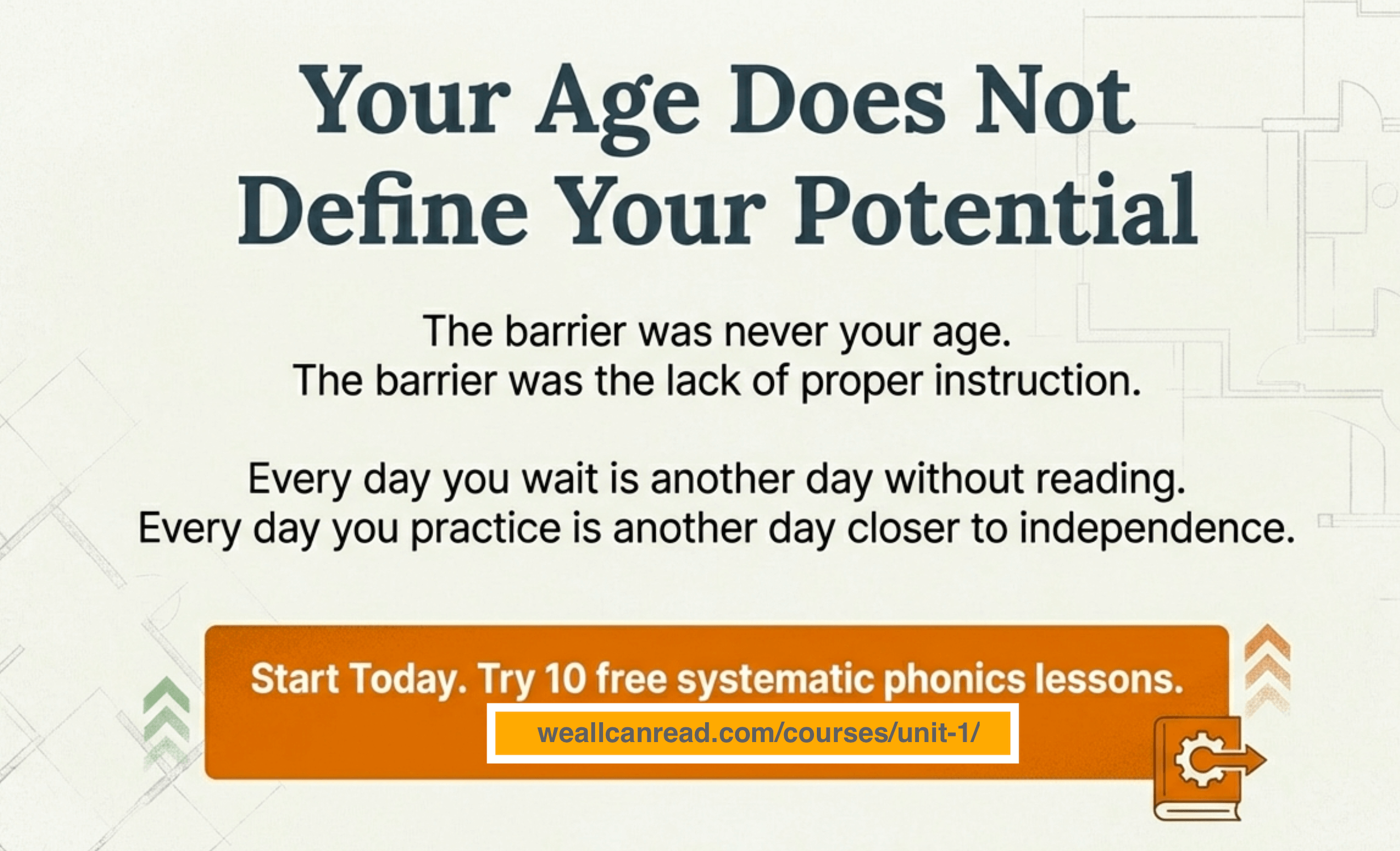
Your age doesn’t define your potential. Your willingness to try does.