Teaching Phonemic Awareness: The Foundation of Reading Success
What Is Phonemic Awareness?
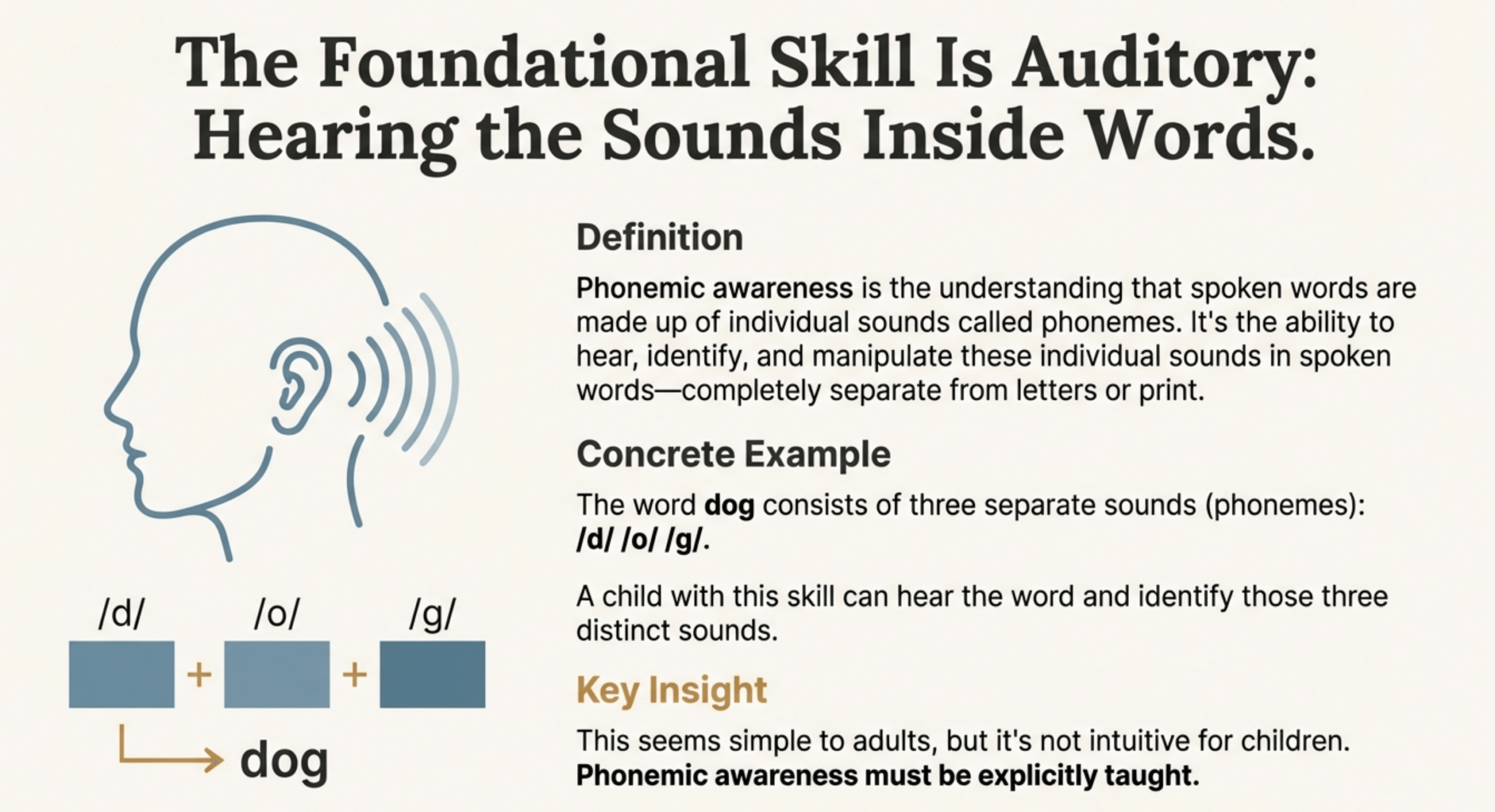
Phonemic awareness is the understanding that spoken words are made up of individual sounds called phonemes. It’s the ability to hear, identify, and manipulate these individual sounds in spoken words—completely separate from letters or print.
Example: The word “dog” consists of three separate sounds (phonemes): /d/ /o/ /g/. A child with phonemic awareness can hear that word and identify those three distinct sounds, blend them together, or manipulate them (change /d/ to /f/ to make “fog”).
This seems simple to adults who are proficient readers, but it’s not intuitive for young children or struggling readers. Phonemic awareness must be explicitly taught.
Phonemic Awareness Powers Both Reading AND Spelling
Segmenting words into individual sounds isn’t just for reading—it’s the foundation of spelling. When students learn to isolate and manipulate phonemes, they unlock both decoding and encoding. See how systematic spelling instruction builds on phonemic awareness.
Why Phonemic Awareness Is Critical
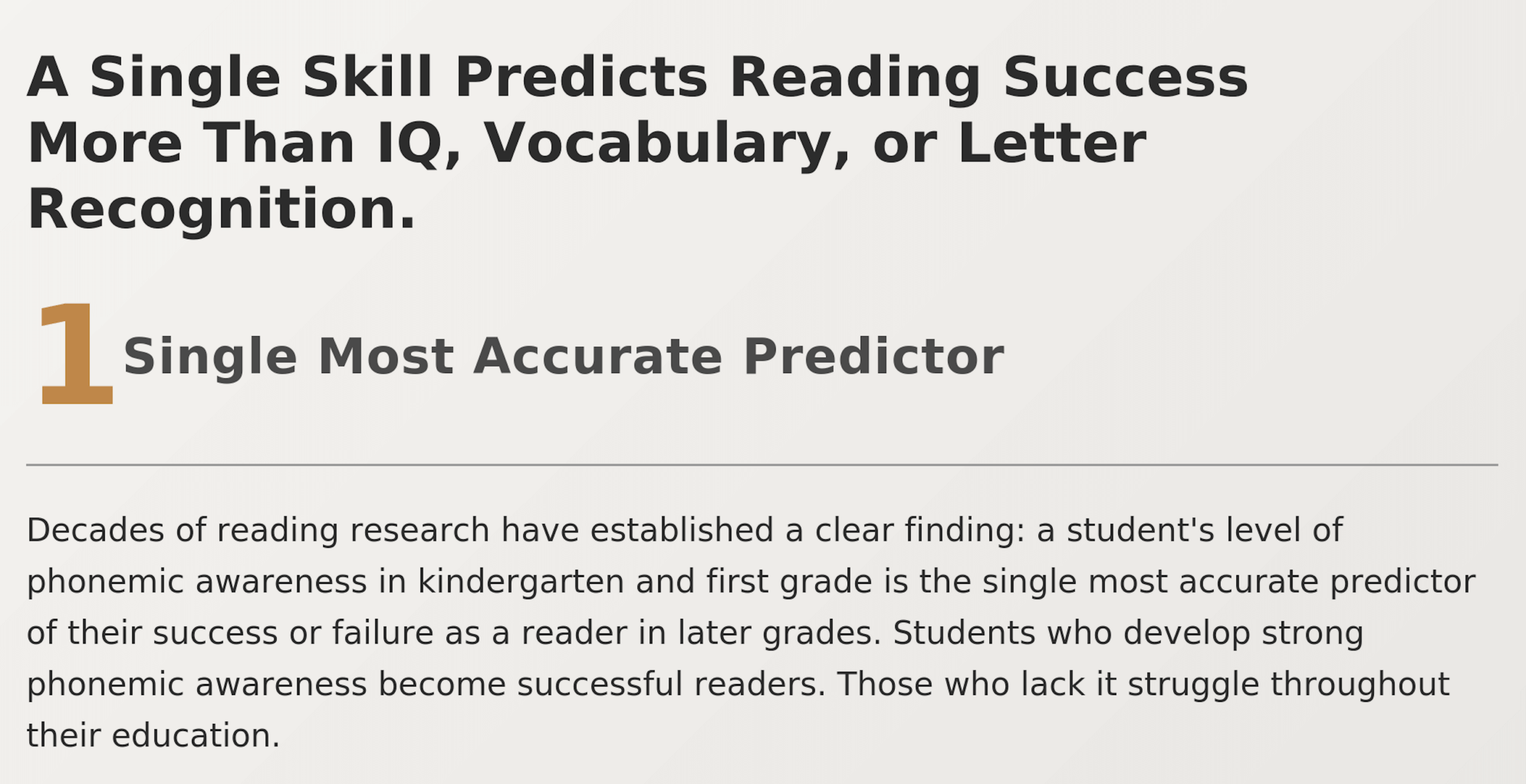
The #1 Predictor of Reading Success
Decades of reading research have established a clear finding: a student’s level of phonemic awareness in kindergarten and first grade is the single most accurate predictor of their success or failure as a reader in later grades.
Students who develop strong phonemic awareness become successful readers. Students who lack phonemic awareness struggle with reading throughout their education, often requiring intensive intervention to catch up.
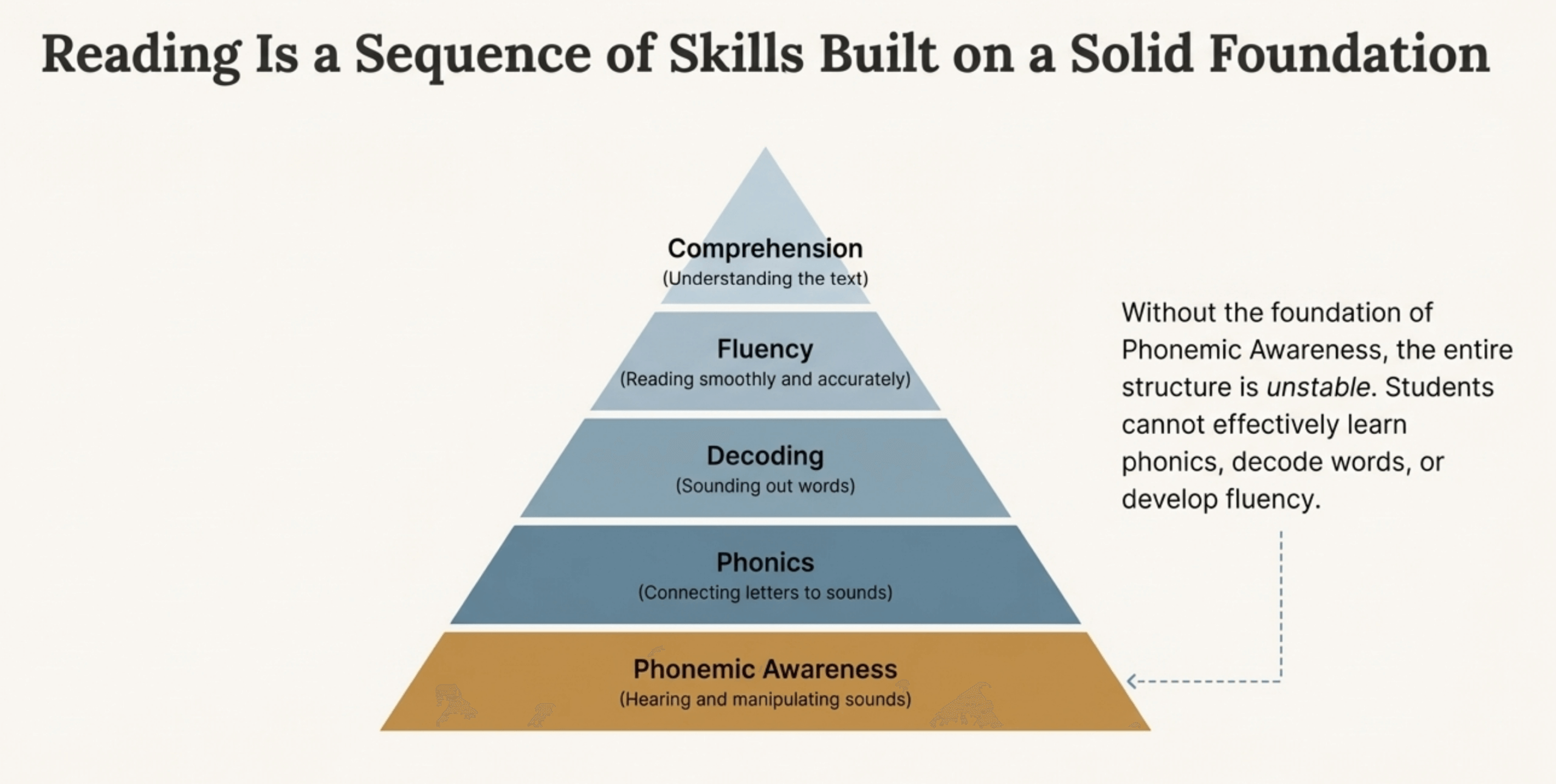
This predictive power exceeds other factors like letter recognition, vocabulary knowledge, or even IQ. Phonemic awareness is foundational—without it, students cannot effectively learn phonics, decode words, or develop reading fluency.
Why Phonemic Awareness Matters for Phonics Learning
Phonics instruction teaches students that letters represent sounds. But if students can’t hear and identify the individual sounds in words, they can’t make the connection between letters and sounds.
Consider teaching the word “cat”:
- Without phonemic awareness: Student sees “cat” as one blob of sound. When told “c says /k/,” they can’t isolate /k/ within the word. The letter-sound connection doesn’t stick.
- With phonemic awareness: Student hears “cat” as /k/ /a/ /t/—three distinct sounds. When told “c says /k/,” they recognize /k/ as the first sound in “cat.” The connection makes sense and is retained.
Phonemic awareness is the prerequisite for phonics. Students must be able to hear and manipulate sounds before they can successfully map letters to those sounds.
Phonemic Awareness vs. Phonics: What’s the Difference?
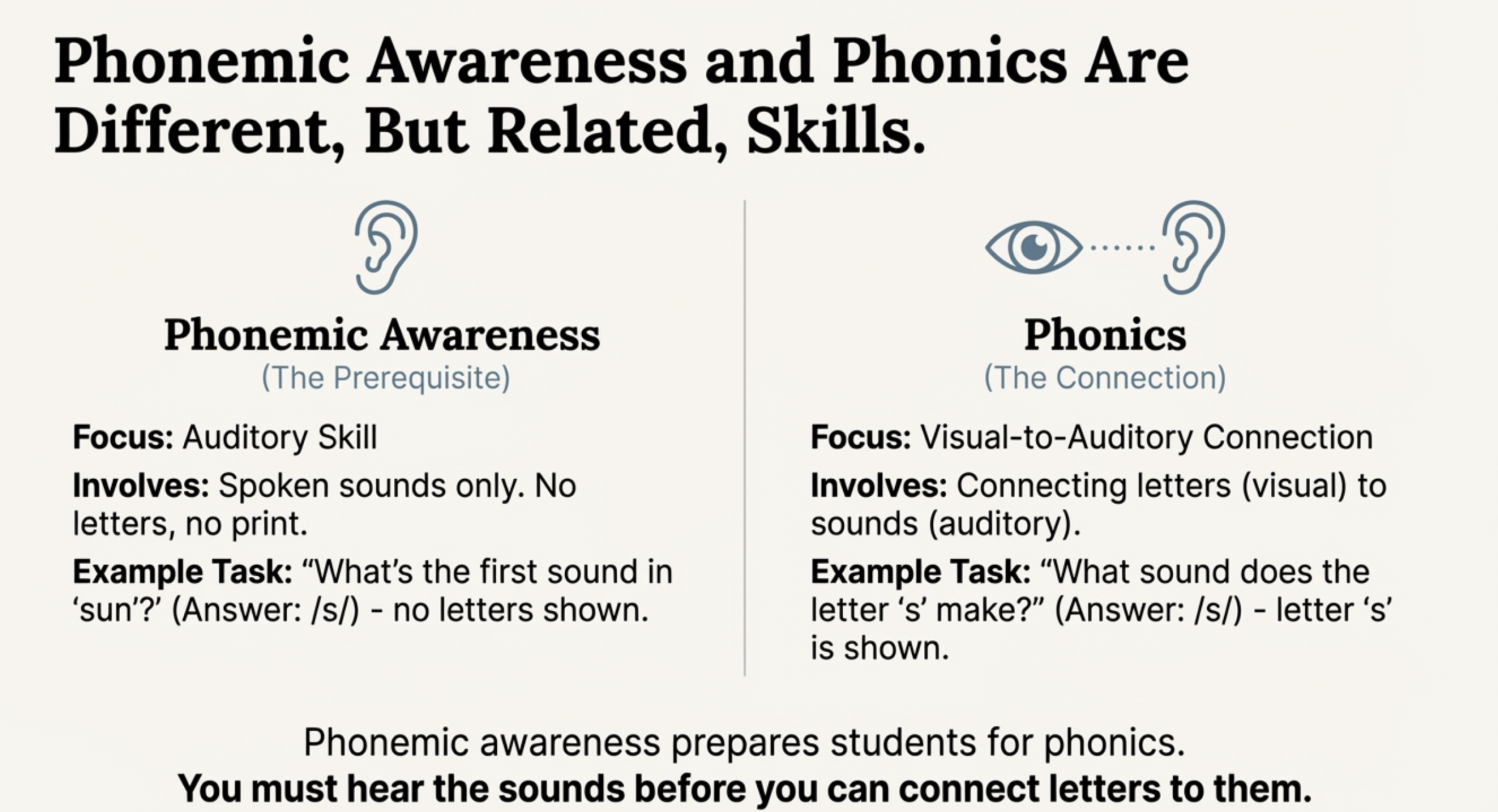
Many parents and even some educators confuse phonemic awareness with phonics. They’re related but distinct skills:
Phonemic Awareness (Auditory Skill)
- Involves: Spoken sounds only—no letters, no print, no visual component
- Activities: Listening to words, identifying sounds, blending sounds orally, segmenting words into sounds
- Example task: “What’s the first sound in ‘sun’?” (Answer: /s/) — no letters shown
- When taught: Before and during early phonics instruction
Phonics (Visual-to-Auditory Connection)
- Involves: Connecting letters (visual) to sounds (auditory)
- Activities: Looking at letters, saying their sounds, reading words, spelling words
- Example task: “What sound does the letter ‘s’ make?” (Answer: /s/) — letter is shown
- When taught: After foundational phonemic awareness is established
The Relationship
Phonemic awareness prepares students for phonics. Phonics then reinforces and extends phonemic awareness. The two skills develop together in successful readers, each strengthening the other.
The sequence: Phonemic awareness → Phonics → Decoding → Fluency → Comprehension
The Continuum of Phonemic Awareness Skills
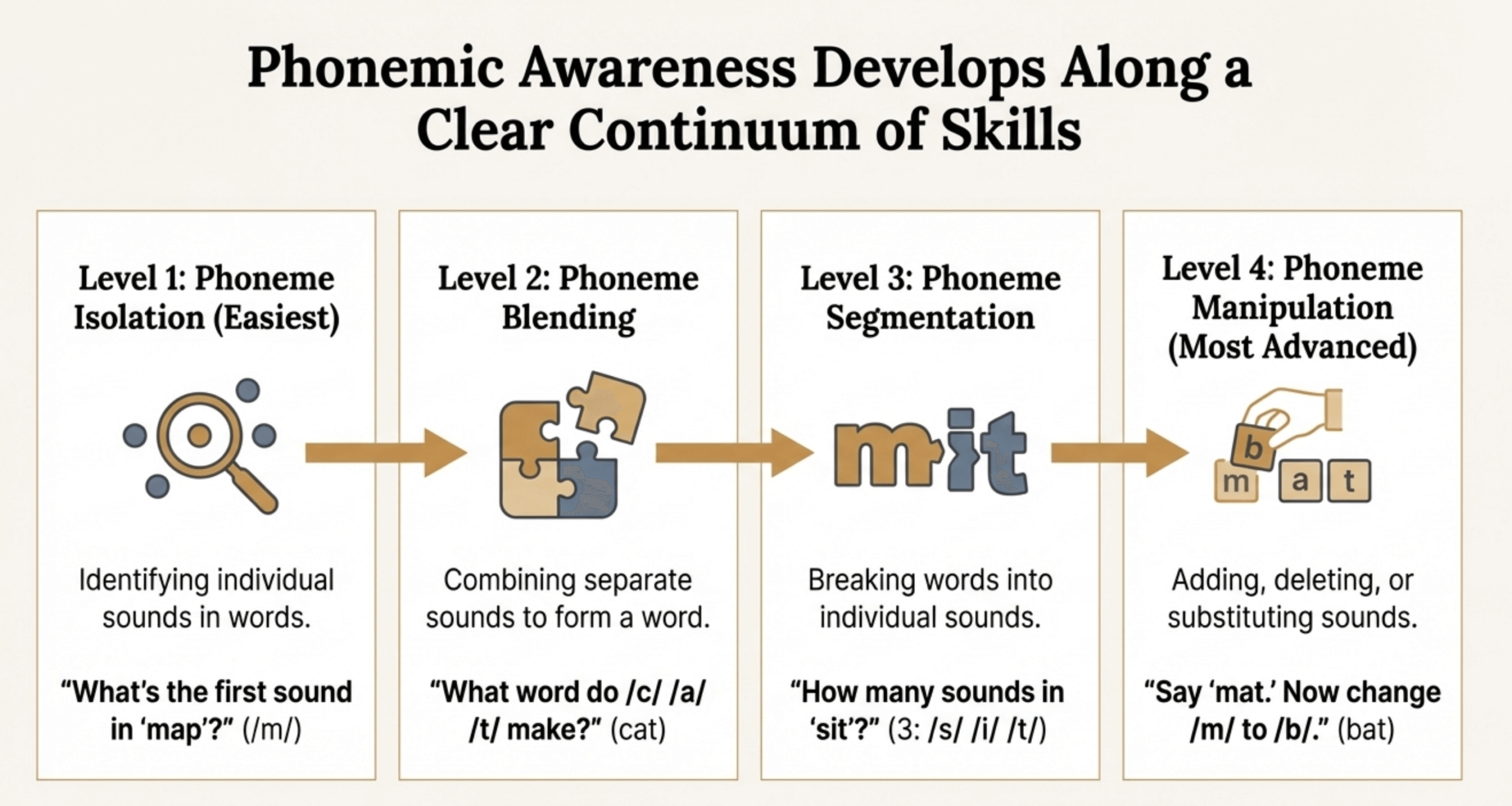
Phonemic awareness develops through a progression from simple to complex skills. Students typically master easier skills before advancing to more challenging ones.
Level 1: Phoneme Isolation (Easiest)
Skill: Identifying individual sounds in words
Example tasks:
- “What’s the first sound in ‘map’?” (/m/)
- “What’s the last sound in ‘dog’?” (/g/)
- “What’s the middle sound in ‘pen’?” (/e/)
Level 2: Phoneme Blending
Skill: Combining separate sounds to form a word
Example tasks:
- “Listen to these sounds: /c/ /a/ /t/. What word do they make?” (cat)
- “Blend these sounds: /sh/ /o/ /p/.” (shop)
This skill directly supports reading—students hear individual sounds and blend them into recognizable words.
Level 3: Phoneme Segmentation (Most Advanced)
Skill: Breaking words into individual sounds
Example tasks:
- “How many sounds do you hear in ‘sit’?” (3: /s/ /i/ /t/)
- “Tell me each sound in ‘trap’.” (/t/ /r/ /a/ /p/)
This skill directly supports spelling—students hear whole words and must identify each component sound to represent them with letters.
Level 4: Phoneme Manipulation
Skill: Adding, deleting, or substituting sounds in words
Example tasks:
- “Say ‘cat.’ Now say ‘cat’ without the /c/.” (at)
- “Say ‘mat.’ Now change /m/ to /b/.” (bat)
- “Say ‘stop.’ Now add /s/ to the beginning.” (sstop—isn’t a real word, but tests manipulation skill)
This advanced skill demonstrates complete phonemic awareness mastery.
The Two Most Critical Skills
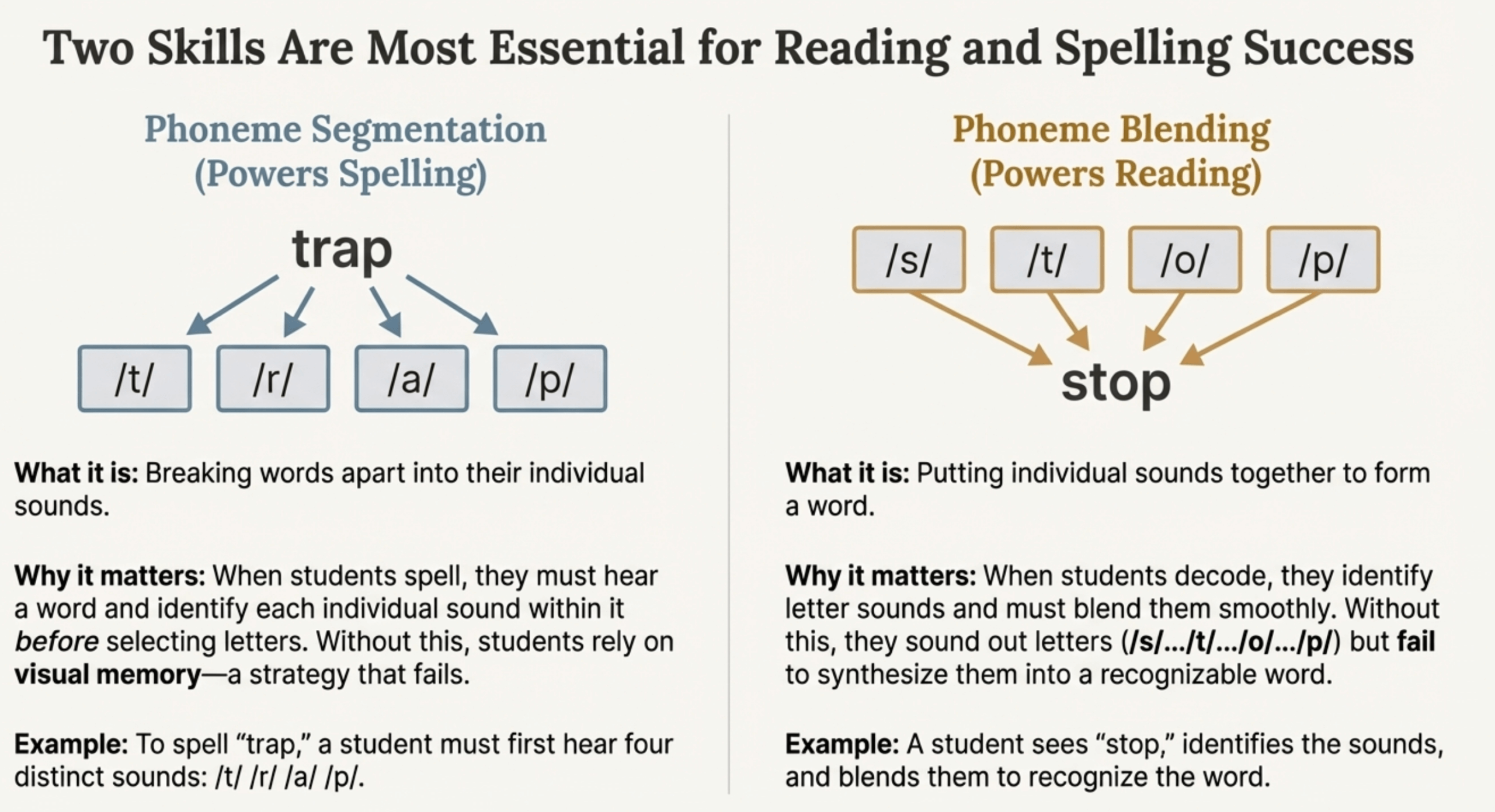
Research identifies two phonemic awareness skills as most essential for reading success:
1. Phoneme Segmentation (Breaking Words Apart)
Why it matters for spelling: When students spell, they must hear a word and identify each individual sound within it before selecting letters to represent those sounds.
Example: To spell “trap,” students must recognize four distinct sounds: /t/ /r/ /a/ /p/. Then they write: t-r-a-p.
Students without strong segmentation skills try to spell by visual memory alone—a strategy that fails with unfamiliar words and creates poor spellers.
2. Phoneme Blending (Putting Sounds Together)
Why it matters for reading: When students decode words, they identify individual letter sounds and must blend them smoothly to recognize the word.
Example: Student sees “stop,” identifies /s/ /t/ /o/ /p/, blends them together, and recognizes “stop.”
Students without strong blending skills sound out letters (/s/… /t/… /o/… /p/) but can’t synthesize them into a recognizable word. They decode letters but don’t read words.
Signs of Weak Phonemic Awareness
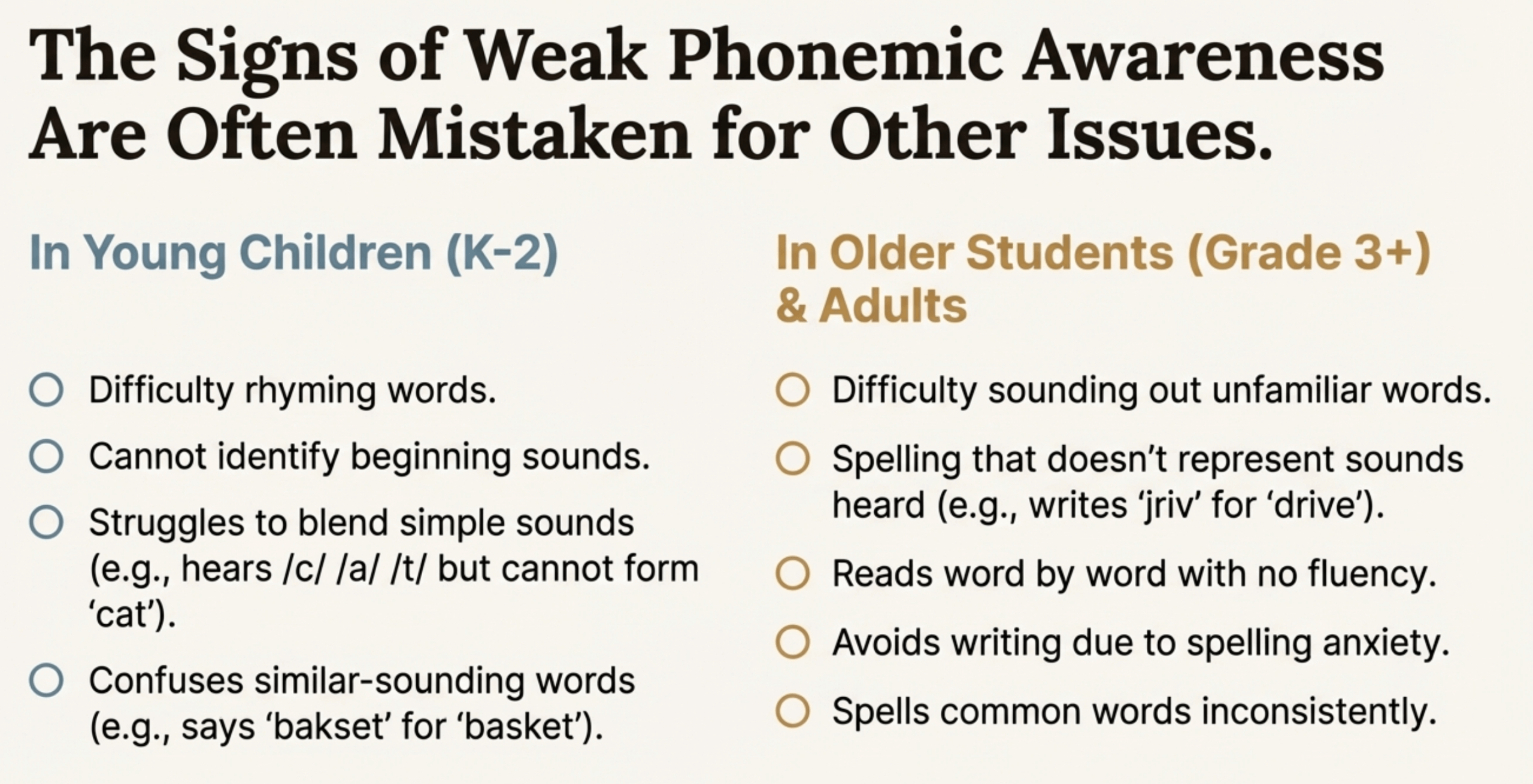
Students with underdeveloped phonemic awareness often display specific struggles:
In Young Children (K-2)
- Difficulty rhyming words
- Cannot identify beginning sounds in words
- Struggles to blend simple sounds into words (can’t hear /c/ /a/ /t/ as “cat”)
- Cannot clap out syllables in words
- Confuses similar-sounding words (pronounces “basket” as “bakset”)
In Older Students (Grade 3+)
- Difficulty sounding out unfamiliar words
- Spelling attempts that don’t represent sounds heard (writes “jriv” for “drive”)
- Reading word by word with no fluency
- Cannot decode nonsense words (struggles with “blat” or “flem”)
- Relies heavily on memorization rather than phonetic decoding
In Adults and Struggling Readers
- Extreme difficulty spelling—especially unfamiliar words
- Cannot “sound out” words—must recognize them by sight or guess
- Spells common words inconsistently (writes “because” three different ways in one document)
- Avoids writing due to spelling anxiety
How to Develop Phonemic Awareness
Start with Oral Activities (No Letters)
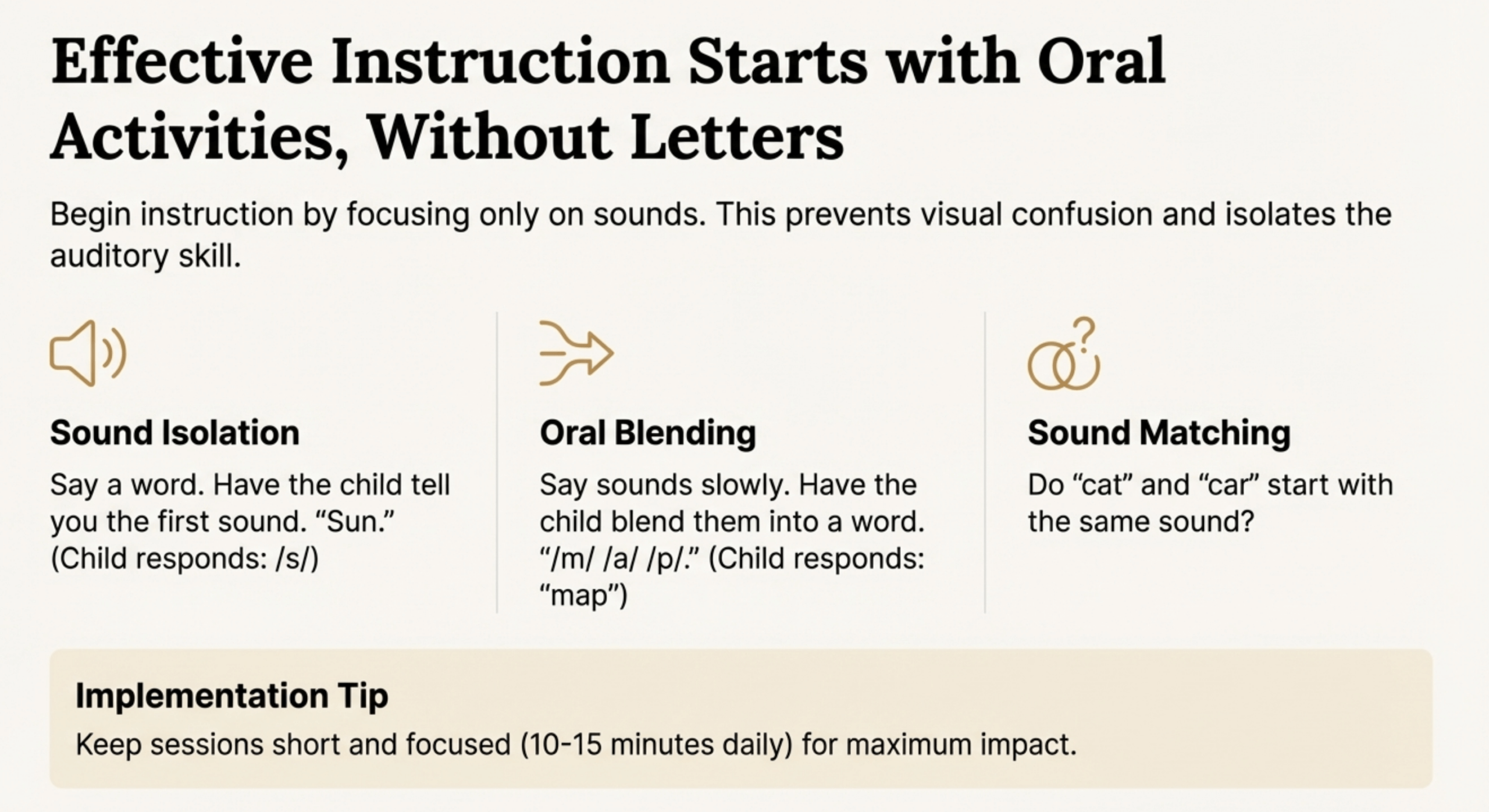
Begin phonemic awareness instruction without any written letters. This keeps focus on sounds, not visual symbols.
Simple activities:
Sound isolation: “I’m going to say a word. You tell me the first sound. Ready? ‘Sun.'” (Child responds: /s/)
Sound matching: “Do ‘cat’ and ‘car’ start with the same sound?” (Yes—both /k/)
Oral blending: “I’ll say sounds slowly. You tell me the word. Ready? /m/ /a/ /p/.” (Child responds: “map”)
Progress to Segmentation Activities

Once students can identify and blend sounds, teach them to break words apart:
Count the sounds: “How many sounds in ‘dog’?” (Hold up fingers: 3 sounds)
Say each sound: “Tell me each sound in ‘fish.'” (/f/ /i/ /sh/—note that ‘sh’ is one sound, not two)
Use manipulatives: Use blocks, chips, or counters. Say “cat.” Student pushes forward one block for each sound: /c/ (push) /a/ (push) /t/ (push). Three sounds = three blocks.
Integrate with Phonics Instruction
Once students have basic phonemic awareness, combine it with letter learning:
Sound-to-letter connection: “What’s the first sound in ‘bat’?” (/b/) “Great! The letter ‘b’ makes that sound. Let’s write it.”
Spelling with sound awareness: “Let’s spell ‘cat.’ How many sounds?” (3) “Tell me each sound.” (/k/ /a/ /t/) “Now write the letter for each sound.” (c-a-t)
This integration reinforces both phonemic awareness and phonics simultaneously.
Phonemic Awareness for Older Students and Adults
It’s Never Too Late
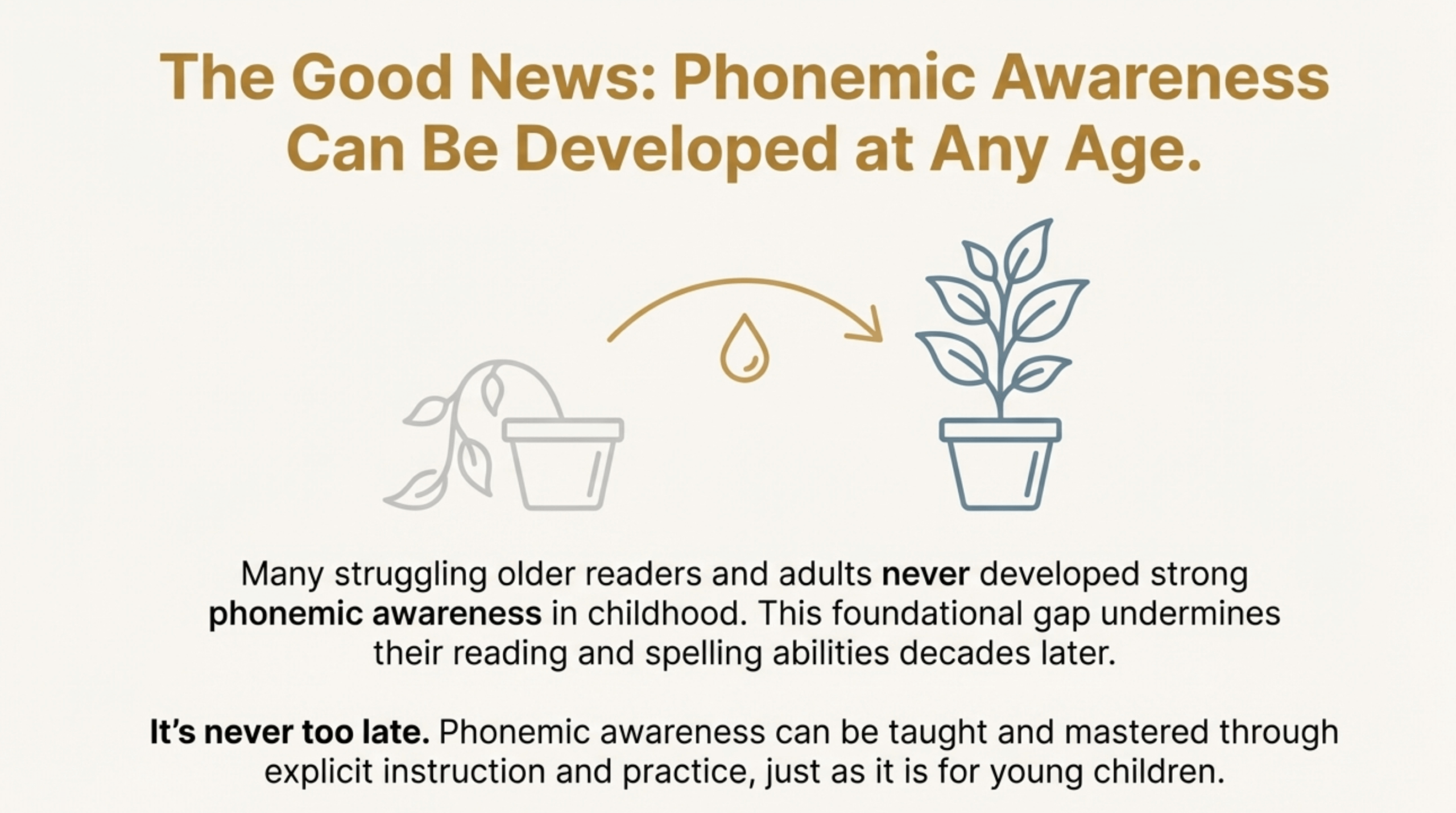
Many struggling older readers and adults never developed strong phonemic awareness in childhood. This foundational gap undermines their reading and spelling abilities decades later.
Good news: Phonemic awareness can be developed at any age. Adults can master these skills through explicit instruction and practice, just as young children do.
Age-Appropriate Activities
Older students need the same skills but delivered with age-appropriate materials and respect for their maturity:
- No childish manipulatives: Skip the blocks and colorful chips. Use paper and pencil or mental tracking.
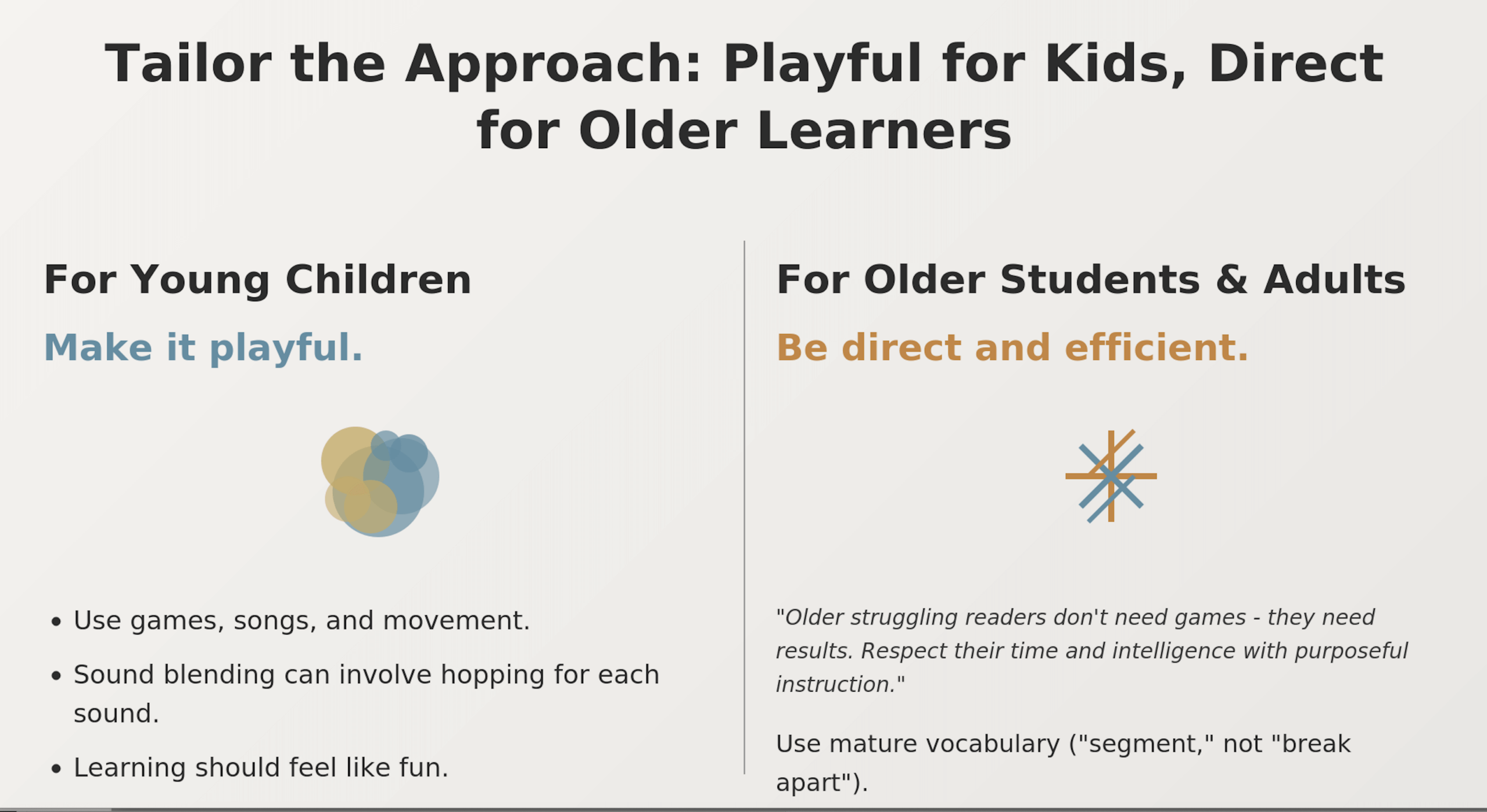
- Mature vocabulary: Use adult-level words for activities (“segment,” “manipulate,” not “break apart,” “play with”)
- Real-world connection: Explain why this matters: “This skill is why you struggle to spell. Let’s fix that.”
- Quick progression: Adults learn phonemic awareness faster than children. Move through levels efficiently.
Focus on Spelling Connection
For older students, emphasize how phonemic awareness directly improves spelling—often their greatest frustration:
Activity example: “I’ll say a word. You tell me how many sounds you hear. Ready? ‘Strap.'” (5 sounds: /s/ /t/ /r/ /a/ /p/) “Now write a letter for each sound.” (s-t-r-a-p)
This immediate application to spelling motivates adult learners far more than abstract sound games.
How Our Program Develops Phonemic Awareness
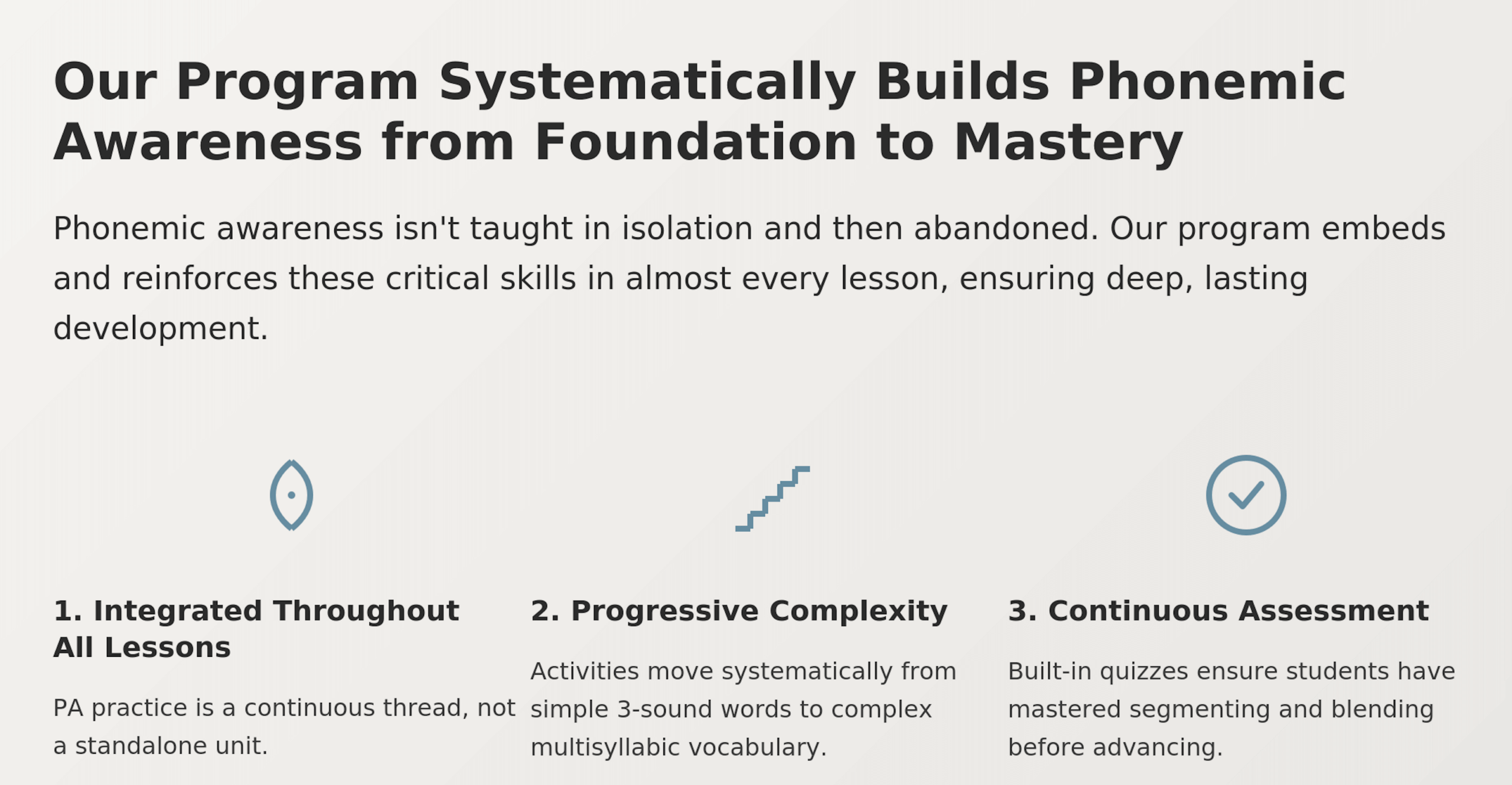
Integrated Throughout All Lessons
Phonemic awareness isn’t taught in isolation and then abandoned. Our program embeds phonemic awareness activities in almost every lesson from beginning to end, developing and reinforcing these skills continuously.
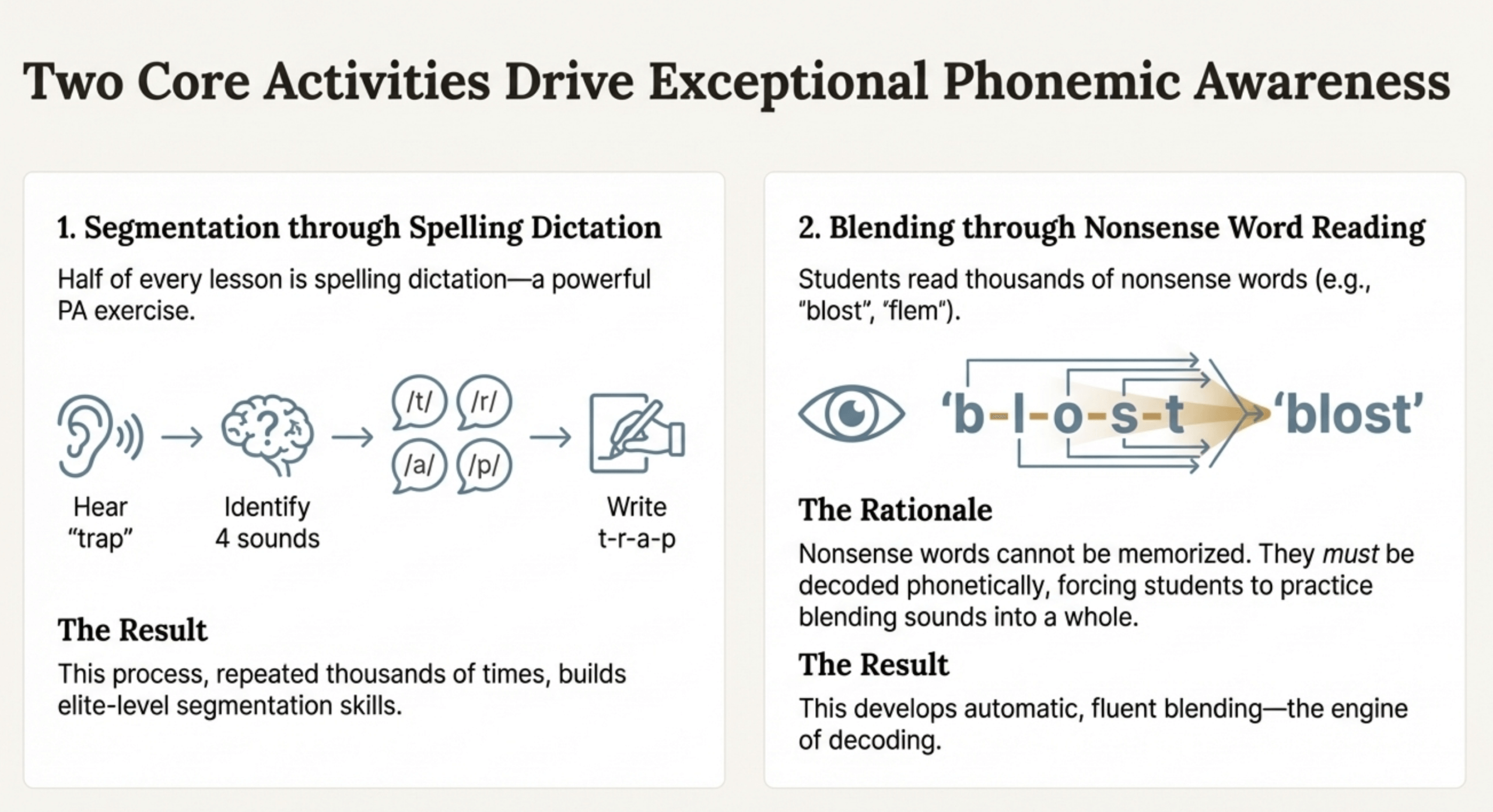
Segmentation Through Spelling Dictation
Half of every lesson consists of spelling dictation. This activity is fundamentally a phonemic awareness exercise:
- Student hears the word: Teacher says “trap”
- Student identifies sound count: “How many sounds?” (4 sounds)
- Student articulates each sound: /t/ /r/ /a/ /p/
- Student matches letters to sounds: Writes t-r-a-p
This process, repeated thousands of times throughout the program, builds exceptional phonemic awareness while simultaneously developing spelling skill.
Blending Through Nonsense Word Reading
Students read thousands of nonsense words throughout the program. Nonsense words cannot be memorized—they must be decoded phonetically, which requires strong blending skills.
Example: Student sees “blost” (not a real word). Cannot rely on memory. Must identify: /b/ /l/ /o/ /s/ /t/, then blend: “blost.”
This intensive blending practice with unfamiliar words develops automatic phoneme blending—the foundation of reading fluency.
Progressive Complexity
Phonemic awareness activities progress systematically:
- Level 1: Simple CVC words (3 sounds: /c/ /a/ /t/)
- Level 2: Blends and digraphs (4-5 sounds: /s/ /t/ /o/ /p/)
- Level 3: Complex patterns and multisyllabic words
Students master phonemic awareness with simple words before tackling complex multisyllabic vocabulary.
Continuous Assessment
Our built-in quizzes assess both phonemic awareness and phonics knowledge. Students cannot advance until they demonstrate they can:
- Segment words accurately (spelling tests)
- Blend sounds fluently (nonsense word reading)
- Apply phonemic awareness to real reading and spelling
For Teachers and Parents: Implementation Tips
Start Early, But It’s Never Too Late
Ideally, phonemic awareness instruction begins in kindergarten. But struggling readers of any age benefit from explicit phonemic awareness instruction. Don’t skip this foundation even with older students.
Keep Sessions Short and Focused
Phonemic awareness practice is mentally demanding. Short, focused sessions (10-15 minutes) produce better results than long, exhausting drills. Daily practice is more effective than long weekly sessions.
Make It Playful for Young Children
For young learners, incorporate games, songs, and movement. Sound isolation can be a treasure hunt. Blending can involve hopping for each sound. Learning should feel fun, not tedious.
Be Direct and Efficient with Older Students
Older struggling readers don’t need games—they need results. Be straightforward: “This skill will help you spell better. Let’s practice.” Respect their time and intelligence with efficient, purposeful instruction.
Monitor Progress
Track whether students are improving:
- Can they segment words with increasing numbers of sounds?
- Is their blending becoming faster and more automatic?
- Are their spelling attempts becoming more phonetically accurate?
- Is their decoding improving?
Measurable progress motivates continued effort.
The Foundation That Makes Everything Else Possible
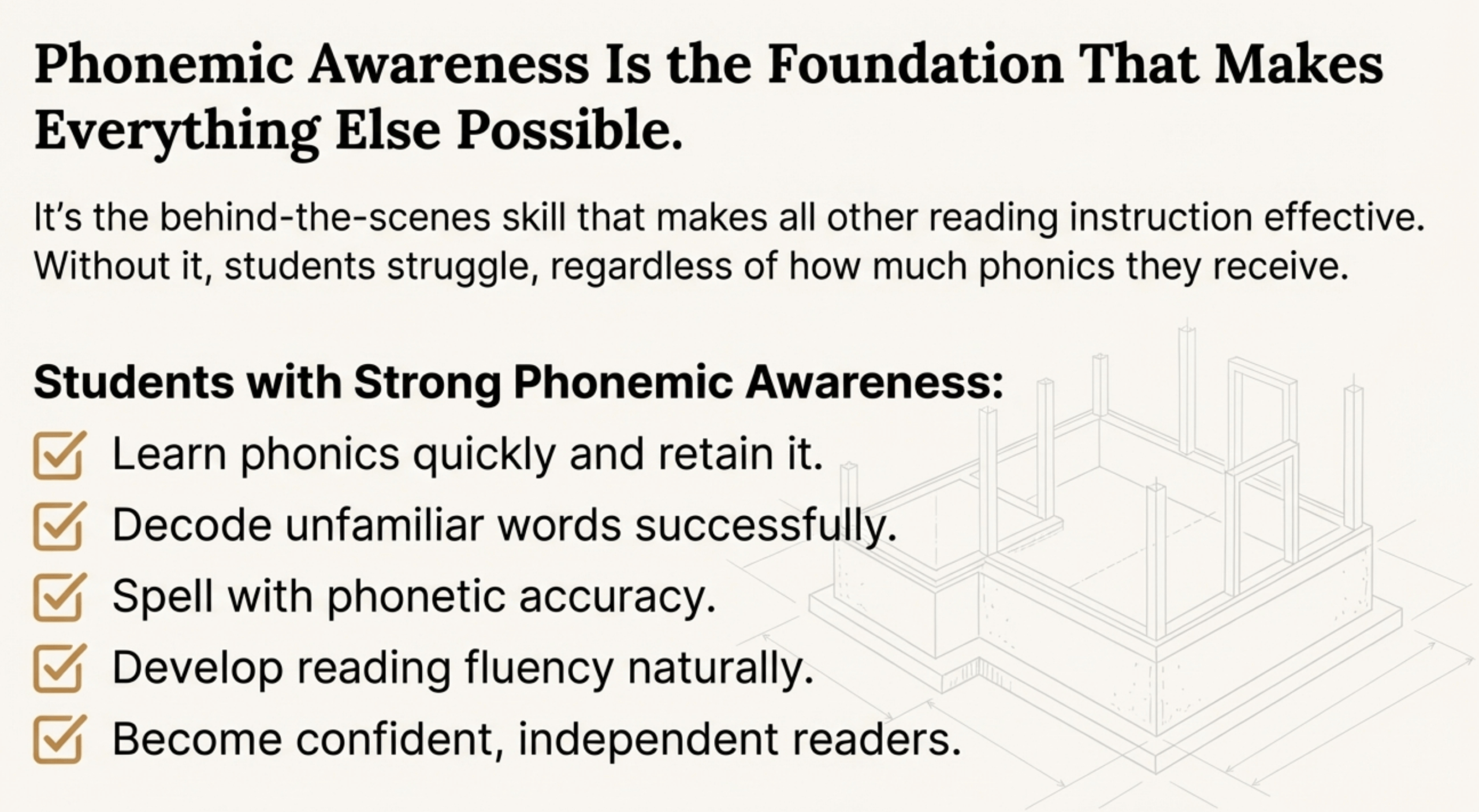
Phonemic awareness isn’t flashy. It doesn’t involve interesting stories or colorful workbooks. It’s the behind-the-scenes skill that makes all other reading instruction effective.
Students with strong phonemic awareness:
- ✅ Learn phonics quickly and retain it permanently
- ✅ Decode unfamiliar words successfully
- ✅ Spell with phonetic accuracy
- ✅ Develop reading fluency naturally
- ✅ Become confident, independent readers
Students without phonemic awareness struggle with all of the above, regardless of how much phonics instruction they receive.
The bottom line: Phonemic awareness is the foundation. Build it first, build it well, and everything else becomes dramatically easier.
Experience Systematic Phonemic Awareness Development
Our comprehensive program integrates phonemic awareness development throughout all 720 lessons. Try our first 10 lessons free—no credit card required.
Related topics: Systematic phonics instruction | Orton-Gillingham methodology | Help for struggling readers
Questions about phonemic awareness? Contact us or explore our frequently asked questions.