Systematic Phonics Instruction: How the Alphabet Unlocks Reading
The Alphabetic Principle: The Foundation of Reading
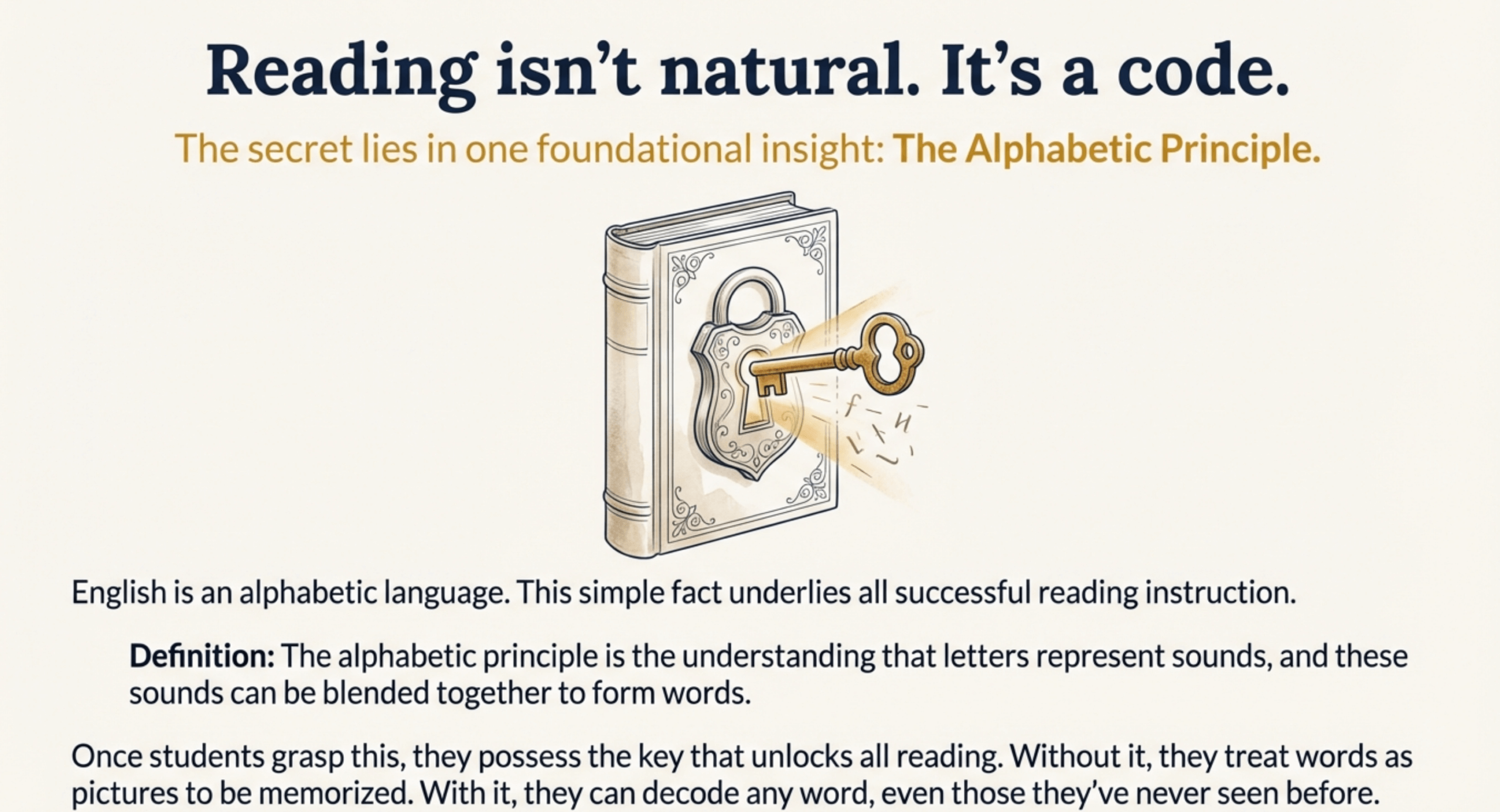
English is an alphabetic language. This simple fact underlies all successful reading instruction—yet many struggling readers never fully grasp what this means or why it matters.
The alphabetic principle is the understanding that letters represent sounds, and these sounds can be blended together to form words.
This seems obvious to proficient readers, but it’s a profound insight for beginning readers and struggling students. Once students understand this principle—that written symbols (letters) systematically represent spoken sounds—they possess the key that unlocks all reading.
Without understanding the alphabetic principle, students treat words as pictures to be memorized. With it, they can decode any word, even words they’ve never seen before.
What Phonics Instruction Actually Is
Phonics: The System Connecting Letters to Sounds
Phonics is the instructional method that teaches students the systematic relationship between letters (graphemes) and sounds (phonemes) in the English language.
Phonics instruction teaches:
- Individual letter sounds (b = /b/, m = /m/)
- Letter combinations that represent single sounds (sh = /sh/, th = /th/)
- Vowel patterns and rules (silent-e, vowel teams)
- How to blend individual sounds into words
- How to segment words into sounds for spelling
Effective phonics instruction is explicit, systematic, and cumulative. Students learn the code of written English in logical sequence, mastering simple patterns before progressing to complex ones.
Why Phonics Works: The Science
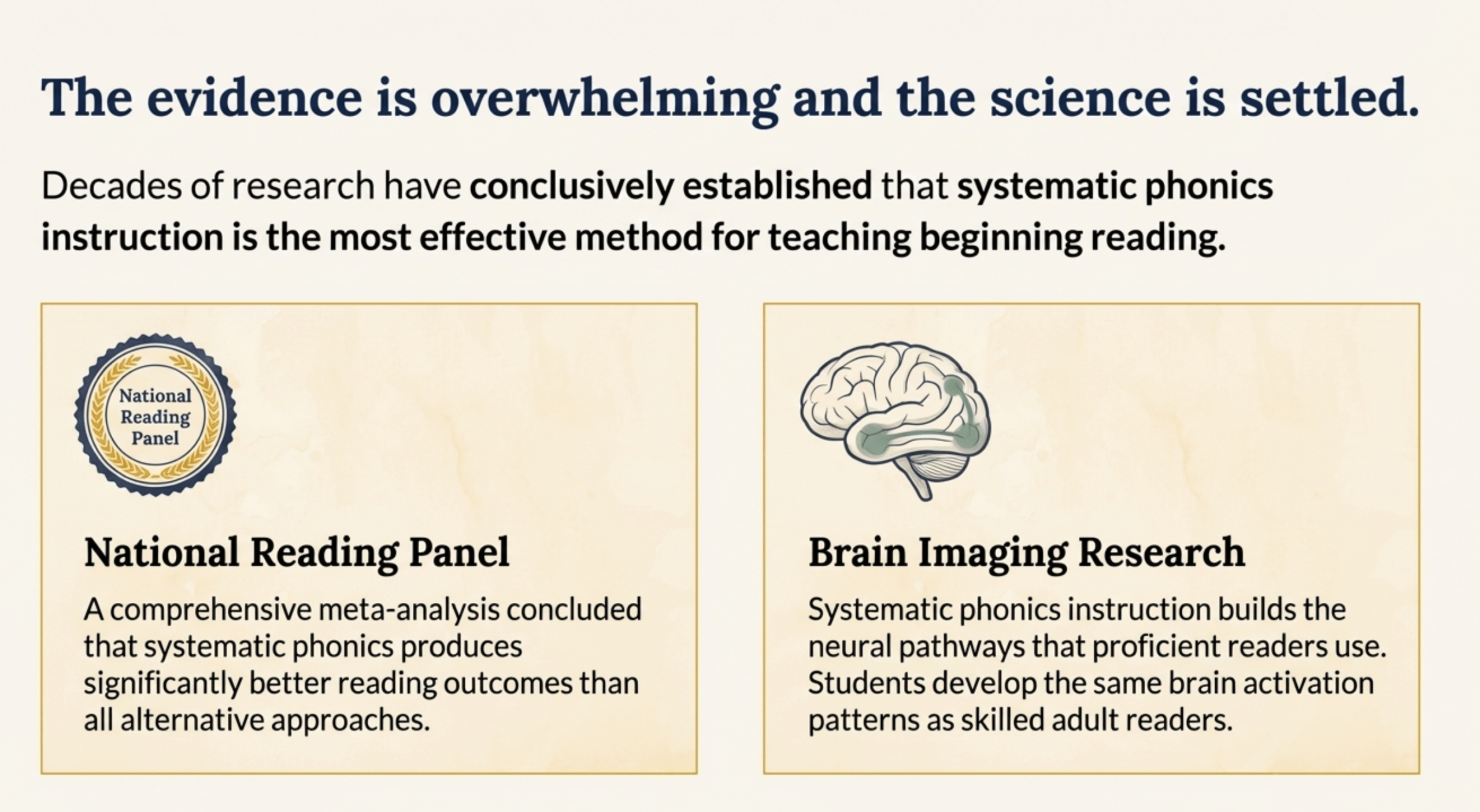
Decades of research—including comprehensive reviews by the National Reading Panel—have conclusively established that systematic phonics instruction is the most effective method for teaching beginning reading.
The evidence is overwhelming:
- Students receiving systematic phonics instruction significantly outperform students taught by other methods
- Phonics benefits all students, especially struggling readers and students at risk for reading failure
- Effects are long-lasting—students maintain advantages through later grades
- Phonics instruction improves both reading and spelling abilities
Brain imaging research shows why: systematic phonics instruction builds the neural pathways that proficient readers use. Students learning through phonics develop the same brain activation patterns as skilled adult readers.
Systematic vs. Incidental Phonics: A Critical Distinction
What “Systematic” Means
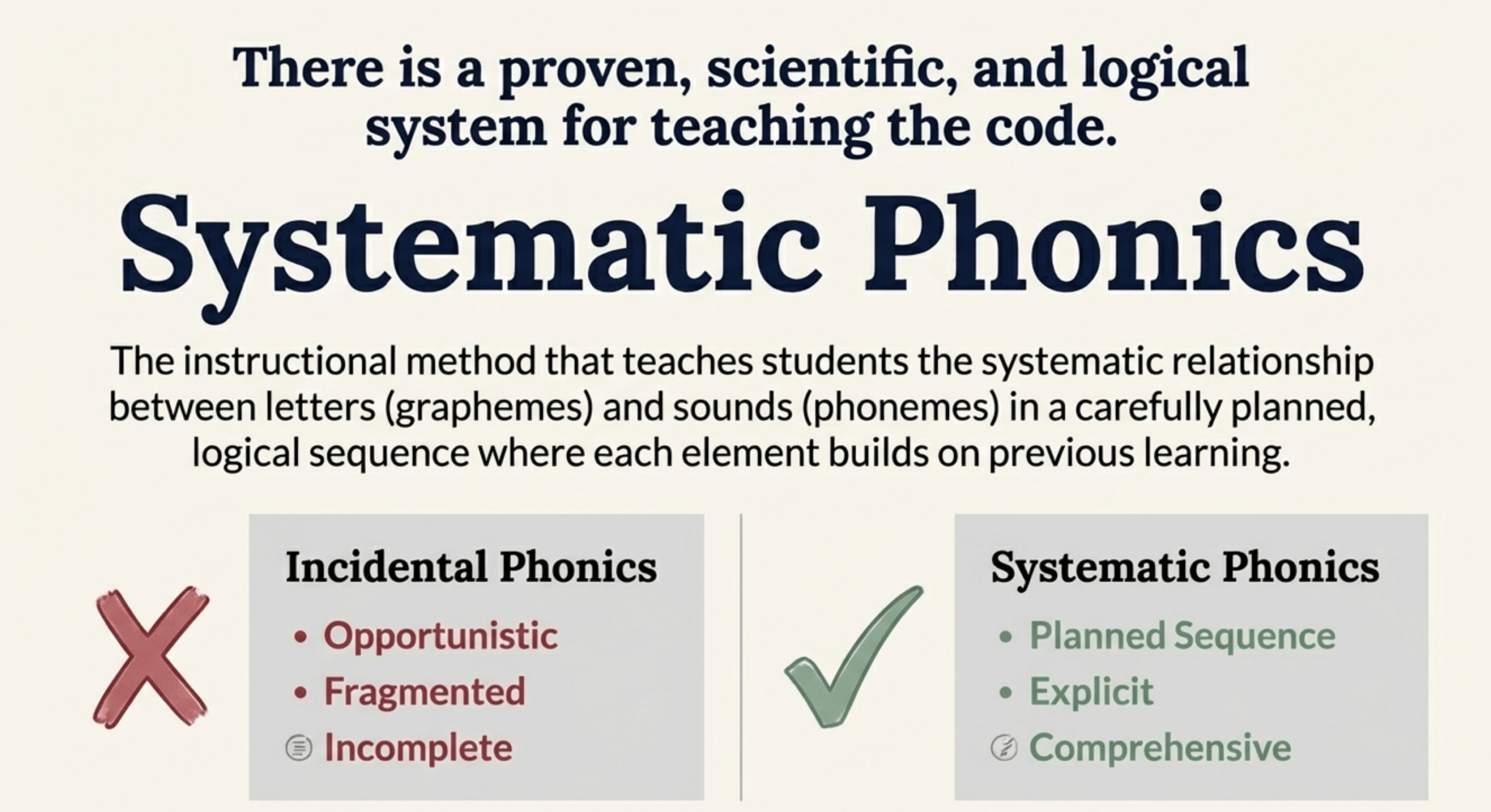
Not all phonics instruction is equally effective. The key word is systematic—phonics must be taught in a carefully planned, logical sequence where each element builds on previous learning.
Systematic phonics instruction:
- Follows a predetermined scope and sequence
- Teaches all major sound-spelling relationships explicitly
- Progresses from simple to complex in logical order
- Provides extensive practice with each new element before advancing
- Reviews previously taught patterns continuously
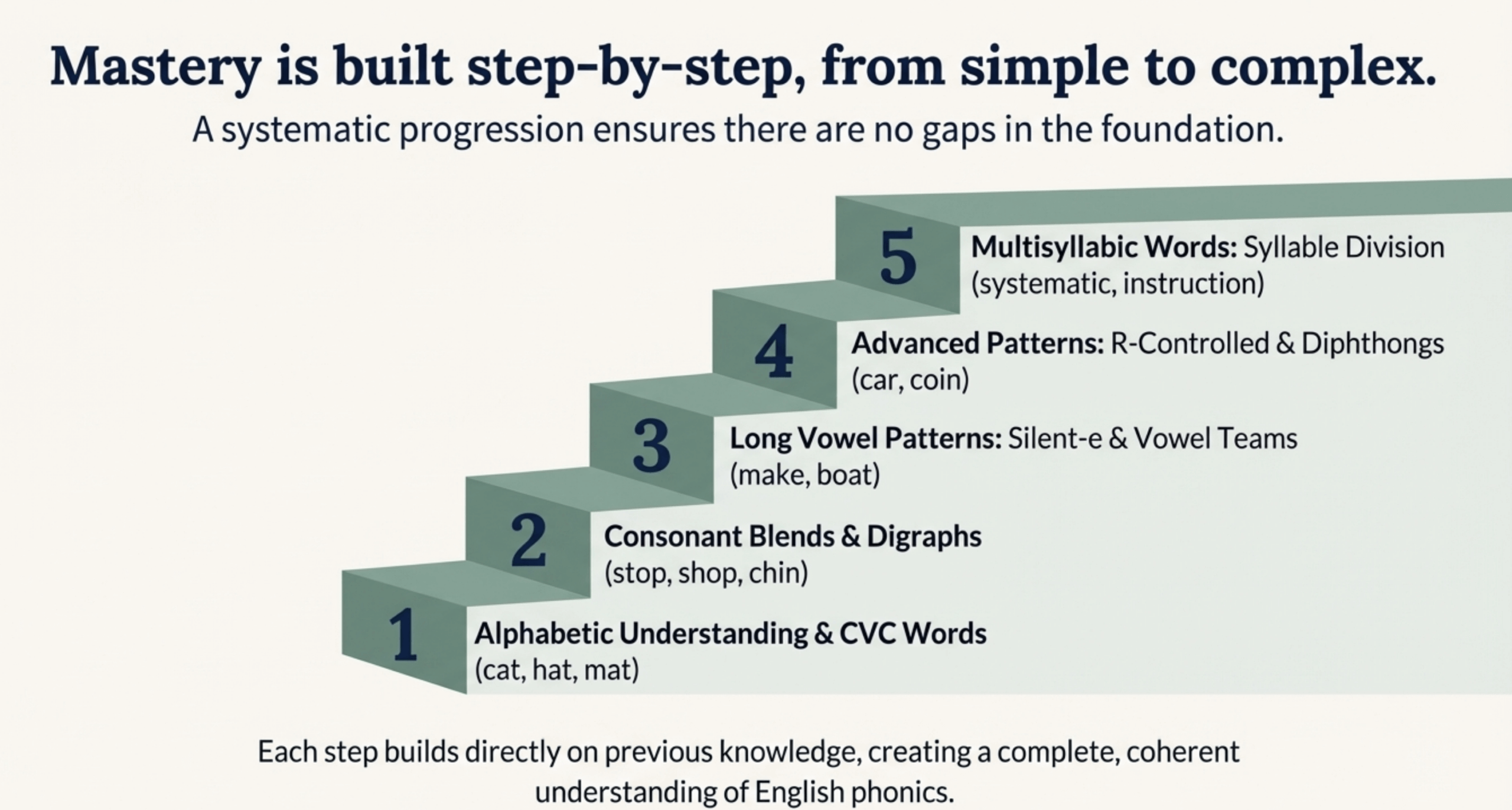
Example systematic progression:
- Consonant sounds (b, c, d, f…)
- Short vowel a
- CVC words with short a (cat, hat, mat)
- Remaining short vowels (e, i, o, u)
- Consonant blends (st, bl, tr)
- Consonant digraphs (sh, ch, th)
- Long vowel patterns (silent-e, vowel teams)
- Advanced patterns (r-controlled, diphthongs)
- Multisyllabic word reading
Each step builds directly on previous knowledge, creating a complete, coherent understanding of English phonics.
What “Incidental” Phonics Looks Like

Some programs claim to teach phonics but do so incidentally—teaching letter sounds opportunistically as they appear in stories or books, without systematic sequence or comprehensive coverage.
Incidental phonics instruction:
- Teaches sounds as they happen to appear in texts
- May skip patterns that don’t appear in selected books
- Provides no systematic progression from simple to complex
- Offers limited practice with each pattern
- Leaves gaps in students’ phonics knowledge
The result: Students learn some letter-sound relationships but have an incomplete, fragmented understanding of the phonetic code. They can read some words but struggle with many others. The system never becomes automatic or complete.
Why Systematic Instruction Is Essential
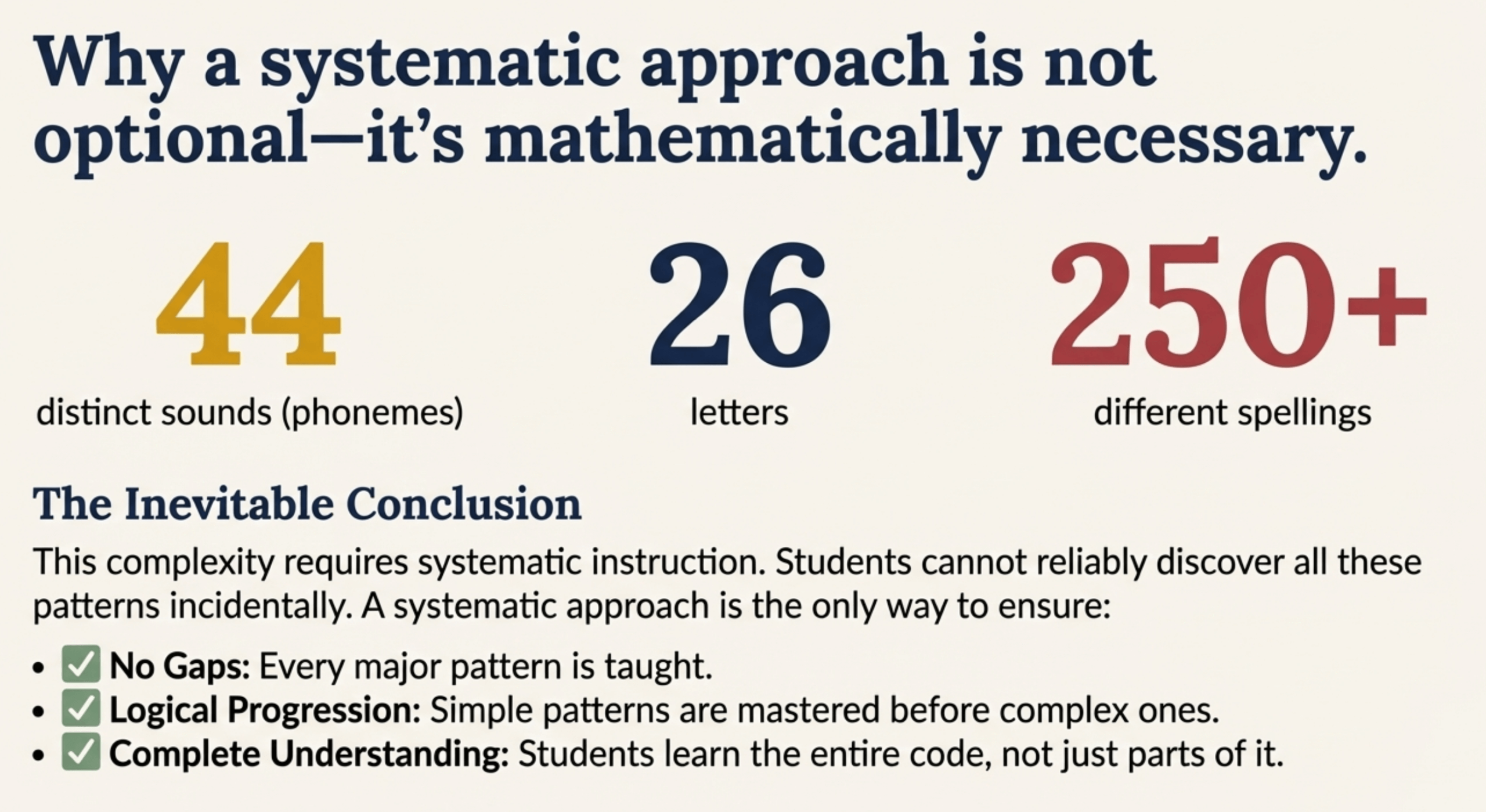
English has approximately 44 distinct sounds represented by 26 letters in various combinations. There are over 250 different ways to spell these 44 sounds. This complexity requires systematic instruction—students cannot reliably discover all these patterns incidentally.
Systematic instruction ensures:
- ✅ No gaps—every major pattern is taught
- ✅ Logical progression—simple patterns before complex
- ✅ Sufficient practice—mastery before advancement
- ✅ Complete understanding—students learn the entire code
The Proper Sequence: Building the Foundation
Stage 1: Alphabetic Understanding
Goal: Students understand that letters represent sounds
Instruction:
- Teach consonant sounds first (more stable than vowels)
- Use key words for memory anchors (b = bus, d = dog)
- Practice isolating sounds in words
- Connect sounds to letter symbols
Evidence of mastery: Student can look at any consonant letter and produce its sound automatically
Stage 2: Simple Word Reading (CVC Words)
Goal: Students can decode simple three-letter words
Instruction:
- Introduce short vowel sounds (a, e, i, o, u)
- Teach blending: /c/ /a/ /t/ → “cat”
- Practice with consonant-vowel-consonant (CVC) words
- Use only words with taught patterns (controlled vocabulary)
Evidence of mastery: Student can decode any CVC word containing taught letters (real or nonsense words)
Stage 3: Blends and Digraphs
Goal: Students read words with consonant combinations
Instruction:
- Introduce consonant blends (two letters, two sounds: st, bl, tr)
- Teach consonant digraphs (two letters, one sound: sh, ch, th)
- Practice blending with these new elements
- Continue using controlled vocabulary
Evidence of mastery: Student reads words like “stop,” “shop,” “chin” accurately
Stage 4: Long Vowel Patterns
Goal: Students understand and apply vowel patterns
Instruction:
- Teach silent-e pattern (make, like, home)
- Introduce vowel teams (ai, oa, ee, ea)
- Teach vowel pattern rules and when they apply
- Compare short and long vowel words (cap vs. cape)
Evidence of mastery: Student correctly reads and spells words with various long vowel patterns
Stage 5: Advanced Patterns
Goal: Students master complex phonetic elements
Instruction:
- R-controlled vowels (ar, er, ir, or, ur)
- Diphthongs (oi, oy, ou, ow)
- Less common patterns (igh, eigh, ough)
- Syllable division rules
- Multisyllabic word strategies
Evidence of mastery: Student can decode complex, multisyllabic words independently
Key Principles of Effective Phonics Instruction
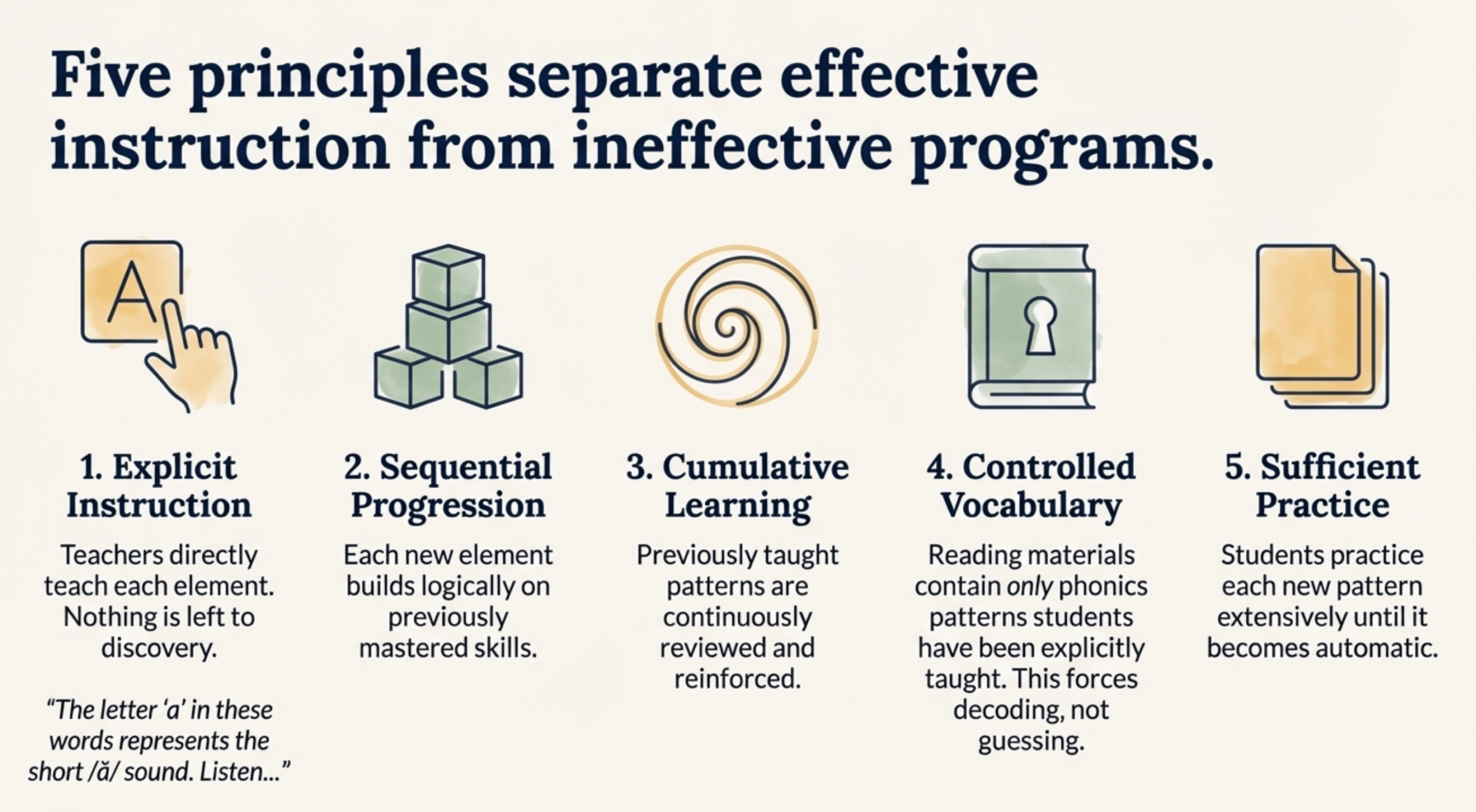
1. Explicit Instruction
What it means: Teachers directly teach each phonics element—nothing is left to discovery or inference
Not explicit: “Look at these words: cat, hat, mat. What do you notice about them?”
Explicit: “The letter ‘a’ in these words represents the short /ă/ sound. Listen: /ă/. Now you say it.”
Explicit instruction ensures all students learn the pattern, not just those who happen to notice it independently.
2. Sequential Progression
What it means: Each new element builds on previously mastered skills
Students must master short vowels before learning long vowels. They must read single-syllable words fluently before tackling multisyllabic words. The sequence is carefully designed to build from simple to complex.
Why it matters: Gaps in foundational knowledge undermine all subsequent learning. Sequential instruction prevents gaps.
3. Cumulative Learning
What it means: Previously taught patterns are continuously reviewed and reinforced
When teaching “oa” words, students also practice previously learned “ai” words. When reading multisyllabic words, students apply all previously learned patterns. Nothing is taught once and abandoned.
Why it matters: Cumulative practice builds automaticity and prevents forgetting. Skills become permanent through continuous use.
4. Controlled Vocabulary
What it means: Reading materials contain only phonics patterns students have been explicitly taught
If students have learned short vowels and consonant blends but haven’t yet learned “ch,” they should not encounter words like “chip” in their reading materials. Every word should be decodable using current knowledge.
Why it matters: Controlled vocabulary ensures students practice phonics, not guessing. They experience success because they have the tools to decode every word.
5. Sufficient Practice
What it means: Students practice each new pattern extensively before moving forward
One lesson on “ai” words is insufficient. Students need to read “ai” words in isolation, in sentences, in stories, and spell them in dictation—dozens or hundreds of times—before the pattern becomes automatic.
Why it matters: Automaticity requires extensive practice. Rushing through patterns creates the illusion of learning but not true mastery.
Why Struggling Readers Need Systematic Phonics
They Missed the Foundation
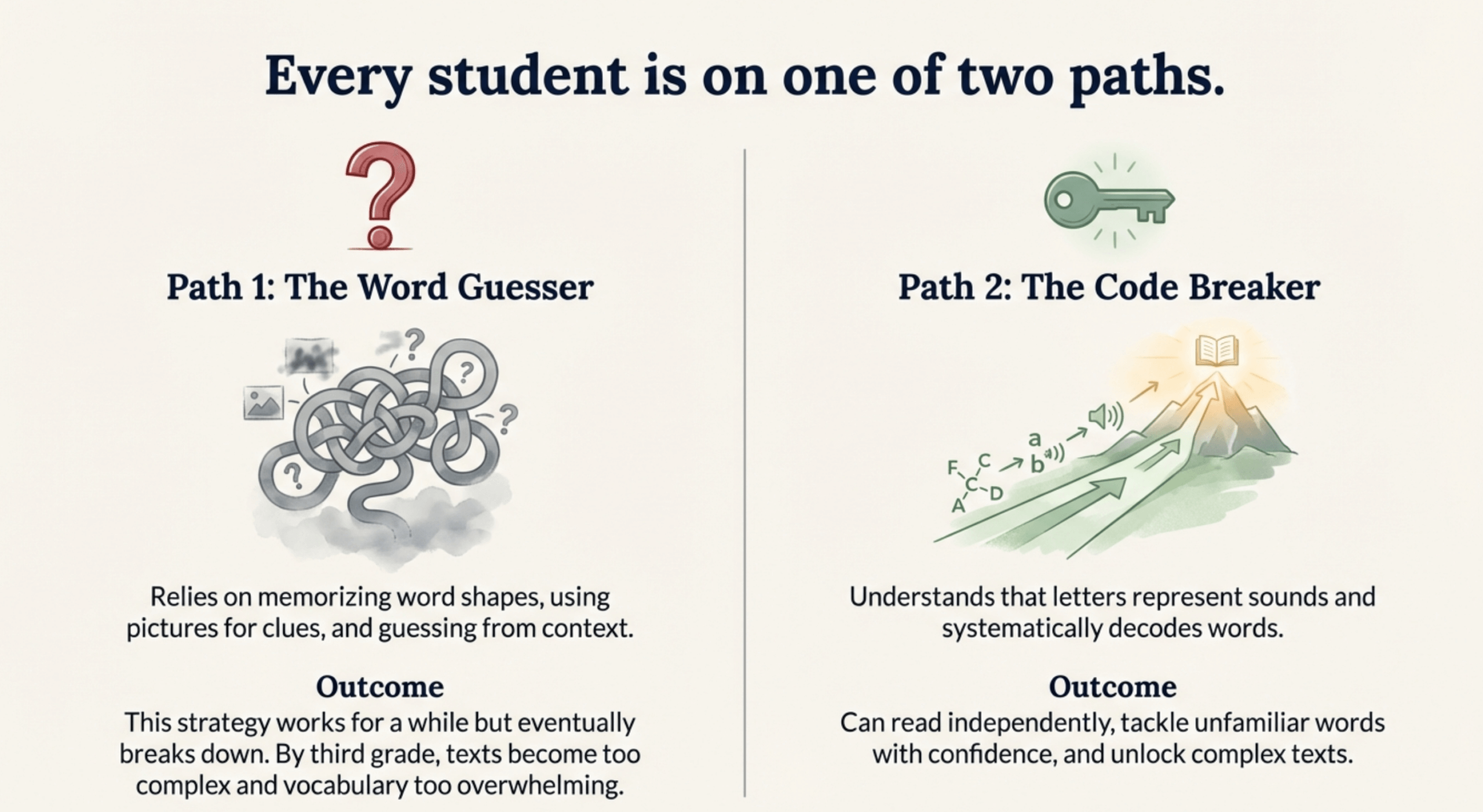
Most struggling readers in grades 3-12 never received systematic phonics instruction in early grades. They were expected to “pick up” reading through exposure to books, or they received incidental phonics that left critical gaps.
These students developed compensatory strategies:
- Memorizing words by sight
- Guessing from context and pictures
- Recognizing first letters and guessing the rest
These strategies work for a while but eventually break down. By third or fourth grade, texts become too complex, vocabulary too advanced, and the number of new words too overwhelming for compensation strategies.
The solution: Go back to the foundation. Teach systematic phonics from the beginning, building the complete code that was never properly learned.
They Need Explicit, Not Incidental Learning
Struggling readers don’t “pick up” phonics patterns incidentally. They need direct, explicit instruction in every pattern. They need to be told—clearly and directly—that “ai” says /ā/, that “ck” comes after short vowels, that syllables divide between consonants.
What works for students who easily learn to read doesn’t work for struggling readers. They need systematic, explicit, comprehensive phonics instruction with extensive practice.
They Have Limited Working Memory
Many struggling readers have processing or working memory challenges. Random, incidental phonics instruction overwhelms them—there’s no organizing structure to support memory.
Systematic instruction provides that structure. When phonics follows a logical sequence, students can organize and retain the information. The system makes sense, which makes it learnable.
Why Older Students Need Age-Appropriate Phonics
They Need the Same Skills, Different Materials
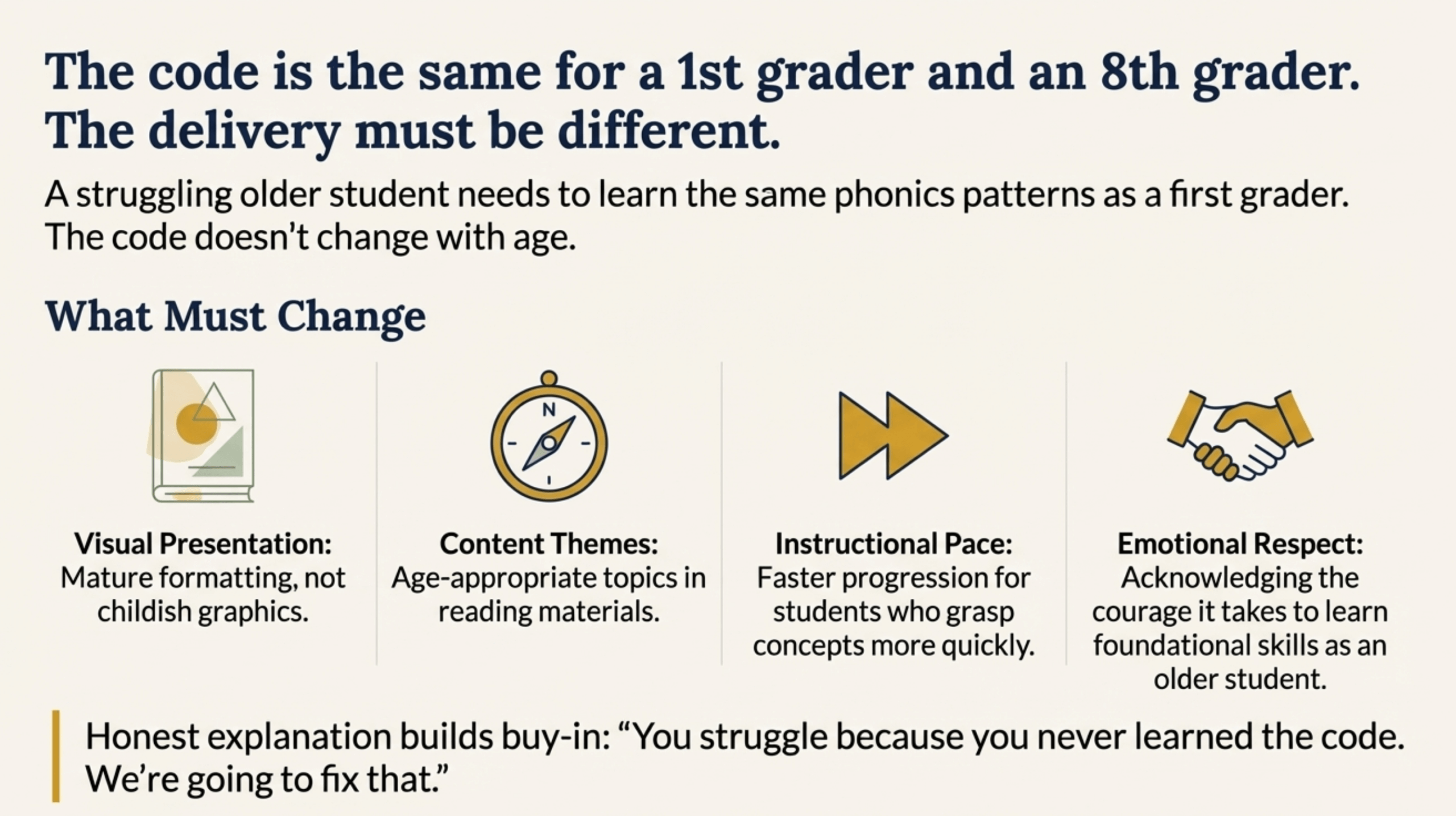
A struggling eighth grader needs to learn the same phonics patterns as a first grader—consonant sounds, short vowels, blends, long vowel patterns. The phonics code doesn’t change with age.
What must change:
- Visual presentation: Mature formatting, not childish graphics
- Content themes: Age-appropriate topics in reading materials
- Instructional pace: Faster progression for older students who learn concepts more quickly
- Emotional respect: Acknowledgment that learning phonics as an older student requires courage
They Benefit From Explicit Explanation
Older students can understand why they’re learning phonics and how it will help them. They appreciate honest explanation:
“You struggle with reading because you never learned how letters and sounds work together systematically. We’re going to fix that. This will take time, but you’ll see improvement quickly.”
This transparency builds buy-in and motivation. Older students work harder when they understand the purpose and see the logic.
The Role of Nonsense Words in Phonics Instruction
Why Nonsense Words Matter
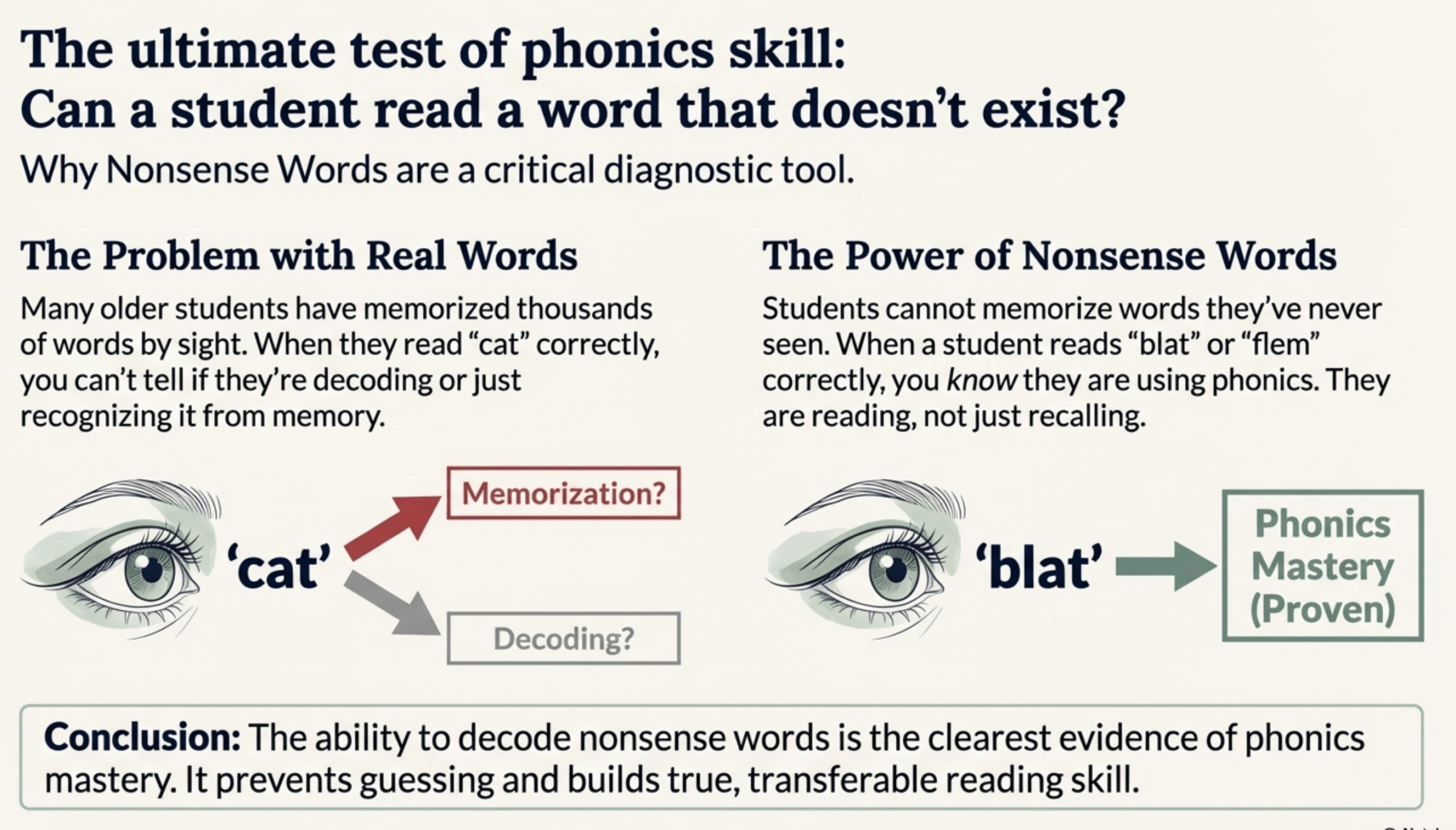
Nonsense words—made-up words following English phonics patterns but having no meaning (like “blat” or “flem”)—are essential in phonics instruction, especially for older students.
The problem with real words only: Many older students have memorized hundreds or thousands of words by sight. When they read “cat” correctly, you can’t tell if they’re decoding it phonetically or recognizing it from memory.
Why nonsense words reveal true phonics knowledge: Students cannot memorize words they’ve never seen. When they read “blat” correctly, you know they’re using phonics—identifying /b/ /l/ /ă/ /t/ and blending those sounds. They’re reading, not recalling.
Nonsense Words Prevent Guessing
When reading real text, students can guess words from context: “The dog ran to the ___.” Even without reading “park,” students might guess it from context and pictures.
Nonsense words eliminate this compensatory strategy. There’s no context, no meaning, no pictures to help. Students must decode every letter using phonics knowledge.
Building True Reading Skill
The ability to decode nonsense words is the clearest evidence of phonics mastery. Students who can read “blist,” “scront,” and “pluft” can read any real English word that follows the patterns they’ve learned.
This transfers directly to real reading. When students encounter an unfamiliar vocabulary word in science or history, they use the same decoding skills practiced with nonsense words.
How Our Program Teaches Systematic Phonics
Complete Scope and Sequence
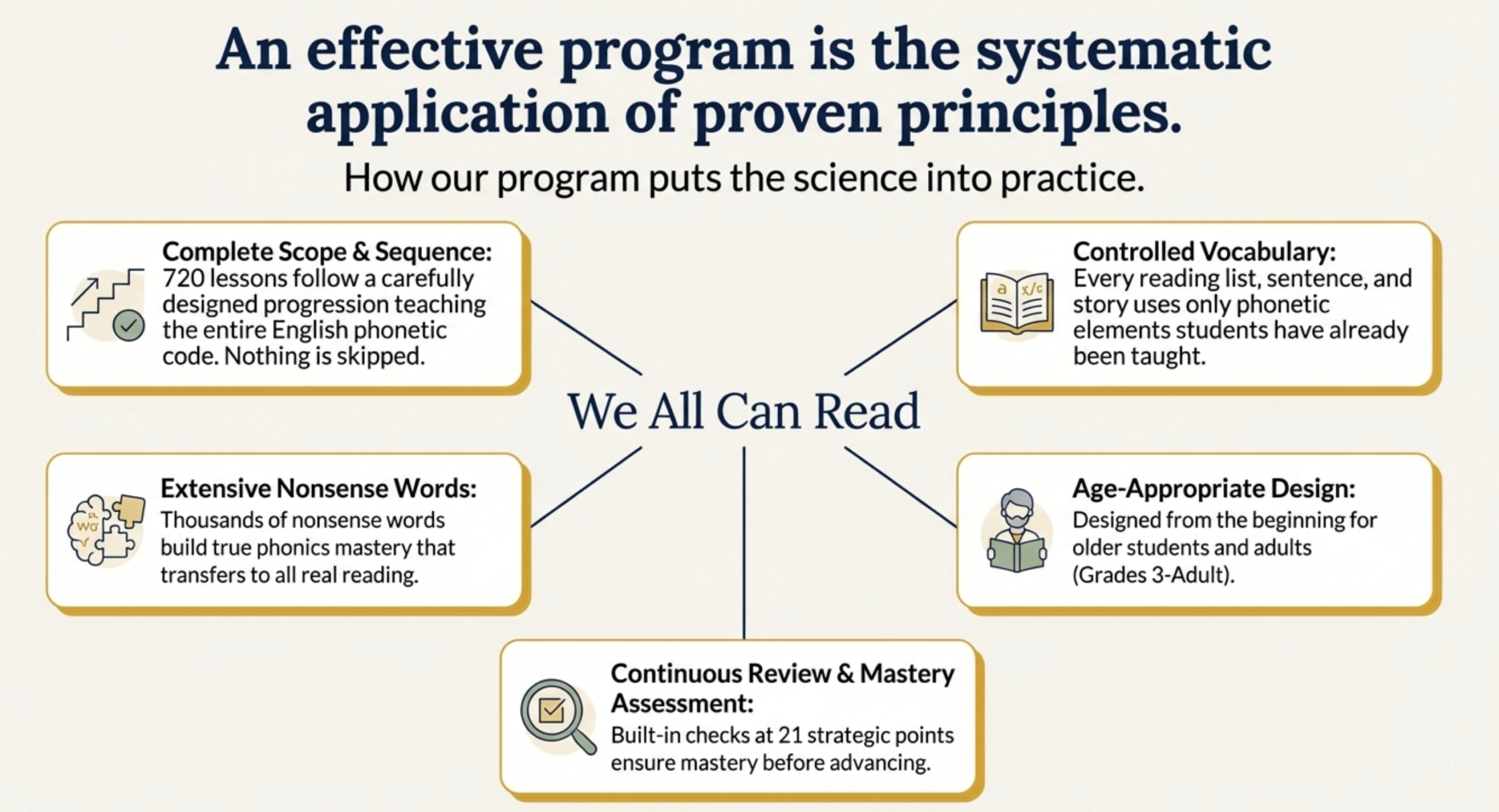
Our 720 lessons follow a carefully designed progression teaching the entire English phonetic code:
Section 1 (Lessons 1-157): Consonants, short vowels, blends, digraphs
Section 2 (Lessons 158-369): Long vowel patterns, vowel teams, syllable patterns
Section 3 (Lessons 370-575): Advanced patterns, syllable division, multisyllabic words
Section 4 (Lessons 576-720): Complete review and consolidation
Every major sound-spelling relationship in English is taught explicitly. Nothing is skipped or left to chance.
Controlled Vocabulary Throughout
Every reading list, sentence, and story uses only phonetic elements students have already been taught. If “igh” hasn’t been introduced, no word contains “igh.” This strict control ensures students decode using phonics, not guessing.
Extensive Use of Nonsense Words
Students read thousands of nonsense words in word lists, sentences, and short stories. This extensive practice builds true phonics mastery that transfers to all real reading.
Integrated Spelling Practice
Half of every lesson consists of spelling dictation using the same phonics patterns taught for reading. This dual practice—reading and spelling the same patterns—creates deep, permanent understanding of the alphabetic code.
Continuous Review and Mastery Assessment
Previously taught patterns are reviewed continuously in subsequent lessons. Built-in mastery checks at 21 strategic points ensure students have truly mastered each level before advancing to more complex material.
Age-Appropriate Design for Grades 3-Adult
Our program was designed from the beginning for older students and adults:
- Professional, mature visual design
- Age-appropriate content themes
- Efficient pacing for older learners
- Respect for students’ intelligence and experience
Students learn foundational skills without being treated like children.
The Evidence: Why Systematic Phonics Works
Research Consensus
The National Reading Panel’s meta-analysis of reading research concluded that systematic phonics instruction produces significantly better reading outcomes than all alternative approaches, including:
- Whole language instruction
- Balanced literacy without systematic phonics
- Literature-based programs
- Incidental phonics
The effects are large, consistent across studies, and long-lasting. This isn’t a close call—the evidence overwhelmingly favors systematic phonics.
Benefits for All Students
Systematic phonics helps:
- Students at risk for reading failure
- Students with dyslexia or learning disabilities
- English language learners
- Students from low-income backgrounds
- Typical students (faster progress, better spelling)
No subgroup is harmed by phonics instruction. All benefit, with the greatest gains seen in students who struggle most.
Real-World Success
Our program has helped thousands of struggling readers—from third graders to adults—finally learn to read. The systematic approach works because it teaches the complete code explicitly, provides extensive practice, and ensures mastery at each step.
Read success stories from our students →
The Alphabet Unlocks Everything
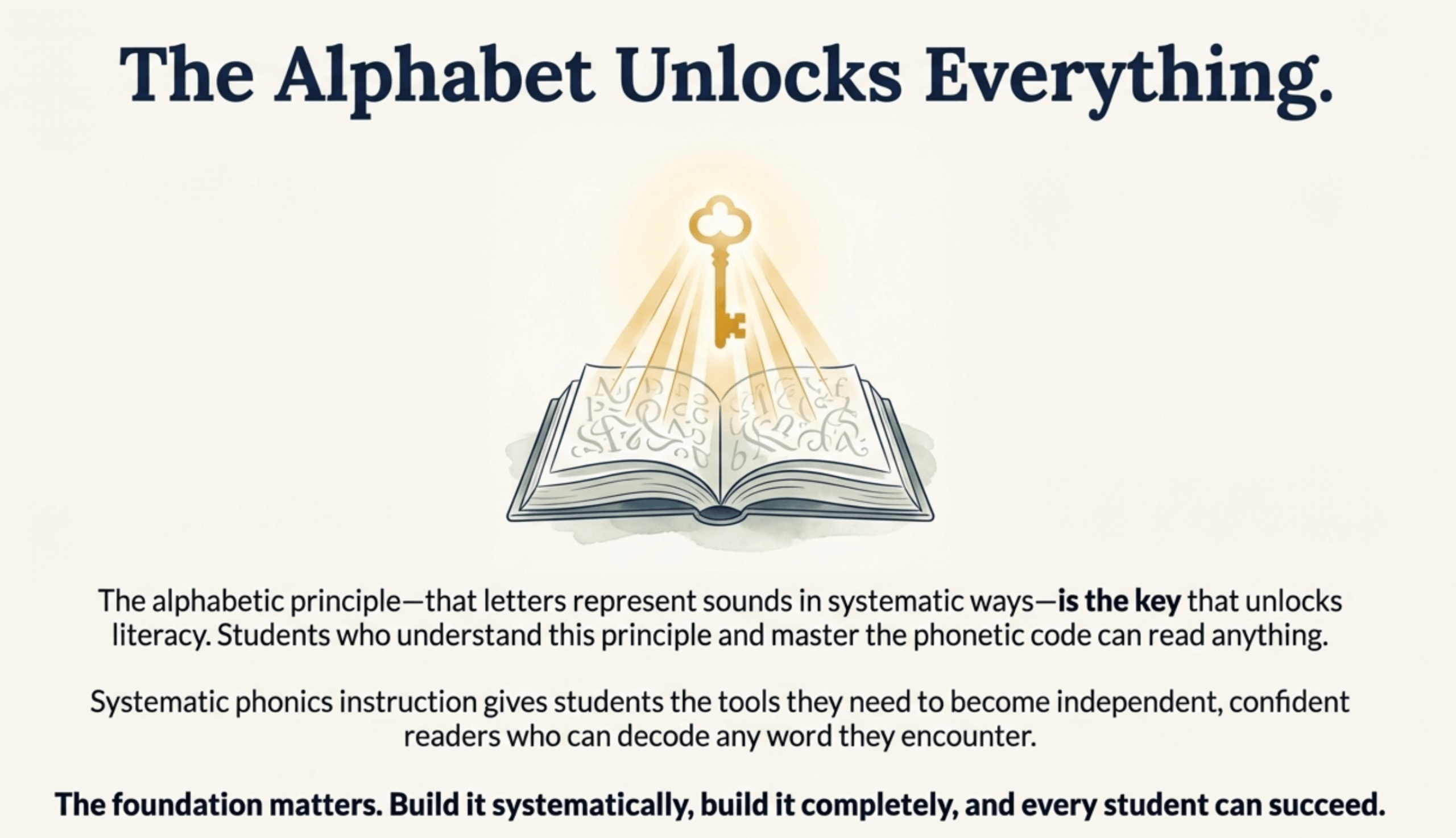
The alphabetic principle—that letters represent sounds in systematic ways—is the key that unlocks literacy. Students who understand this principle and master the phonetic code can read anything.
Systematic phonics instruction teaches this principle explicitly and comprehensively. It gives students the tools they need to become independent, confident readers who can decode any word they encounter.
The foundation matters. Build it systematically, build it completely, and students succeed.
Experience Systematic Phonics Instruction
Our comprehensive program teaches the complete English phonetic code systematically across 720 lessons. Try our first 10 lessons free—no credit card required.
Related topics: Teaching phonemic awareness | Orton-Gillingham methodology | Core spelling instruction
Questions about systematic phonics? Contact us or explore our frequently asked questions.