How to Learn to Read as an Adult: A Complete Guide
If you’re an adult who struggles with reading, you’re carrying a secret that millions of others share. You’ve developed sophisticated strategies to hide your reading difficulties. You avoid situations that require reading aloud. You feel shame about something that wasn’t your fault.
Here’s what you need to know: adults can absolutely learn to read, regardless of age. The reason you struggle isn’t because you lack intelligence or ability. You struggle because you were never properly taught the foundational code that underlies written English. And that code can be learned at any age.
This guide explains how adults actually learn to read, what methods work, and how you can finally master this essential skill. Whether you’re a complete beginner or someone who can read but struggles significantly, there’s a clear path forward.
Why Adults Struggle with Reading: It’s Not Your Fault
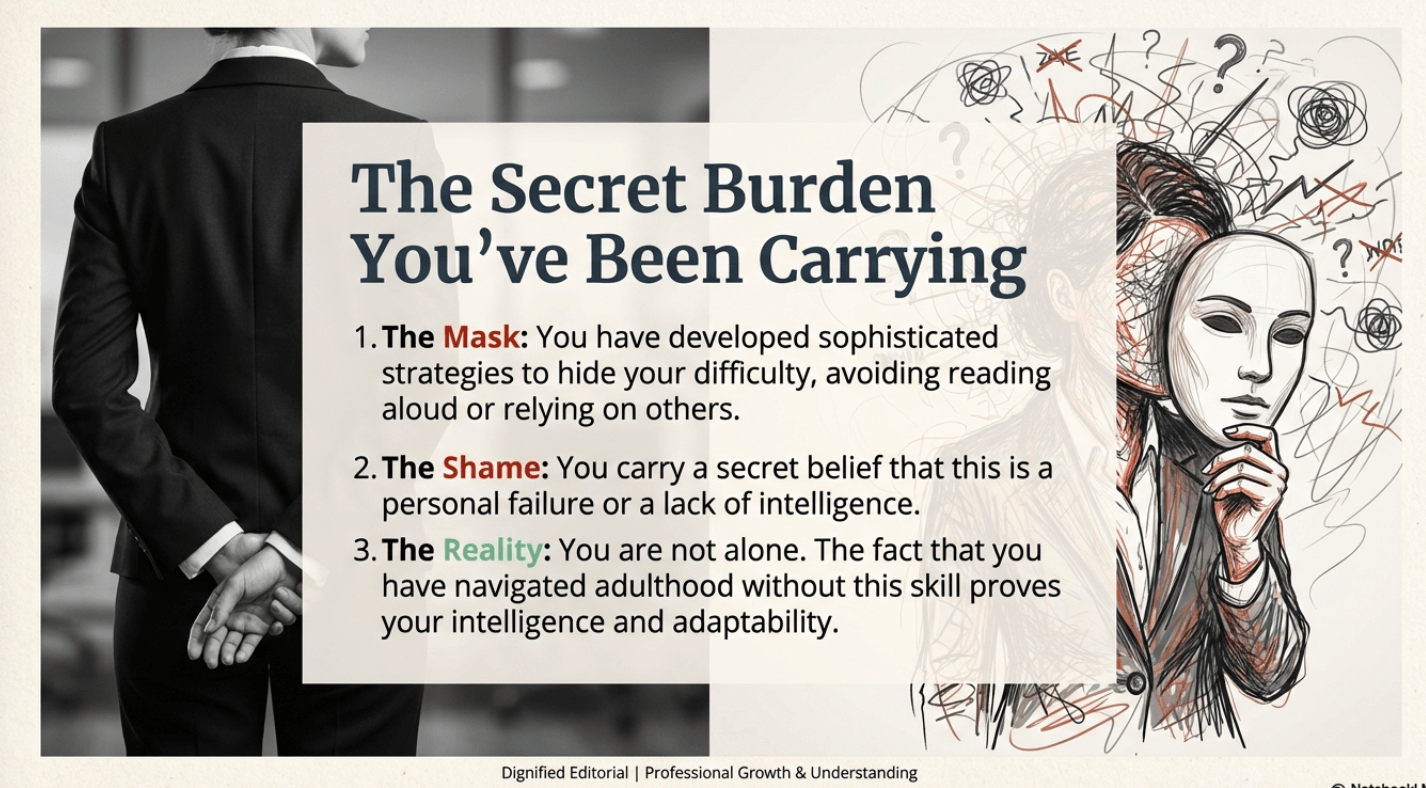
Most adults who struggle with reading were passed along through school despite not understanding how written language actually works. You weren’t failing school—school was failing you.
Here’s what typically happened:
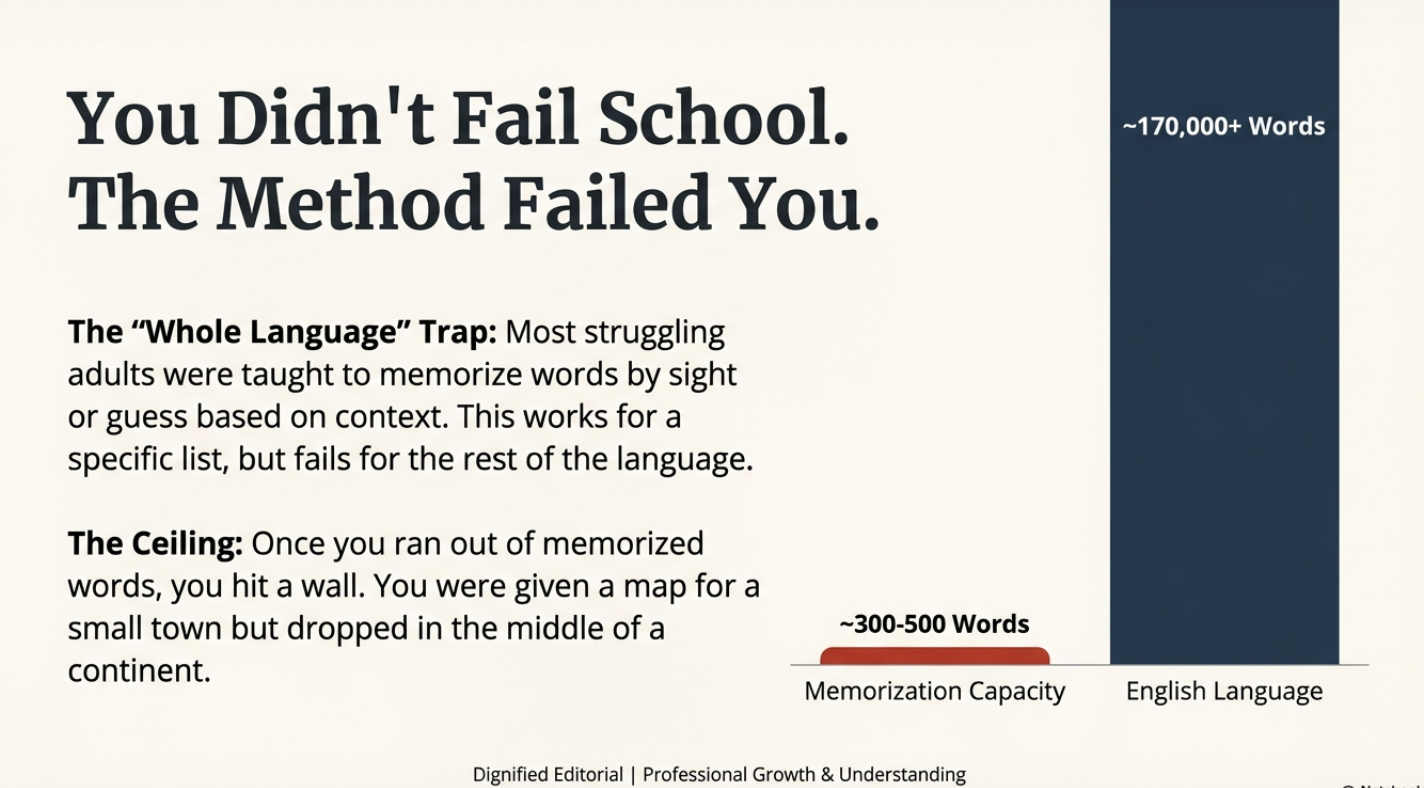
You weren’t taught the code. English is an alphabetic language where letters and letter combinations represent sounds. Learning to read means learning this letter-sound code systematically. Many schools in the past decades relied on “whole language” approaches that expected students to memorize whole words by sight or use context clues to guess at words. These methods work for some students but leave others completely unable to decode unfamiliar words.
You were taught to memorize, not understand. Perhaps you were given lists of “sight words” to memorize without being taught why those words are spelled the way they are. Memorization has severe limits. You can memorize a few hundred words, but English has over 170,000 commonly used words. Without understanding the underlying code, you can’t decode the thousands of words you haven’t memorized.
You developed coping strategies instead of skills. Smart students who don’t understand the reading code become excellent at compensation. You memorized textbook passages. You relied on pictures and context. You had others read to you. These strategies got you through school but didn’t teach you to actually read.
Different teaching methods were tried but didn’t address the root problem. Maybe you received extra help, went to summer school, or worked with tutors. But if they used the same methods that didn’t work the first time, the extra instruction couldn’t solve the problem.
The critical point: The teaching method failed you. You didn’t fail. Your brain is perfectly capable of learning to read—it just needs the right instruction.
How Adults Actually Learn to Read
Adults and children learn to read using the same fundamental process, but adults often learn faster because of their cognitive maturity and motivation.
The Foundation: Systematic Phonics Instruction
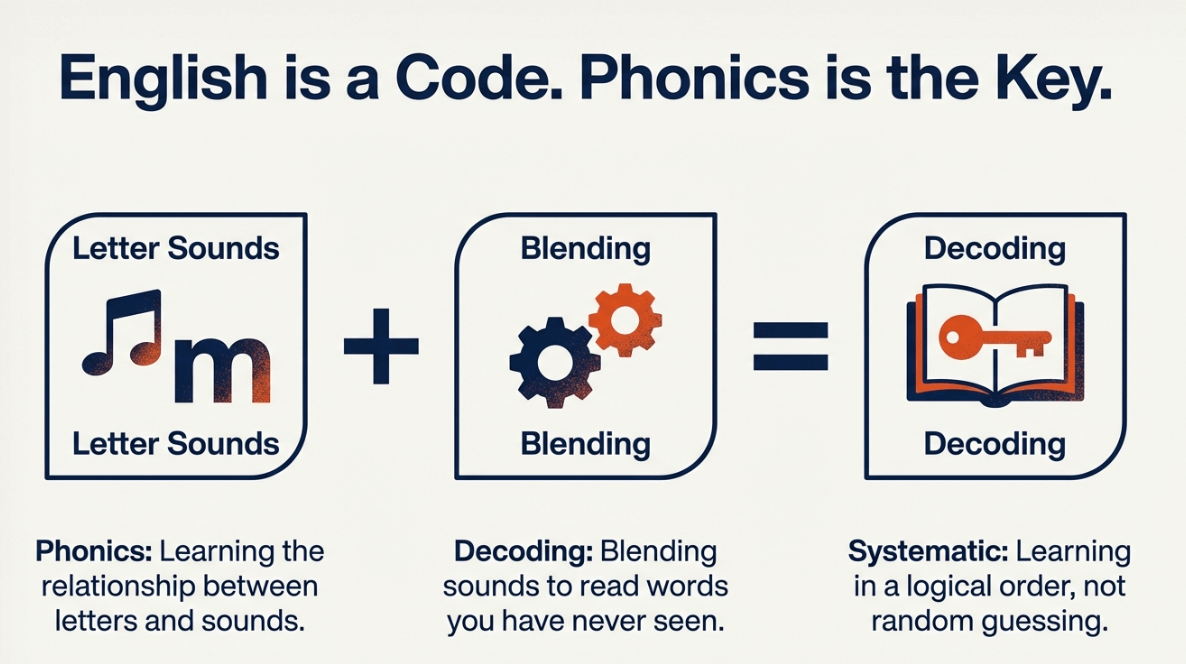
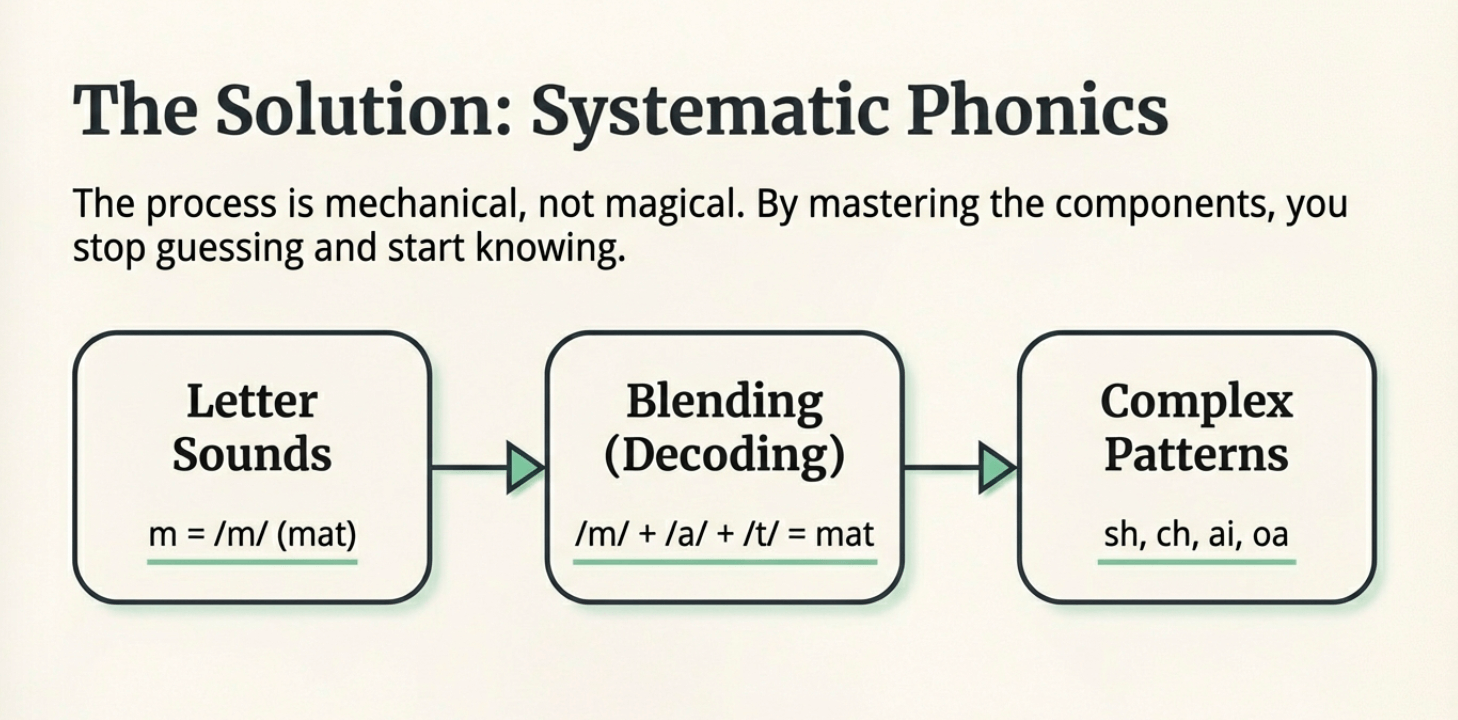
The most effective way for adults to learn to read is through systematic phonics instruction. This means learning the relationship between letters and sounds in a structured, sequential way.
Here’s how it works:
Start with individual letter sounds. Before you can read words, you need to know what sound each letter represents. The letter “m” makes the sound /m/ as in “mat.” The letter “s” makes the sound /s/ as in “sat.” This seems basic, but it’s the foundation everything else builds upon.
Learn to blend sounds together. Once you know individual letter sounds, you learn to blend them. The letters “m-a-t” represent three sounds that blend together to make the word “mat.” This blending skill—called decoding—is what allows you to read words you’ve never seen before.
Progress through increasingly complex patterns. English has patterns beyond single letters. Letter combinations like “sh,” “ch,” “th” represent single sounds. Vowel teams like “ai” and “oa” follow predictable patterns. You learn these systematically, from simple to complex.
Practice with real reading. As you learn each new pattern, you practice reading words, sentences, and eventually stories that use only the patterns you’ve learned so far. This builds confidence and fluency.
Learn spelling alongside reading. The same code that helps you read helps you spell. When you understand why “night” is spelled with “igh,” you can spell hundreds of other words with the same pattern.
The key word is “systematic.” Random phonics instruction doesn’t work well. You need a carefully sequenced program that introduces concepts in logical order, with no gaps.
Why Phonics Works for Adult Brains
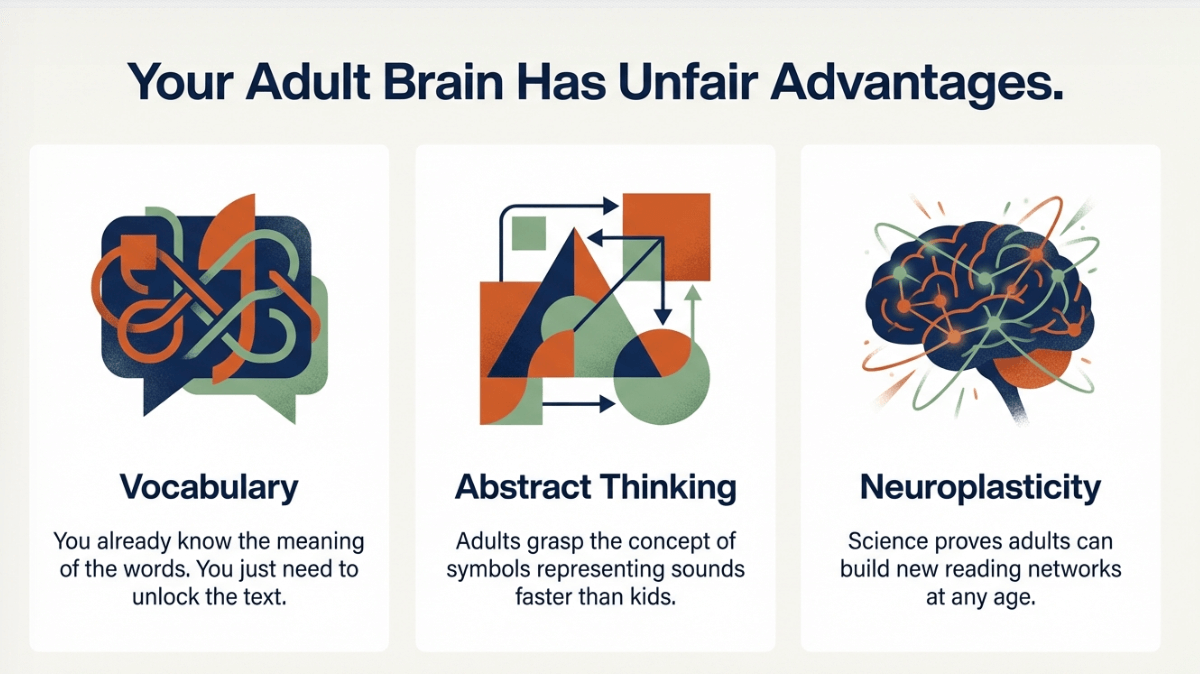
Adult brains are actually well-suited for learning systematic phonics:
You understand abstract concepts. Phonics instruction requires understanding that letters are symbols representing sounds. Adults grasp this abstraction immediately, while young children may struggle with the concept.
You can articulate what you don’t understand. Adults can identify exactly where they’re confused, making targeted instruction more effective.
You have motivation and purpose. Adults learning to read have clear goals—whether for employment, education, helping children, or personal growth. This motivation accelerates learning.
You have existing language knowledge. You already have a rich spoken vocabulary. You’re not learning to read AND learning language simultaneously like children do. You’re simply learning to decode words you already know and use.
You can dedicate focused practice time. Unlike children who are learning multiple subjects, adults can focus intensive effort on reading instruction.
Research shows that adult brains retain neuroplasticity—the ability to form new neural pathways. You can absolutely create the reading networks in your brain that were never properly formed in childhood.
What Makes Adult Reading Instruction Different from Children’s Programs
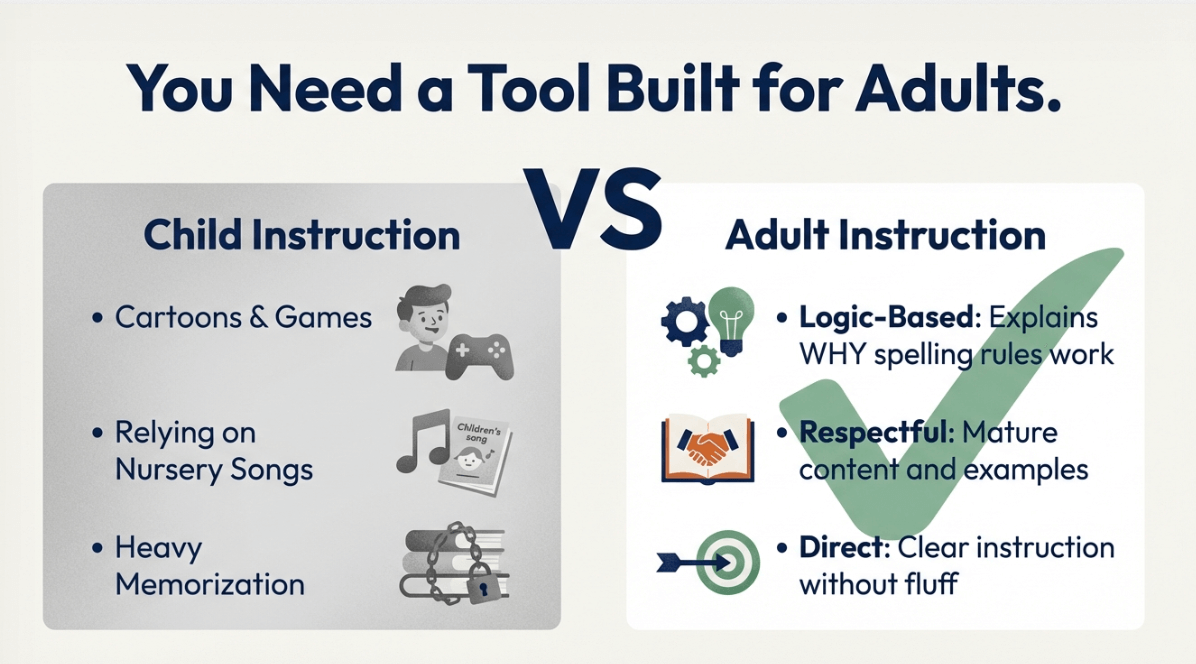
Effective programs for adult learners differ from children’s programs in several critical ways:
Age-appropriate content and examples. Adults need materials that respect their intelligence and life experience. Using children’s books or juvenile examples can feel insulting and creates an emotional barrier to learning. Quality adult programs use mature examples and content from the first lesson.
Self-paced, flexible learning. Adults have jobs, families, and responsibilities. Instruction needs to fit around your schedule, not the other way around. Self-paced online programs allow you to study at 6 AM before work, during lunch breaks, or late at night—whatever works for your life.
Addressing emotional barriers. Adult learners often carry shame, embarrassment, and fear around reading difficulties. Effective instruction acknowledges these feelings while creating a judgment-free environment. Learning in the privacy of your home can eliminate the anxiety of classroom settings.
Clear, direct teaching. Adults don’t need games, songs, or cartoon characters. They need clear, straightforward instruction that explains exactly what they’re learning and why. The best adult programs get straight to the point.
Building confidence alongside skills. Adults need to experience success quickly to overcome years of academic failure. Programs should be structured so you succeed consistently while gradually tackling more complex material.
Understanding the ‘why’ behind spelling. Adults want to understand why English spelling works the way it does. Quality instruction explains the logic behind spelling patterns, not just memorizing exceptions.
Choosing the Right Adult Reading Program
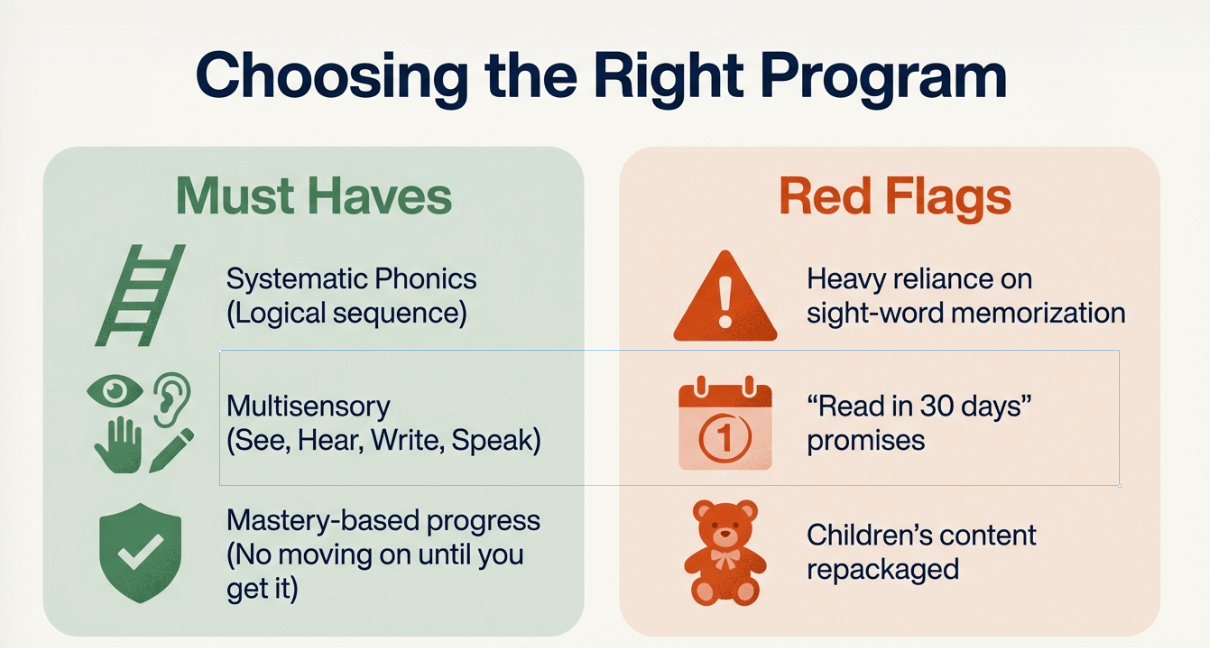
Not all reading programs work equally well for adults. Here’s what to look for:
Essential Features in an Effective Program
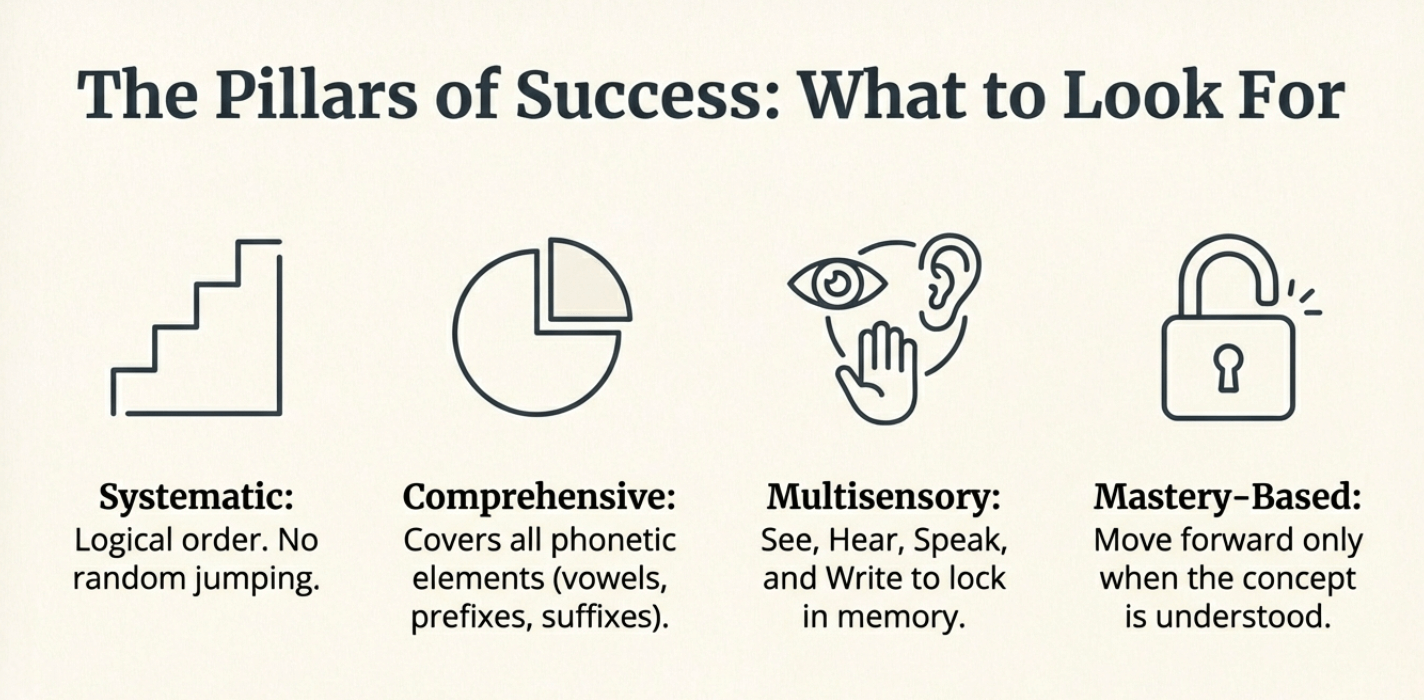
Systematic phonics as the foundation. The program should teach the complete phonetic code of English in a logical, sequential order. Avoid programs that rely heavily on sight word memorization or encourage guessing words from context.
Comprehensive coverage. You need instruction in all the phonetic elements of English, not just basic phonics. This includes vowel teams, syllable patterns, prefixes and suffixes, and spelling rules. Incomplete programs leave gaps in your knowledge.
Multisensory instruction. Learning should engage multiple senses—seeing the letters, hearing the sounds, speaking them aloud, and writing them. This multisensory approach strengthens memory and understanding.
Extensive practice opportunities. You can’t learn to read just by watching videos or listening to explanations. You need to actually practice reading words, sentences, and passages using what you’ve learned.
Mastery-based progression. You should demonstrate understanding before moving to new material. Programs with built-in quizzes or assessments ensure you’re truly learning, not just moving through lessons.
Age-appropriate materials from day one. Check sample lessons. Are the examples and reading materials suitable for adults? Or are they thinly disguised children’s materials?
Red Flags to Avoid
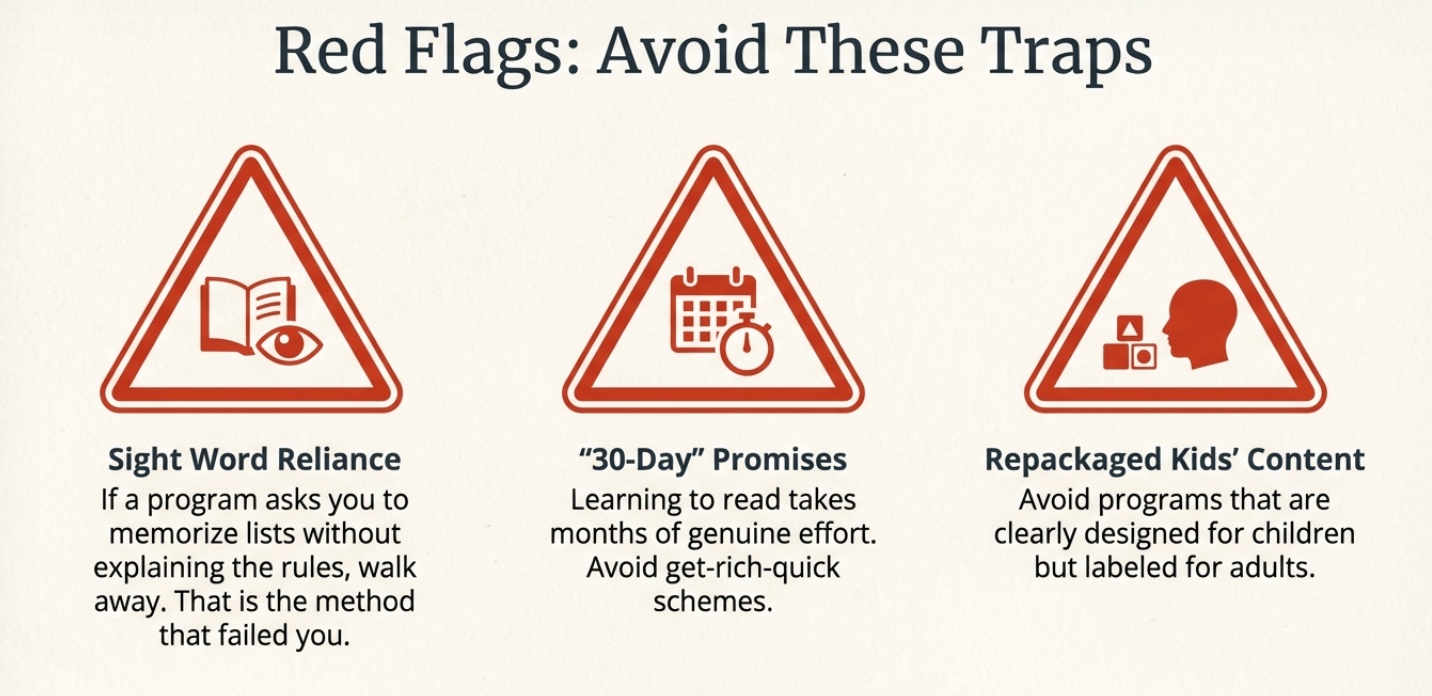
Heavy reliance on sight word memorization. If a program emphasizes memorizing long lists of words without teaching you how to decode them, it’s using the method that likely failed you in childhood.
Incomplete phonics instruction. Some programs teach only basic phonics, leaving you unable to read complex words. You need comprehensive instruction covering all English phonetic patterns.
Children’s content repackaged for adults. Many “adult” programs are simply children’s materials with grown-up labeling. This shows a fundamental misunderstanding of adult learning needs.
No structured sequence. Random phonics lessons or activities without clear progression won’t build the systematic understanding you need.
Promises of extremely rapid results. Learning to read as an adult takes genuine time and effort. Programs promising you’ll “read in 30 days” are typically overpromising. Realistic programs acknowledge this is a skill that develops over months of practice.
Questions to Ask Before Investing
Before committing to any program, consider:
- Does this teach systematic phonics or rely on memorization?
- Is the content truly age-appropriate for adults?
- Can I learn at my own pace on my own schedule?
- What’s the total time commitment and cost?
- Are there testimonials from adult learners like me?
- Can I try before buying to see if the teaching style works for me?
For a detailed comparison of different approaches and programs, including cost breakdowns, see our Adult Phonics Cost Comparison Guide.
Your Step-by-Step Path Forward
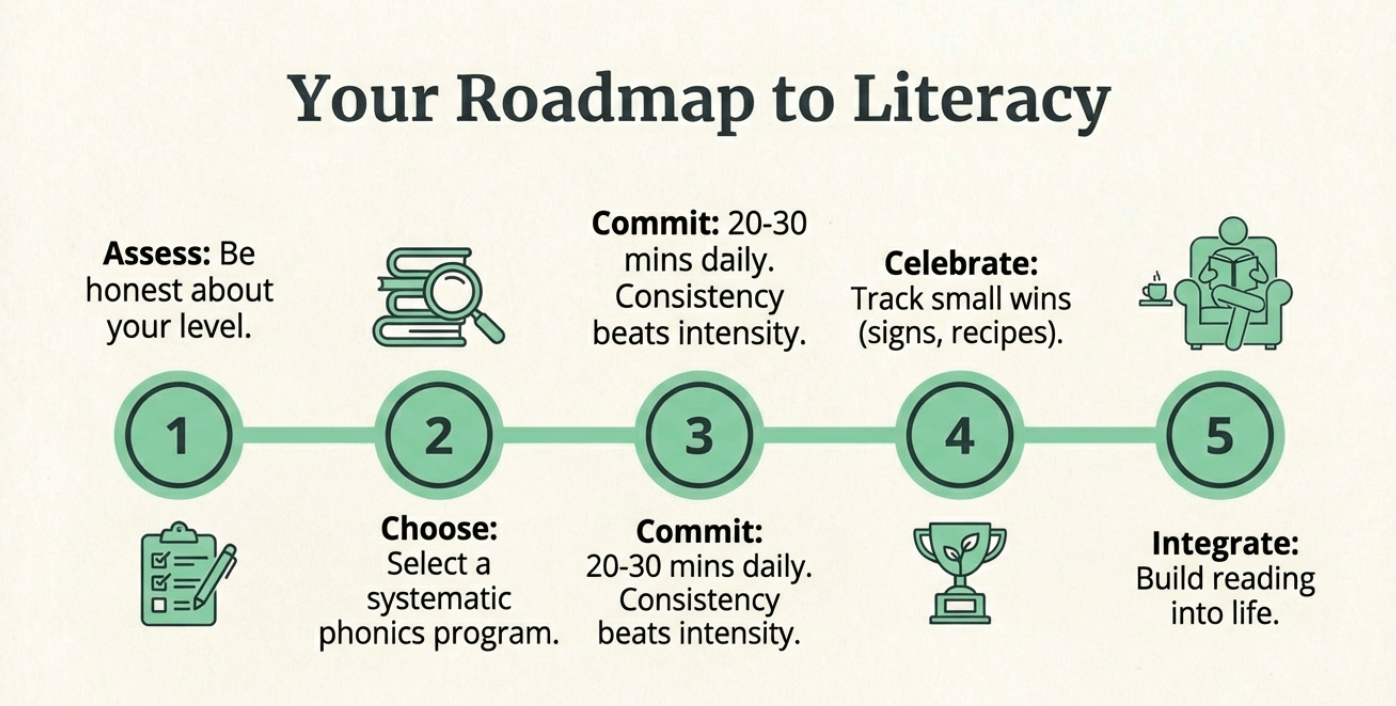
If you’re ready to learn to read, here’s a realistic roadmap:
Step 1: Assess Where You Are Now
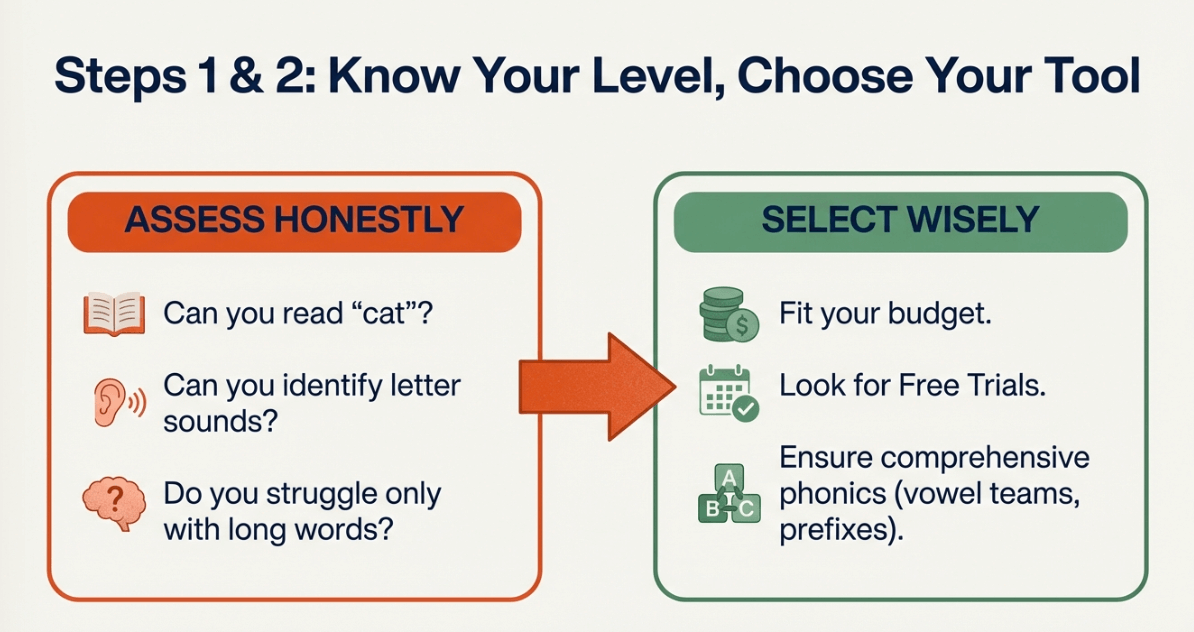
Be honest about your current reading level:
- Can you identify all 26 letters and their basic sounds?
- Can you read simple three-letter words like “cat” and “dog”?
- Do you struggle primarily with longer words?
- Can you read somewhat but spell very poorly?
Understanding your starting point helps you choose appropriate instruction and set realistic goals.
Step 2: Choose a Systematic Phonics Program
Based on the criteria above, select a program that:
- Teaches comprehensive systematic phonics
- Uses age-appropriate content
- Fits your schedule and learning style
- Falls within your budget
Consider starting with programs that offer free trial lessons so you can experience the teaching style before committing financially.
Step 3: Commit to Regular Practice
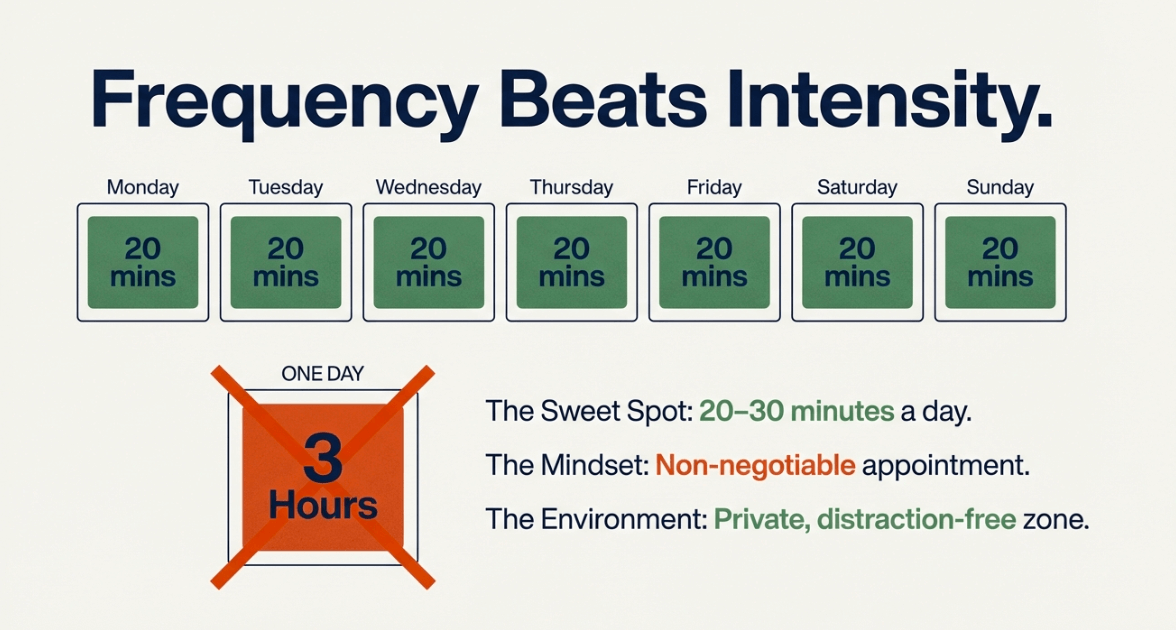
Consistency matters more than intensity. Daily practice of 20-30 minutes works better than occasional marathon sessions.
Set a sustainable schedule:
- Choose a specific time each day
- Create a dedicated study space free from distractions
- Treat study time as a non-negotiable appointment with yourself
Most adults see noticeable progress within the first month of consistent daily practice.
Step 4: Celebrate Progress and Stay Motivated
Learning to read as an adult requires persistence through challenges:
- Acknowledge small victories—reading a new word type, completing a lesson, finishing a paragraph
- Keep a journal of progress to see how far you’ve come
- Remember that difficulty with new concepts is normal and temporary
- Connect your reading practice to your personal goals
If you’re learning to read for employment, start reading job postings. If you’re doing it to help your children, practice with their school forms. Connecting practice to real-world goals reinforces motivation.
Step 5: Build Reading into Daily Life
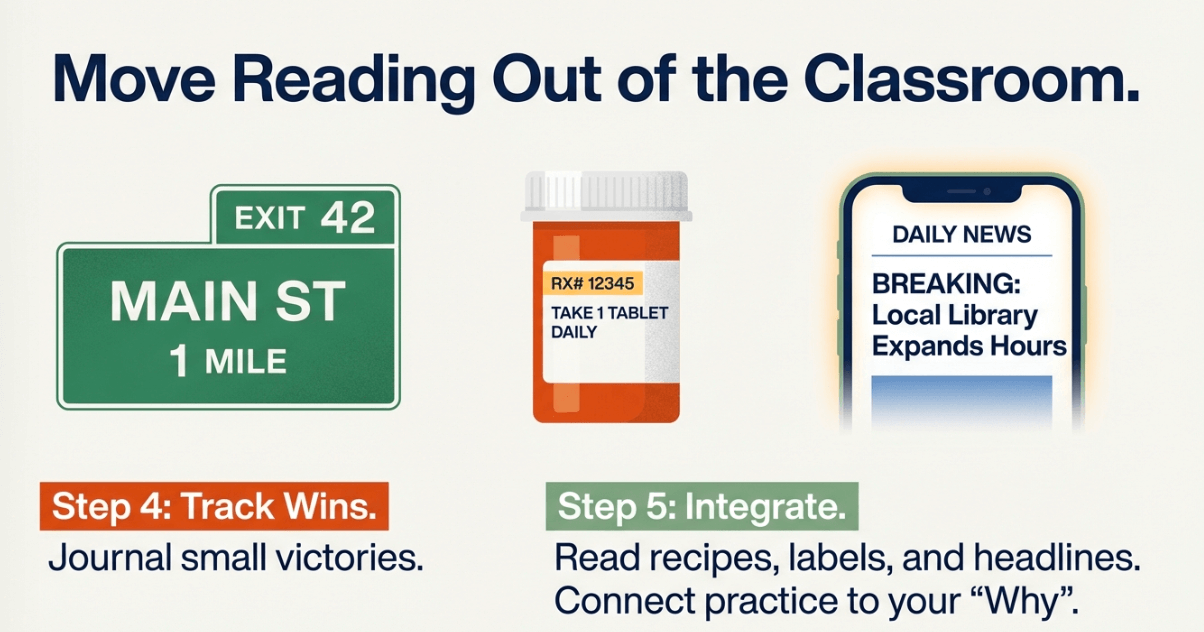
As skills develop, incorporate more reading into everyday activities:
- Read recipes while cooking
- Read street signs and store names when driving
- Read product labels at the grocery store
- Read text messages and emails
- Read news headlines on your phone
Real-world reading practice builds both skill and confidence. You’re not just learning to read—you’re becoming a reader.
Realistic Timeline Expectations
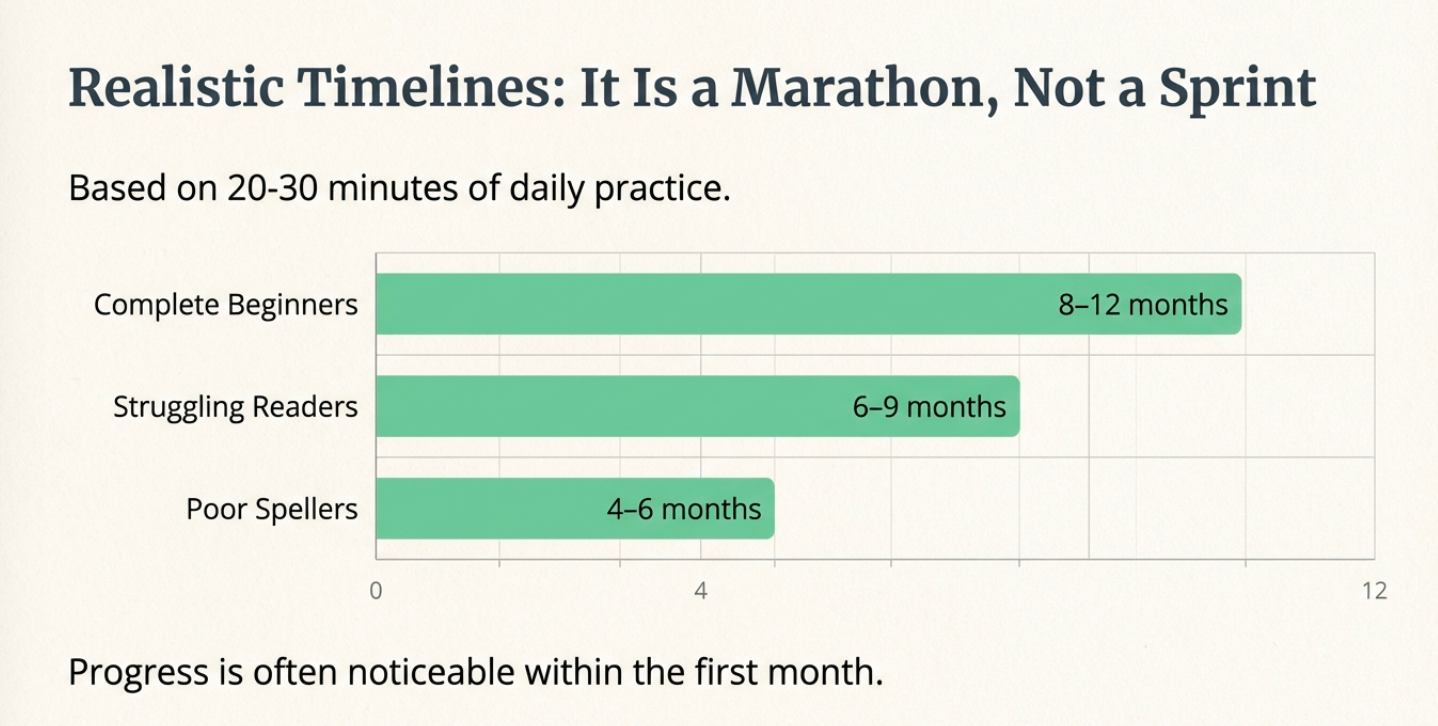
How long does it take? It depends on your starting point and study consistency:
- Complete beginners: 8-12 months of daily practice to achieve functional reading ability
- Struggling readers with some skills: 6-9 months to significantly improve
- Poor spellers who can read somewhat: 4-6 months to master spelling patterns
These timeframes assume 20-30 minutes of daily focused practice. More intensive practice can accelerate progress.
For a detailed breakdown of learning timelines and what to expect at each stage, see How Long Does It Take Adults to Learn Phonics?
Real Stories from Adults Who Learned to Read
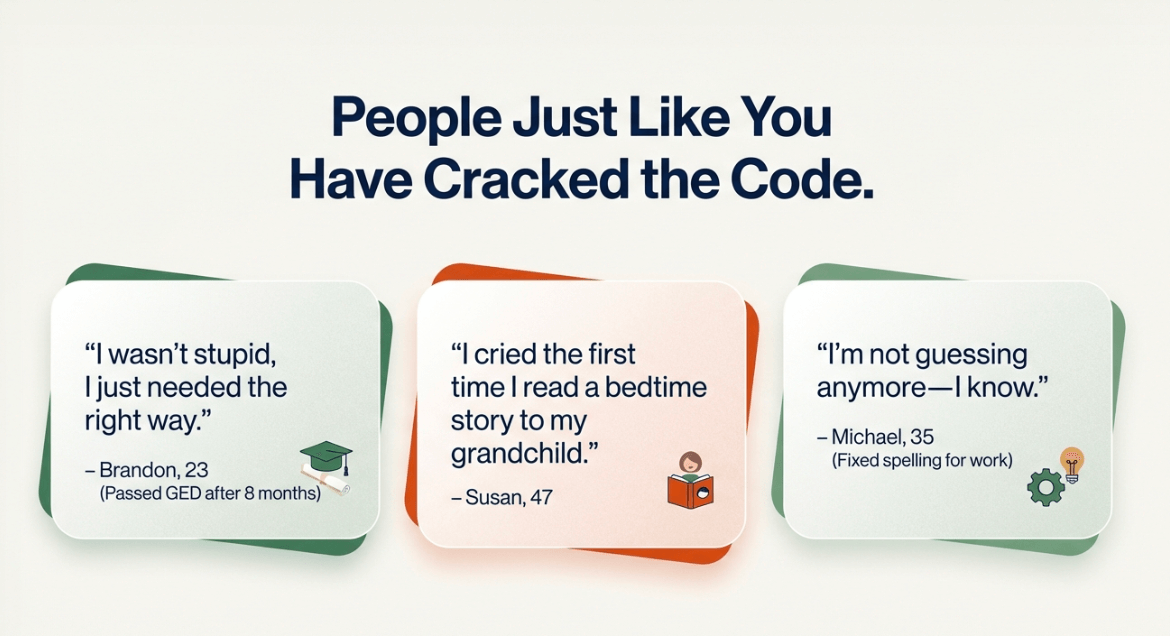
You’re not alone on this journey. Thousands of adults have successfully learned to read:
Brandon, age 23, struggled through school barely able to read. After eight months of systematic phonics instruction, he passed his GED and enrolled in community college. He later wrote: “I can’t believe I spent my whole life thinking I was stupid. I just needed someone to teach me the right way.”
Susan, age 47, hid her reading difficulties for decades. She relied on her husband to read everything from mail to medicine bottles. Through dedicated daily practice, she progressed from reading at a second-grade level to reading novels independently. “I cried the first time I read a bedtime story to my grandchild,” she shared.
Michael, age 35, could read slowly but couldn’t spell. Poor spelling held him back professionally. After completing a comprehensive phonics program, his spelling improved dramatically. He wrote: “Understanding why words are spelled the way they are changed everything. I’m not guessing anymore—I know.”
These aren’t exceptional cases. They’re typical results when adults receive proper systematic phonics instruction. The common thread: They all needed the same foundational instruction they missed in childhood, presented in an age-appropriate way that respected their adult status.
Read more detailed success stories from adult learners at different ages and starting points: Adult Phonics Success Stories
Special Considerations for Different Adult Learners
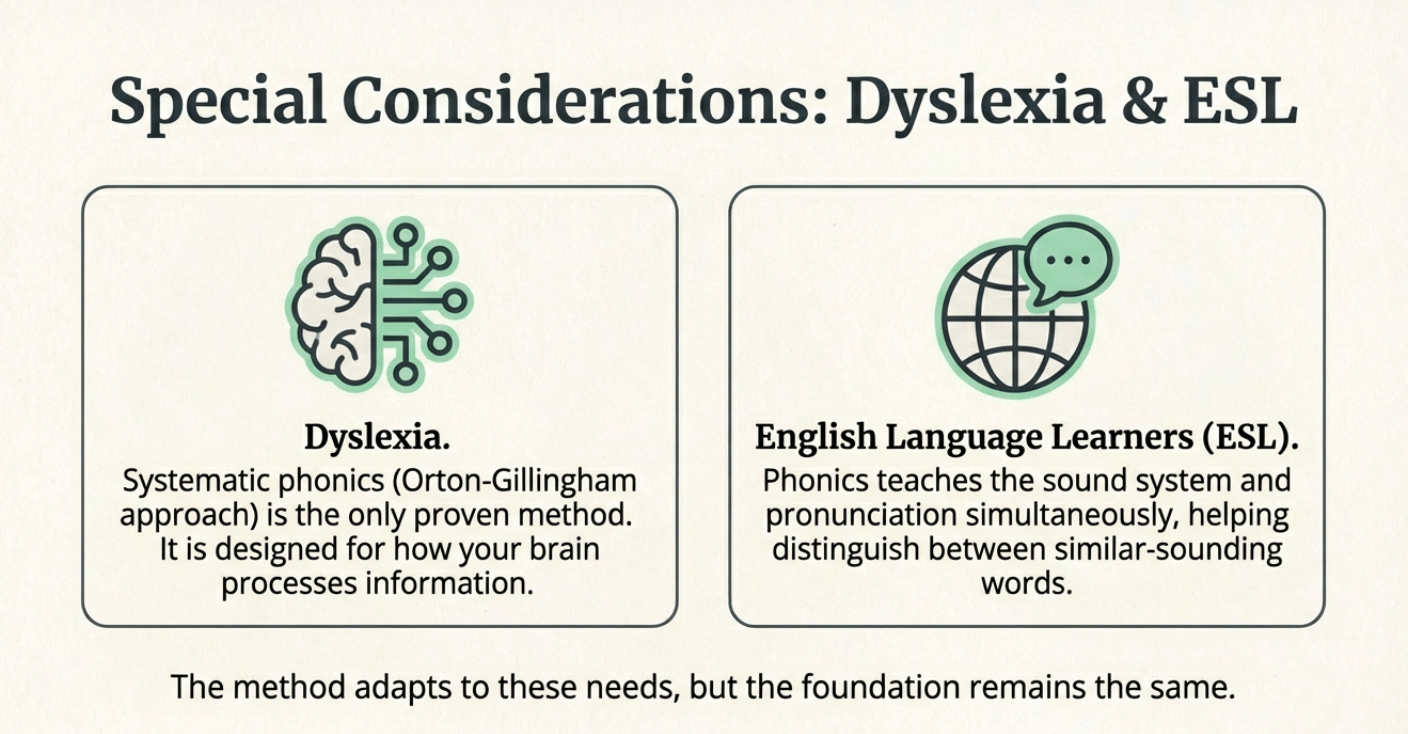
While the systematic phonics approach works for all adults, some groups have specific considerations:
Adults with Dyslexia or Learning Disabilities
If you have dyslexia or suspect you might, systematic phonics instruction is especially important. Research consistently shows that people with dyslexia learn to read most effectively through structured, multisensory phonics instruction following the Orton-Gillingham approach.
The key differences:
- You may need more repetition and practice
- Multisensory methods (seeing, hearing, speaking, writing simultaneously) are crucial
- A slower, more thorough pace often yields better long-term results
- Understanding that dyslexia is neurological, not a reflection of intelligence
For comprehensive information: Can Adults with Dyslexia Learn to Read?
Adults Concerned About Age
If you’re worried that you’re too old to learn to read, you’re not alone. Many adults in their 40s, 50s, 60s, 70s, and beyond have this concern. The good news: age is not a barrier—in fact, older adults often have advantages when learning to read.
For detailed information about learning at different ages: Learning to Read at 30, 40, 50, 60, 70+
English Language Learners
If English is your second language, you’re learning both English pronunciation and reading simultaneously. The phonics approach works well because it explicitly teaches the sound system of English.
Advantages for ESL learners:
- Systematic phonics improves pronunciation alongside reading
- You learn spelling patterns that help with both reading and writing
- Understanding phonics helps distinguish between similar-sounding English words
Adults Preparing for GED or Job Advancement
If you need to improve reading for specific goals:
- Focus programs toward your particular needs
- Practice reading materials related to your goals (GED practice tests, workplace documents)
- Connect reading instruction to immediate practical applications
- Set milestone goals (pass practice test, read work manual independently)
It’s Never Too Late: Overcoming Age Concerns
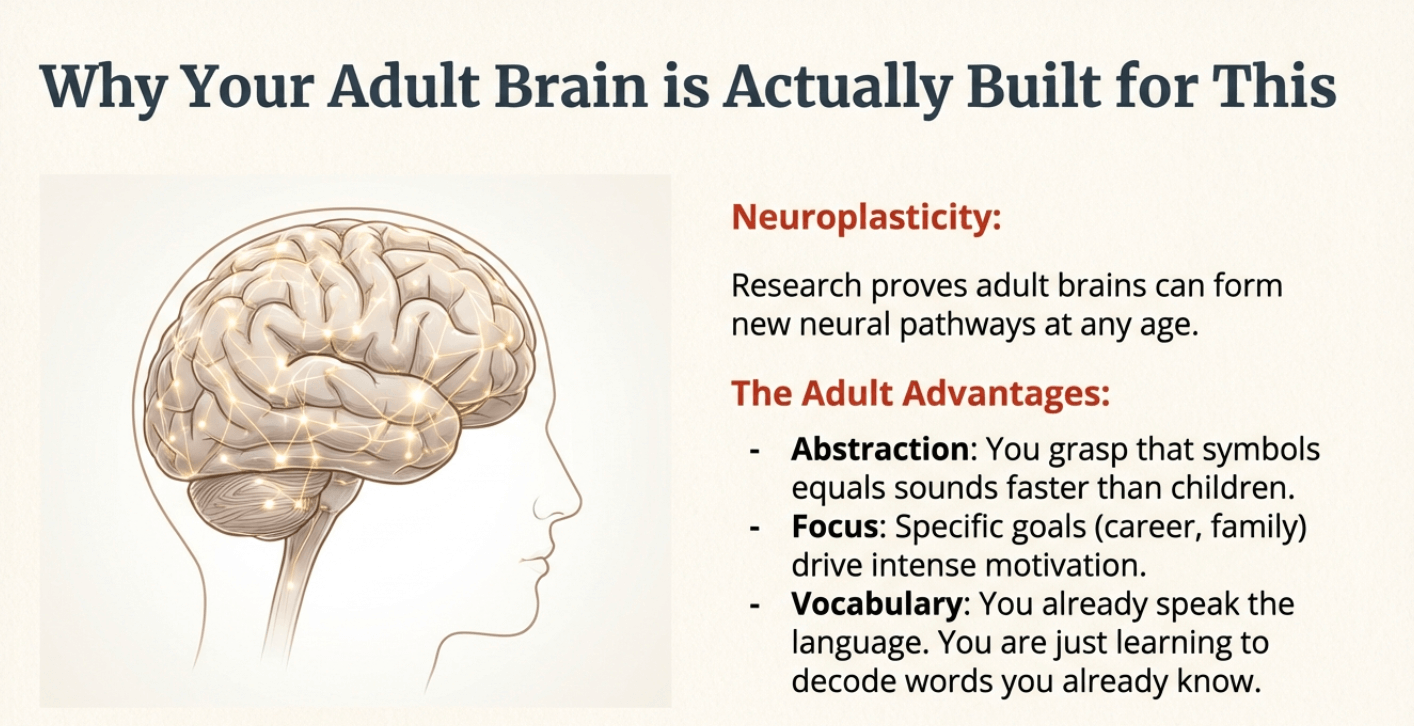
A common worry: “Am I too old to learn to read?”
The answer is definitively no. Adult brains retain the ability to learn new skills throughout life. Brain imaging studies show that adults who learn to read develop the same neural reading networks that fluent readers have—just later in life.
In fact, adults often have advantages over children:
- Greater motivation and focus
- Better understanding of abstract concepts
- Ability to articulate specific difficulties
- More developed problem-solving skills
- Life experience that aids comprehension
People in their 30s, 40s, 50s, 60s, and beyond have successfully learned to read. The key is finding the right instruction and maintaining consistent practice.
Age is not the barrier—having the right teaching method is what matters.
Taking the First Step
The hardest part of learning to read as an adult is often just getting started. You’ve carried shame and frustration for years. Taking the first step requires courage.
But consider this: Every day you wait is another day of limitation. Another day of depending on others. Another day of avoiding situations because they might require reading.
You deserve to read independently. You deserve to help your children with homework. You deserve to advance in your career. You deserve to read for pleasure.
The path is clear:
- Acknowledge that your reading struggles weren’t your fault
- Understand that systematic phonics instruction is how adults learn to read
- Choose an appropriate program with age-appropriate content
- Commit to consistent daily practice
- Connect with others who have succeeded on this same journey
Reading is a skill, not an innate talent. Skills can be learned at any age with proper instruction and practice.
Next Steps: Getting Started Today
Ready to begin? Here are immediate actions you can take:
Try free lessons. Many systematic phonics programs offer free introductory lessons. This lets you experience the teaching method and see if it fits your learning style without financial commitment. Start with 10 free lessons
Research your options. Compare different adult reading programs based on methodology, cost, and format. Our Adult Phonics Cost Comparison Guide provides detailed analysis.
Talk to someone who succeeded. Reading success stories from adults who started where you are now can provide motivation and practical insights. Read adult learner testimonials
Commit to starting this week. Don’t wait for the “perfect time.” There’s no perfect time. Choose a start date within the next seven days and protect that commitment.
Learning to read as an adult is one of the most empowering actions you can take. The journey requires effort, but thousands of adults prove every year that it’s absolutely achievable.
You can learn to read. The question is: when will you start?
Frequently Asked Questions
How long does it really take an adult to learn to read?
With consistent daily practice (20-30 minutes), most complete beginners achieve functional reading ability in 8-12 months. Adults who can read somewhat but struggle significantly typically see major improvement in 4-6 months. The timeline depends on your starting level and practice consistency.
Can I learn to read on my own, or do I need a tutor?
Many adults successfully learn to read using well-designed self-paced online programs. The key is choosing a program with systematic phonics instruction, clear video teaching, and structured practice. While one-on-one tutoring can be effective, it’s not necessary if you have access to comprehensive online instruction.
What if I’ve tried to learn before and failed?
Previous failure almost always reflects ineffective teaching methods, not your ability to learn. If you were taught using sight word memorization or whole language approaches, those methods simply don’t work for many adults. Systematic phonics instruction is fundamentally different and has much higher success rates.
Is there a difference between learning to read and learning phonics?
Phonics is the method—the system of understanding how letters represent sounds. Learning to read is the goal. Systematic phonics instruction is the most effective method for achieving the goal of reading independently.
Will learning to read help my spelling too?
Absolutely. Systematic phonics teaches you the code that underlies both reading and spelling. As you learn why words are spelled the way they are, your spelling naturally improves alongside your reading. Many programs include explicit spelling practice as part of the curriculum.
What about reading comprehension?
Reading comprehension requires two things: decoding skills (being able to read the words) and language comprehension (understanding what the words mean). Since you already have strong spoken language skills, once you master decoding through phonics instruction, comprehension typically follows naturally.
How much does it cost to learn to read as an adult?
Costs vary widely. Private tutoring can cost $6,000-$28,000 for a complete program. Quality online phonics programs typically range from $73-$200/month. Some community literacy programs offer free services, though they may have waitlists. The key is finding effective instruction that fits your budget.
Can I learn to read if I have dyslexia?
Yes. People with dyslexia can absolutely learn to read, though they typically need more intensive systematic phonics instruction. The Orton-Gillingham approach to phonics was specifically designed for dyslexic learners and has decades of research supporting its effectiveness.
Related Resources: