Controlled Text in Reading is Essential
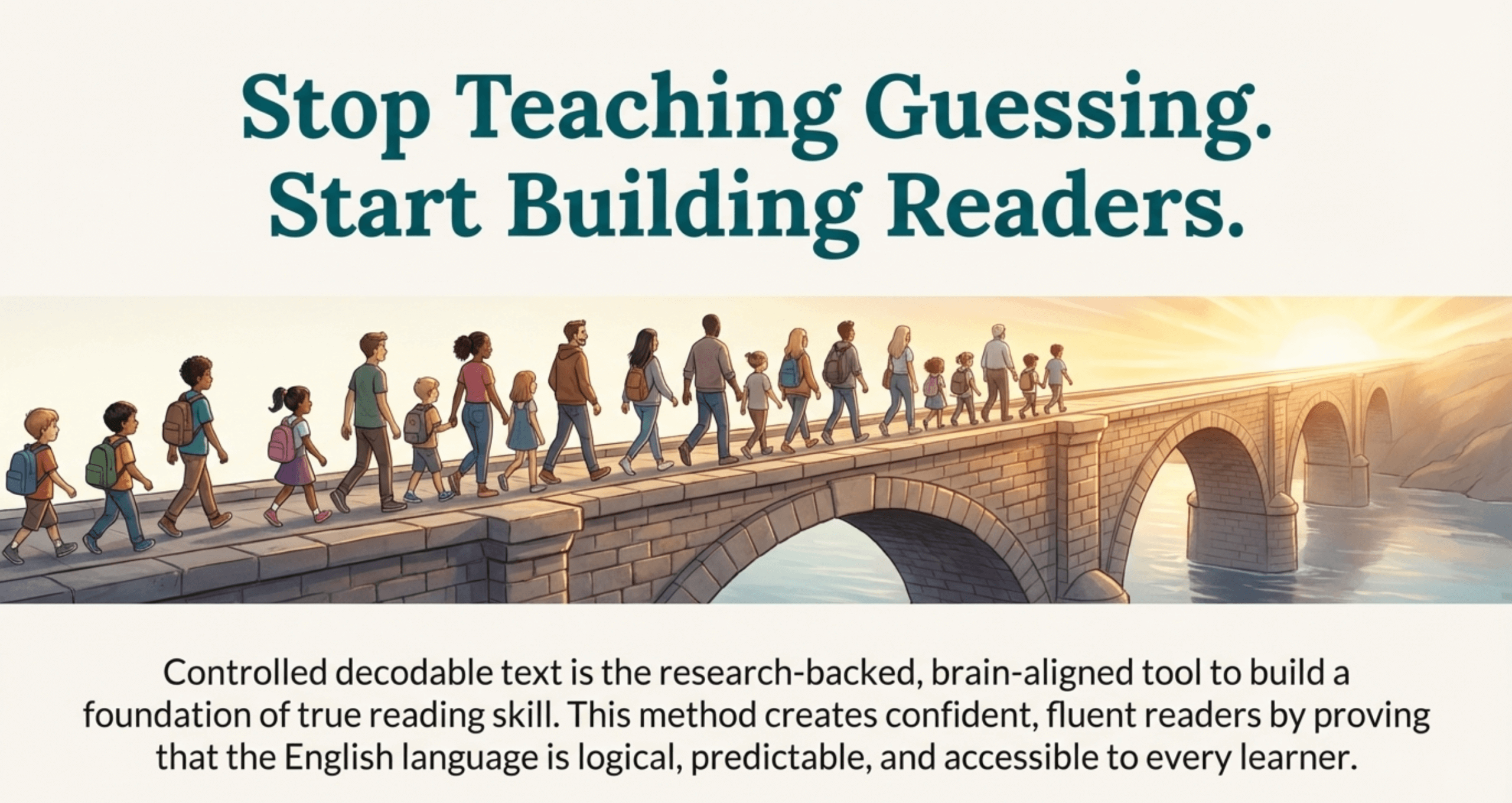
Use decodable text (controlled lists of words, sentences and stories) to teach phonics and fluency.
Decoding accuracy and reading fluency are skills that develop over time with oral reading practice. It is critical for an individual at this developmental stage of reading to encounter words that are phonetically consistent and contain only those phonetic elements that he has already learned.
from The Teacher’s Guide to We All Can Read Third Grade to Adult Edition
What is Controlled (Decodable) Text?
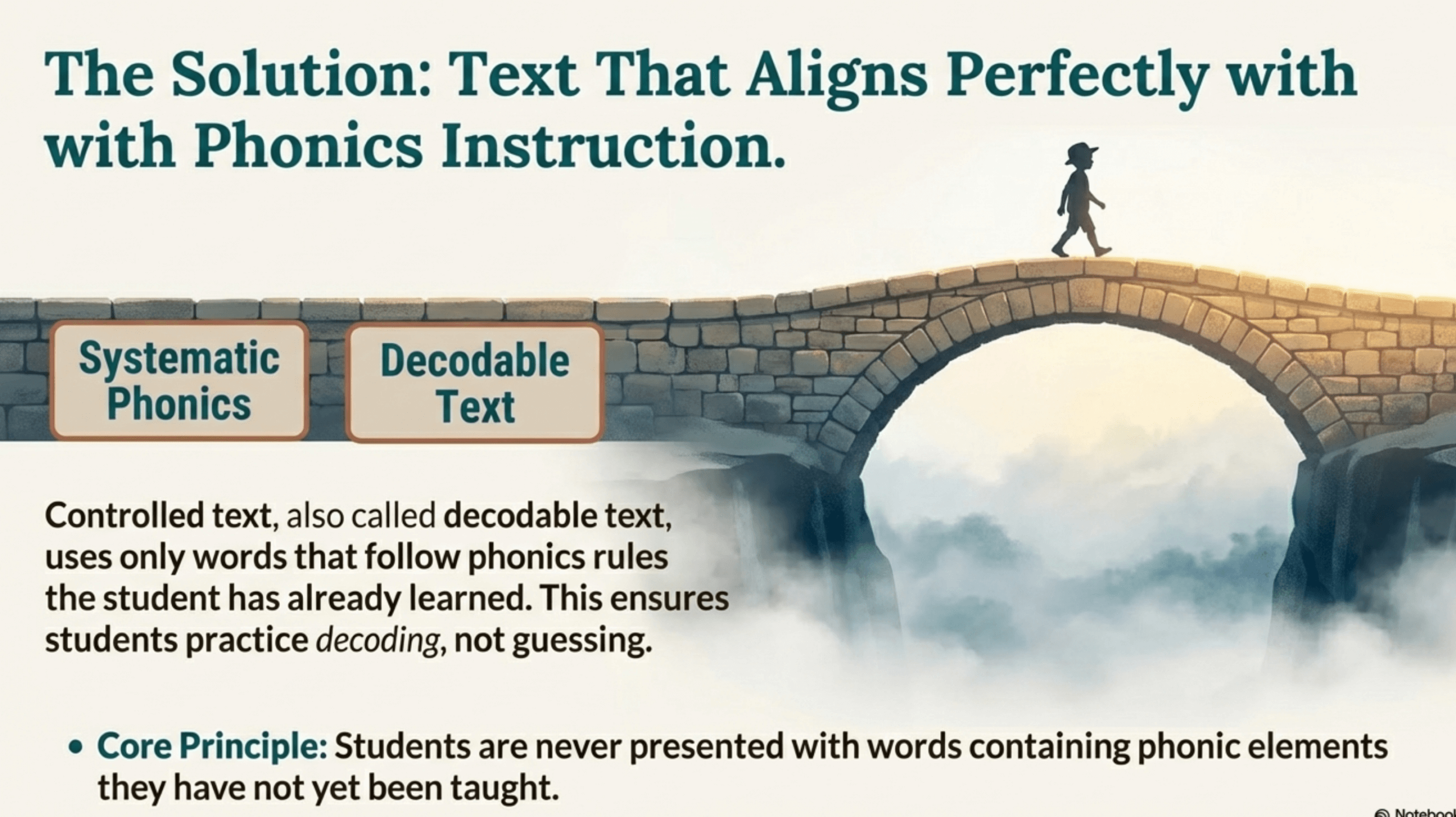
Controlled text, also called decodable text, uses only words that follow phonics rules the student has already learned. This ensures students practice decoding, not guessing.
Example of NON-Decodable Text (Traditional):

“The light in the sky is bright.”
Problems: “light”, sky, and “bright” use phonics patterns not yet taught and not appropriate for beginning readers. Students must memorize or guess these words.
Example of Decodable Text (Science of Reading):
“The big cat sat on a mat.”
Why this works: All words use simple CVC (consonant-vowel-consonant) patterns the student has been explicitly taught. No guessing required.
As students progress through systematic phonics instruction, controlled text gradually introduces new phonics patterns while continuously reinforcing previously learned ones. This builds true reading skill, not memorization.
Why Traditional Leveled Readers Don’t Work for Phonics Instruction
Many popular reading programs use “leveled readers” based on:
- High-frequency sight words
- Picture clues for context
- Sentence pattern memorization
- Predictable, repetitive text structures
The Problem: These Books Teach Guessing, Not Reading

A child might successfully “read” the sentence “The cat is in the tree” by:
- Memorizing the repetitive sentence pattern from previous pages
- Looking at the picture of a cat in a tree
- Guessing based on the first letter and context
- Recognizing a few memorized sight words
But they haven’t actually learned to decode the words. They’ve learned to guess using context clues.
The Result: The Third Grade Reading Wall
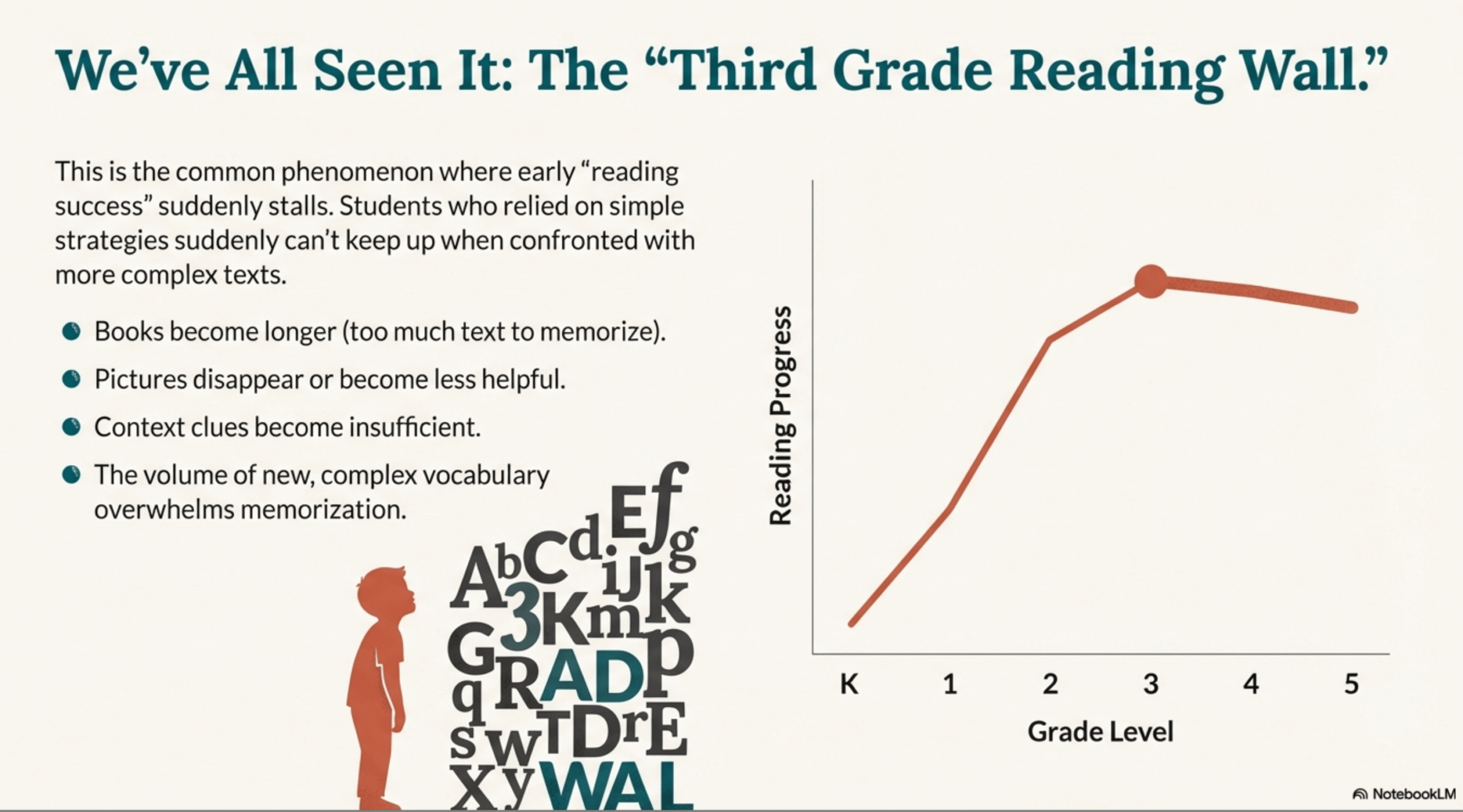
Students who rely on memorization and guessing strategies hit a critical barrier around 3rd-4th grade when:
- Books become longer (too much text to memorize)
- Pictures disappear or become less helpful
- Context clues become insufficient
- Vocabulary becomes increasingly complex
- The volume of new words overwhelms memorization strategies
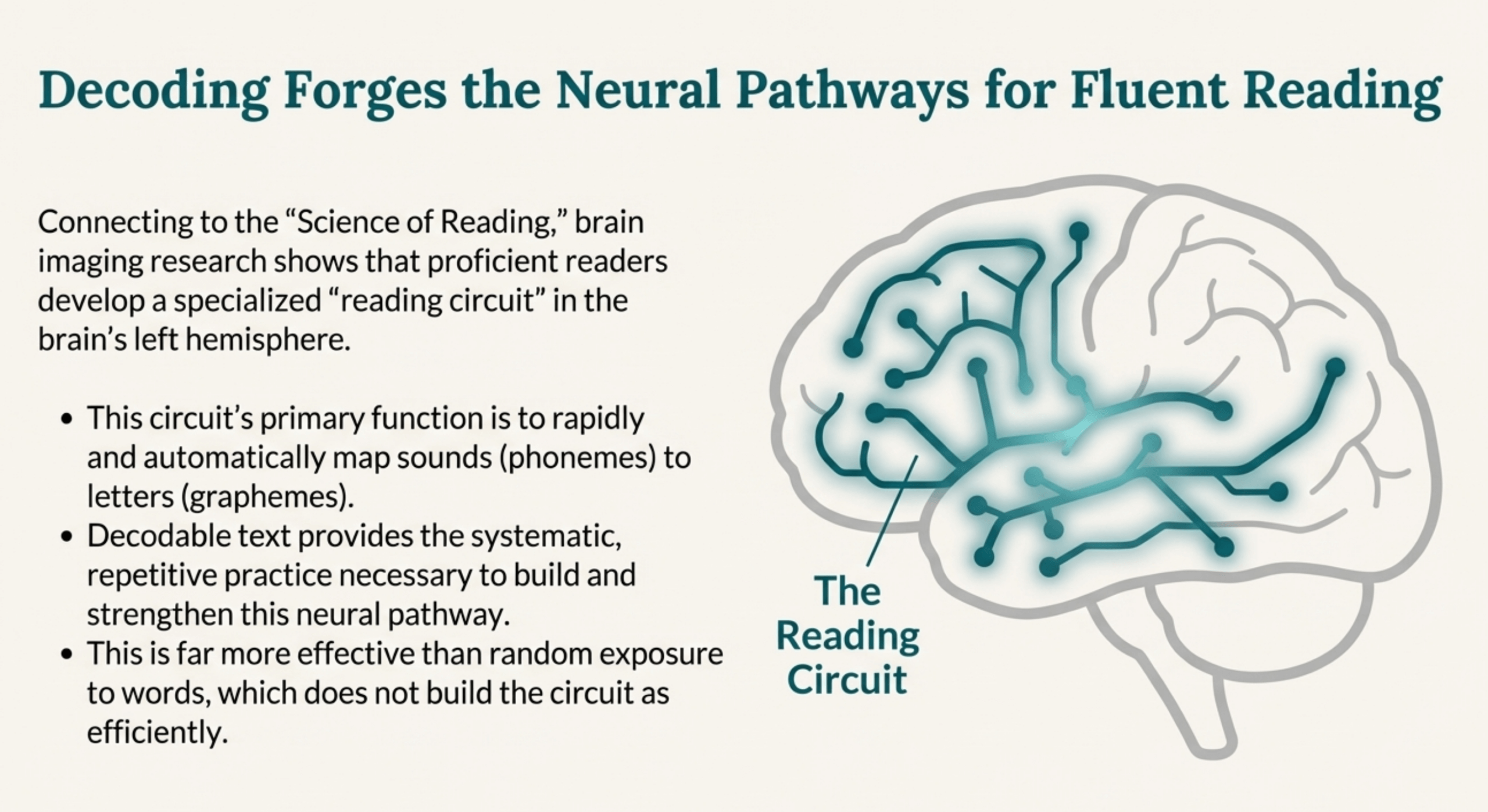
This is why controlled decodable text is essential from the very beginning of reading instruction. It builds the neural pathways for true phonetic decoding rather than compensatory guessing strategies.
The Research Supporting Controlled Decodable Text

Research shows that the single best instructional technique for developing reading fluency is to provide guided oral reading practice using decodable text. Decodable text is text that is composed of words that primarily contain only those phonetic elements that have been previously introduced. Words containing phonic elements not yet taught in the program are not included in the text.
Key Research Findings:
National Reading Panel (2000):
The comprehensive meta-analysis by the National Reading Panel found that systematic phonics instruction with decodable text produces significantly better reading outcomes than whole language approaches or programs that don’t control text complexity.
The Science of Reading:
Brain imaging research shows that proficient readers develop a “reading circuit” in the left hemisphere that maps sounds (phonemes) to letters (graphemes). Decodable text provides the systematic, repetitive practice necessary for this neural pathway development. Random exposure to words doesn’t build these pathways as effectively.
Orton-Gillingham Approach:
One of the foundational principles of the research-validated Orton-Gillingham methodology is using controlled text that precisely matches the student’s current phonics knowledge. This systematic approach has been successfully used for decades with struggling readers, students with dyslexia, and English language learners.
Students are never presented with words containing phonic elements they have not yet been taught. This process of using controlled reading lists is essential. Students learn that the English language is predictable and governed by an underlying set of consistent rules. Most students who struggle in reading believe the language is illogical, inconsistent and arbitrary.
How Controlled Text Works in Practice
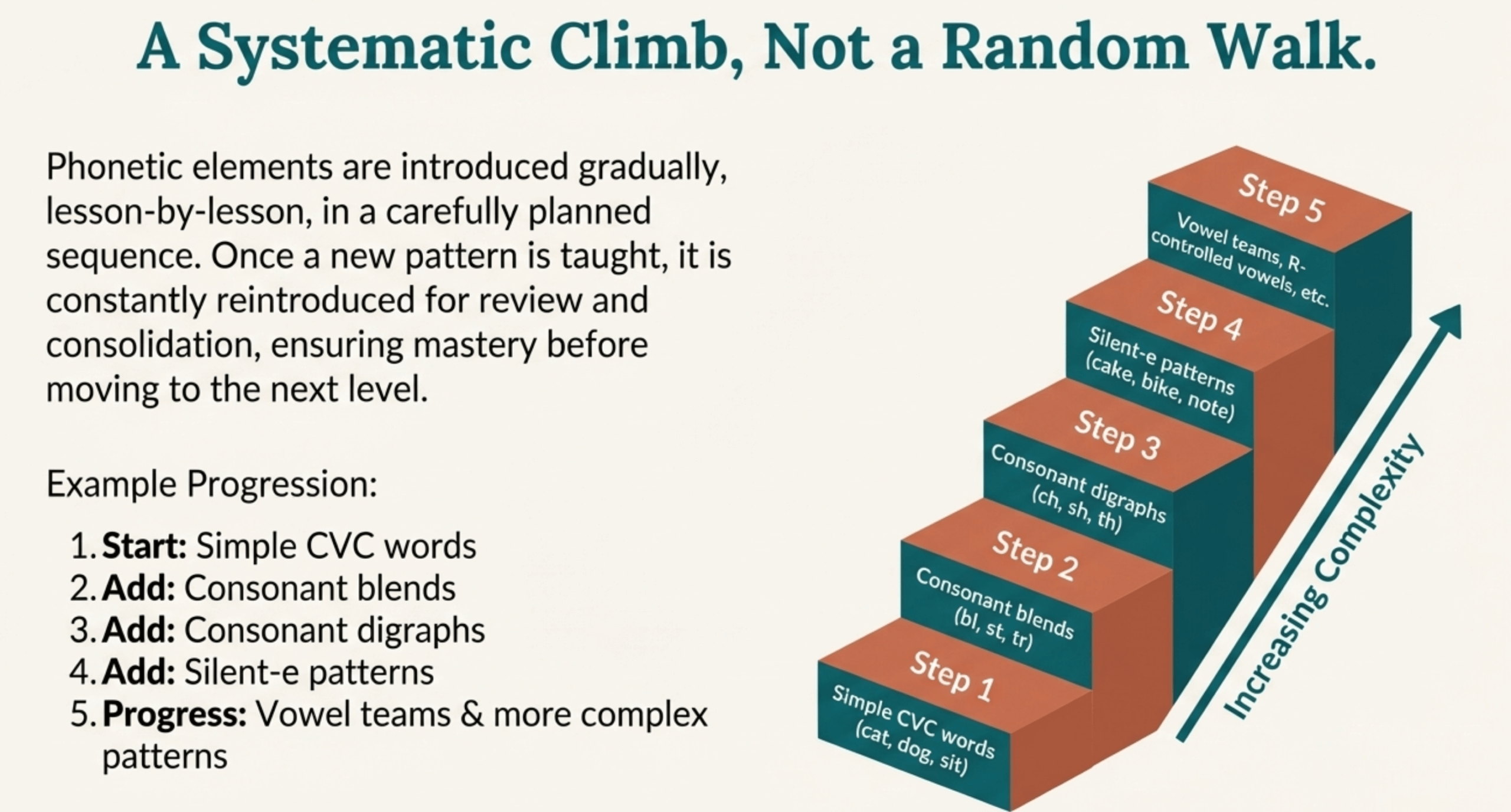
Gradually, lesson-by-lesson, more and more phonetic elements are introduced. Once a new phonic element is taught, it is constantly reintroduced in subsequent lessons for purposes of review and consolidation. Eventually students learn all of the major phonetic constructions in English and thus are able to read and spell with accuracy, fluency and confidence.
Real Example from Our Program:
As an example, if the consonant team ch has not yet been introduced in the program, then no word in the text will contain the ch team until that consonant team is formally presented in the program. All of the sentences and stories in our online program have been carefully developed to include only those phonetic elements that have been taught up to the particular point currently reached in the program. Some common sight words are also used.
The Progressive Structure of the We All Can Read Curriculum:
UNIT 1 – Lessons 1-101: Only simple CVC words (cat, dog, sit, pan, bed)
- Text example: “The cat sat. The dog ran. The pig is big.”
Units 2 to 4 – Lessons 101-157: Add consonant blends (bl, st, tr, gr, fl)
- Text example: “The black sled is on the step. The truck was fast.”
Units 5 to 6 – Lessons 158-211: Add consonant digraphs (ch, sh, th, wh)
- Text example: “The champ chose a thick shake at the shop. The ranch hand led a bunch of stock”
Unit 7 – Lessons 212-253: Add silent-e patterns (cake, bike, note, tune)
- Text example: “The fine cat gave chase to the mice on the white plate. Mike rode his bike home.”
Units 8 to 27 – Lessons 254+: Progressively add vowel teams (ai, oa, ee), r-controlled vowels (ar, er, ir, or, ur), advanced patterns, and multi-syllabic words.
Each new element is:
- Explicitly taught in isolation
- Practiced with controlled word lists
- Applied immediately in controlled sentences and stories
- Reviewed consistently in subsequent lessons for mastery
Common Mistakes When Using Decodable Text
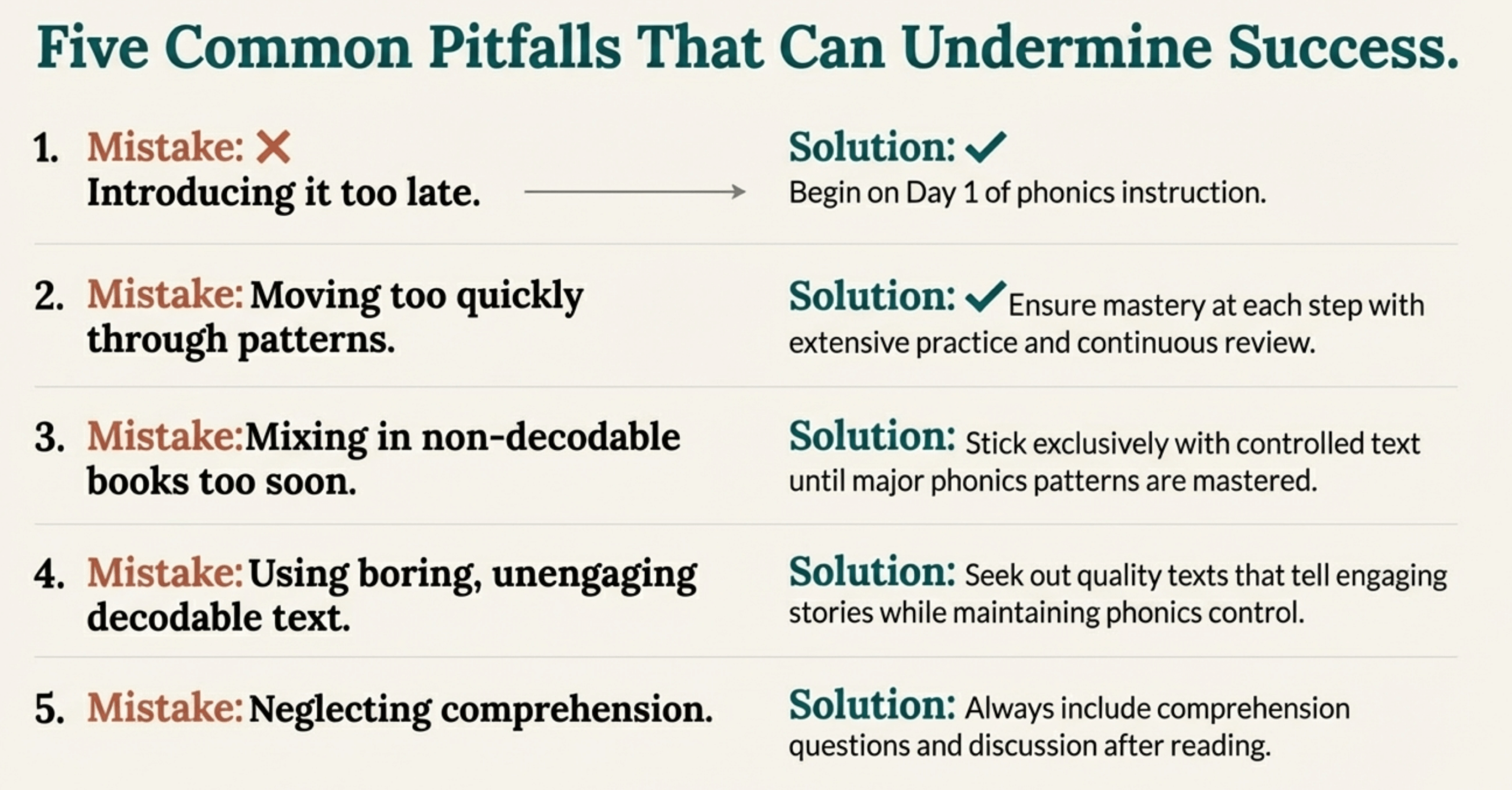
Mistake #1: Introducing It Too Late
Many programs wait until students are already struggling or frustrated before introducing systematic phonics and decodable text. By this time, students have often developed compensatory guessing strategies that are difficult to unlearn.
Solution: Decodable text should begin on Day 1 of phonics instruction, from the very first letter-sound correspondences.
Mistake #2: Moving Too Quickly Through Phonics Patterns
Students need extensive practice with each new phonics pattern before moving on. Simply introducing a pattern once and moving forward doesn’t provide the repetition necessary for mastery and automaticity.
Solution: Each phonics element should be practiced extensively in isolation, then in controlled words, then in controlled sentences and stories, with continuous review in subsequent lessons.
Mistake #3: Mixing in Non-Decodable Books Too Soon
Well-meaning teachers and parents often supplement decodable text with “just one” predictable reader or picture book to make reading more fun. This undermines the systematic approach and reintroduces guessing habits.
Solution: During the critical learning phase, stick exclusively with controlled decodable text until students have mastered all major phonics patterns. Then gradually introduce authentic literature.
Mistake #4: Using Boring, Unengaging Decodable Text
Early decodable text can be repetitive and simplistic. Some publishers produce decodable books that are so boring they actually discourage reading practice.
Solution: Seek out decodable texts that tell engaging stories, use humor, include interesting facts, or connect to students’ interests—all while maintaining strict phonics control. Quality decodable text exists; it just requires careful selection.
Mistake #5: Neglecting Comprehension
Some teachers focus so heavily on decoding accuracy with controlled text that they forget to check for understanding.
Solution: Always include comprehension questions and discussion about decodable texts. Understanding should develop alongside decoding skill.
How We All Can Read Uses Controlled Decodable Text
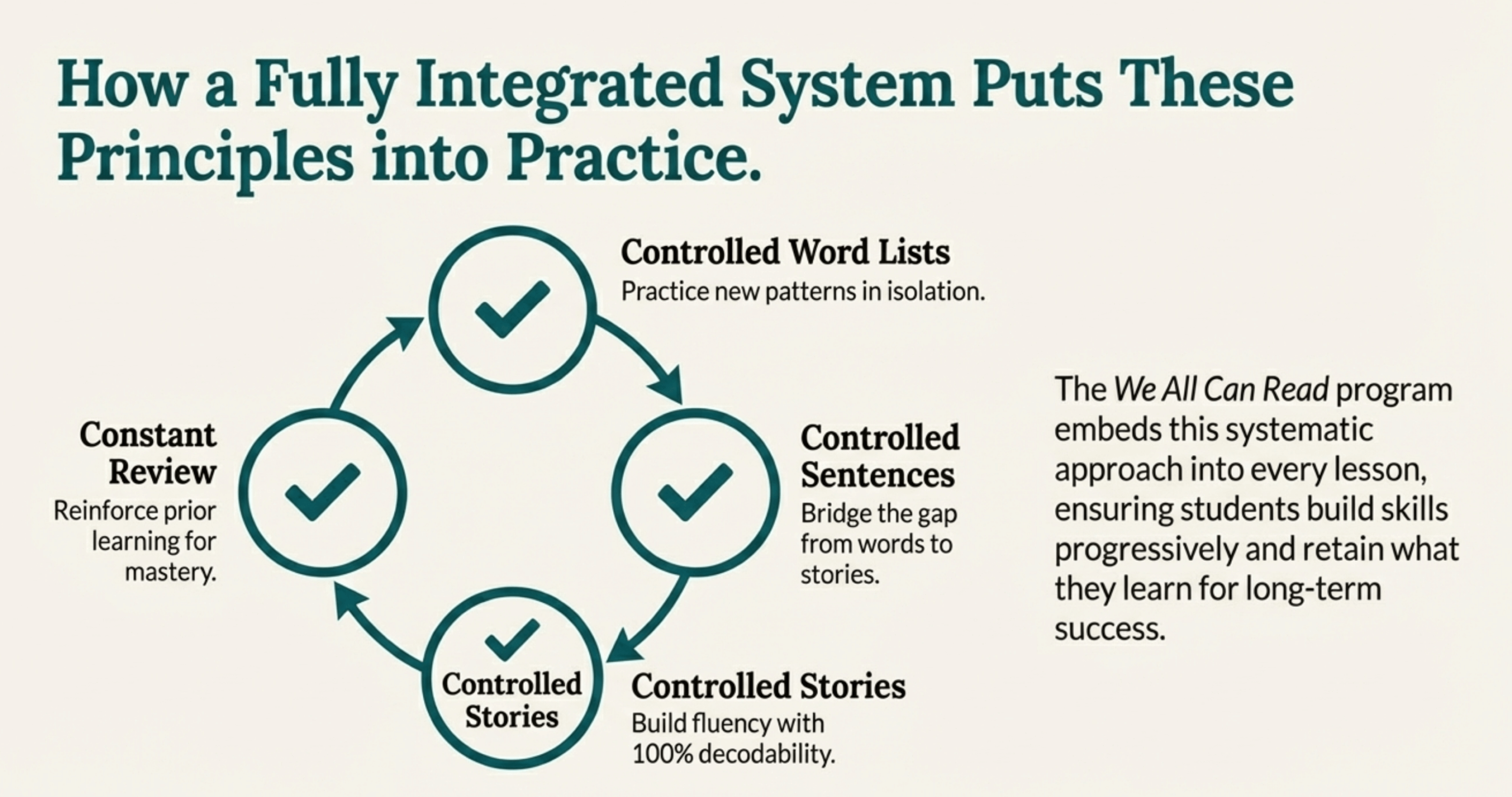
Every one of our 720 lessons includes carefully sequenced controlled text designed to build true reading mastery:
Our Systematic Approach:
✅ Controlled Word Lists: Students practice new phonics patterns in isolation first, ensuring they can decode accurately before moving to connected text.
✅ Controlled Sentences: Words are combined into meaningful sentences that use only taught patterns. This bridges the gap between isolated words and full stories.
✅ Controlled Stories: Engaging narratives using only taught phonetic patterns allow students to practice fluency while maintaining 100% decodability.
✅ Progressive Complexity: Each lesson builds systematically on previous knowledge. The progression is carefully mapped so students never encounter patterns they haven’t been taught.
✅ Constant Review: Previously learned patterns are reinforced throughout subsequent lessons for purposes of review and consolidation, ensuring long-term retention and automaticity.
Why Our Approach Works:
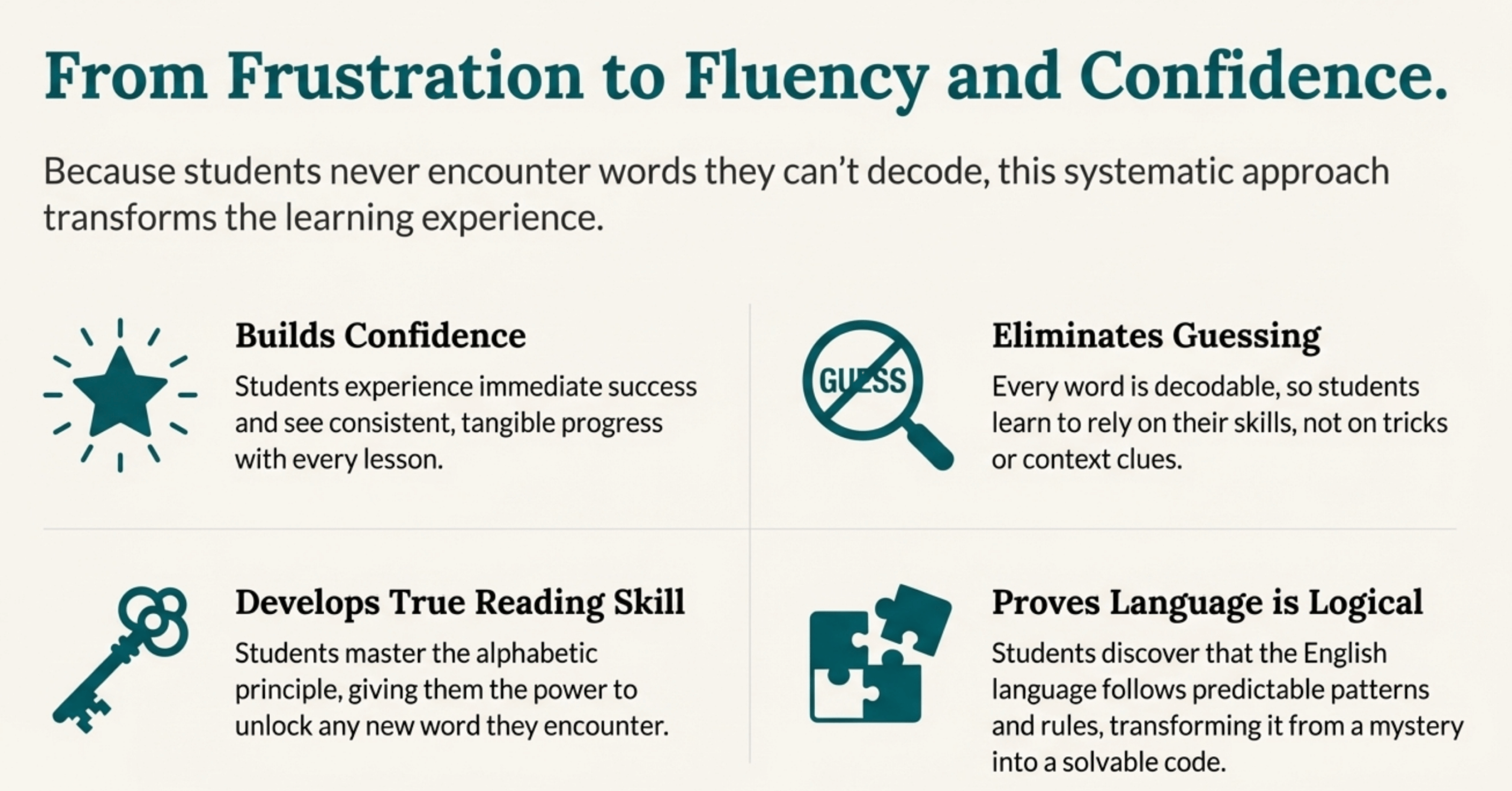
Students never encounter words they can’t decode. This systematic approach:
- Builds confidence – Students experience immediate success and see consistent progress
- Eliminates guessing – No need for context clues or memorization; every word is decodable
- Develops true reading skill – Students learn the alphabetic principle and phonetic patterns that unlock any word
- Creates fluency through practice – Repeated exposure to patterns builds automatic recognition
- Proves language is logical – Students discover English follows predictable patterns and rules
Our approach is specifically designed for students in grades 3-12 and adults who have struggled with traditional reading instruction. The content is age-appropriate while maintaining strict phonetic control.
Frequently Asked Questions About Controlled Decodable Text
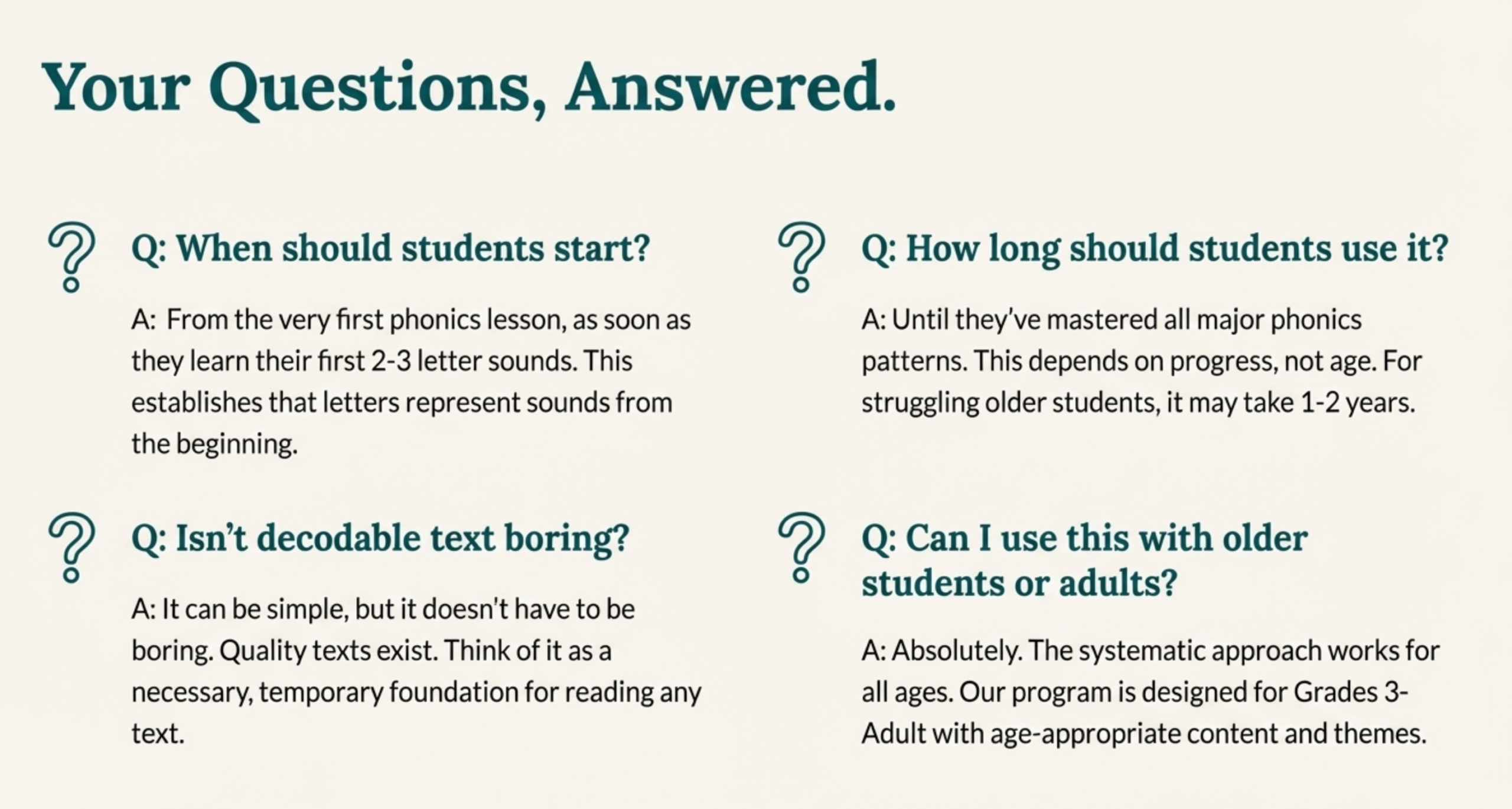
When should students start using decodable text?
From the very first phonics lesson. As soon as students learn their first letter-sound correspondences (even just 2-3 letters), they should immediately practice reading words and sentences using only those sounds. This establishes the foundational understanding that letters represent sounds and can be blended to form words.
Isn’t decodable text boring and repetitive?
Early decodable text can be simple because it’s limited to a small number of phonics patterns. However, it doesn’t have to be boring. Well-written decodable stories can be engaging, humorous, and interesting while maintaining phonics control. The key is finding quality decodable texts and understanding that this simplified text is temporary—it’s the necessary foundation for future reading of any text.
How long should students use controlled decodable text?
Until they’ve mastered all major phonics patterns—typically through 2nd-3rd grade for students who began phonics instruction in kindergarten. However, struggling readers in upper elementary, middle school, high school, or adults learning to read for the first time will need systematic instruction with decodable text for 1-2 years regardless of their age. The timeline depends on the student’s starting point and pace of progress, not their age.
Can I use decodable text with older students or adults?
Absolutely! The systematic approach works for learners of all ages. The key is using age-appropriate content. Our program is specifically designed for grades 3-adult, with themes and stories that respect the reader’s age and life experience while maintaining strict phonetic control. Many adults have successfully learned to read using systematic phonics with decodable text.
What about sight words that aren’t decodable?
A small number of high-frequency words (the, of, was, said, one, etc.) don’t follow regular phonics patterns and must be learned as sight words. These should be introduced gradually alongside decodable text, not instead of it. In our program, essential sight words are introduced systematically, but the focus remains on phonics patterns that unlock thousands of words rather than memorizing individual words.
How do I know if a book is truly decodable?
Truly decodable text clearly indicates which phonics patterns it uses and only includes words that follow those patterns (plus a small number of previously taught sight words). Look for books that specify the phonics scope and sequence. Be wary of books labeled “decodable” that include many words outside the stated phonics focus—these undermine the systematic approach.
What’s the difference between “decodable” and “controlled” text?
These terms are used interchangeably. Both refer to text where the phonetic content is carefully controlled to match what students have been explicitly taught. Some educators prefer “decodable” because it emphasizes that students can decode (sound out) every word. Others prefer “controlled” because it emphasizes the intentional control of phonetic elements.
Won’t students get stuck reading only decodable books?
No. Decodable text is a temporary scaffold during the learning phase. Once students have mastered all major phonics patterns and developed fluency, they transition naturally to authentic literature of all kinds. The goal is to use decodable text during instruction to build the foundational skills that unlock all future reading.
Experience Controlled Decodable Text in Action
See how systematic controlled text builds reading skills with our comprehensive phonics program.
720 lessons | Grades 3-Adult | Self-paced online learning
Every lesson includes carefully sequenced decodable word lists, sentences, and stories that build true reading mastery—not guessing strategies.
Continue Reading: The 9 Essential Strategies
← Previous: How to Sound Out Words: Step-by-Step Method
Next → Teach Spelling at Each Step
Questions about what to teach struggling readers? Contact us.