Best Adult Reading Programs: What Actually Works
Choosing an adult reading program can feel overwhelming. You’ll find dozens of options, each claiming to be the best solution for struggling adult readers. Some cost thousands of dollars for private tutoring. Others promise quick results with minimal effort. Many are simply children’s programs repackaged with “adult” labels.
How do you know which programs actually work?
This guide cuts through the marketing to show you what separates effective adult reading programs from those that waste your time and money. You’ll learn which teaching methods have proven results, what features matter most, and how to evaluate programs based on your specific needs and budget.
Why Most Adult Reading Programs Fail
Before exploring what works, it’s important to understand why so many programs fail adult learners.
The Wrong Teaching Method
The most common failure: programs that use the same methods that didn’t work for you in childhood.
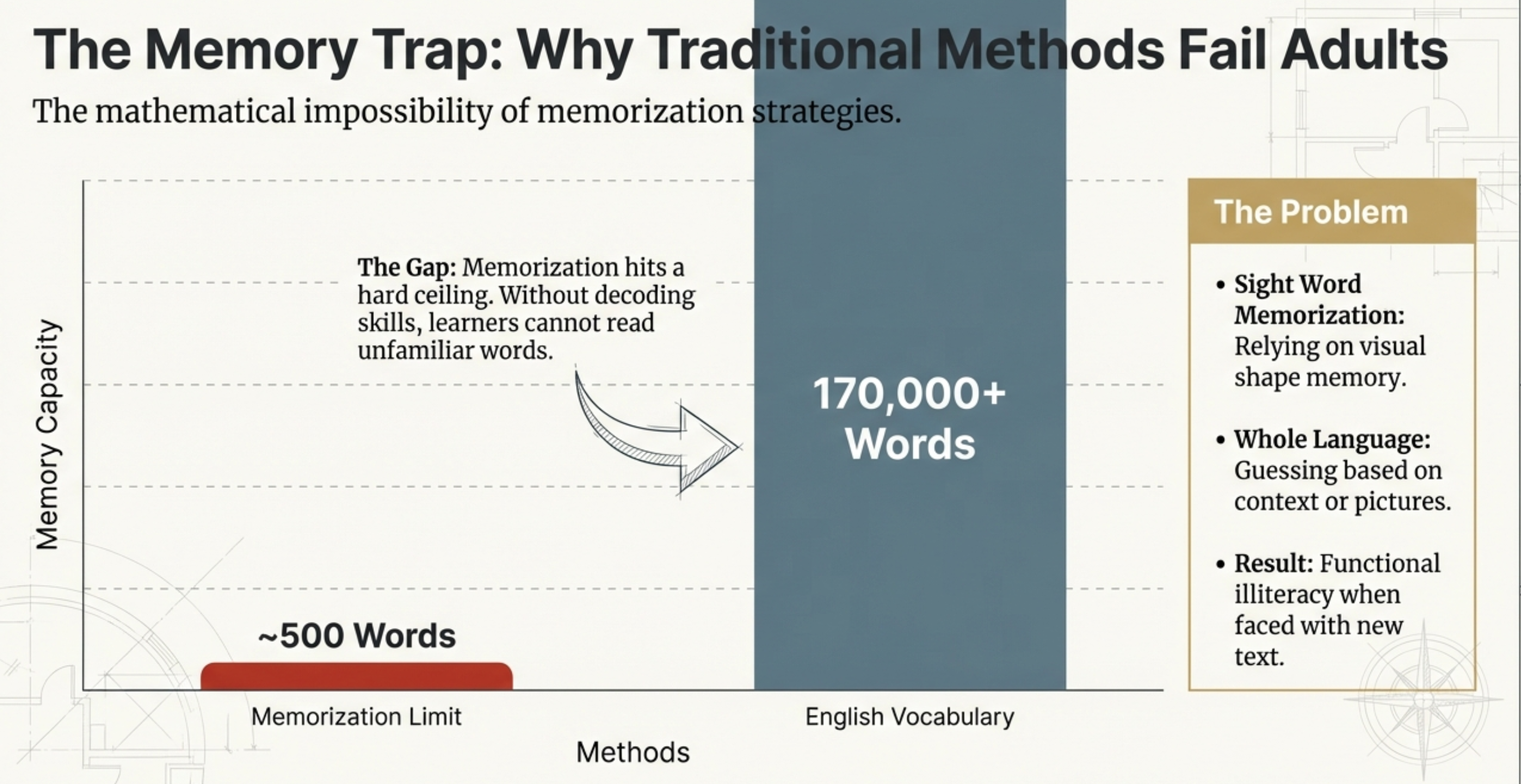
Sight word memorization. Many programs focus heavily on memorizing whole words by sight without teaching you how to decode them. You might memorize 100, 200, even 500 words—but English has over 170,000 commonly used words. Memorization has severe limits and leaves you unable to read unfamiliar words independently.
Whole language approaches. These programs encourage you to guess words from context, look at pictures, or use the first letter as a clue. While fluent readers use context to enhance comprehension, beginning readers need to actually decode words, not guess at them.
Mixed methods without systematic phonics. Some programs claim to teach phonics but only cover the basics before moving to memorization and guessing strategies. This incomplete phonics instruction leaves critical gaps in your knowledge.
If a program relies primarily on memorization or context clues rather than teaching you the complete alphabetic code, it’s using methodology that has high failure rates with adults who struggle with reading.
Age-Inappropriate Materials
The second major failure: programs that don’t respect adult learners.
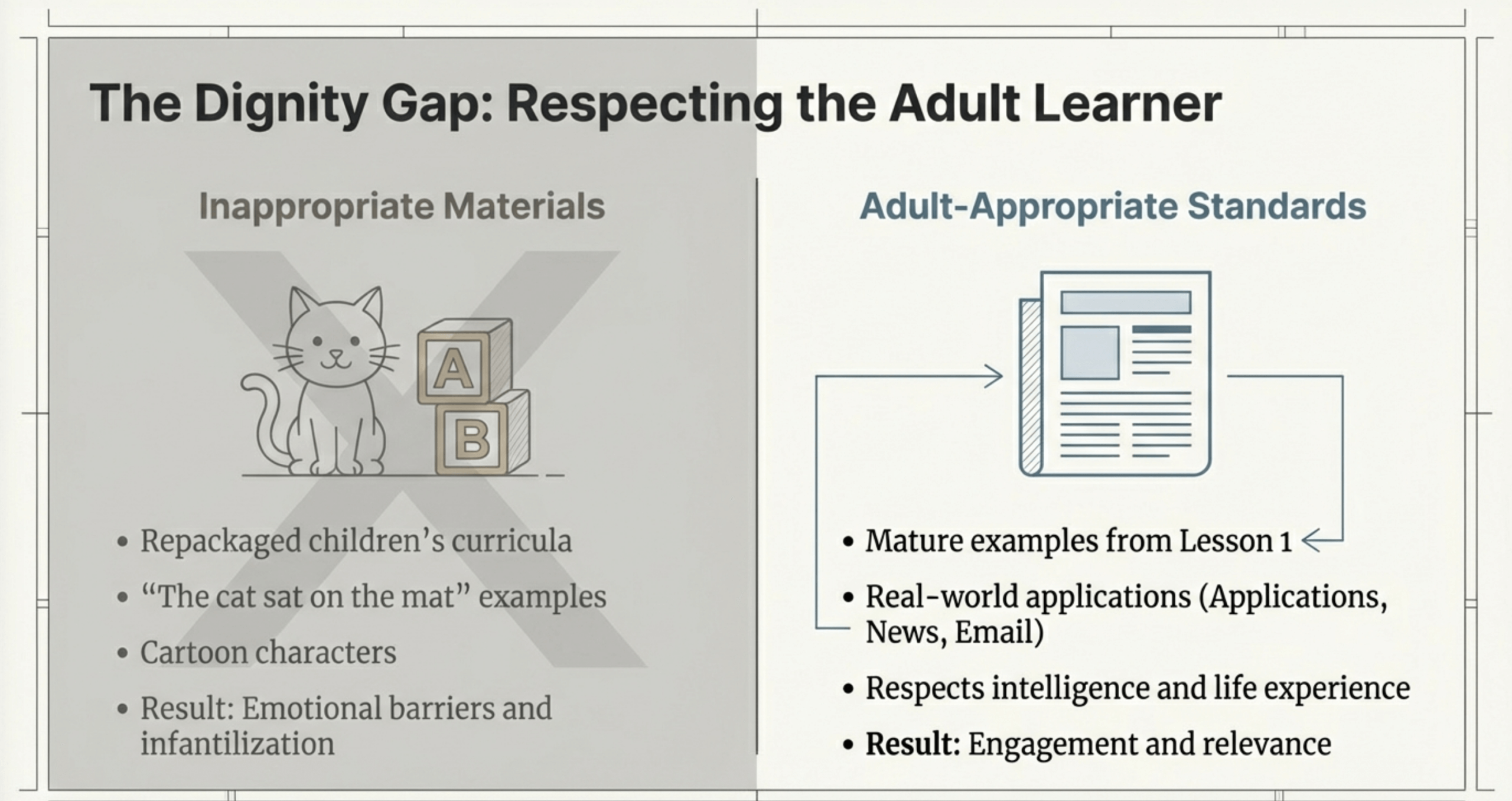
Many “adult” reading programs are simply children’s materials with a different cover. Reading passages about “The cat sat on the mat” or completing worksheets with cartoon characters feels infantilizing. This creates emotional barriers that interfere with learning.
Adults need materials that:
- Use mature examples and content from lesson one
- Address real-world reading needs (job applications, news, emails)
- Respect your intelligence and life experience
- Don’t make you feel like you’re in elementary school
Unrealistic Promises
Be skeptical of programs promising you’ll “read fluently in 30 days” or “master reading in weeks.”
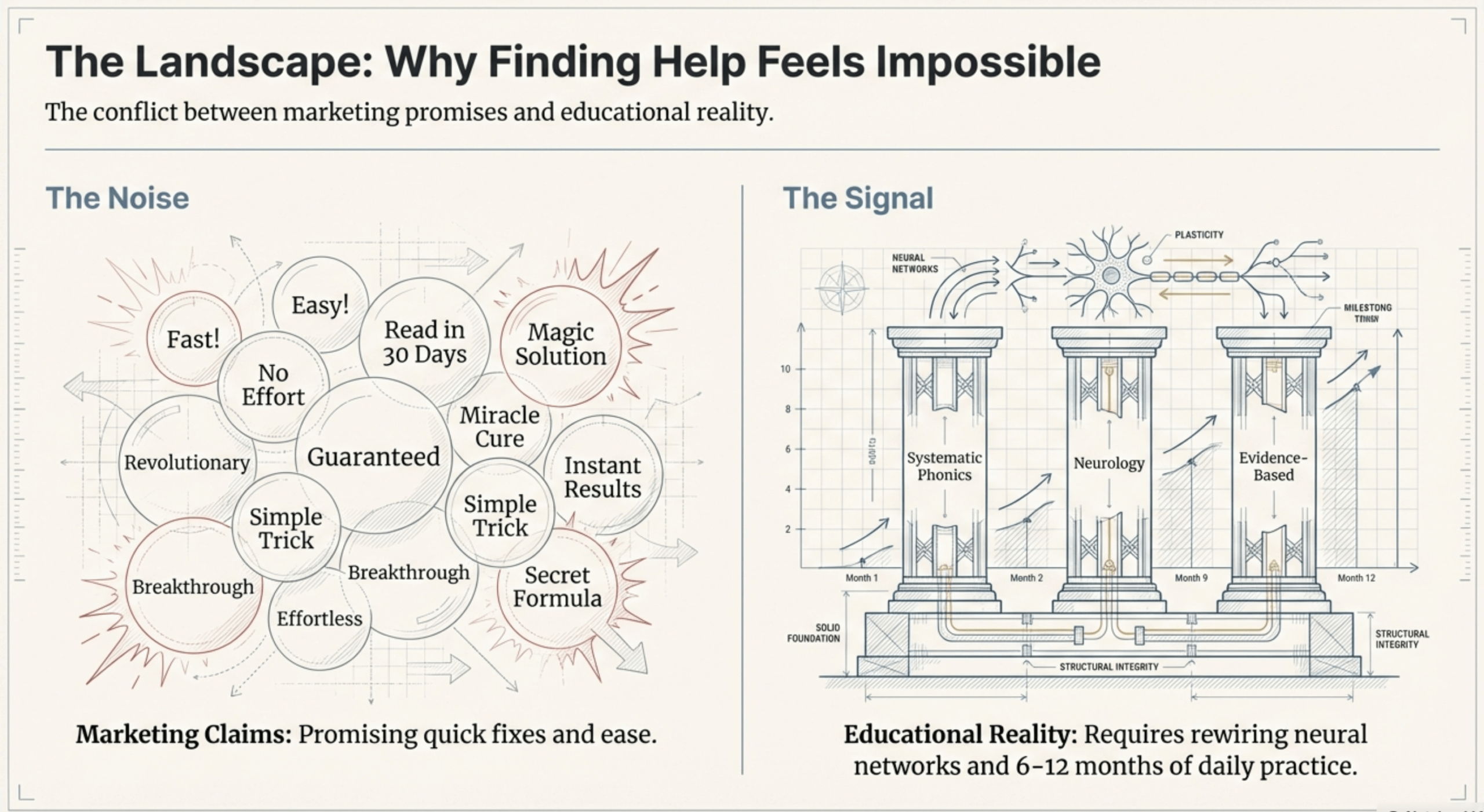
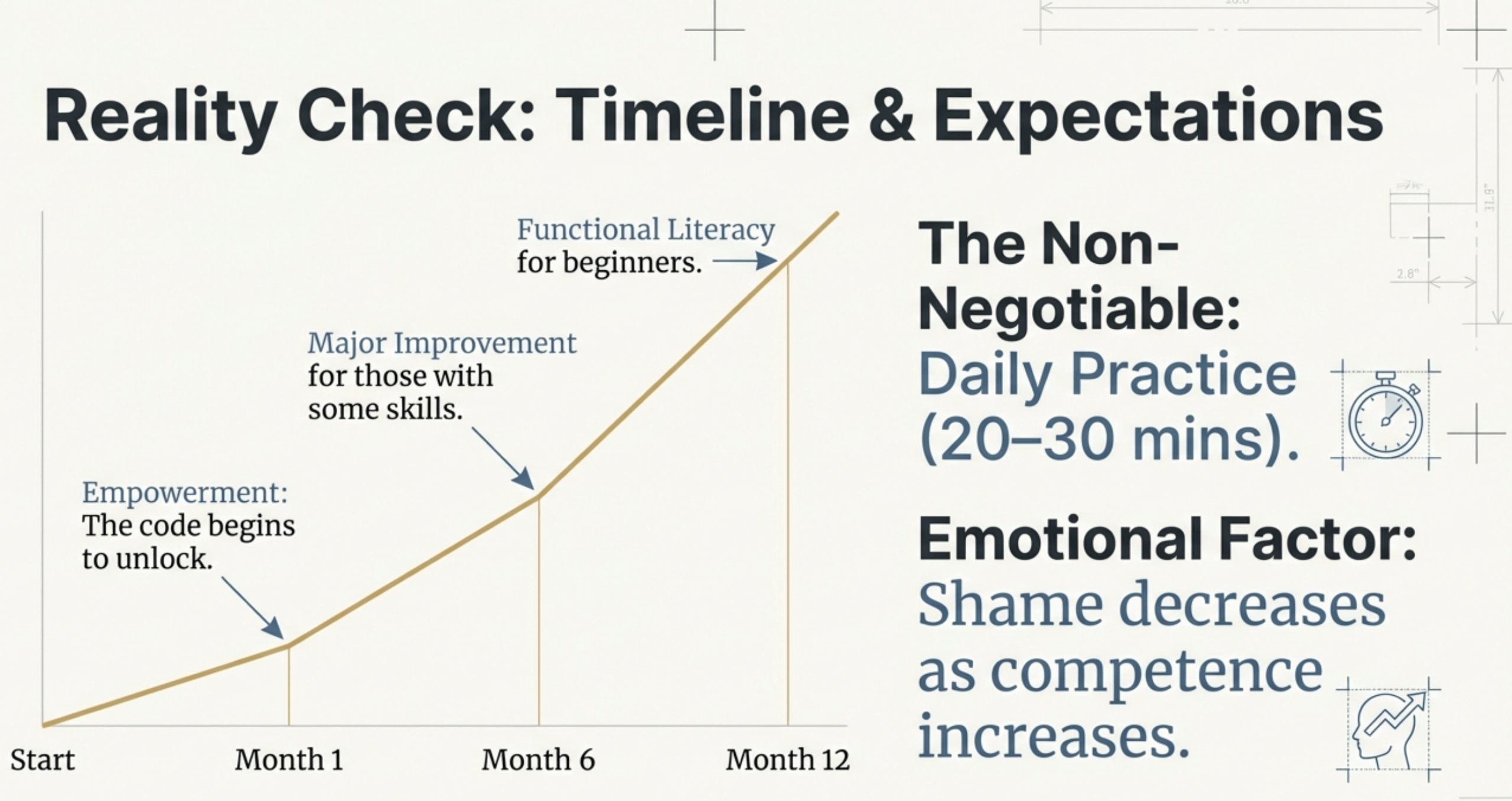
Learning to read as an adult—particularly if you’re starting from the beginning—requires genuine time and effort. Most adults need 6-12 months of consistent daily practice to achieve solid reading skills. Programs that promise dramatically faster results are either targeting people who already have basic skills or overpromising what they can deliver.
Lack of Systematic Instruction
Random phonics activities or lessons without clear sequence don’t build comprehensive understanding.
Effective programs follow a carefully planned progression:
- Simple to complex
- Each new concept builds on previously mastered skills
- No gaps in the phonetic code
- Regular review and practice
Programs that jump around, introduce concepts randomly, or cover only basic phonics leave you with incomplete knowledge.
What Makes an Adult Reading Program Effective
Research on adult literacy, combined with decades of practical experience, shows what actually works.
Systematic Phonics as the Foundation
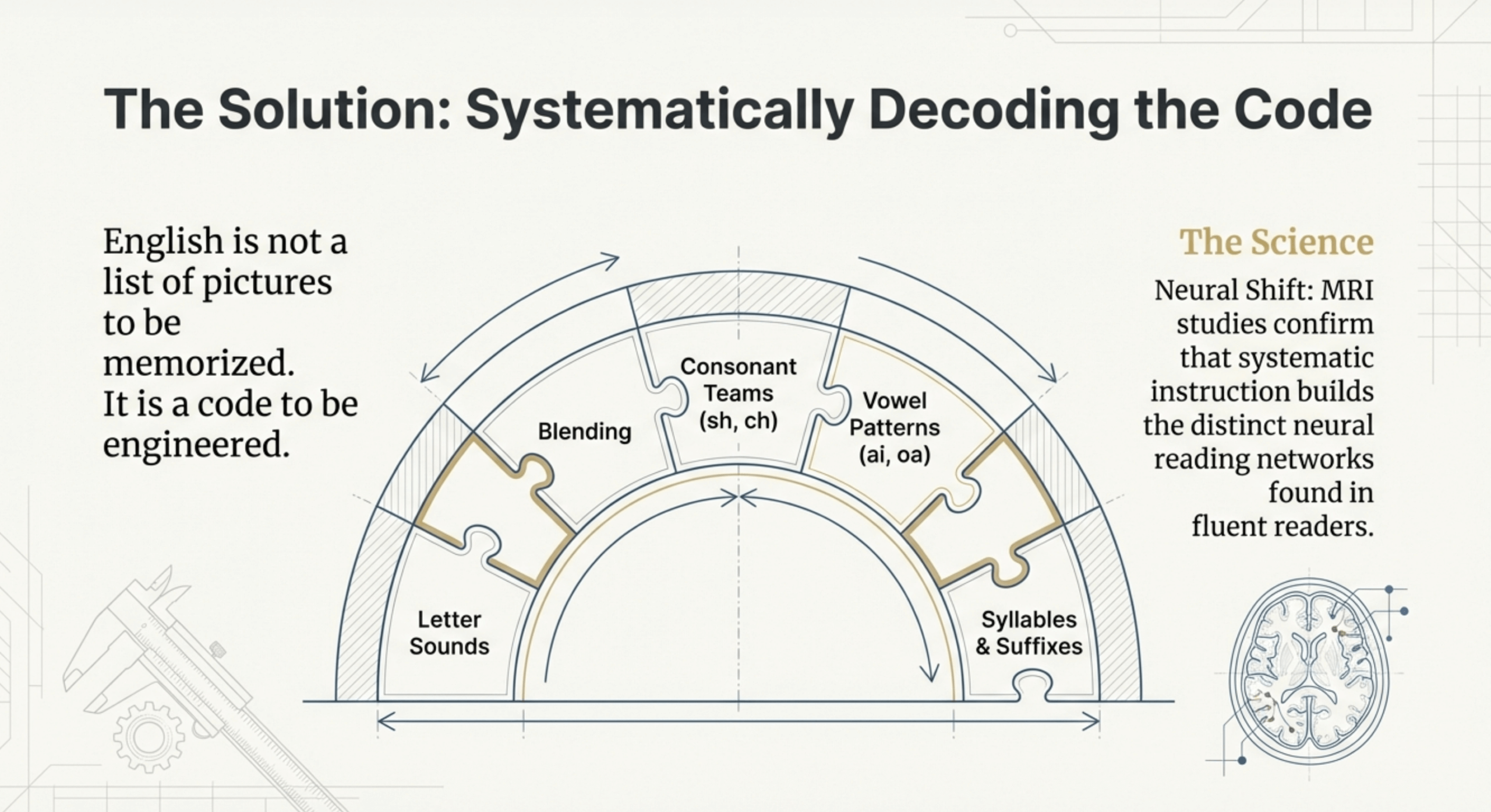
The single most important factor: the program must teach comprehensive, systematic phonics.
What is systematic phonics? It means teaching the complete relationship between letters and sounds in English in a logical, sequential order. You learn:
- Individual letter sounds
- How to blend sounds together to read words
- Consonant combinations (sh, ch, th, etc.)
- Vowel patterns (ai, oa, igh, etc.)
- Syllable patterns for longer words
- Prefixes, suffixes, and word structure
- Spelling rules and patterns
This isn’t just “basic phonics.” It’s the entire alphabetic code of English, taught systematically from simple to complex.
Why phonics works for adults. Once you understand the code, you can decode any word—not just ones you’ve memorized. This gives you independence. You’re not guessing or relying on context. You’re actually reading.
Brain imaging studies show that systematic phonics instruction develops the same neural reading networks in adult brains that fluent readers have. The networks form later in life, but they do form.
The Orton-Gillingham Approach
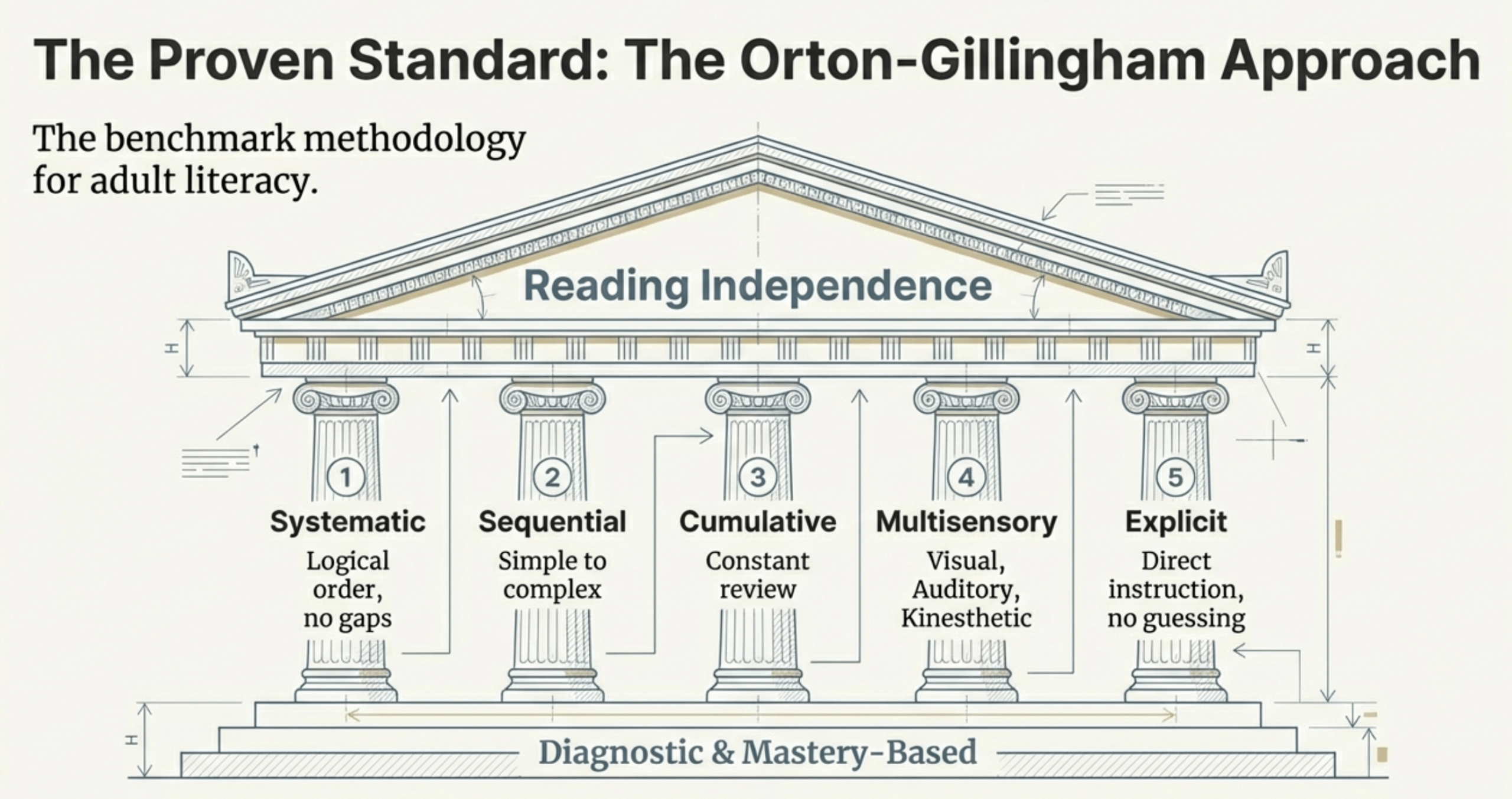
The most effective systematic phonics programs for adults follow the Orton-Gillingham approach, developed in the 1930s specifically for struggling readers.
Key principles:
- Systematic and sequential: Concepts taught in logical order with no gaps
- Cumulative: Continuous review of previously learned material
- Multisensory: Engaging visual, auditory, and kinesthetic learning simultaneously
- Explicit instruction: Nothing left to chance; every pattern taught directly
- Diagnostic: Regular assessment to ensure mastery before advancing
Originally developed for students with dyslexia, this approach works effectively for all struggling readers because it assumes nothing and teaches everything explicitly.
Programs following Orton-Gillingham principles have the strongest research support and highest success rates with adult learners.
Essential Program Features
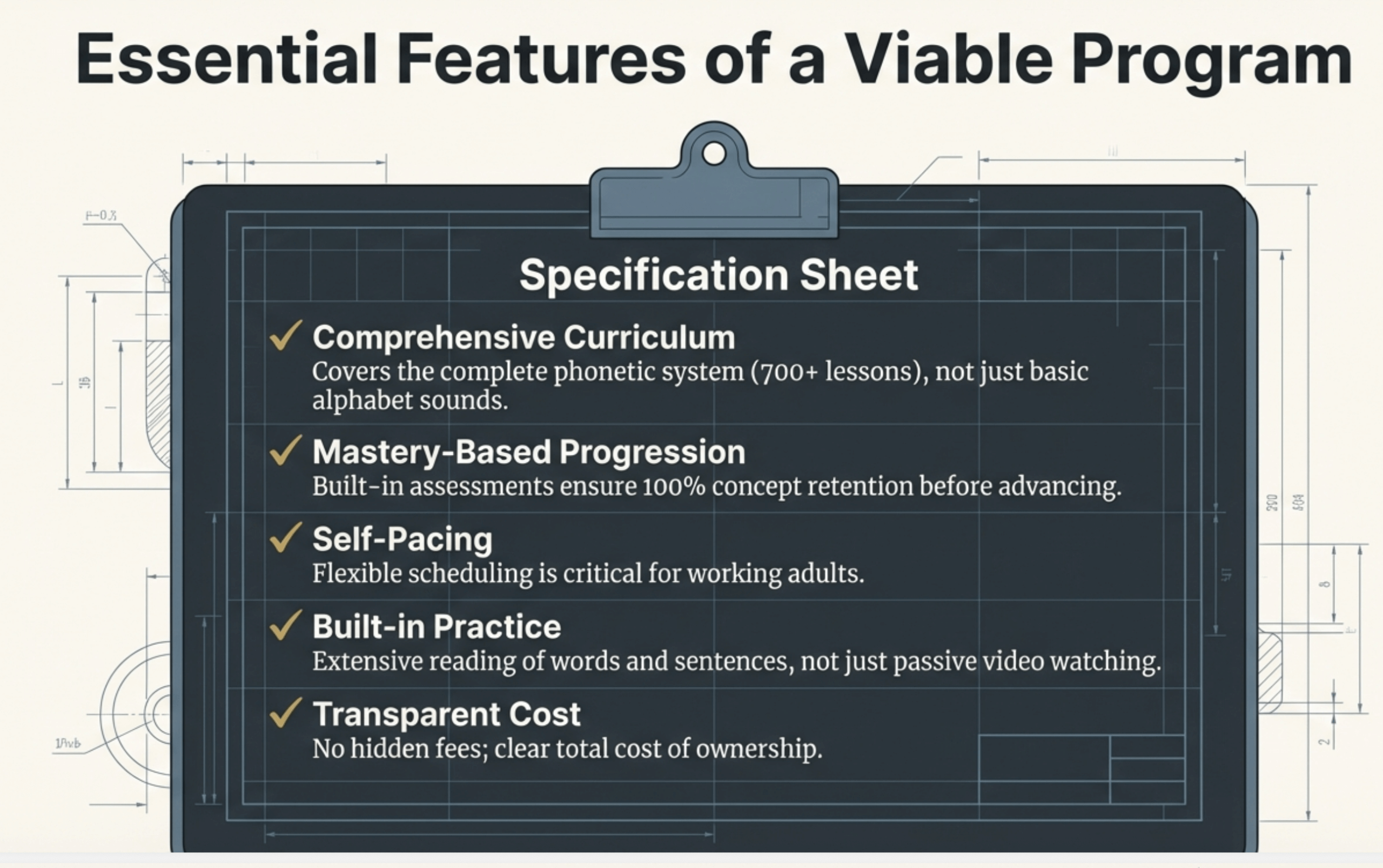
Beyond teaching method, effective adult reading programs share these characteristics:
Comprehensive curriculum. The program should cover the complete phonetic system of English, not just basic phonics. Look for programs with several hundred lessons, not just 20 or 30.
Age-appropriate content. Materials should be designed for adults from the start, using mature examples and real-world applications.
Self-paced learning. Adults need flexibility to study when it fits their schedule—early morning, lunch breaks, late evening. Rigid class schedules don’t work for most working adults.
Built-in practice. You can’t learn to read just by watching videos or reading explanations. Quality programs include extensive practice reading actual words, sentences, and passages.
Mastery-based progression. Regular quizzes or assessments ensure you’ve truly learned each concept before moving forward. This prevents advancing with gaps in knowledge.
Reasonable cost. Effective instruction shouldn’t require tens of thousands of dollars. While private tutoring works, well-designed online programs can deliver similar results at a fraction of the cost.
Types of Adult Reading Programs: Pros and Cons
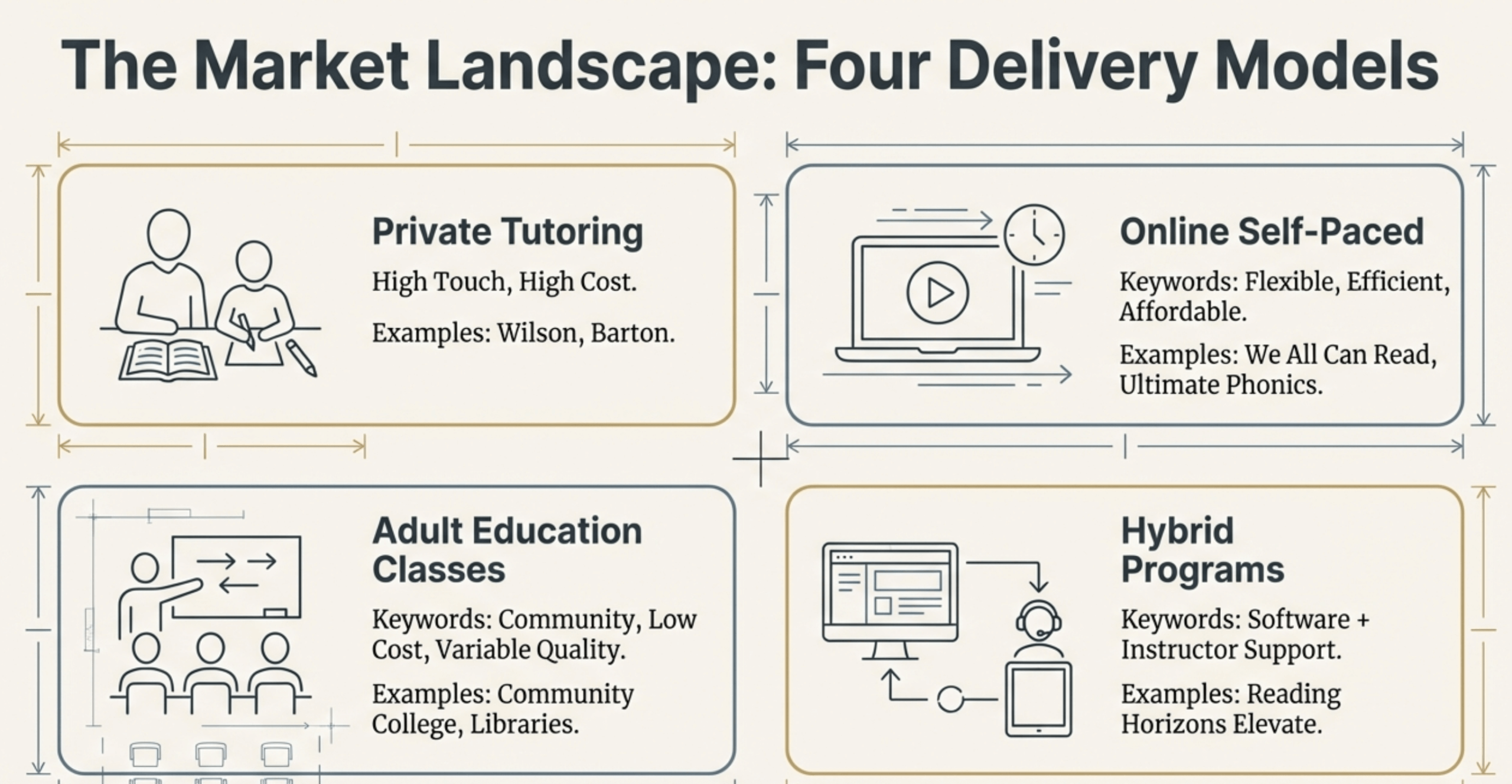
Adult learners have several program formats to choose from. Here’s an honest look at each:
Private Tutoring Programs
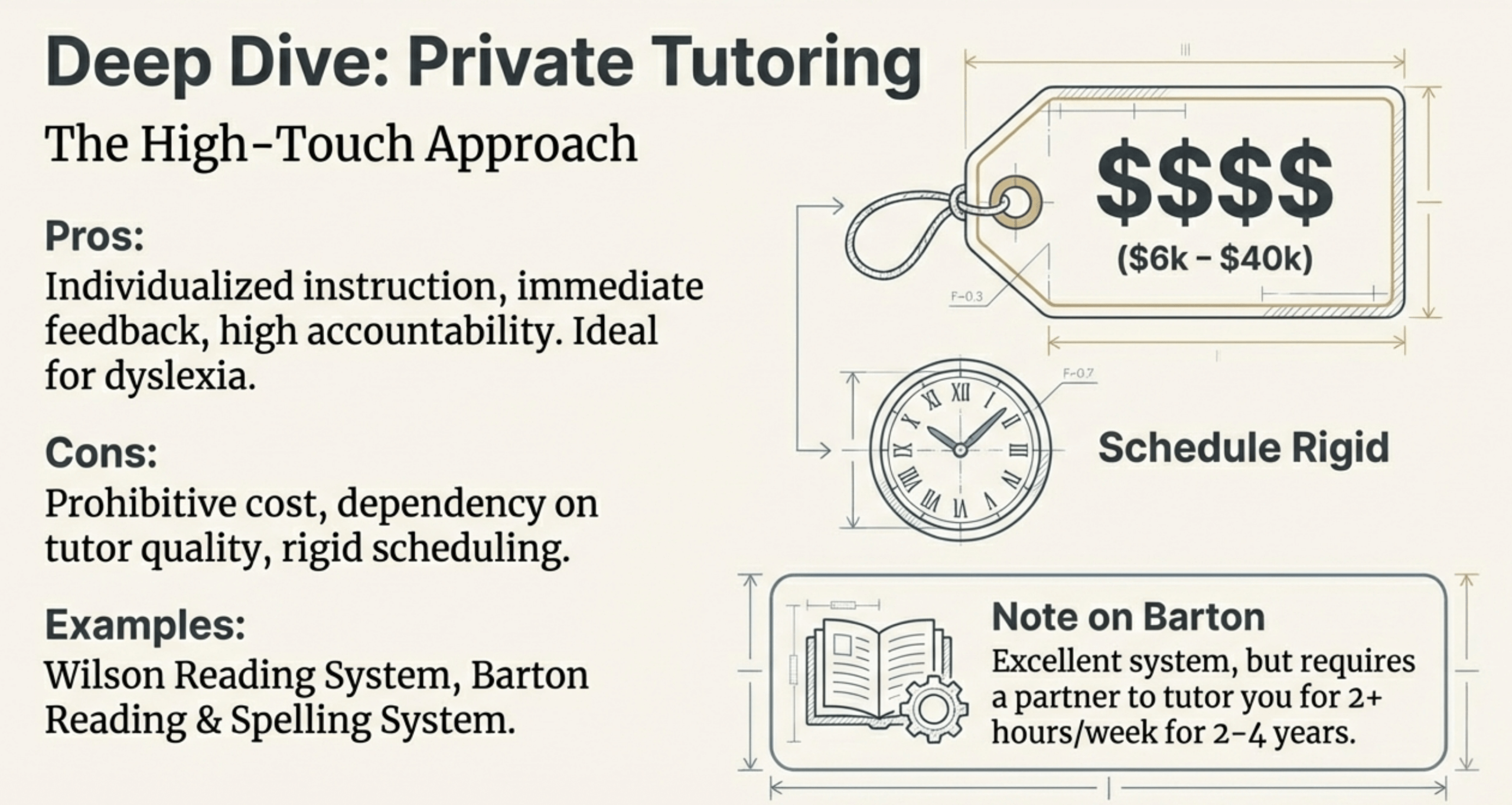
How they work: One-on-one instruction with a certified reading tutor or specialist, typically meeting 1-3 times per week.
Major programs:
- Wilson Reading System (requires certified Wilson tutor)
- Barton Reading & Spelling System (requires trained tutor)
- Lindamood-Bell instruction
- Private Orton-Gillingham tutors
Pros:
- Individualized instruction tailored to your exact needs
- Immediate feedback and correction
- Accountability from scheduled sessions
- Personal connection with instructor
Cons:
- Very expensive: $6,000-$40,000+ for complete instruction
- Limited availability of qualified tutors in many areas
- Requires scheduling around tutor’s availability
- Progress depends heavily on tutor quality
Best for: Adults who can afford private instruction, need intensive support, or have specific learning challenges requiring individual attention.
Cost comparison: See our Adult Phonics Cost Comparison Guide for detailed pricing.
Online Self-Paced Programs
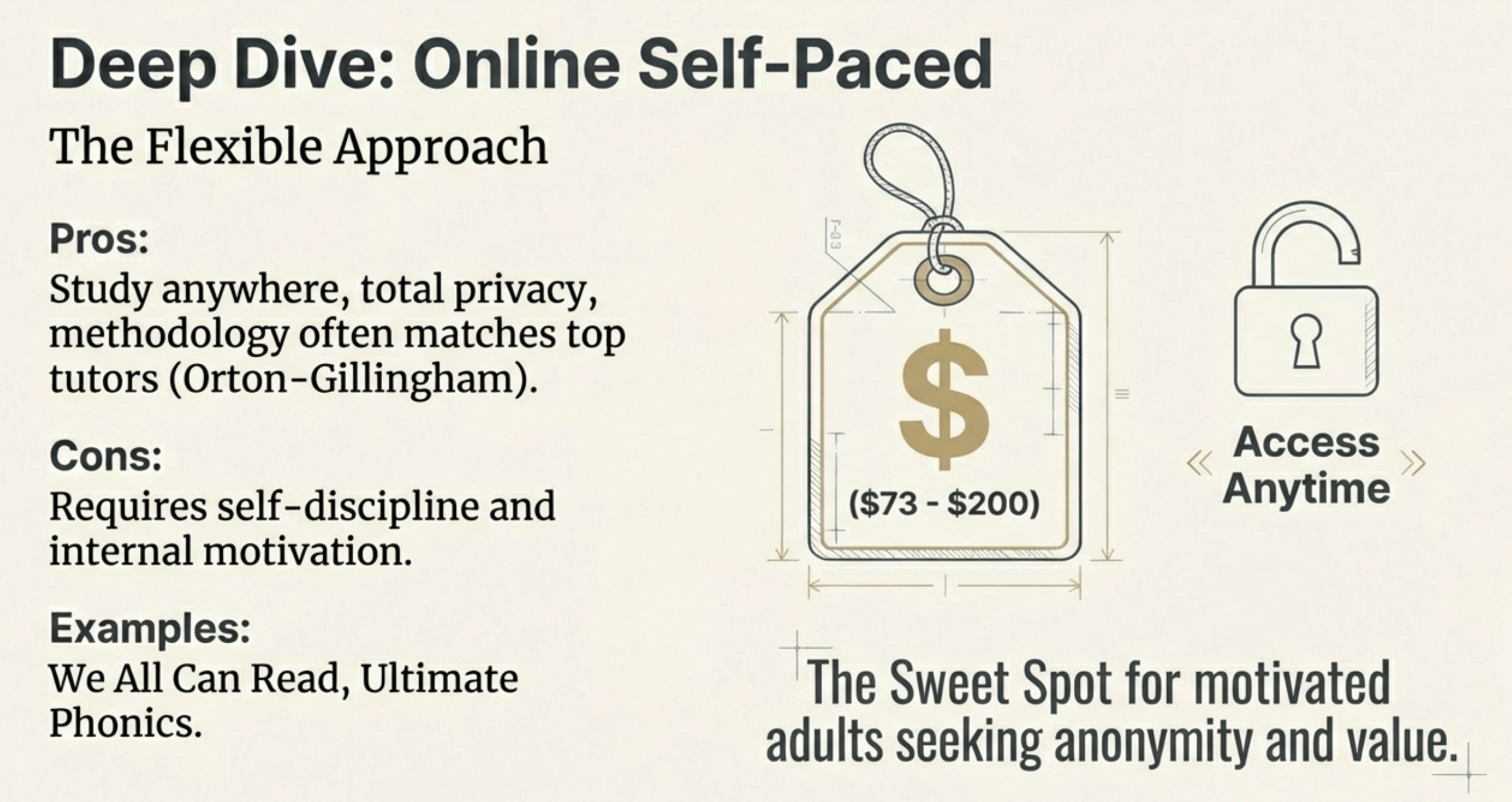
How they work: Comprehensive video-based instruction you complete independently on your own schedule.
Major programs:
- We All Can Read (systematic Orton-Gillingham phonics)
- Ultimate Phonics
- Various other online phonics programs
Pros:
- Affordable ($73-$200/month typically)
- Complete flexibility—study anytime, anywhere
- Privacy—learn at home without classroom anxiety
- Can work at your own pace, spending more time on difficult concepts
- Access to entire curriculum immediately
Cons:
- Requires self-discipline and motivation
- No instructor to ask questions (though some programs offer email support)
- May take longer without external accountability
Best for: Motivated adult learners who need schedule flexibility, prefer learning privately, and want affordable comprehensive instruction.
Adult Education Classes
How they work: Group classes offered through community colleges, libraries, or literacy organizations.
Examples:
- Community college adult basic education (ABE) programs
- Library literacy programs
- Workforce development reading classes
Pros:
- Often free or very low cost
- Peer support from other adult learners
- Instructor available for questions
- Structured schedule provides accountability
Cons:
- Fixed class schedules may conflict with work
- Group pace may be too fast or too slow for you
- Quality varies dramatically by program and instructor
- Many use ineffective teaching methods (sight words, whole language)
- May have waitlists
Best for: Adults who learn well in group settings, need free or very low-cost options, and have schedules compatible with class times.
Important: Ask about the teaching method before enrolling. Many adult education programs don’t use systematic phonics, which means they may not be effective.
Hybrid Programs
How they work: Combination of online lessons with periodic tutor sessions or class meetings.
Examples:
- Reading Horizons Elevate (online + instructor support)
- Some community programs combining software with classes
Pros:
- Flexibility of online learning with some personal instruction
- Often more affordable than pure tutoring
- Accountability from instructor check-ins
Cons:
- Still relatively expensive ($2,000-$8,000 typically)
- Requires coordination with instructor schedule for sessions
- Quality depends on both software and instructor
Best for: Adults who want some personal instruction but need more flexibility and affordability than weekly tutoring.
Red Flags: Programs to Avoid
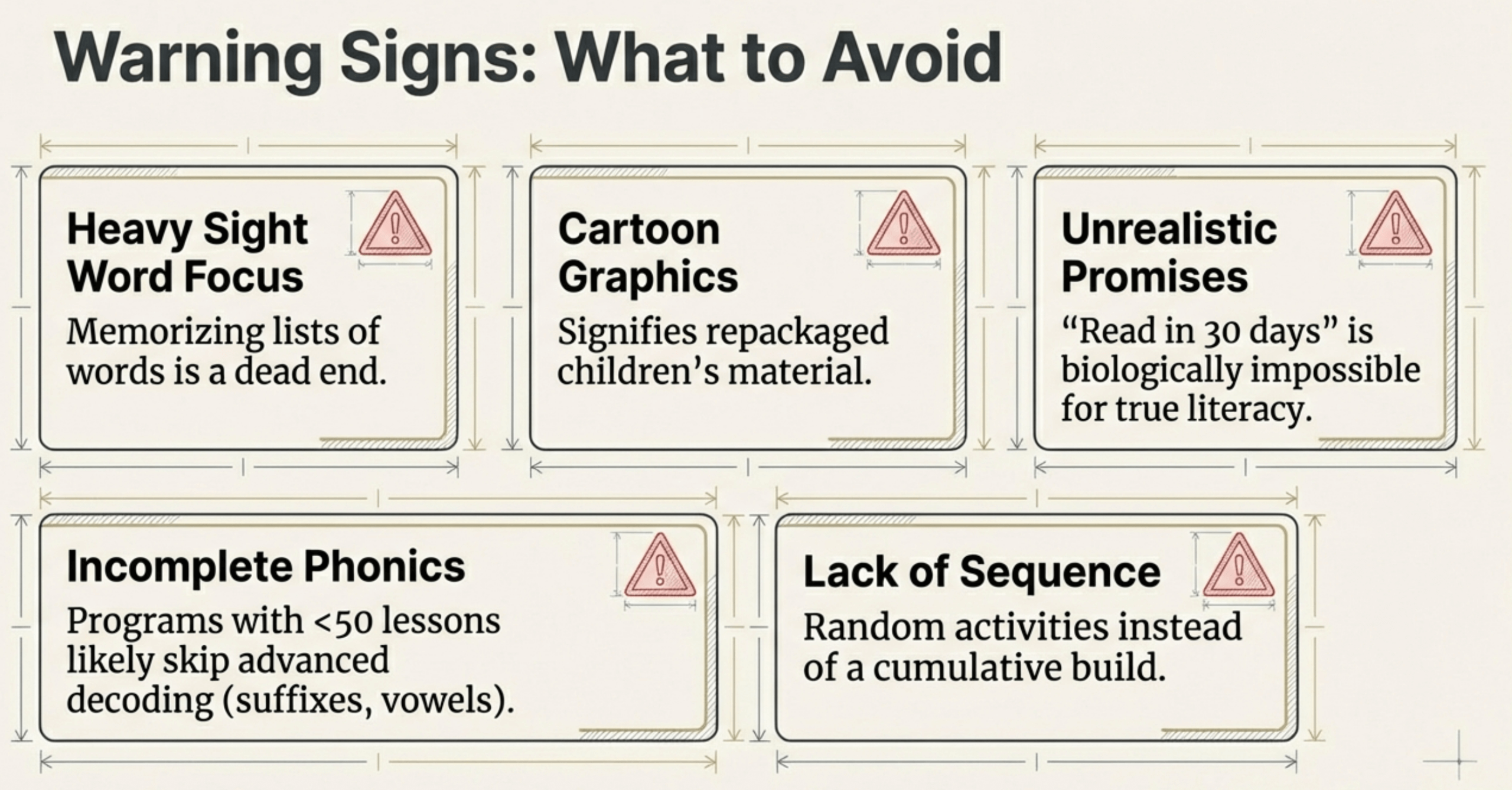
Not every program calling itself an “adult reading program” is worth your time or money. Watch for these warning signs:
Warning Sign #1: Heavy Sight Word Focus
If the program emphasizes memorizing long lists of sight words as the primary teaching method, it’s repeating the approach that likely failed you in childhood.
Small numbers of truly irregular words (the, was, of, etc.) can be memorized, but comprehensive reading ability comes from understanding the phonetic code, not from memorizing thousands of words.
Warning Sign #2: Children’s Materials Relabeled
Look at sample lessons carefully. Are the examples and reading passages actually appropriate for adults? Or are they elementary school materials with “adult” on the cover?
Red flags:
- Reading passages about animals, toys, or playground activities
- Cartoon illustrations
- Childish fonts and graphics
- Examples using children’s names and situations
Warning Sign #3: Incomplete Phonics Coverage
Some programs teach basic letter sounds and simple three-letter words, then quickly move to memorization strategies and guessing techniques.
Effective programs teach the complete phonetic system:
- All vowel patterns (not just short vowels)
- Consonant teams and digraphs
- Syllable division rules
- Prefixes and suffixes
- Advanced spelling patterns
If a program has only 20-50 lessons, it’s almost certainly providing incomplete phonics instruction.
Warning Sign #4: No Clear Teaching Sequence
Random phonics activities or games without systematic progression don’t build comprehensive understanding.
Effective programs have:
- Clear lesson-by-lesson sequence
- Each concept building on previous learning
- Regular review and cumulative practice
- Assessment to ensure mastery
If you can’t see a clear instructional path from beginning to advanced skills, the program lacks the structure needed for success.
Warning Sign #5: Unrealistic Promises
Be skeptical of programs claiming:
- “Read in 30 days!”
- “No effort required!”
- “Just 10 minutes a day!”
- “Works for everyone!”
Learning to read as an adult requires genuine time, effort, and practice. Programs making extreme promises are either targeting people who already have basic skills or significantly overstating their effectiveness.
How to Choose the Right Program for Your Situation
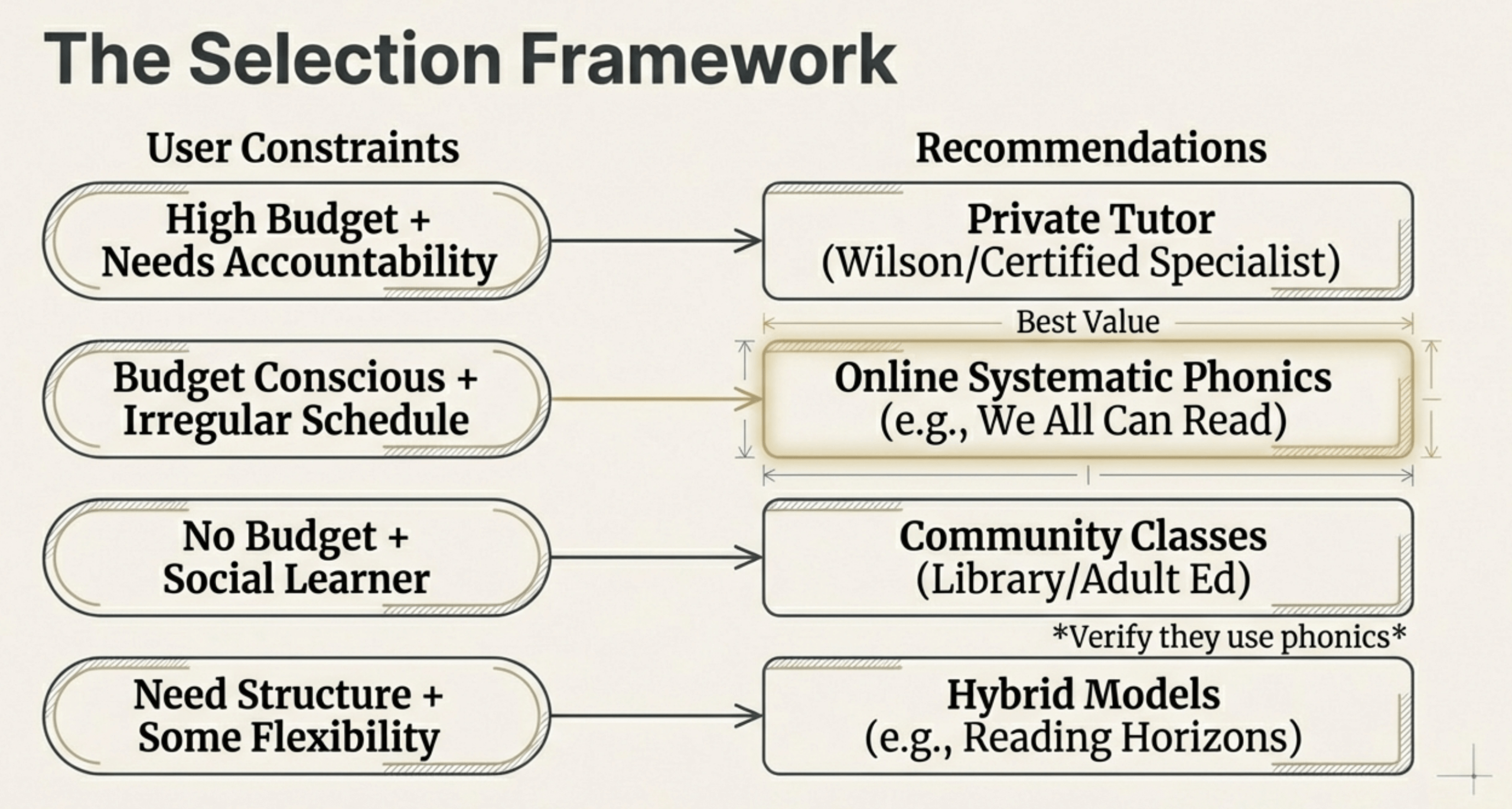
The “best” program depends on your specific circumstances, learning preferences, and goals.
Consider Your Budget
Very limited budget ($0-$50/month):
- Start with free community programs or library literacy classes
- Check if they use systematic phonics (ask specifically)
- Supplement with free online resources
Moderate budget ($50-$200/month):
- Quality online systematic phonics programs
- Self-paced with comprehensive curriculum
- Best value for most adult learners
Larger budget ($500+/month):
- Private tutoring if you prefer individual instruction
- Hybrid programs with tutor support
- Consider whether the added cost provides enough benefit over good online programs
See our Adult Phonics Cost Comparison Guide for detailed analysis of what different programs cost and what you get for that investment.
Assess Your Learning Style
Prefer self-paced independent learning:
- Online programs provide maximum flexibility
- Learn at your own pace without pressure
- Privacy of learning at home
Thrive with structure and accountability:
- Consider classes or programs with scheduled sessions
- Regular meetings provide external motivation
- Social aspect of group learning
Need personalized attention:
- Private tutoring provides individualized instruction
- Immediate feedback on your specific challenges
- Highest cost but maximum support
Evaluate Your Schedule
Irregular schedule, shift work, busy family life:
- Online self-paced programs essential
- Study at 5 AM, during lunch, or at 11 PM—whenever works
- No missed classes when schedule changes
Regular schedule with predictable free time:
- Can accommodate weekly class or tutoring sessions
- Benefit from accountability of scheduled appointments
Consider Your Goals and Timeline
Need to improve quickly for employment or GED:
- Intensive daily practice required regardless of program
- Consider programs offering email support for questions
- May benefit from tutor accountability
Long-term personal goal with flexible timeline:
- Self-paced programs work well
- Can adjust intensity based on other life demands
- Progress steadily without pressure
Account for Emotional Factors
Significant shame or embarrassment:
- Privacy of online learning at home may be important
- Avoid classroom settings that trigger anxiety
- One-on-one tutoring provides judgment-free environment
Isolated, want community support:
- Group classes provide peer connection
- Share journey with others in similar situations
- Motivation from seeing others succeed
Comparing Top Adult Reading Programs
Here’s how major programs compare on key factors:
We All Can Read
Teaching Method: Systematic Orton-Gillingham phonics (720 comprehensive lessons)
Format: Self-paced online video instruction
Content: Specifically designed for adults (grades 3-adult), age-appropriate throughout
Cost: $73/month, typically 12-18 months to completion ($876 – $1,314 total)
Best for: Motivated adults wanting comprehensive systematic phonics at affordable cost with maximum schedule flexibility
Detailed comparison: We All Can Read vs Wilson Reading System, vs Reading Horizons, vs Hooked on Phonics, vs Barton Reading & Spelling System
Wilson Reading System
Teaching Method: Systematic Orton-Gillingham phonics
Format: One-on-one tutoring with certified Wilson instructor
Content: Research-based, proven effective for struggling readers and dyslexia
Cost: $75-160/hour for tutoring, typically $6,000-$28,800 for complete program
Best for: Adults who can afford private tutoring, need intensive individual support, or have learning challenges requiring personalized instruction
Detailed comparison: Wilson Reading System vs We All Can Read
Reading Horizons Elevate
Teaching Method: Mixed approach with limited phonics plus sight word instruction
Format: Online lessons with instructor support
Content: Designed for adults
Cost: $6,000-$8,000 for complete program
Best for: Adults wanting structured online program with instructor support who don’t mind mixed methodology
Note: 20 of 95 lessons focus on memorizing 150+ sight words—the same method that failed many adult learners in childhood
Detailed comparison: Reading Horizons vs We All Can Read
Hooked on Phonics Adult Edition
Teaching Method: Mixed whole-language and phonics with heavy sight word emphasis
Format: Self-paced workbooks and audio
Cost: $200-300 for complete kit
Best for: Adults on tight budgets willing to accept incomplete phonics instruction
Concern: Limited systematic phonics coverage; relies heavily on sight word memorization
Detailed comparison: Hooked on Phonics vs We All Can Read
Barton Reading & Spelling System
Teaching Method: Systematic Orton-Gillingham phonics (10 levels, 120-150 lessons)
Format: One-on-one tutoring using physical materials and DVDs (tutor-dependent)
Content: Designed for dyslexic learners, primarily homeschool market
Cost: ~$2,900 for all materials (10 levels); plus tutor costs if hiring professional tutor ($11,520-$30,720)
Critical factor: Requires a tutor for every lesson. Cannot be used independently.
Best for: Homeschool parents teaching dyslexic children; adults who have a family member willing to commit 2+ hours/week for 2-4 years to tutor them; those who can afford professional Barton tutoring
Key consideration for adults: Barton was designed for parent-child homeschool tutoring. Adults must answer: “Who will tutor me 2+ hours/week for 2-4 years?” Options are limited:
- Family member (requires their multi-year commitment)
- Professional Barton tutor ($45-60/hour = $11,520-$30,720 total)
- Cannot self-tutor (tutoring model doesn’t work solo)
Completion outcome: Mid-9th grade reading level
Detailed comparison: Barton Reading & Spelling System vs We All Can Read
Community Adult Basic Education Programs
Teaching Method: Varies widely—ask about their approach
Format: In-person classes, typically weekly
Content: Varies by program
Cost: Usually free
Best for: Adults needing free instruction who learn well in groups
Important: Many don’t use systematic phonics. Ask specifically what teaching method they use before enrolling.
Questions to Ask Before Choosing a Program
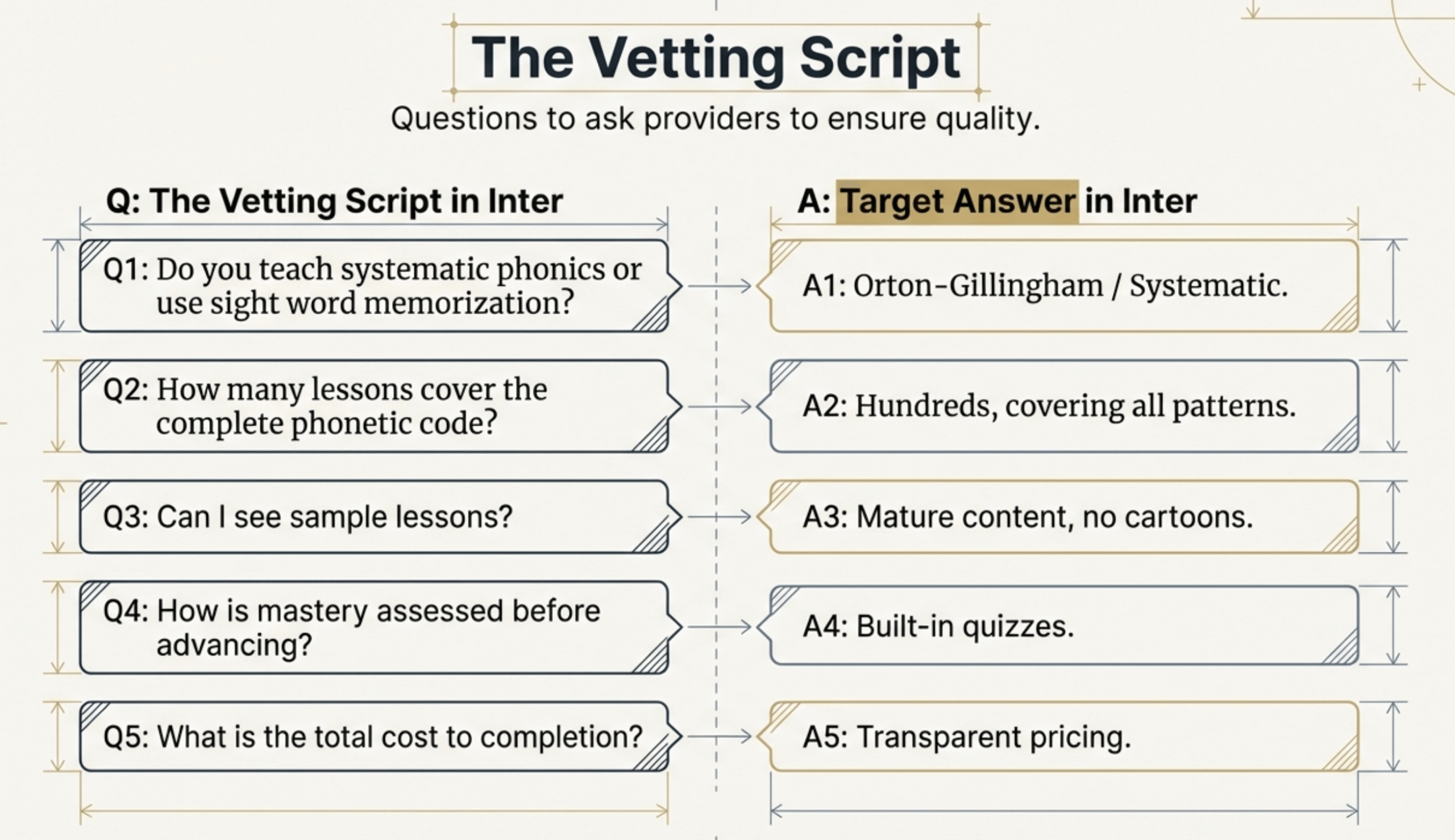
Don’t just accept marketing claims. Ask these specific questions:
About Teaching Method
- “Do you teach systematic phonics or use sight word memorization?”
- Look for: “Comprehensive systematic phonics” or “Orton-Gillingham approach”
- Red flag: “Balanced approach” often means mixed methods with incomplete phonics
- “How many lessons cover the complete phonetic code?”
- Look for: Several hundred lessons covering all English phonetic patterns
- Red flag: Programs with only 20-50 lessons have incomplete coverage
- “Do students learn to decode unfamiliar words or memorize specific words?”
- Look for: Focus on decoding skills and understanding patterns
- Red flag: Heavy emphasis on word lists to memorize
About Content and Format
- “Can I see sample lessons to verify the content is age-appropriate?”
- Look at actual examples—don’t just trust descriptions
- Verify reading passages, examples, and exercises respect adult learners
- “Is this self-paced or do I need to follow a fixed schedule?”
- Determine if format fits your availability and learning style
- “What practice opportunities are included?”
- Look for: Extensive reading practice at each level
- Red flag: Mostly explanation with minimal actual reading practice
About Support and Assessment
- “How do you ensure I’ve mastered concepts before advancing?”
- Look for: Built-in quizzes or assessments throughout
- Red flag: No mechanism to verify understanding
- “What support is available if I get stuck or have questions?”
- Options might include: email support, tutor sessions, online forums
- Some programs provide no support beyond the materials
About Cost and Commitment
- “What’s the total cost to complete the program?”
- Get complete picture: monthly fees, materials costs, any additional charges
- Ask about typical completion timeline to calculate total investment
- “Can I try before committing financially?”
- Look for: Free trial lessons or money-back guarantee
- Experience the teaching style before investing
Taking Action: Starting Your Search
Ready to choose a program? Here’s your action plan:
Before diving into program selection, make sure you understand the complete process of learning to read as an adult. Our comprehensive guide covers everything from why adults struggle to realistic timelines: How to Learn to Read as an Adult
Step 1: Identify Your Must-Haves
Based on your situation, determine your non-negotiables:
- Maximum budget
- Schedule requirements (fixed or flexible)
- Learning format preference (self-paced, classes, tutoring)
- Timeline and goals
Step 2: Research 3-5 Programs
Don’t just pick the first program you find. Compare several options:
- Review their websites
- Check if they use systematic phonics
- Look at sample lessons if available
- Read reviews from other adult learners
Step 3: Ask Questions
Contact programs directly with the questions listed above. Their responses will reveal:
- Whether they actually use systematic phonics
- If content is truly age-appropriate
- How much support they provide
- Whether they’re transparent about costs
Step 4: Try Before Buying
If possible, experience the teaching before committing:
- Take free trial lessons
- Attend a sample class
- Request demonstration materials
Many adults find that teaching style matters enormously. What works well for one person may not click for another.
Step 5: Commit and Begin
Once you’ve chosen:
- Set a specific start date
- Block out daily practice time
- Create your study space
- Tell supportive people about your goal
Most adults see noticeable progress within the first month of consistent practice with a quality systematic phonics program.
Why Methodology Matters More Than Marketing
The adult literacy field is full of programs making impressive claims. Some spend heavily on marketing but use ineffective teaching methods. Others have modest marketing but deliver exceptional results.
What separates effective from ineffective programs isn’t marketing budget or brand recognition—it’s teaching methodology.
Programs using systematic phonics consistently achieve higher success rates because they teach you the complete code underlying written English. Once you understand the code, you can read independently, not just recognize words you’ve memorized.
Programs using sight word memorization and mixed methods have much higher failure rates because they repeat the same approaches that didn’t work in childhood. Memorization has severe limits, and guessing strategies don’t build true reading ability.
When choosing a program, focus on methodology first, other factors second.
The right program will:
- Teach comprehensive systematic phonics
- Use age-appropriate materials
- Provide extensive practice
- Fit your schedule and budget
- Give you tools to read any word, not just memorize specific words
Moving Forward: You Can Learn to Read
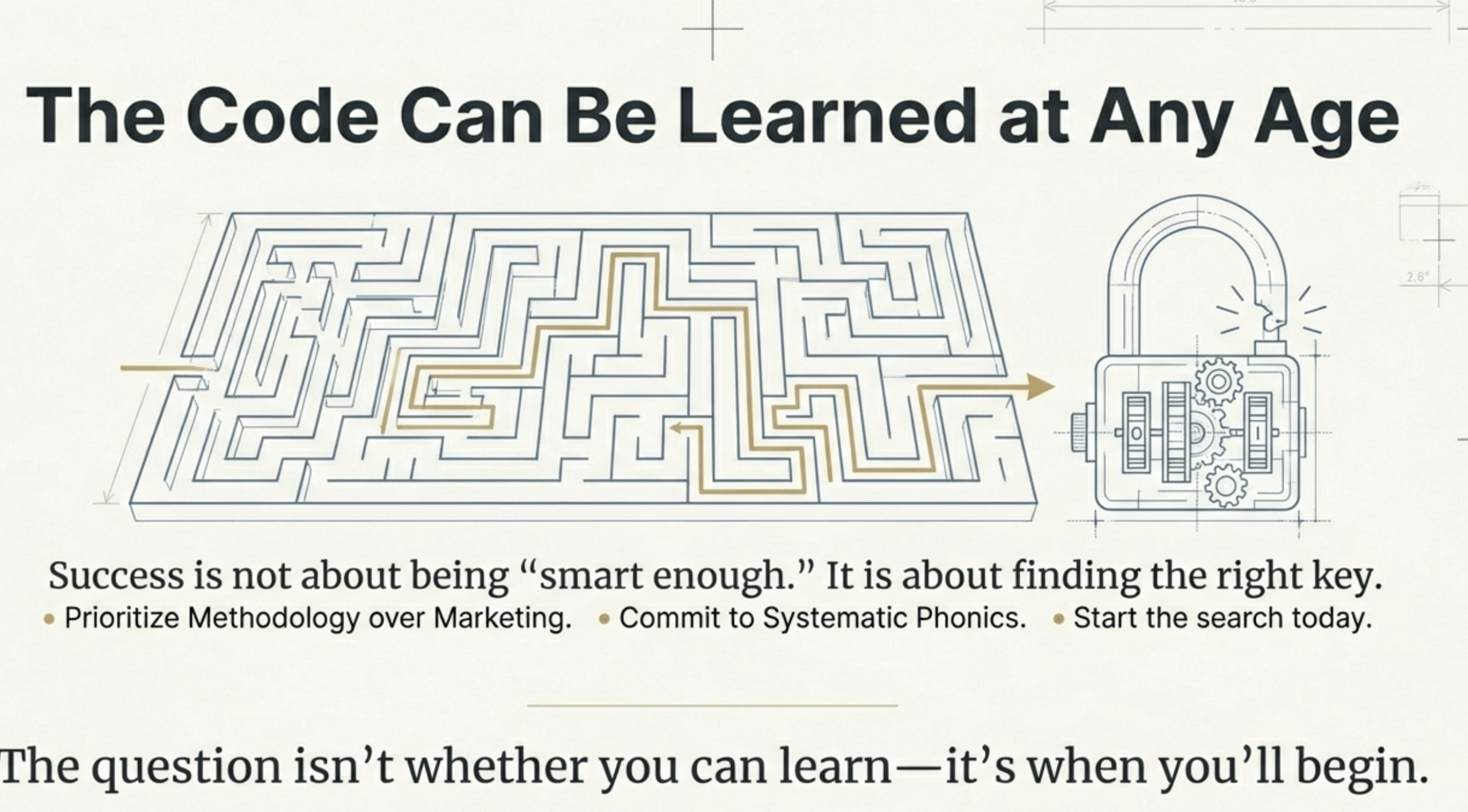
Thousands of adults successfully learn to read every year. The common factor: they found effective instruction using systematic phonics and committed to consistent practice.
You can do this too.
The program you choose matters, but what matters most is starting. Every day you delay is another day of limitation. You deserve reading independence, career opportunities, and the ability to help your children with homework.
Next steps:
- Try 10 free lessons to experience systematic phonics instruction
- Read success stories from adults who learned to read
- Compare program costs to find the right investment for your budget
- Learn more about how long it takes to set realistic expectations
- Understand systematic phonics and why it works for adult learners
- Address age concerns if you’re worried about being too old
The path to reading is clearer than you think. The question isn’t whether you can learn—it’s when you’ll begin.
Frequently Asked Questions
What’s the difference between phonics programs and reading programs?
“Phonics” and “reading” often describe the same thing from different angles. Phonics is the teaching method—the system for understanding how letters represent sounds. Reading is the goal. The best adult reading programs use systematic phonics as their primary teaching method because it’s the most effective approach for adults who struggle with reading.
Can online programs really work as well as tutoring?
Yes, if they provide comprehensive systematic phonics instruction. While tutoring offers personalized attention, well-designed online programs teach the same content with the same systematic approach. Many adults actually prefer online learning because of the privacy, flexibility, and significantly lower cost. The key is choosing an online program with complete curriculum and clear instruction.
How do I know if a program is really using systematic phonics?
Ask specifically: “Do you teach the complete alphabetic code systematically from simple to complex?” Look for programs with several hundred lessons covering all phonetic patterns—not just basic phonics. Check if they follow Orton-Gillingham principles. If a program mentions “balanced approach” or emphasizes sight words heavily, it’s likely using mixed methods rather than true systematic phonics.
What if I’ve tried programs before and they didn’t work?
If previous programs used sight word memorization, whole language, or mixed methods, they weren’t using the approach most likely to work. Systematic phonics is fundamentally different. Many adults who failed with memorization-based programs succeed with phonics-based instruction because it teaches understanding rather than rote learning.
Are expensive programs better than affordable ones?
Not necessarily. Program cost often reflects delivery format (private tutoring vs. online) rather than teaching quality. A $20,000 tutoring program and a $600 online program might teach the exact same systematic phonics content. The difference is individual attention vs. self-paced learning. Choose based on which format works for your learning style and budget, not price alone.
How long should I expect it to take?
With consistent daily practice (20-30 minutes), most adults starting from the beginning achieve functional reading ability in 8-12 months. Adults who can read somewhat but struggle significantly typically see major improvement in 4-6 months. Be skeptical of programs promising dramatically faster results—learning to read requires genuine time and practice.
Related Resources: