Proven Techniques for Developing Reading Fluency
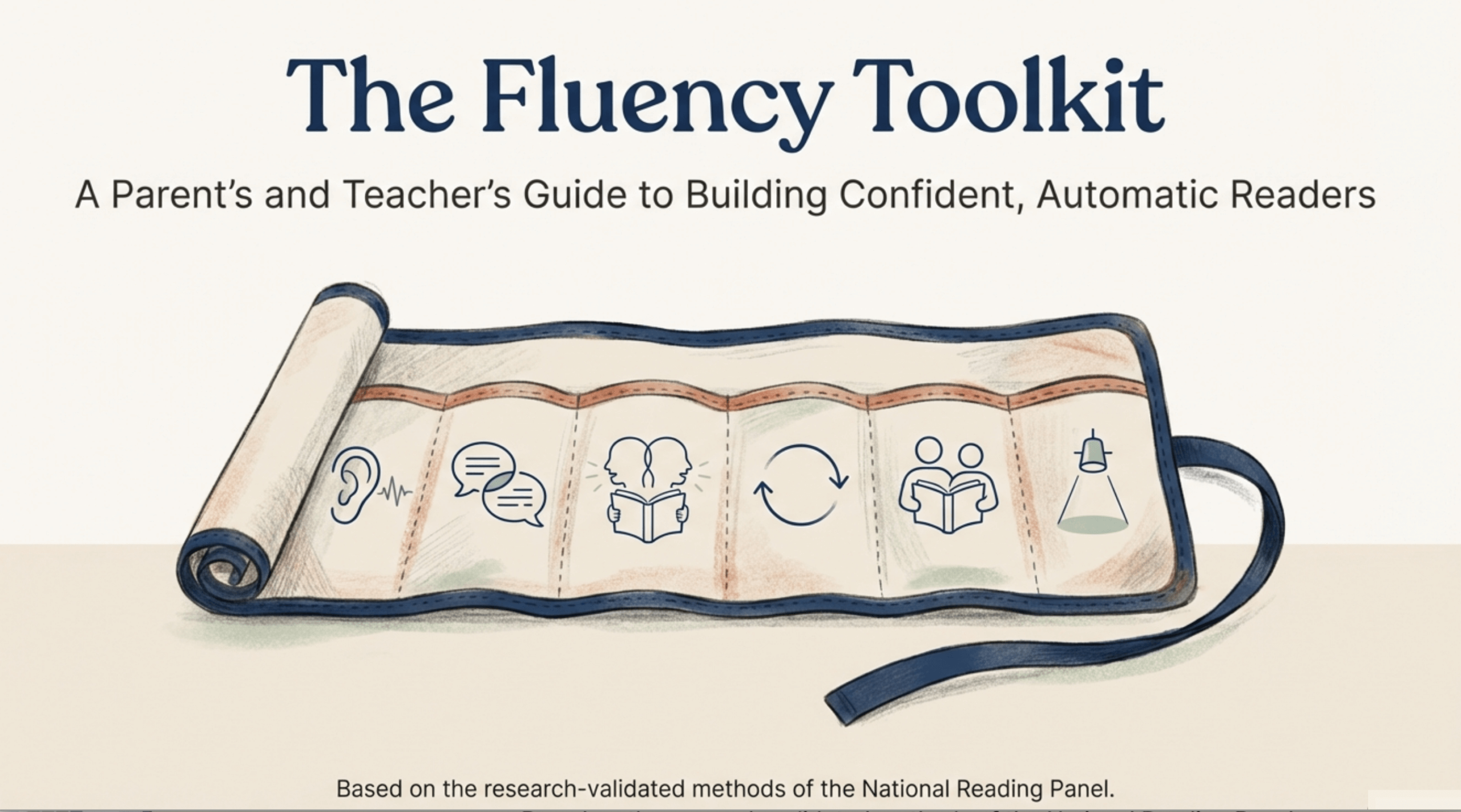
Fluency Requires Explicit Instruction and Practice
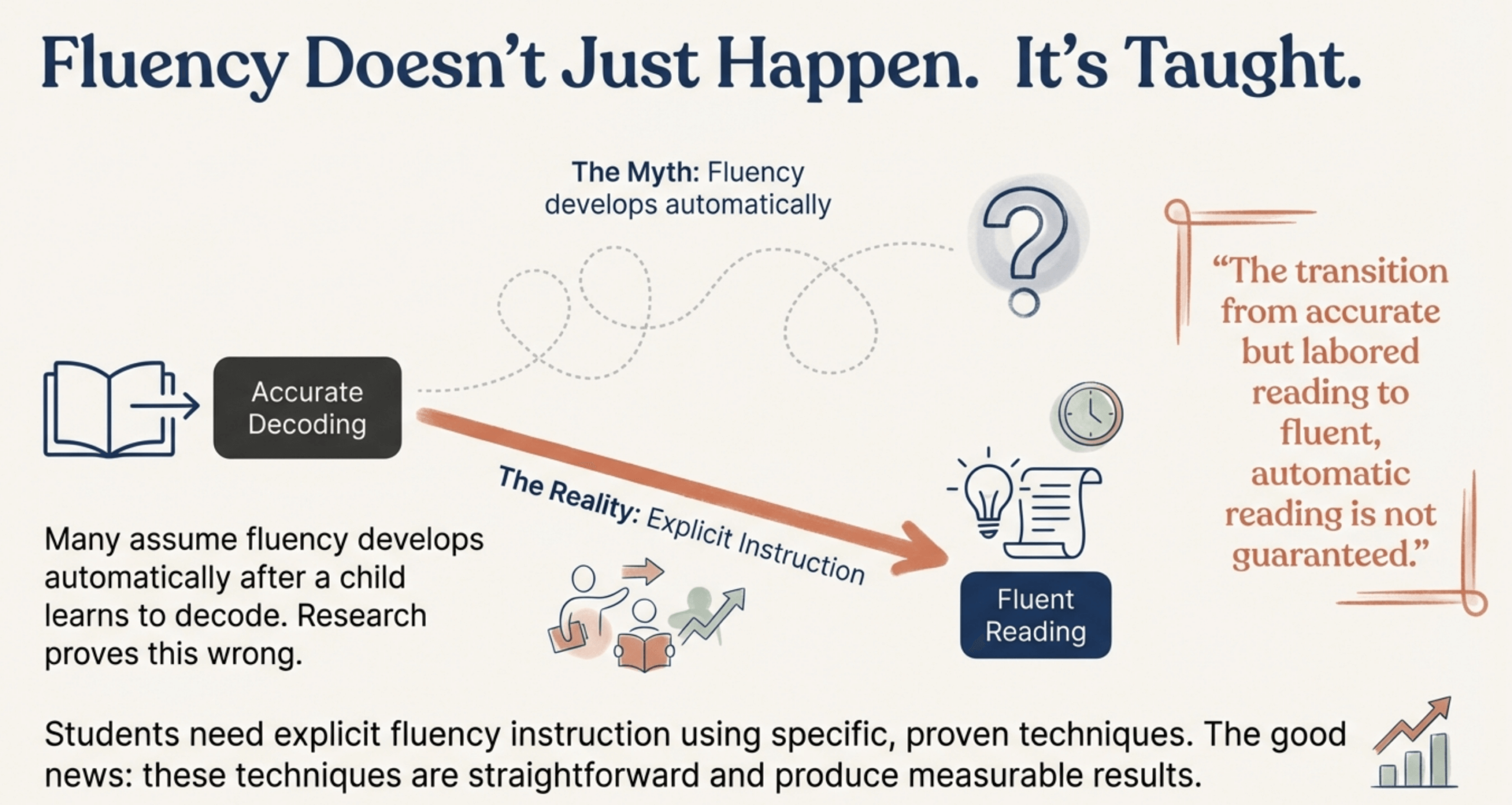
Many parents and teachers assume that fluency develops automatically once students can decode accurately. They believe students simply need more reading practice—any reading practice—and fluency will naturally emerge over time.
Research proves this assumption wrong. The transition from accurate but labored reading to fluent, automatic reading is not guaranteed. Students need explicit fluency instruction using specific, research-validated techniques.
Fortunately, these techniques are straightforward, require no special training, and produce measurable results when applied consistently. Parents can implement them at home with remarkable success.
The Foundation: Guided Oral Reading Practice
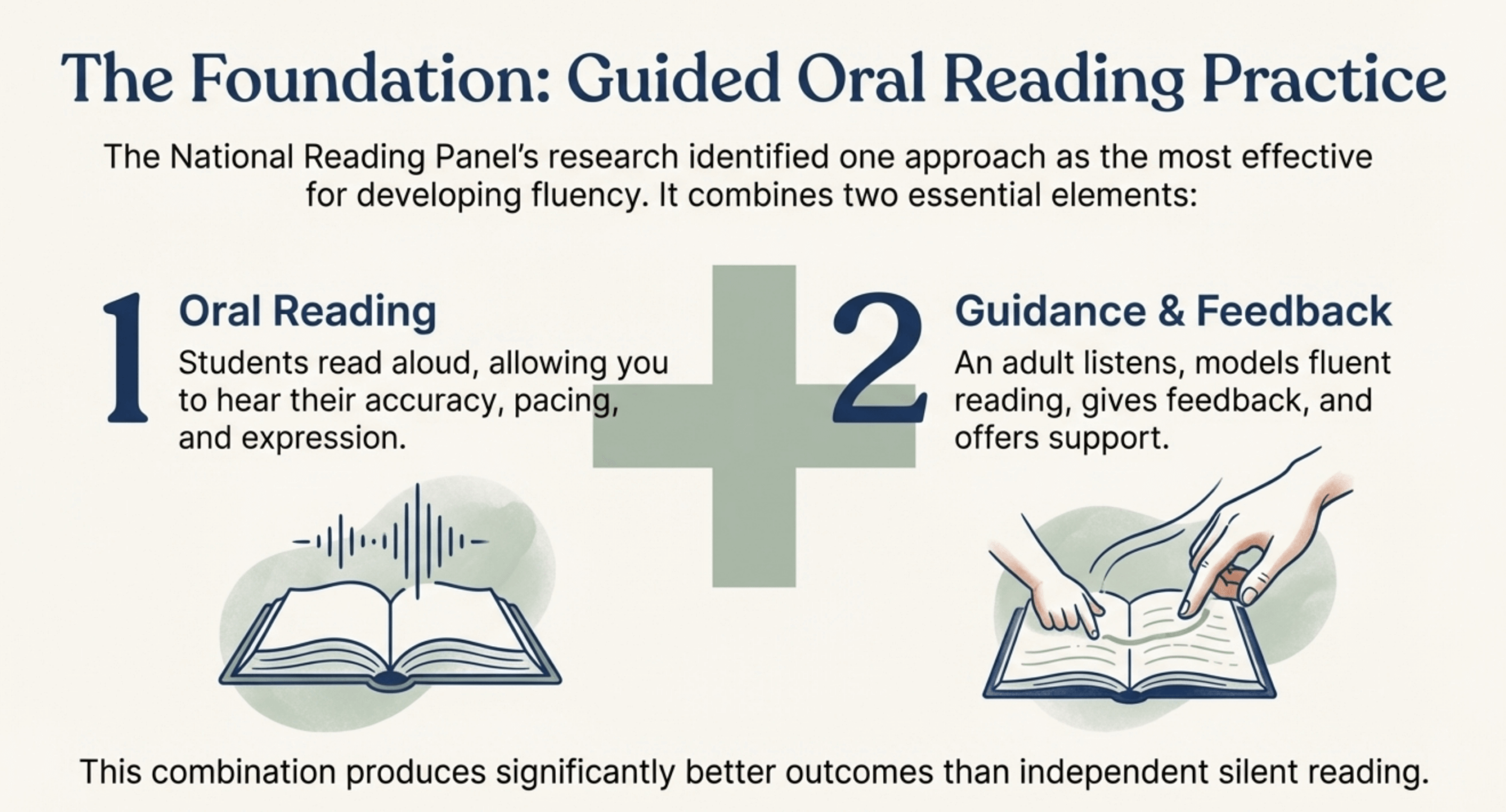
The National Reading Panel’s comprehensive review of reading research identified guided oral reading practice as the single most effective approach for developing fluency. This method combines two essential elements:
1. Oral Reading
Students read aloud (not silently), allowing you to hear accuracy, pacing, and expression
2. Guidance and Feedback
An adult (parent, teacher, tutor) listens, provides modeling, gives feedback, and offers support
This combination—oral reading with guidance—produces significantly better fluency outcomes than independent silent reading or round-robin classroom reading without feedback.
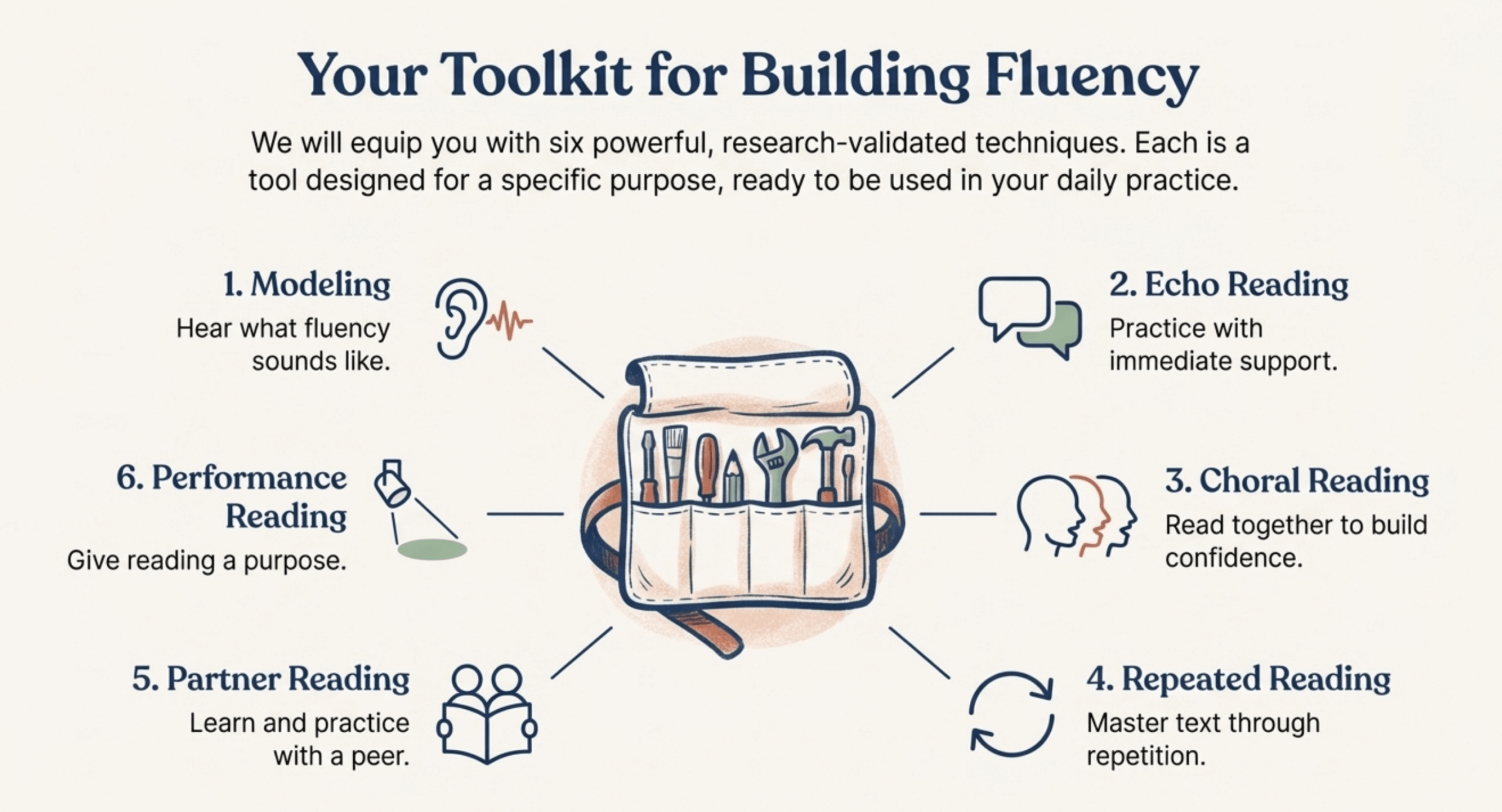
Technique 1: Teacher/Parent Modeling

What It Is
The adult reads aloud while the student follows along silently with the text, listening to fluent reading and observing how proficient readers handle phrasing, pacing, and expression.
Why It Works
Students need to hear what fluent reading sounds like before they can produce it themselves. Modeling demonstrates:
- Appropriate reading rate (not too fast, not too slow)
- Natural phrasing (grouping words into meaningful chunks)
- Expressive intonation (voice rising for questions, emphasizing important words)
- Appropriate pauses (at commas, periods, and phrase boundaries)
Many struggling readers have rarely heard fluent reading modeled. They don’t know what they’re aiming for. Modeling provides a clear target.
How to Implement
Step 1: Select a passage of appropriate difficulty (your child should be able to decode 95%+ of words)
Step 2: Have your child follow along with their finger while you read
Step 3: Read with natural expression and appropriate pacing—exactly how you want your child to read
Step 4: Optionally, repeat the same passage a second time, reinforcing the fluent model
Frequency: Model reading at the beginning of every fluency practice session before asking your child to read
Technique 2: Echo Reading
What It Is
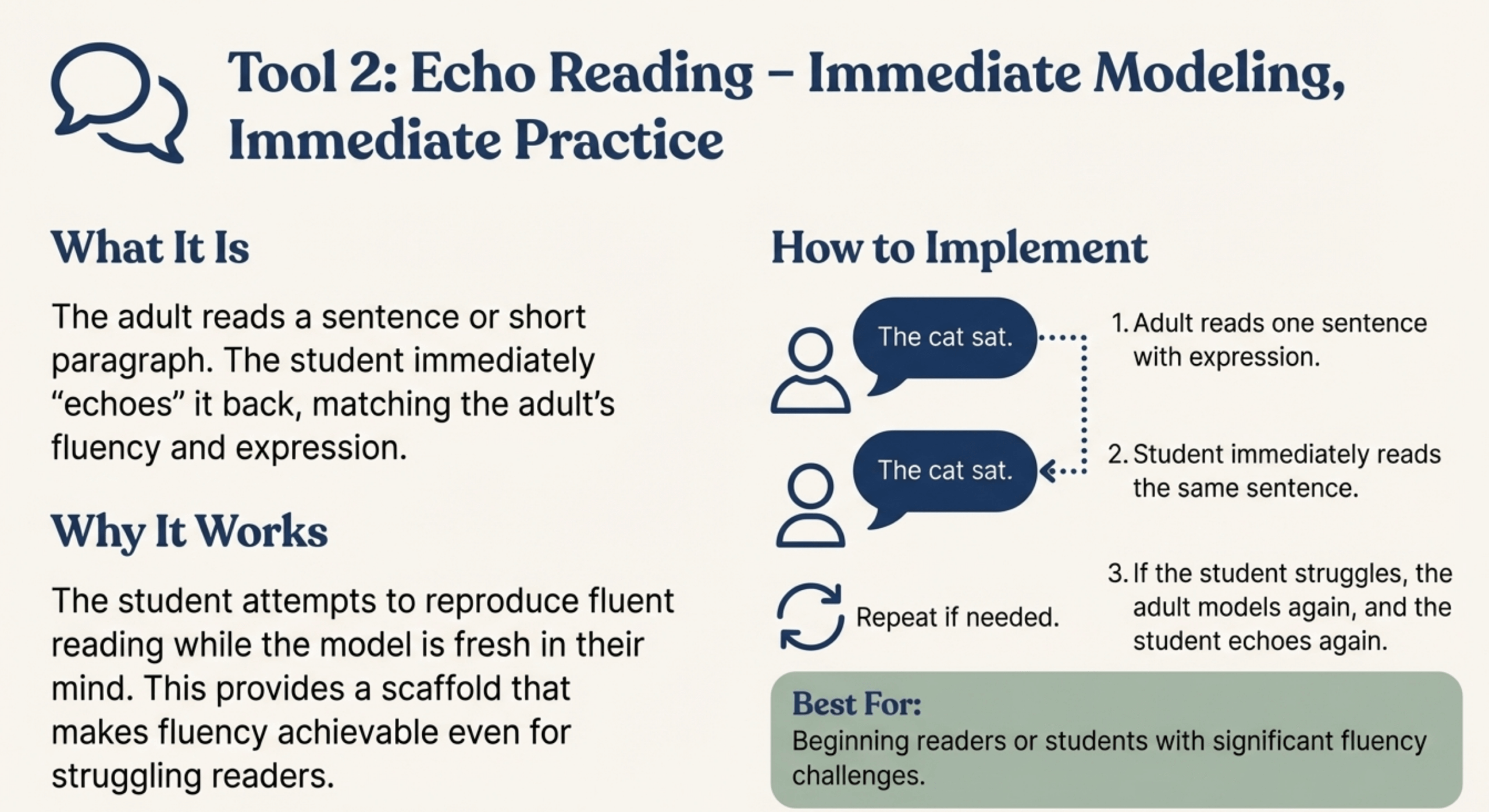
The adult reads a sentence or short paragraph aloud. The student immediately “echoes” the same sentence or paragraph, attempting to match the adult’s fluency, pacing, and expression.
Why It Works
Echo reading provides immediate modeling followed by immediate practice. The student hears fluent reading, then instantly attempts to reproduce it while the model is fresh in their mind.
This technique works particularly well with struggling readers who need extensive support. The adult’s modeling provides a scaffold that makes fluent reading achievable even for students who struggle when reading independently.
How to Implement
Step 1: Adult reads one sentence with expression
Step 2: Student immediately reads the same sentence, attempting to match the adult’s fluency
Step 3: If the student struggles, the adult can read the sentence again (modeling), then the student echoes again
Step 4: Move to the next sentence and repeat
Variation: For longer passages, read and echo entire paragraphs rather than individual sentences
Best for: Beginning readers, students with significant fluency challenges, or when introducing new, more complex text
Technique 3: Choral Reading (Unison Reading)
What It Is
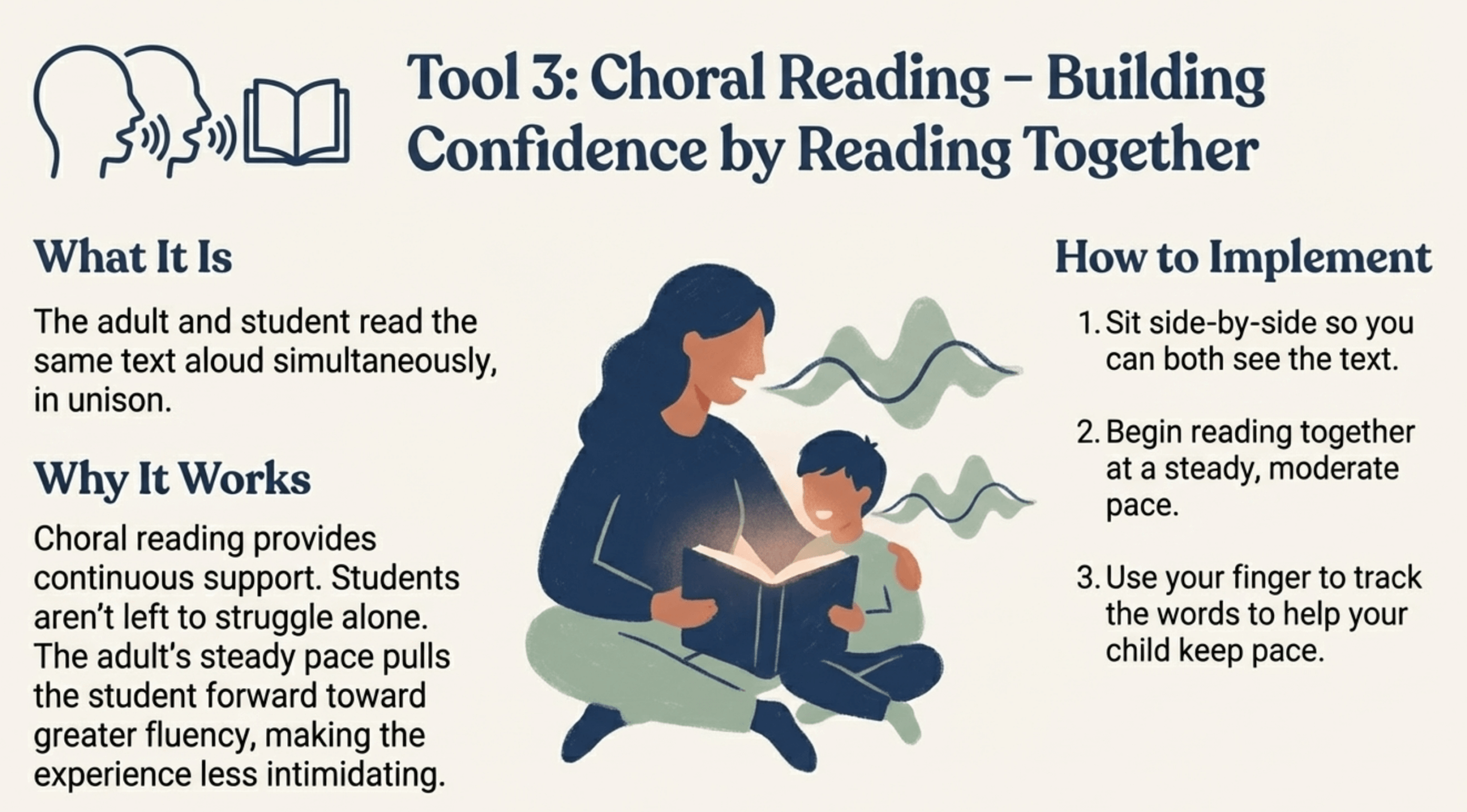
The adult and student read aloud together simultaneously, speaking in unison. The adult’s fluent reading supports and guides the student’s oral reading in real-time.
Why It Works
Choral reading provides continuous support throughout the reading. Students aren’t left to struggle alone—they read alongside a fluent model who maintains appropriate pacing and expression.
This technique builds confidence. Students who fear reading aloud because they’re slow or make mistakes find choral reading less intimidating. They’re supported throughout, not exposed and alone.
How to Implement
Step 1: Position yourself and your child side-by-side so both can see the text clearly
Step 2: Begin reading together at the same time, maintaining a steady, moderate pace
Step 3: Use your finger or a pointer to track under words as you read, helping your child keep pace
Step 4: Read the entire passage together without stopping
Step 5: Optionally, read the same passage chorally 2-3 times to build fluency
Important: Maintain a pace that supports your child—not so fast they can’t keep up, but faster than they would read independently. Your pacing pulls them forward toward greater fluency.
Best for: Building confidence, introducing new text, or when students need maximum support
Technique 4: Repeated Reading
What It Is
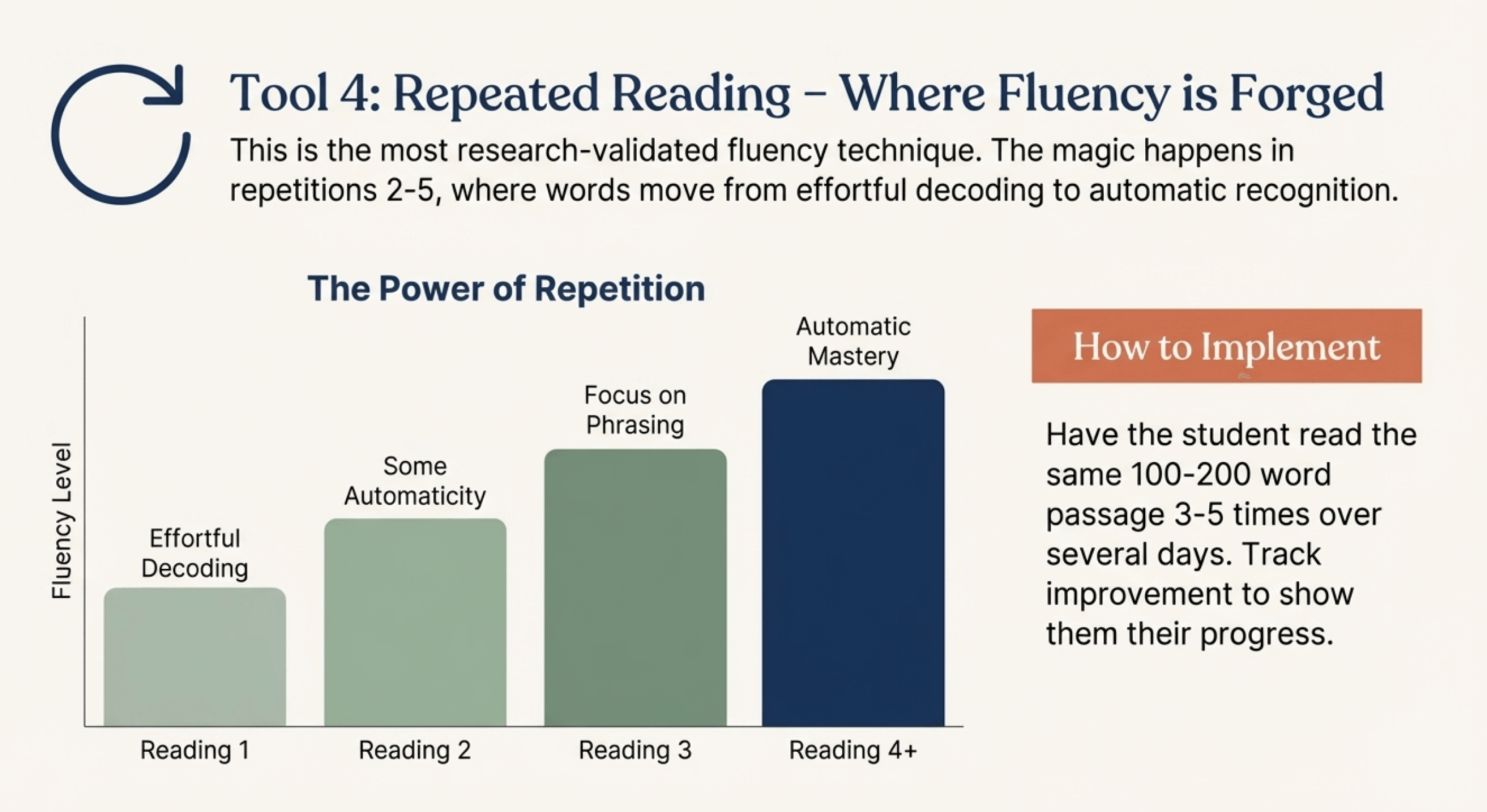
The student reads the same passage multiple times (typically 3-5 times) over several days or practice sessions. Each reading becomes progressively more fluent as word recognition becomes more automatic.
Why It Works
Repeated reading is the most research-validated fluency technique. Studies consistently show dramatic fluency improvements when students reread passages multiple times.
What happens with each reading:
- Reading 1: Student focuses cognitive energy on decoding individual words. Reading is slow and effortful.
- Reading 2: Some words are now recognized automatically. Less decoding effort required. Reading speed increases slightly.
- Reading 3: Most words automatic. Student can focus on phrasing and expression. Reading smoothness improves significantly.
- Reading 4: Nearly effortless automatic recognition. Student reads smoothly with good expression and appropriate pacing.
- Reading 5: Mastery level fluency with this specific text.
Each repetition moves more words from effortful decoding to automatic recognition, freeing cognitive capacity for fluency and comprehension.
How to Implement
Step 1: Select a passage of 100-200 words at appropriate difficulty level
Step 2: Have your child read the passage aloud (Reading 1)
Step 3: Provide feedback: note errors, give encouragement, identify what went well
Step 4: Later the same day or the next day, have your child reread the same passage (Reading 2)
Step 5: Continue rereading the same passage over 3-5 practice sessions
Step 6: Track improvement—time each reading or count errors to show measurable progress
Step 7: Once fluency is achieved with this passage, move to a new passage and repeat the process
Critical: Don’t abandon passages after one reading. The magic happens in repetitions 2-5, where fluency actually develops.
Technique 5: Partner Reading (Paired Reading)
What It Is
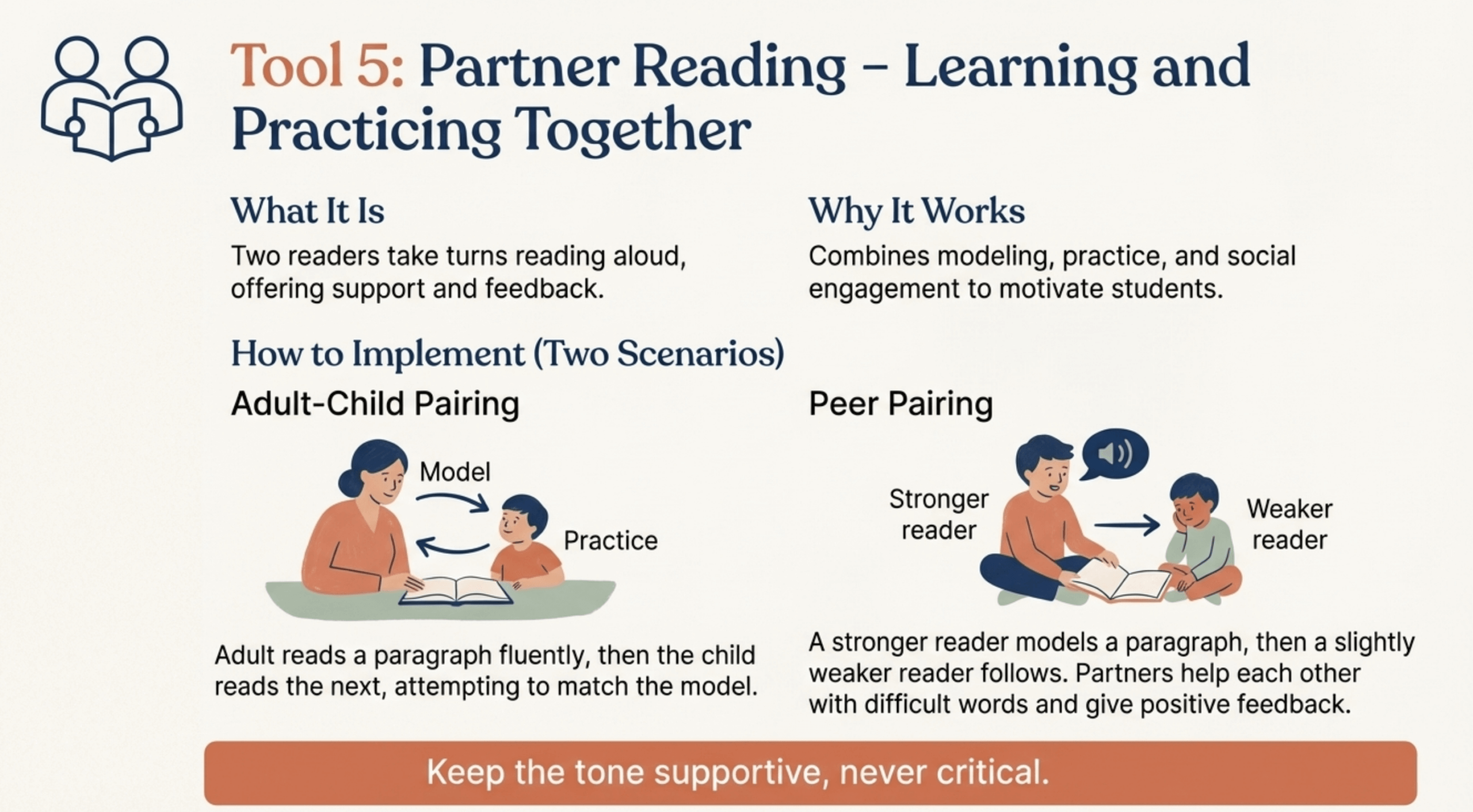
Two students read together, taking turns. One student reads a paragraph or page, then the other student reads the next paragraph or page. Partners provide support and feedback to each other.
Why It Works
Partner reading combines modeling, practice, and social engagement. When paired with a slightly stronger reader, struggling readers hear fluent reading modeled and receive peer support. When paired with a reader of similar ability, students practice together and motivate each other.
How to Implement (Adult-Child Pairing)
Step 1: Adult (stronger reader) reads one paragraph fluently
Step 2: Child reads the next paragraph, attempting to match the adult’s fluency
Step 3: Adult provides immediate feedback and support if child struggles
Step 4: Continue alternating paragraphs through the passage
Step 5: Optional second reading: Reverse roles or have child read the entire passage independently
How to Implement (Sibling or Peer Pairing)
Best pairing: Match a stronger reader with a slightly weaker reader (not too large a gap)
Guidelines for partners:
- Stronger reader goes first, modeling fluent reading
- Weaker reader follows, attempting to match the model
- Partners help each other with difficult words (decode together, don’t just tell the answer)
- Both readers give positive feedback (“That sounded great!” “You read that smoothly!”)
- Keep the tone supportive, never critical
Duration: 10-15 minutes per session, 3-4 times per week
Technique 6: Performance Reading (Reader’s Theater)
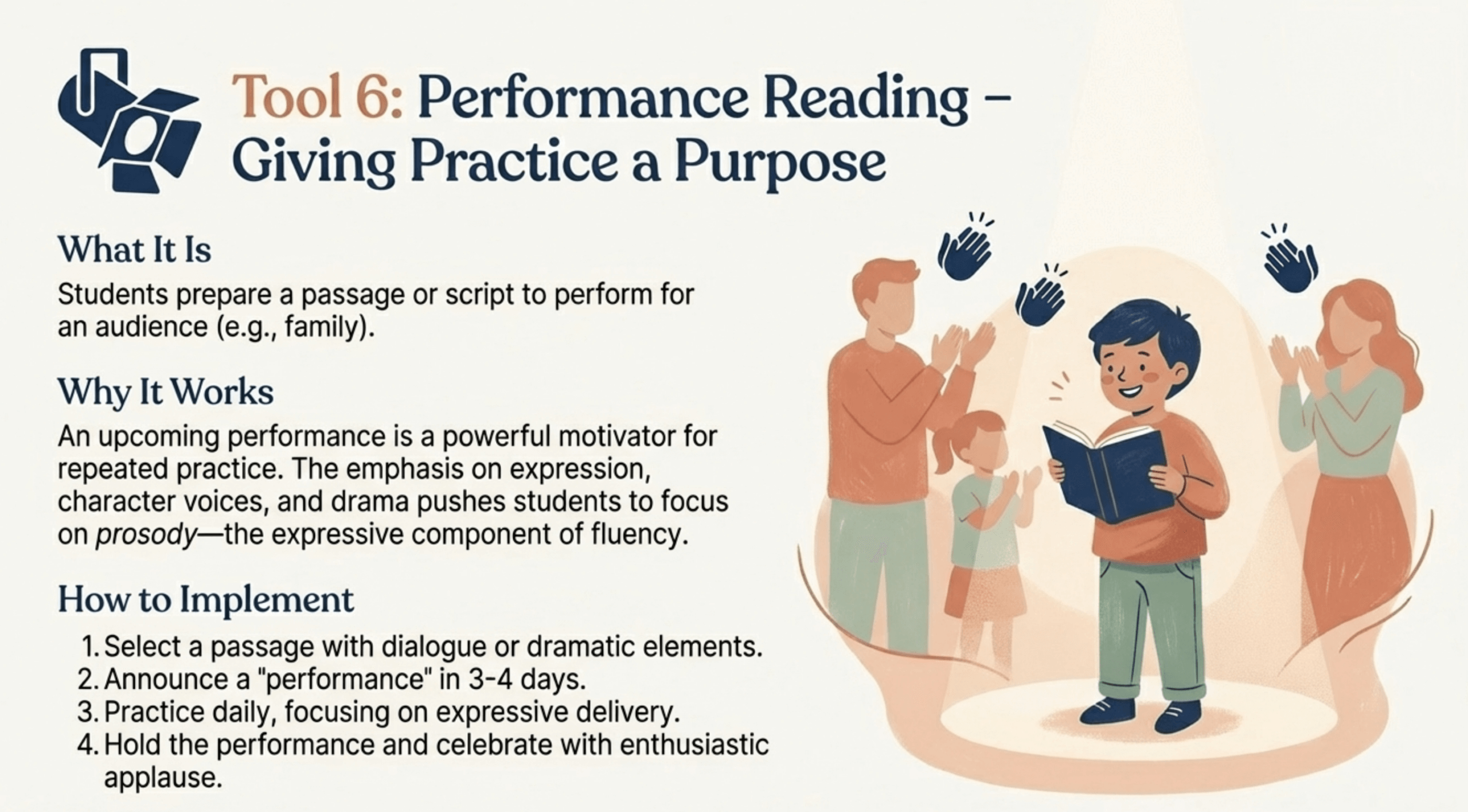
What It Is
Students prepare a passage or script for performance—reading it aloud to an audience (family members, classmates, etc.) with expression, character voices, and drama.
Why It Works
Performance reading gives students a meaningful goal—reading for an audience—which motivates repeated practice. Students willingly reread passages multiple times when preparing for a performance, naturally developing fluency through repetition.
The emphasis on expression and character voices pushes students to focus on prosody (expressive reading), the component of fluency often neglected in other practice methods.
How to Implement
Step 1: Select a passage with dialogue, character roles, or natural dramatic elements
Step 2: Announce that your child will “perform” this reading for family in 3-4 days
Step 3: Practice together daily, working on expression, character voices, pacing, and dramatic delivery
Step 4: Encourage your child to reread independently between practice sessions
Step 5: On performance day, have your child read to family members with full expression
Step 6: Audience provides enthusiastic applause and positive feedback
Materials: Decodable stories with dialogue work well, or use age-appropriate reader’s theater scripts
Frequency: Weekly or bi-weekly performances keep motivation high without overwhelming students
Creating an Effective Fluency Practice Routine
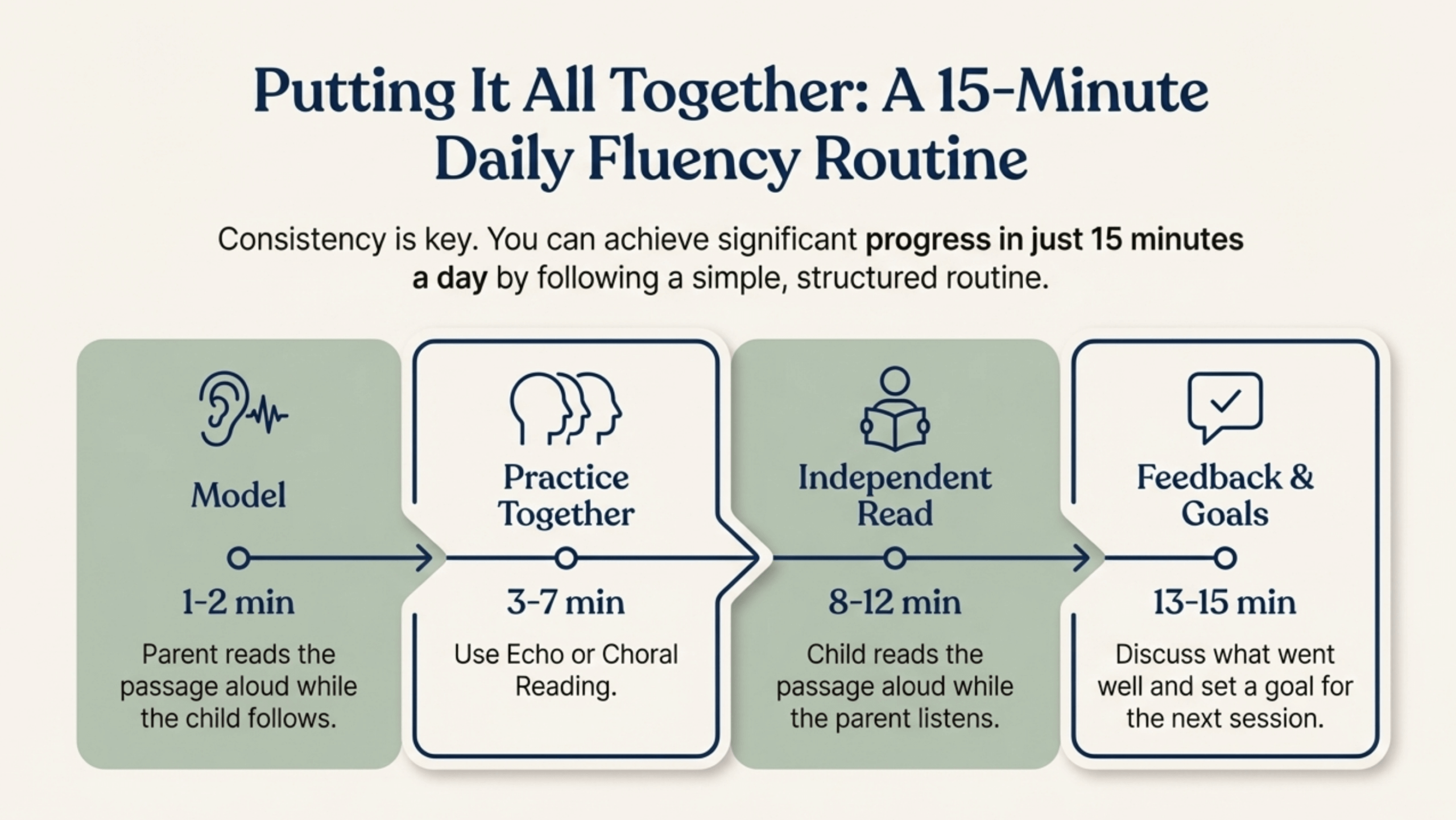
Sample 15-Minute Daily Fluency Session
Minutes 1-2: Modeling
Parent reads passage aloud while child follows along
Minutes 3-7: Echo or Choral Reading
Practice together using echo or choral reading
Minutes 8-12: Independent Reading
Child reads passage independently while parent listens
Minutes 13-15: Feedback and Goal-Setting
Discuss what went well, identify one area for improvement, set goal for next session
Weekly Progression
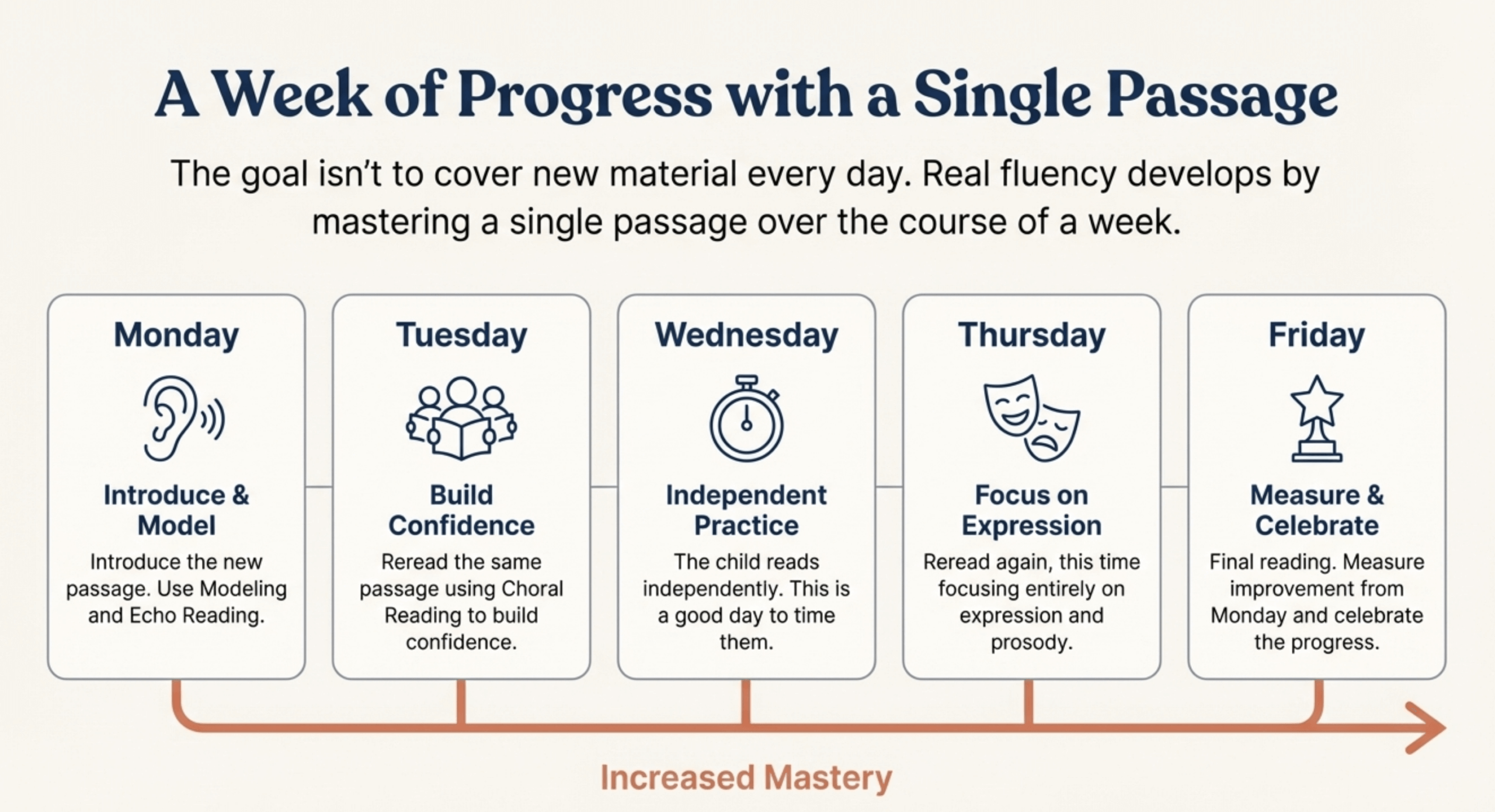
Monday: Introduce new passage, model reading, practice with echo reading
Tuesday: Reread same passage using choral reading
Wednesday: Child reads independently, parent tracks fluency
Thursday: Reread with focus on expression and prosody
Friday: Final reading—measure improvement from Monday, celebrate progress
Adjusting Difficulty
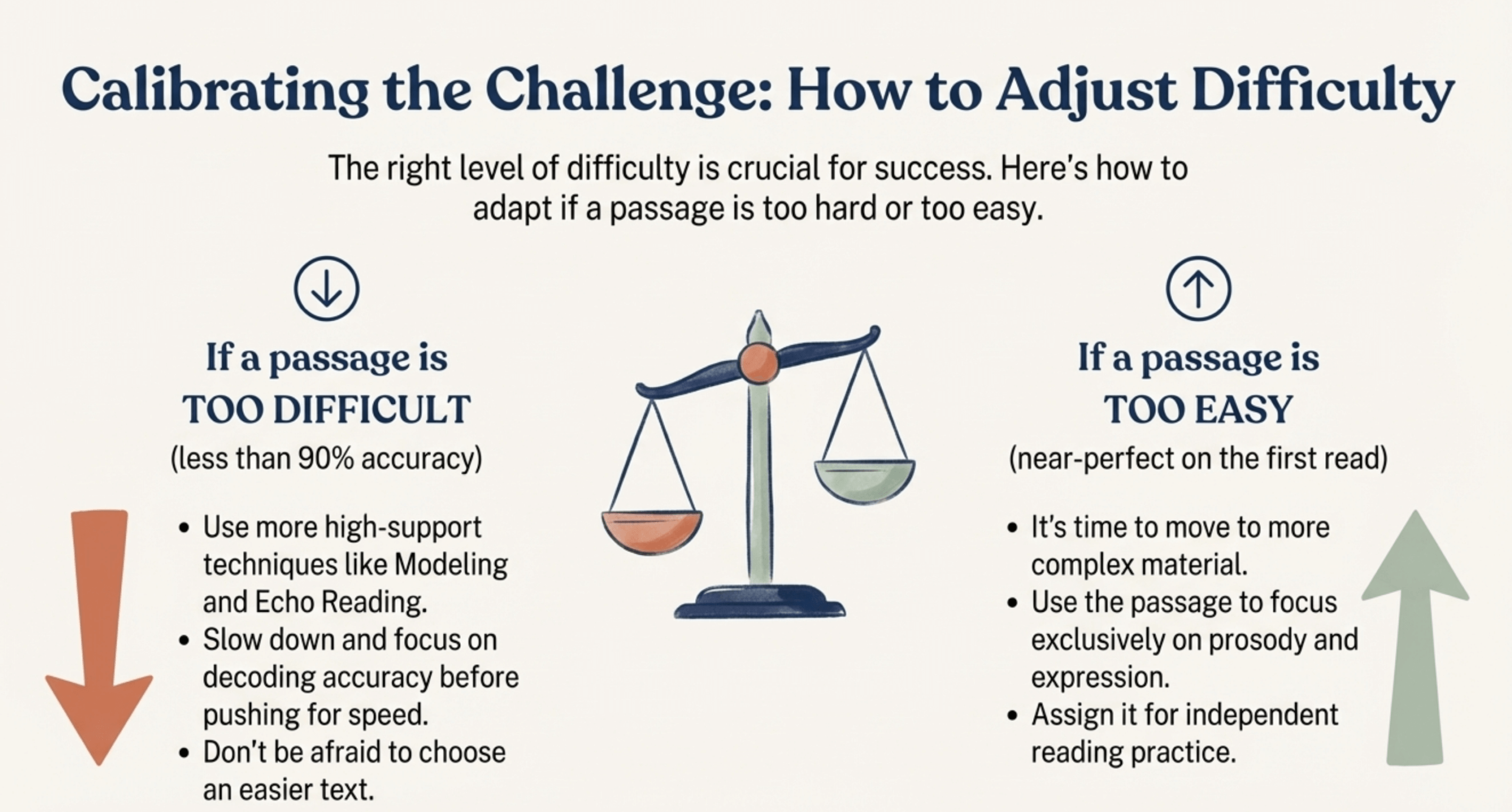
If passage is too difficult (below 90% accuracy):
- Use more modeling and echo reading
- Slow down and work on decoding accuracy first
- Consider choosing easier material
If passage is too easy (near-perfect fluency on first reading):
- Move to more complex material
- Focus on prosody and expression rather than accuracy
- Use the passage for independent reading practice
How Our Program Incorporates These Techniques
Built-In Modeling
Every fluency lesson includes audio recordings of fluent reading. Students hear the model, then practice reading the same passage themselves. This builds-in the modeling component automatically.
Structured for Repeated Reading
Our 720 online lessons and the 141 lessons in our supplemental reader are designed for multiple readings over several days. Each lesson is short enough to read 3-5 times without overwhelming students, yet substantive enough to build real fluency gains through repetition.
Progressive Complexity
Fluency passages begin simple (50-75 words, basic CVC patterns) and gradually increase in length and complexity (200+ words, multisyllabic words, varied sentence structures). This ensures students build fluency at each level before advancing.
Decodable Text Ensures Success
All fluency materials use strictly controlled vocabulary matching students’ phonics knowledge. This allows students to focus on fluency rather than decoding, making all practice techniques more effective.
Parent Guide Provides Direction
Our online program provides guidance regarding how to implement these fluency techniques at home. Parents don’t need to figure out implementation—clear instructions are provided for each technique.
Measuring Fluency Progress
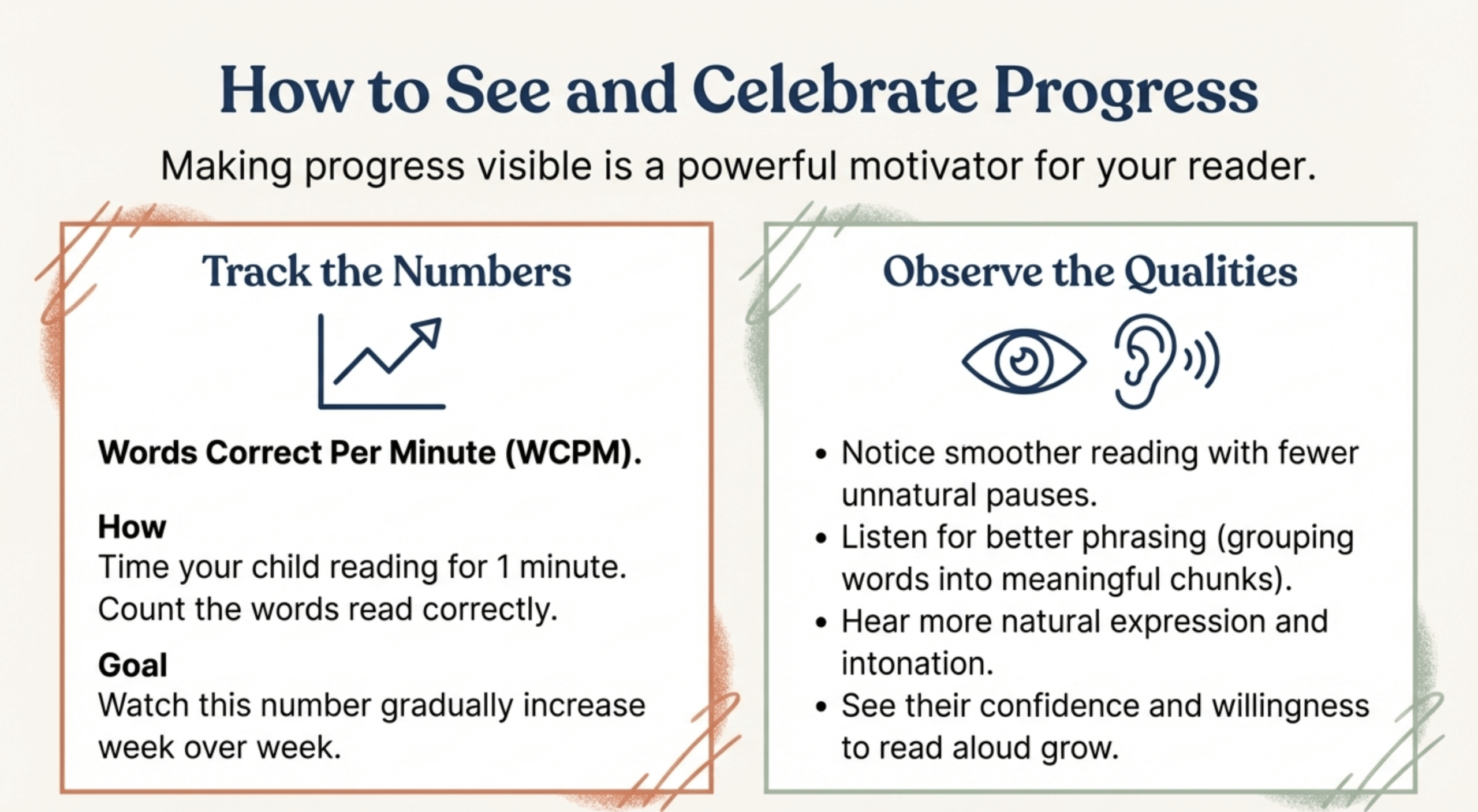
Track Words Correct Per Minute (WCPM)
Time your child reading a passage for 1 minute. Count words read correctly (don’t count errors). Track this number weekly—it should gradually increase over time.
Observe Qualitative Improvements
Beyond speed, notice:
- Smoother reading with fewer pauses
- Better phrasing (grouping words naturally)
- More expression and intonation
- Improved confidence and willingness to read aloud
Compare First and Final Readings
When using repeated reading, compare Monday’s first reading to Friday’s final reading. The improvement should be dramatic and obvious—this visible progress motivates students tremendously.
You’ve Completed the 9 Essential Strategies!
Put These Techniques Into Practice
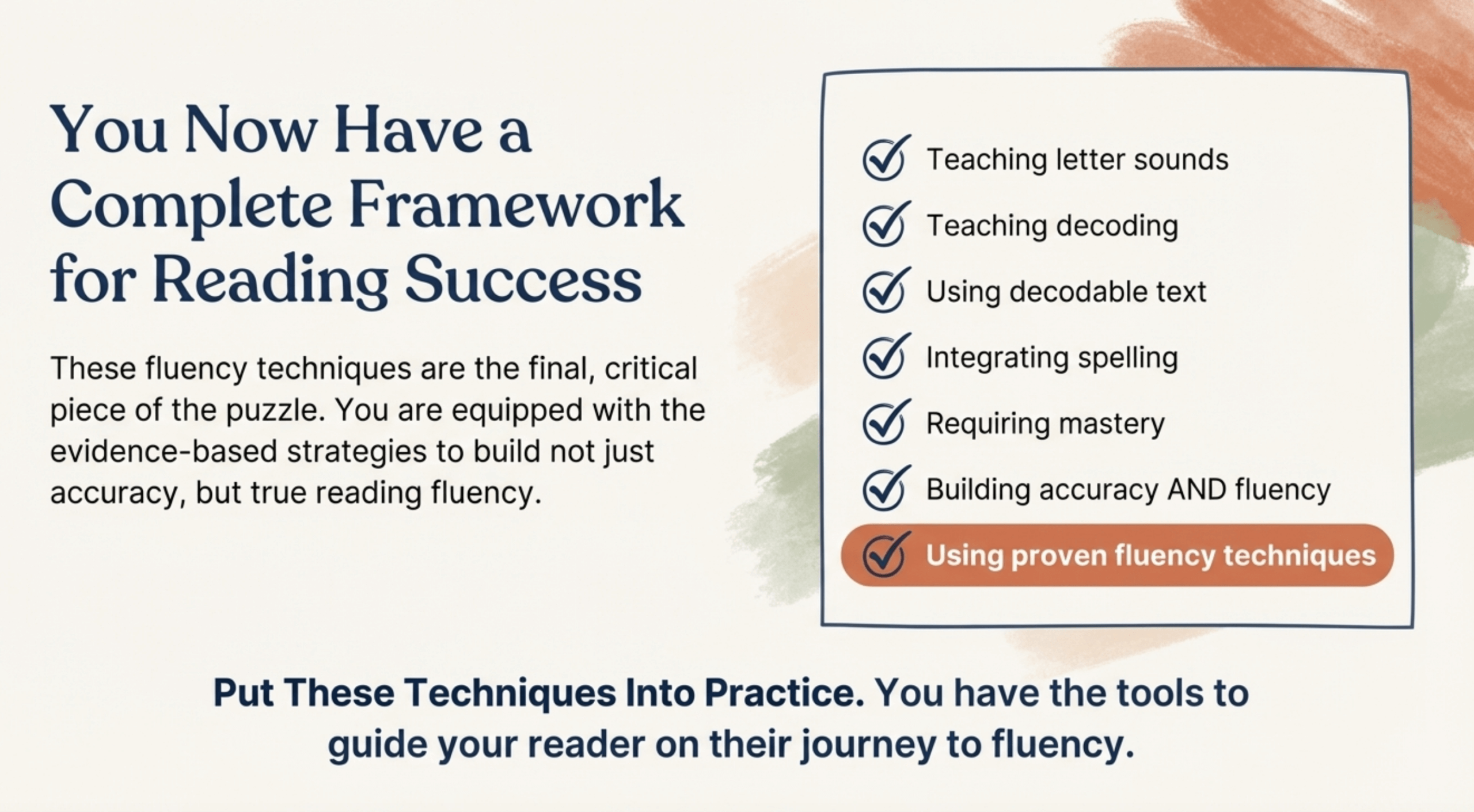
Congratulations on working through all nine evidence-based strategies for helping struggling readers. You now have a complete framework for building reading success:
- ✅ Understanding why parents must take action
- ✅ Teaching letter sounds and spelling rules
- ✅ Teaching decoding without guessing
- ✅ Using decodable text for practice
- ✅ Incorporating spelling at every step
- ✅ Integrating reading and spelling instruction
- ✅ Requiring mastery before advancing
- ✅ Building both accuracy and fluency
- ✅ Using proven fluency techniques

Our comprehensive program includes 720 online lessons and 141 additional extra practice lessons in our supplemental fluency reader. All lessons are designed specifically for repeated reading practice. Try our first 10 lessons free—no credit card required.
Continue Reading: The 9 Essential Strategies
← Previous: Reading Accuracy vs. Fluency: Why Both Matter
Questions about fluency techniques? Contact us.