Teach to Mastery
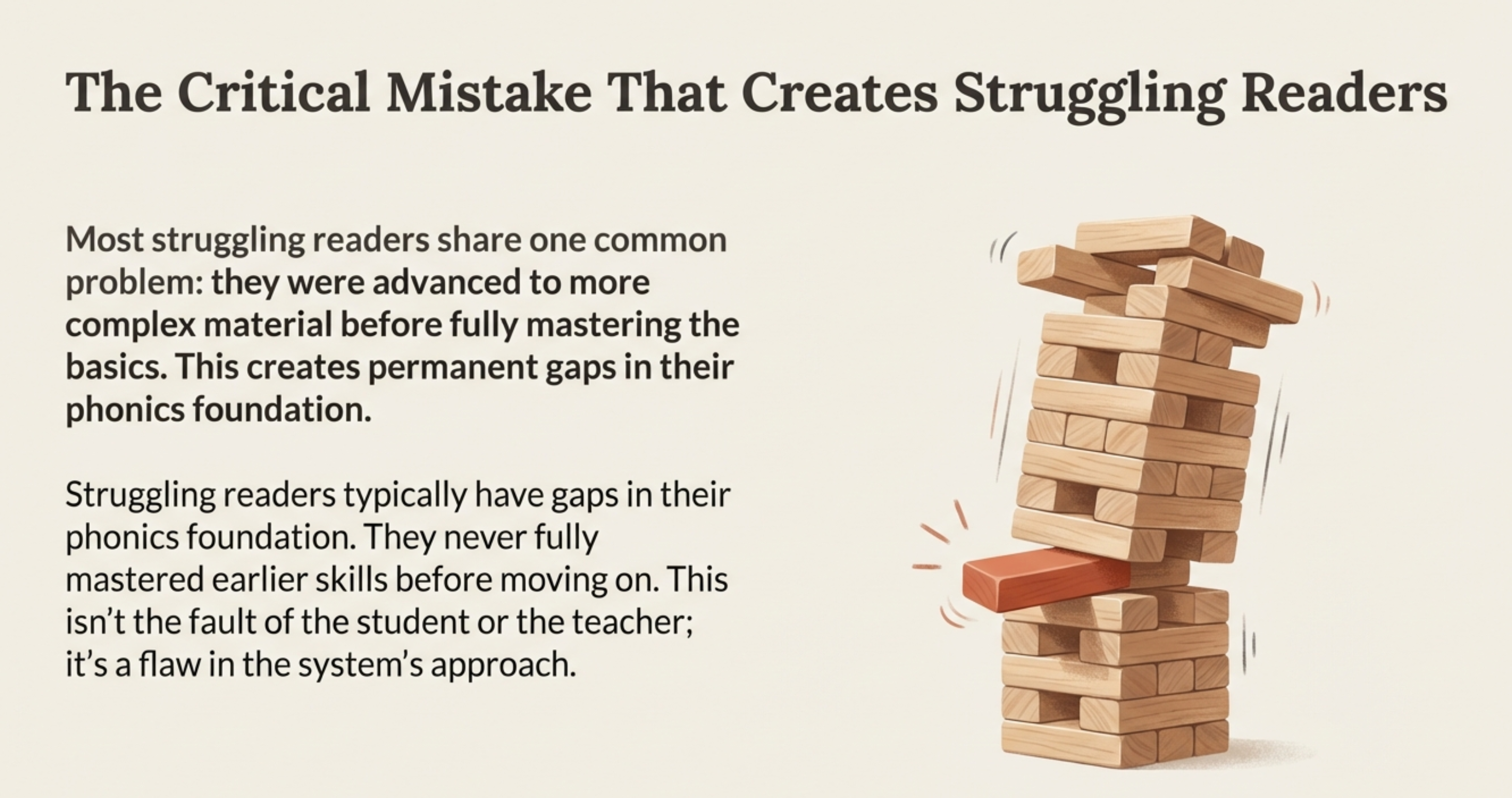
The Critical Mistake Most Reading Programs Make
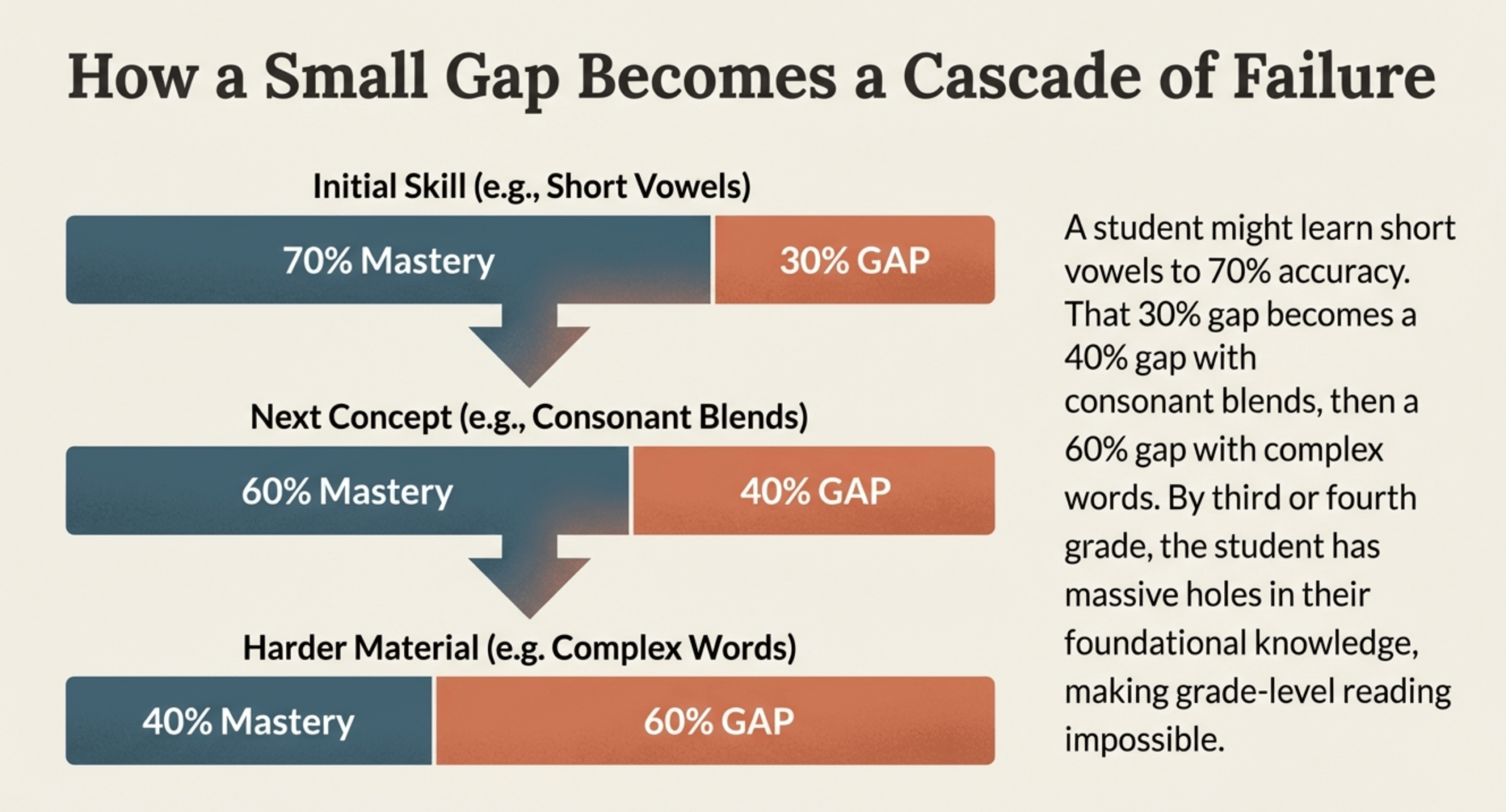
Struggling readers typically have one thing in common: gaps in their phonics foundation. They never fully mastered earlier skills before moving to more complex material. A student might have learned short vowels to 70% accuracy, then moved on to consonant blends before achieving true mastery. That 30% gap becomes a 40% gap, then a 60% gap as material gets harder.
The result: By third or fourth grade, the student has massive holes in foundational knowledge. They’re expected to read grade-level text, but they’re missing critical building blocks from first and second grade instruction.
Mastery-based instruction prevents this catastrophic cascade of gaps by ensuring students fully understand each concept before advancing.
What “Mastery” Actually Means
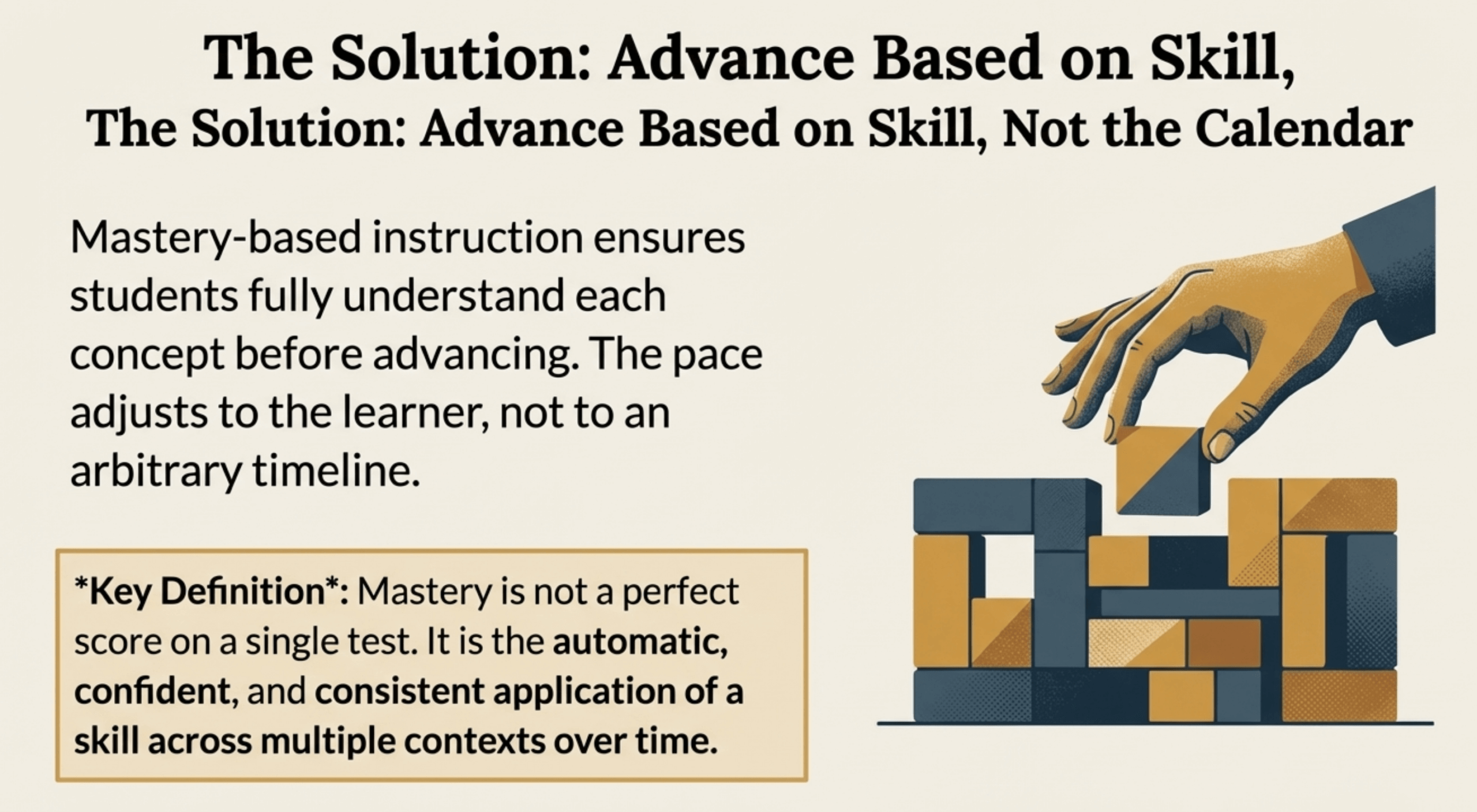
Mastery doesn’t mean perfect performance on a single test. It means automatic, confident, consistent application of a skill across multiple contexts over time.
The Three Essential Mastery Skills
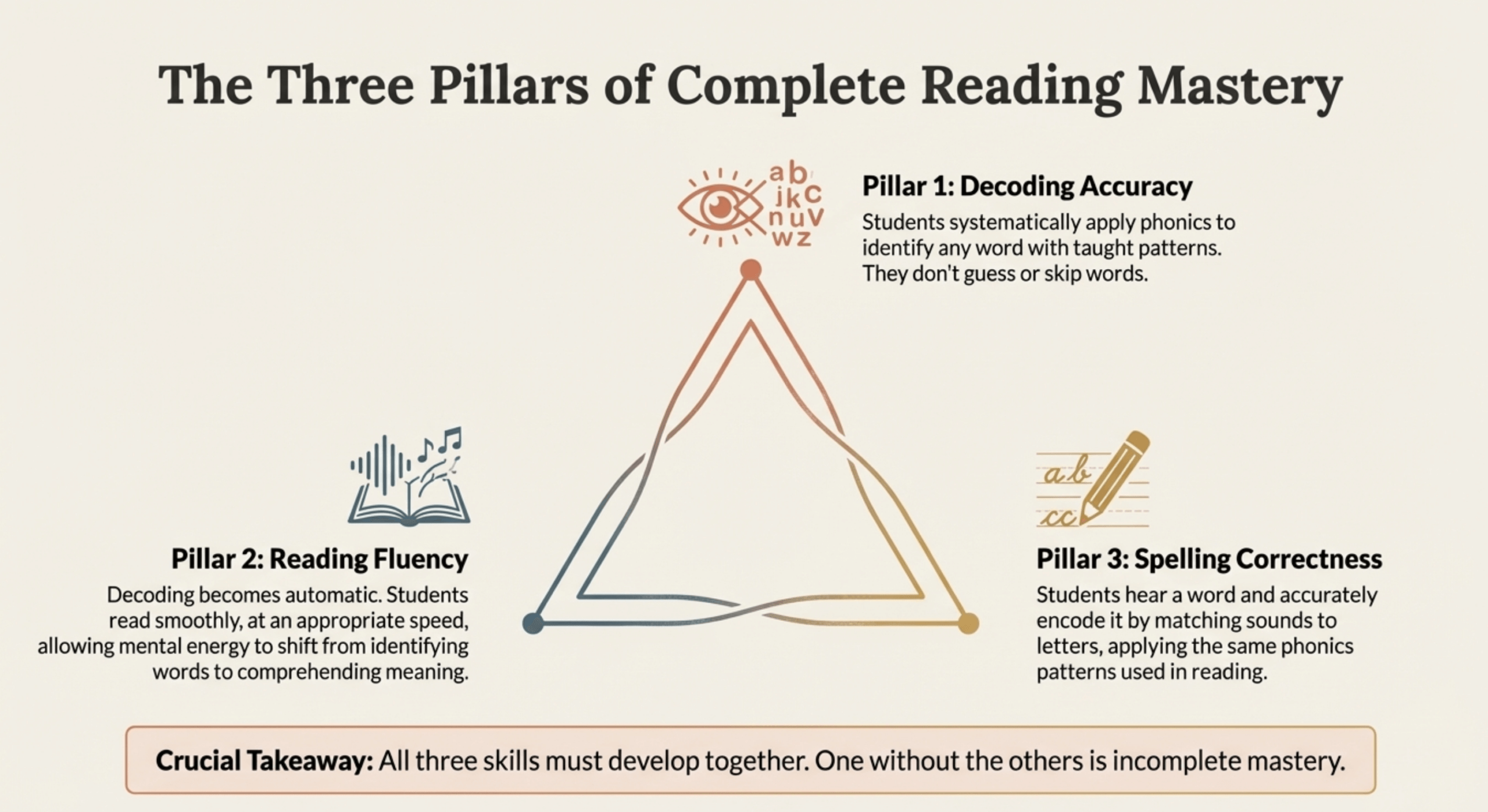
For struggling readers to succeed, they must achieve mastery in three interconnected skill areas:
1. Decoding Accuracy
Students can look at any word containing taught phonetic patterns and identify it correctly by sounding it out. They don’t guess. They don’t skip difficult words. They systematically apply phonics knowledge to decode accurately.
2. Reading Fluency
Students read words smoothly, at appropriate speed, with proper expression. Decoding becomes automatic rather than labored. Mental energy shifts from identifying words to comprehending meaning.
3. Spelling Correctness
Students can hear a word and spell it accurately by segmenting sounds and matching them to correct letters. They apply the same phonics patterns used in reading to encode words in writing.
All three skills must develop together. A student who reads accurately but can’t spell hasn’t mastered the phonics pattern. A student who spells correctly but reads slowly and laboriously hasn’t achieved fluency. Complete mastery requires all three.
Why Struggling Readers Have Gaps
Schools Move Students Forward on Schedule, Not Mastery
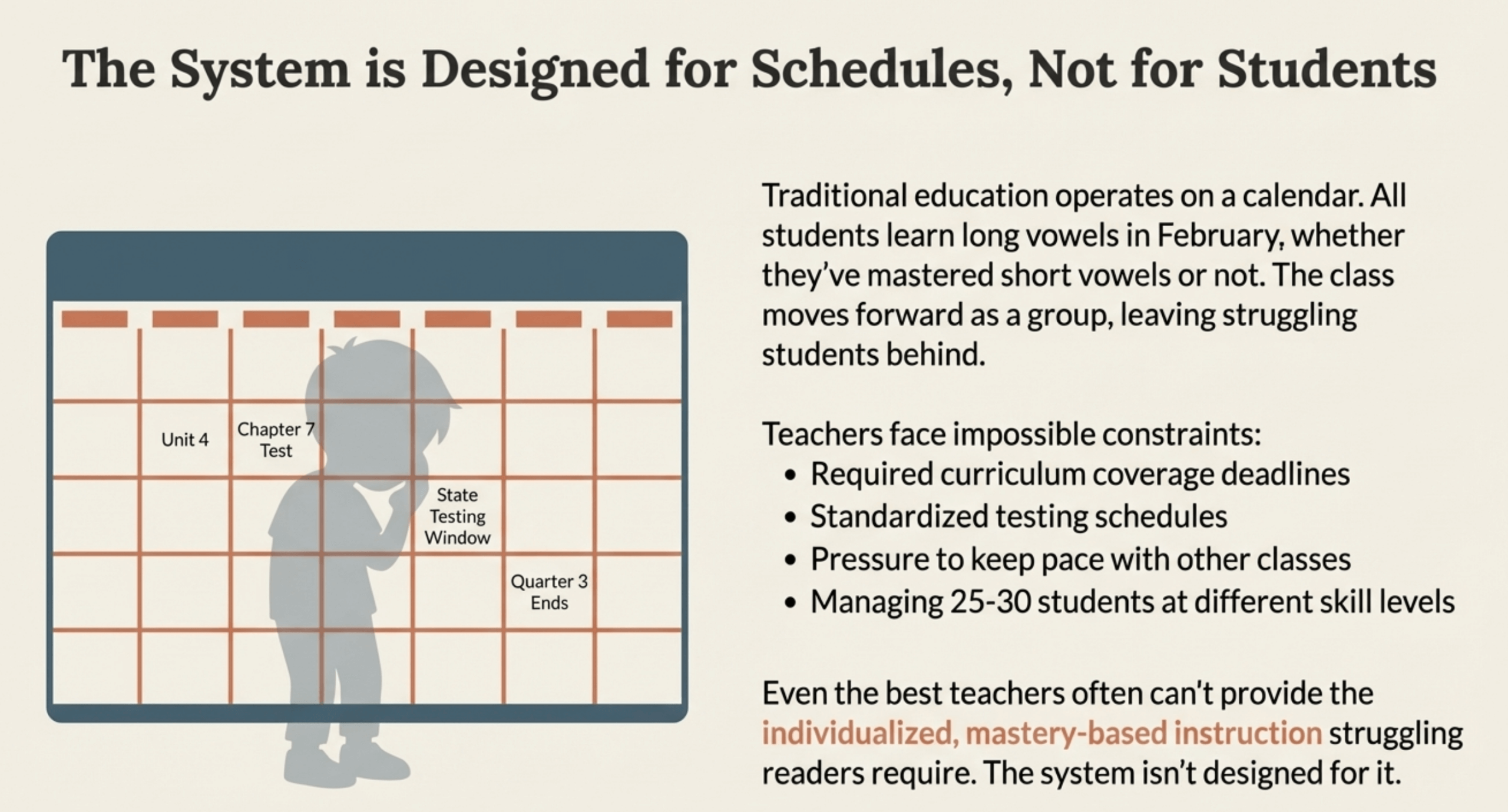
Traditional education operates on a calendar-based progression. All students learn long vowels in February whether they’ve mastered short vowels or not. The class moves forward as a group, leaving struggling students behind.
Teachers face impossible constraints:
- Required curriculum coverage deadlines
- Standardized testing schedules
- Pressure to keep pace with other classes
- 25-30 students at different skill levels
Even well-meaning teachers can’t provide the individualized, mastery-based instruction struggling readers require. The system isn’t designed for it.
Insufficient Practice Time
Most curricula introduce a phonics concept, provide one or two practice activities, give a brief quiz, then move on. Struggling readers need far more practice than this.
Research shows struggling readers need:
- Explicit instruction on new concepts
- Extensive guided practice with feedback
- Independent practice to build automaticity
- Distributed practice over days/weeks (not just one lesson)
- Regular review to prevent forgetting
Without this intensive, systematic practice, struggling readers develop the illusion of understanding—they might pass Friday’s test but can’t apply skills the following week.
The Mastery-Based Approach
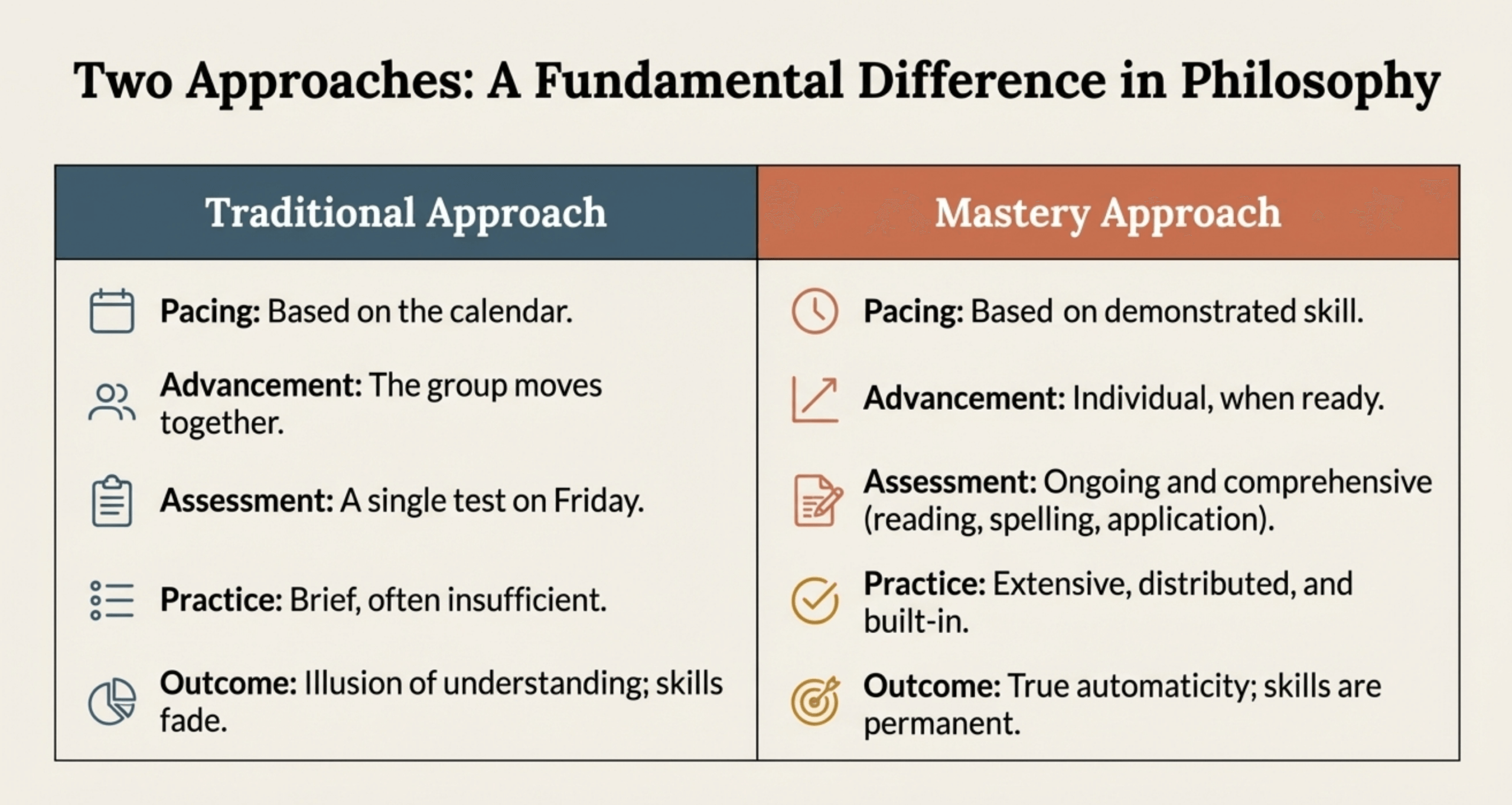
Students Advance Based on Demonstrated Skill, Not Time
In mastery-based instruction, students move to the next lesson only after proving complete understanding of current material. There’s no arbitrary timeline. Some students might spend two days on a lesson; others might need a week. The pace adjusts to the learner.
Assessment Is Ongoing and Comprehensive
Rather than a single test, mastery is demonstrated through:
- Accurate decoding – Reading word lists without errors
- Fluent reading – Reading connected text smoothly at appropriate speed
- Correct spelling – Spelling dictated words with 80%+ accuracy
- Application in context – Using skills in sentences and stories
- Retention over time – Still demonstrating skill days/weeks later
This comprehensive assessment ensures true understanding, not temporary memorization for a test.
Review Is Built Into Every Lesson
Mastery isn’t achieved once and forgotten. Previously learned skills are continuously reviewed and reinforced throughout subsequent lessons. This distributed practice prevents the forgetting that plagues traditional instruction.
What Mastery Looks Like at Each Stage
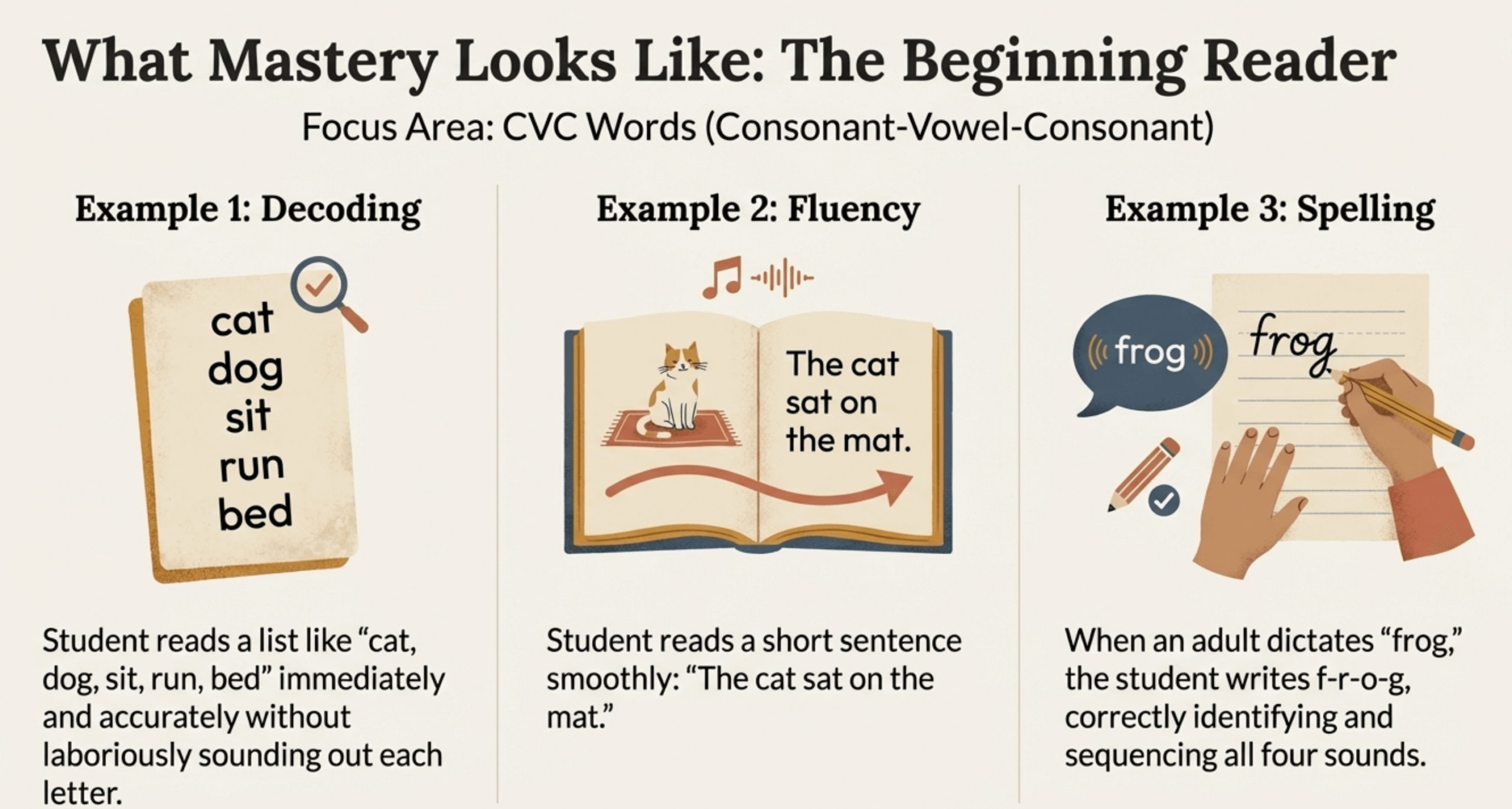
Beginning Reader Mastery (CVC Words)
Decoding: Student reads “cat, dog, sit, run, bed” immediately and accurately without sounding out each letter aloud
Fluency: Student reads short sentences smoothly: “The cat sat on the mat”
Spelling: When parent dictates “frog,” student writes f-r-o-g correctly, tracking each of the four sounds
Intermediate Reader Mastery (Blends and Digraphs)
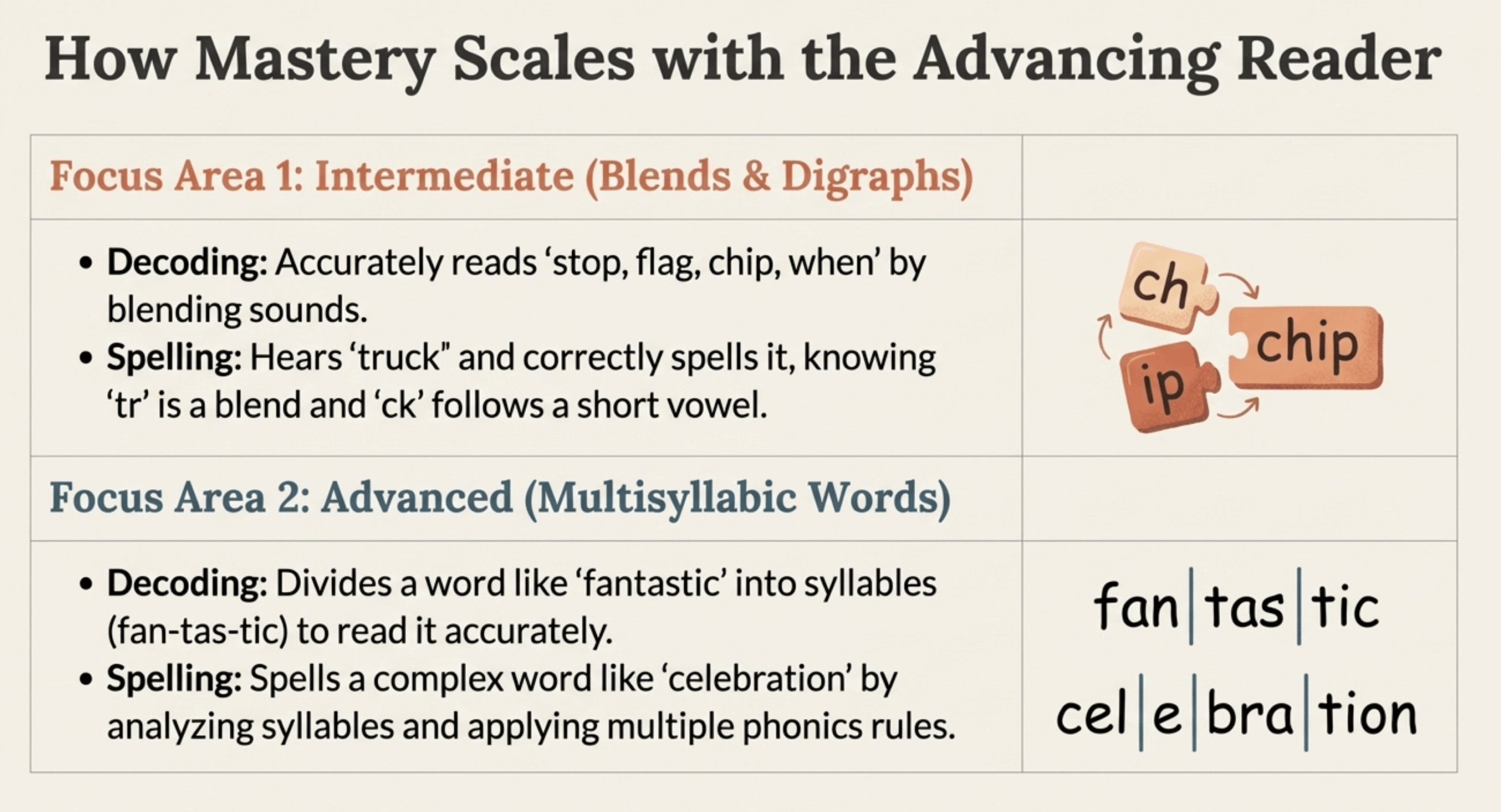
Decoding: Student accurately reads “stop, flag, chip, when” by blending sounds smoothly
Fluency: Student reads controlled text with blends/digraphs at 60-80 words per minute
Spelling: Student hears “truck” and correctly spells it, understanding “tr” is a two-letter blend and “ck” follows short vowels
Advanced Reader Mastery (Multisyllabic Words)
Decoding: Student divides “fantastic” into syllables (fan-tas-tic) and reads it accurately
Fluency: Student reads age-appropriate text at 100-150+ words per minute with expression
Spelling: Student spells complex words like “celebration” by analyzing syllables and applying multiple phonics rules
How to Implement Mastery-Based Instruction at Home
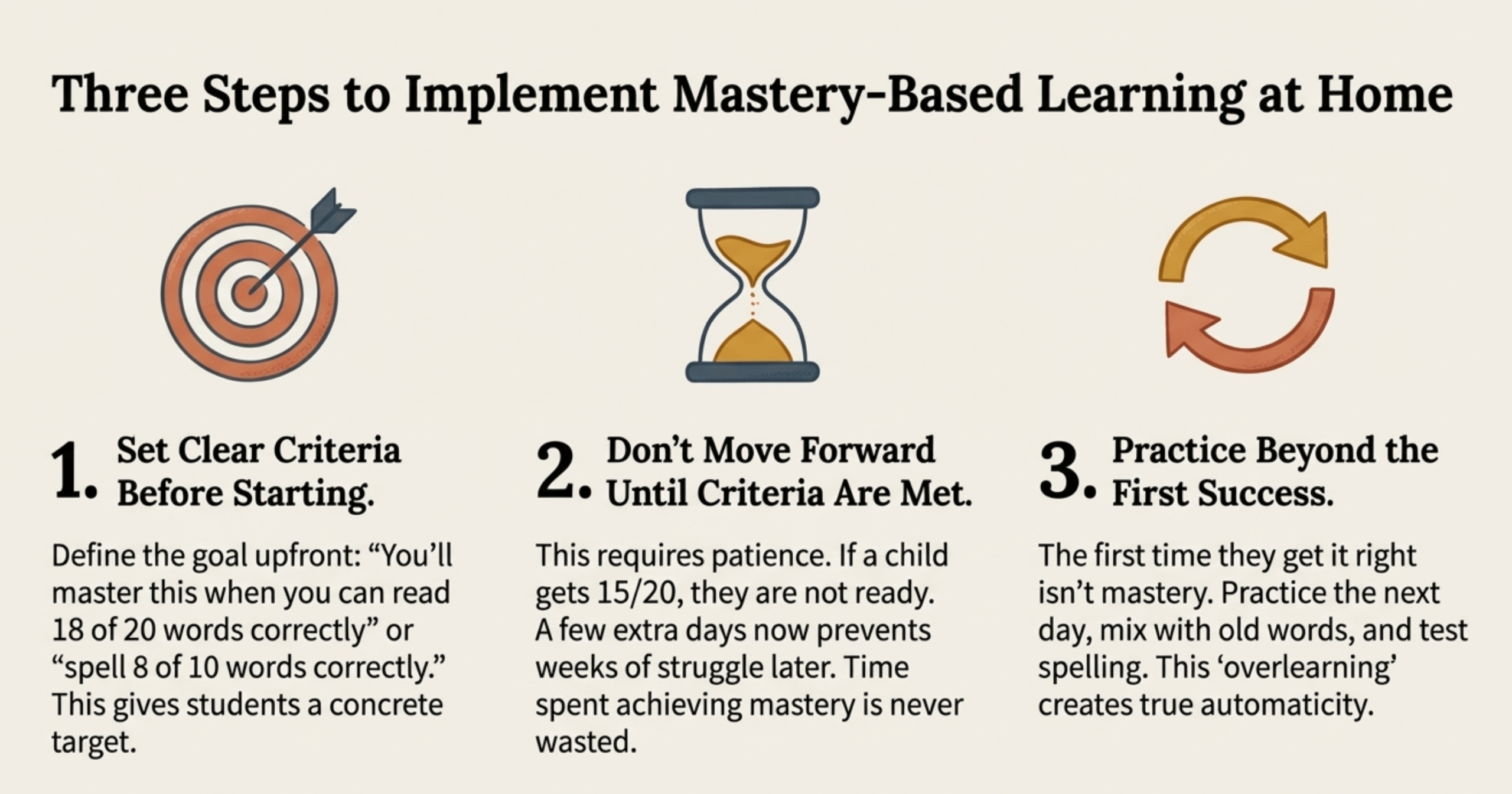
Set Clear Mastery Criteria Before Starting
Before beginning a new phonics lesson, establish what mastery looks like:
- “You’ll master this when you can read at least 18 out of 20 words with no mistakes”
- “You’ll master this when you can spell 8 out of 10 dictated words correctly”
- “You’ll master this when you can read this story smoothly without stopping”
Clear criteria prevent ambiguity and give students concrete goals.
Don’t Move Forward Until Criteria Are Met
This requires patience and discipline. If your child reads 15 out of 20 words correctly, they’re not ready to advance—even if it’s been three days on the same lesson. Keep practicing until they achieve 80%+ accuracy consistently.
Remember: A few extra days now prevents weeks or months of struggle later. Time spent achieving mastery is never wasted.
Practice Beyond the First Success
The first time your child reads all 20 words correctly isn’t mastery—it’s the beginning of mastery. Continue practicing:
- Have them read the same list again the next day
- Mix these words with previously learned words
- Use the words in new sentences and contexts
- Test spelling alongside reading
This overlearning creates the automaticity true mastery requires.
Review Regularly Even After Moving On
Even after achieving mastery and advancing to new material, previously learned skills need regular review:
- Include review words in new spelling dictation
- Have your child reread earlier stories occasionally
- Mix old and new phonics patterns in practice sessions
- If you notice errors creeping back, return to that lesson briefly
Recognizing When Mastery Hasn’t Been Achieved
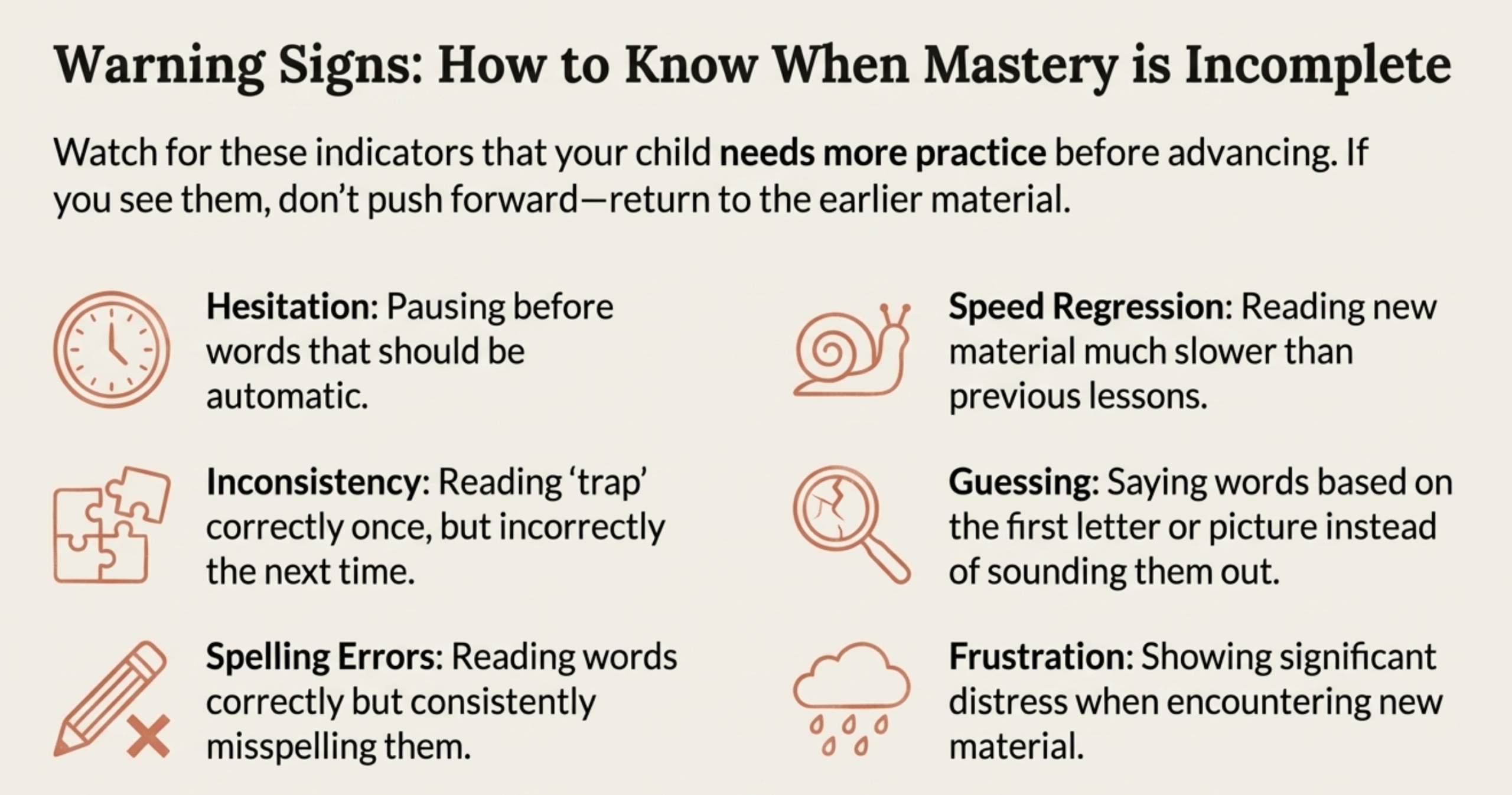
Warning Signs of Incomplete Mastery
Watch for these indicators that your child needs more practice before advancing:
- Hesitation – Pausing before reading words that should be automatic
- Inconsistency – Reading “trap” correctly one time, incorrectly the next
- Spelling errors – Reading words correctly but spelling them wrong
- Speed regression – Reading slower than in previous lessons
- Guessing – Saying words without actually sounding them out
- Frustration – Struggling significantly with new material
These signs mean the previous skill wasn’t fully mastered. Don’t push forward—return to the earlier material and practice until solid.
What to Do When Mastery Isn’t Achieved
Step 1: Identify the specific gap
Which phonics pattern is causing difficulty? Short /e/ vs. short /i/? The “ch” sound? Silent-e patterns?
Step 2: Return to that specific lesson
Go back to where that pattern was taught and review the instruction
Step 3: Increase practice intensity
Do the practice activities multiple times over several days
Step 4: Test in multiple ways
Reading, spelling, in isolation, in context—ensure understanding from all angles
Step 5: Only then move forward
Once you see consistent, confident, accurate performance
How Our Program Ensures Mastery
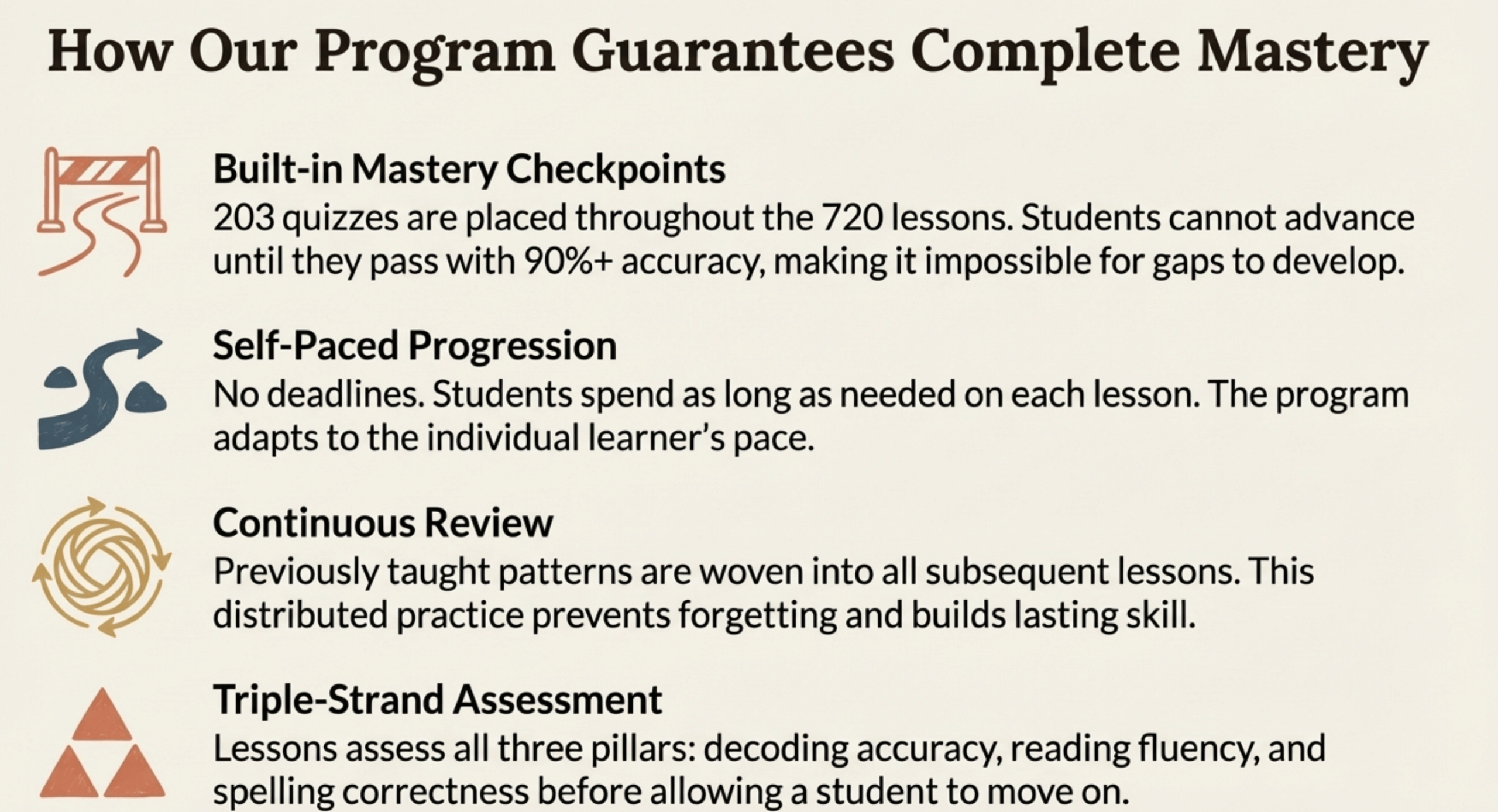
Built-In Mastery Checkpoints
Our 720-lesson program includes 203 quizzes strategically placed throughout the curriculum. Students cannot advance to the next lesson until they pass the quiz with 90%+ accuracy, ensuring no gaps develop.
Self-Paced Progression
There are no arbitrary deadlines or pressure to keep up with classmates. Students spend as long as necessary on each lesson until they achieve true mastery. Some lessons might take one day; others might require a week. The program adapts to the learner.
Continuous Review and Reinforcement
Previously taught patterns are woven throughout subsequent lessons. Students encounter short vowels again when learning long vowels. They review consonant blends when learning vowel teams. This distributed practice prevents forgetting and builds lasting mastery.
Triple-Strand Assessment
Lessons assess all three mastery components:
- Decoding practice with controlled word lists, sentences and short stories
- Fluency practice with controlled word lists, sentences and short stories
- Spelling dictation with controlled word lists providing immediate feedback
Students must demonstrate mastery in reading accuracy, reading fluency, and spelling before the program allows advancement.
Progress Tracking Shows Mastery Over Time
Our dashboard tracks quiz scores and lesson completion. Parents can see at a glance whether their child is achieving mastery or struggling with specific patterns, allowing targeted intervention when needed.
The Long-Term Impact of Mastery-Based Learning
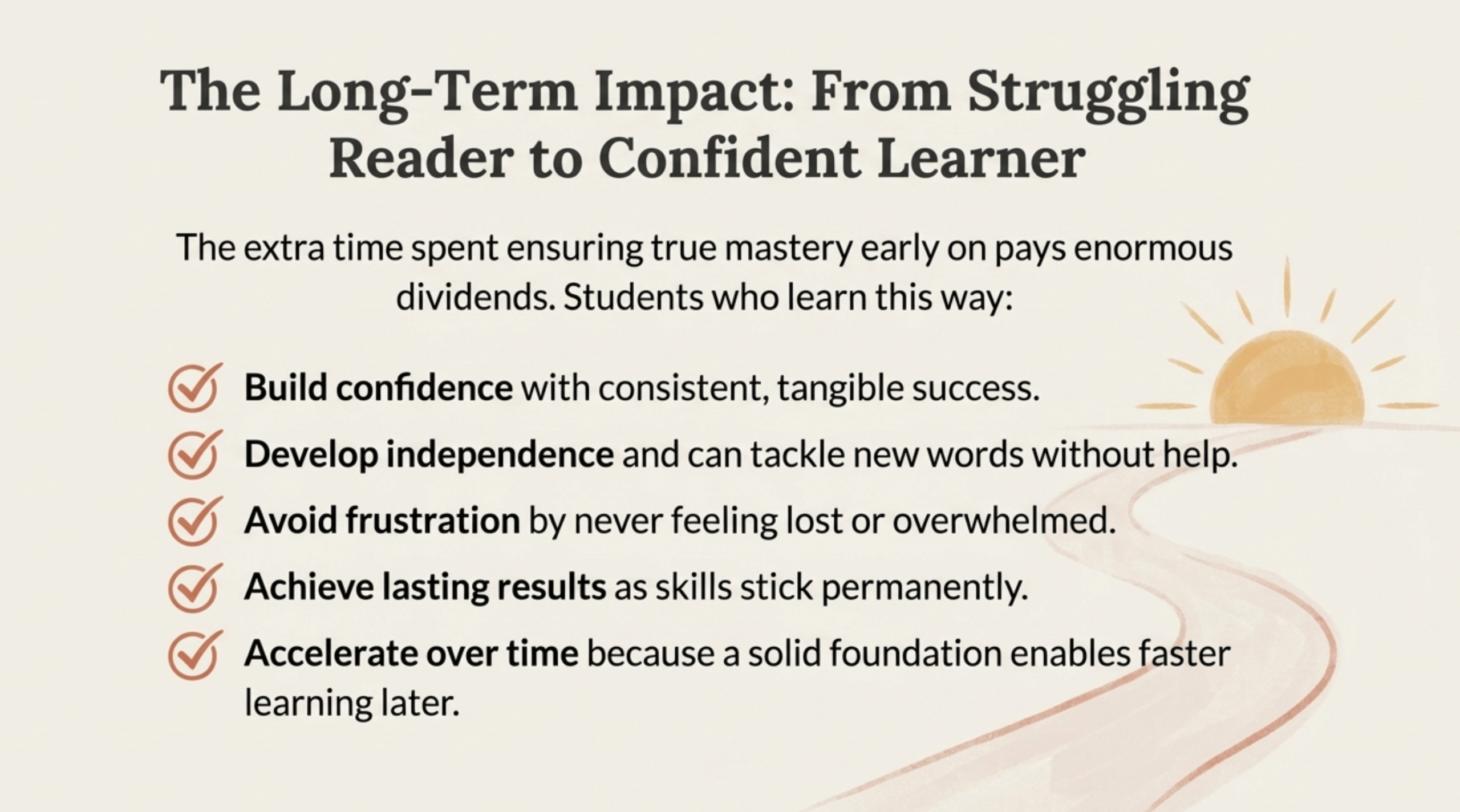
Students who achieve true mastery at each step:
- ✅ Build confidence – Consistent success creates positive momentum
- ✅ Develop independence – Can tackle new words without help
- ✅ Avoid frustration – Never feel lost or overwhelmed by material
- ✅ Achieve lasting results – Skills stick permanently rather than fading
- ✅ Accelerate over time – Solid foundation enables faster learning later
The extra time spent ensuring mastery early pays enormous dividends as students progress through more complex material.
Experience Mastery-Based Learning
See how mastery-based progression builds complete reading skills with no gaps. Try our first 10 lessons free—no credit card required.
Continue Reading: The 9 Essential Strategies
← Previous: How Spelling and Phonics Reinforce Learning
Next → Reading Accuracy vs. Fluency: Why Both Matter
Questions about mastery-based instruction? Contact us.